The Tawdry, Opulent World of James Bidgood’s Underground Classic Pink Narcissus
By Mayukh Sen
In 1971, upon the release of his first and only feature film, James Bidgood pulled a disappearing act. He had spent the better part of seven years shooting Pink Narcissus, a hallucinatory tale of a daydreaming gay hustler, on an anemic budget, only for a meddlesome financier to snatch the film from him and see it to completion.
Bidgood—who had been precious about the final cut—was furious. As a matter of artistic principle, he disavowed the film. In a fit of anger, he even purchased an axe and thought of how he might wield it against the editors, avenging their mutilation of what he called “my seven-year-old.” (He reneged on his plan when he thought of his seven cats. What would they do in his absence, if he were to end up in jail?)
And so it was that Pink Narcissus would, in its rather amusing end credits, attribute the production, writing, photography, and direction to, simply, “ANONYMOUS.” This authorial absence certainly contributed to the film’s allure. Some asked if it was Andy Warhol’s doing, while others speculated Kenneth Anger must have been responsible. But this mystery also expedited the film’s slide from public view, relegating it to a modest afterlife on the gay festival circuit in the 1980s. At a wispy sixty-eight minutes, the film is a beguiling mix of the lewd and the sensual—a parade of dangling dongs, bushy pubes, and peachy posteriors, all soaked in a soft palette of cotton-candy blues and pinks. Even when trade publications like Variety pointed to “one Jim Bidgood” as its possible creator as far back as 1974, Bidgood, a nebbish costume designer, remained secretive about his involvement.
It wasn’t until the late nineties that Bidgood was, by his own admission, “outed” by the inquiring author Bruce Benderson. Following a rumor that the film was Bidgood’s creation, Benderson found the director’s number in a phone book and rang him. Bidgood, in turn, fessed up promptly: Benderson had the right guy. In 1999, the writer published a monograph on Bidgood, who told the Advocate: “I’m grateful for the attention. It would have been better forty years ago.” By the time the filmmaker Wolfgang Hastert got Bidgood on camera for the television documentary The Queer Reveries of James Bidgood (2000), it was clear that Bidgood’s self-imposed reclusion had cost him something: he was living in financial precarity, with a hernia truss and rotting teeth.
Money never seemed to get much easier for Bidgood, even as Pink Narcissus enjoyed that reputational renaissance around the turn of the millennium. When he died in 2022, at age eighty-eight, due to complications from COVID-19, the executor of his estate set up a GoFundMe page to cover his funeral costs—a sad irony, when one considers the artists in his debt. The works of photographers David LaChapelle and Pierre et Gilles bear his aesthetic imprint; the likes of Charli XCX and Olly Alexander have spoken of their obsessions with his film.
Today, Pink Narcissus is still escaping the cult status that Bidgood’s anonymity conferred upon it. A meticulous restoration by the UCLA Film & Television Archive last year, plus the release of the documentary Velvet Vision and the publication of a book of Bidgood’s photographs alongside a corresponding exhibition, have kept his flame lit. The film, now playing on the Criterion Channel, may still present formidable challenges to a casual viewer given its near absence of dialogue, its gratuitousness, and its elliptical, languid pacing. But it endures in large part because of the sincere, even earnest spirit that undergirds it.
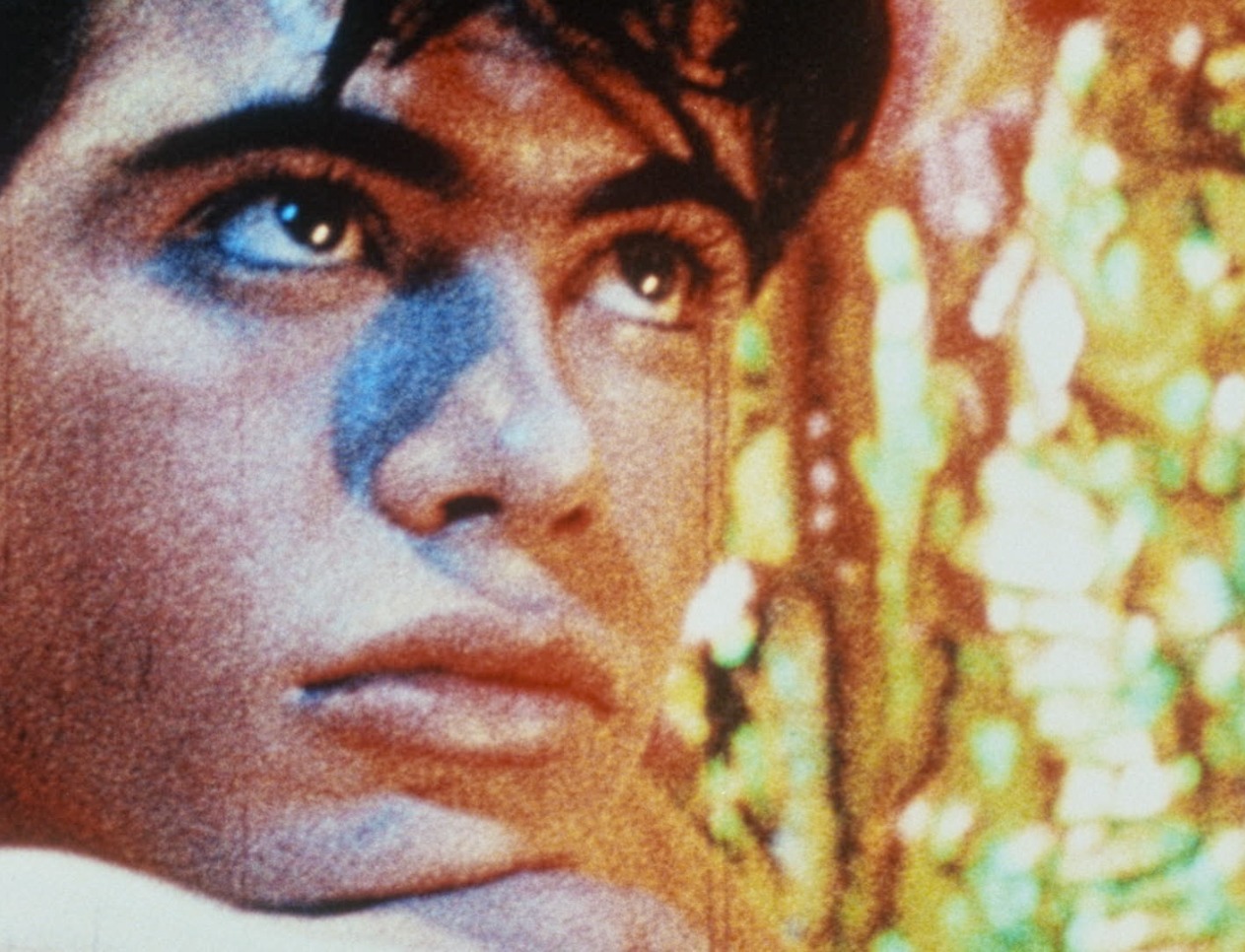
Granted, “earnest” might not exactly be the first descriptor that springs to mind when one thinks of a film as horny as Pink Narcissus. Much of the critical writing on the film—and there’s been a veritable raft of it, despite its low name recognition among general audiences—fixates, justifiably, on its homoerotic pageantry. Bidgood bestows nearly as many extreme close-ups on male appendages as he does on his star (Bobby Kendall). Shot on both Super 8 and 16 mm, Pink Narcissus imagines the reveries of Kendall’s young, nameless character puttering around his New York City apartment. He is beautiful and aware of it, blessed with a princely pout. The sight of his own reflection is enough to send him slipping into trances.

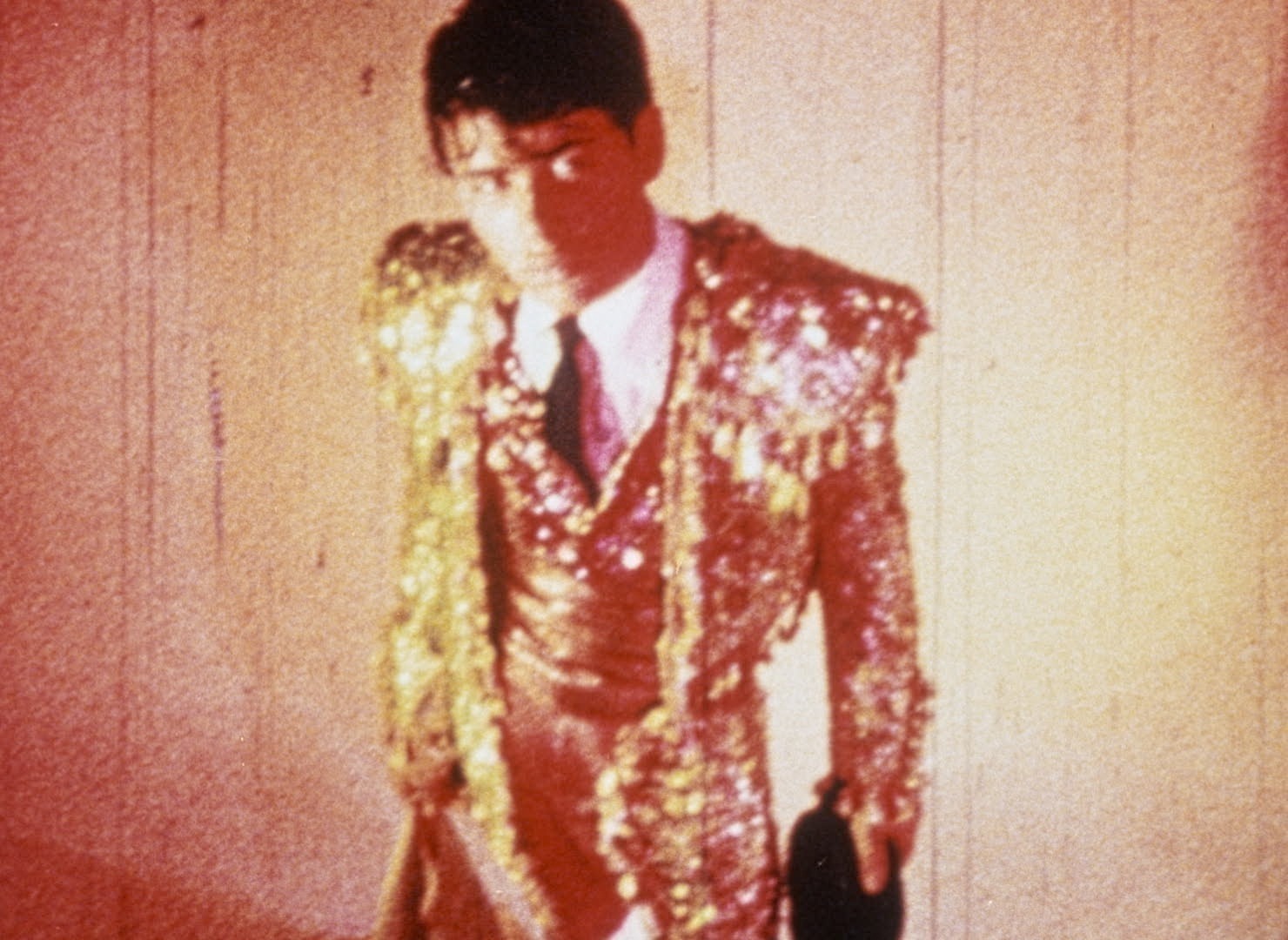
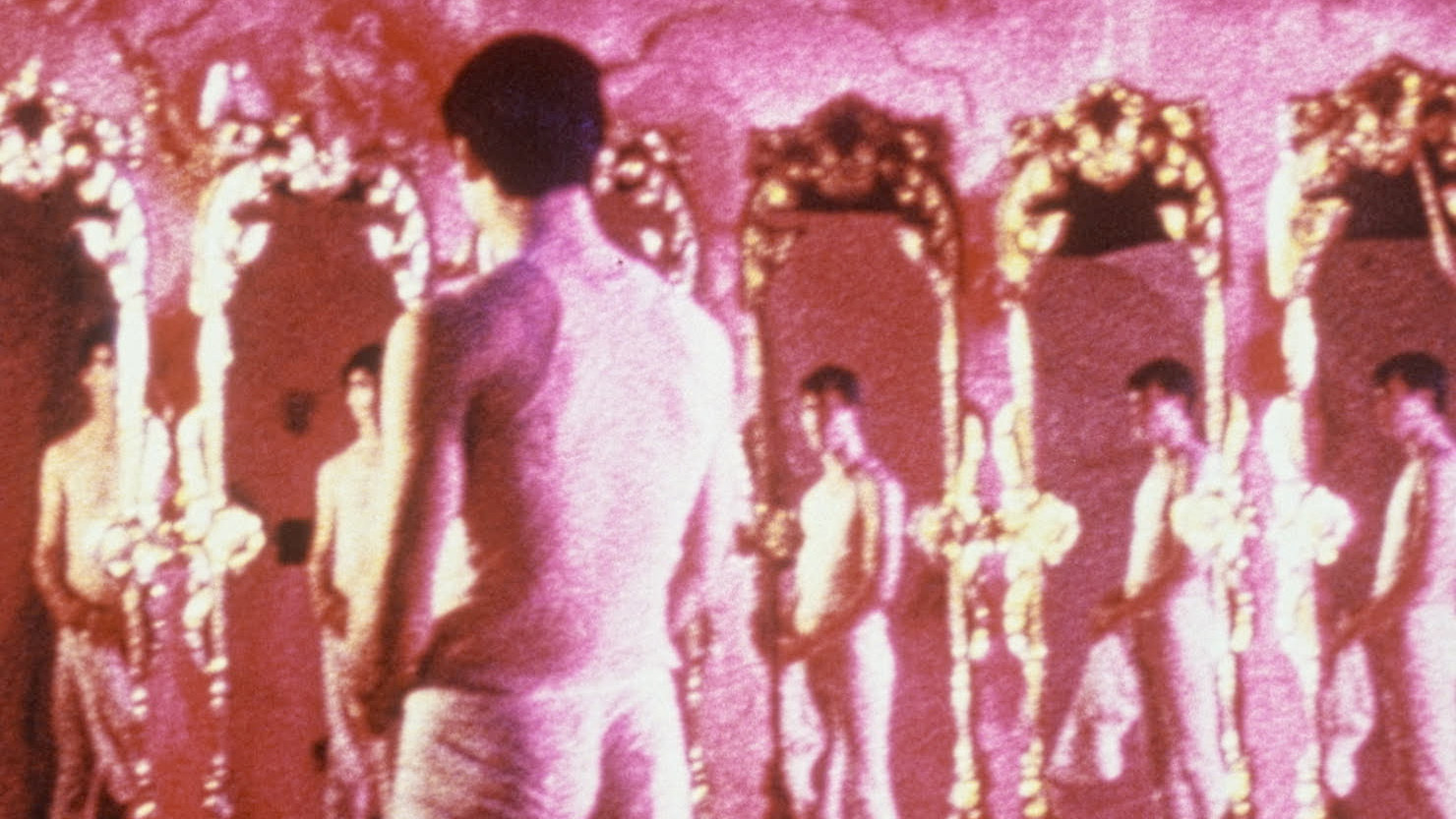
Early on, he preens before a wall of mirrors, All About Eve–style, and envisions that his crisp, white muscle tee has become a matador’s cape. Cue a fantasy sequence that resembles a bullfight ripped from a Tyrone Power film, only the animal here is a biker propositioning Kendall; cut to a different leather-suited stud servicing our narcissist near a row of grimy urinals. This fellation results in a climax so intense that the entire room floods with milk.
Such scenes are especially striking, considering that Bidgood filmed the majority of Pink Narcissus in his Midtown Manhattan apartment. The diegetic intrusions of the outside world are minimal, save the occasional sound of street chatter or the yammering of a radio pundit. Yet Bidgood made his potentially claustrophobic confines feel expansive.
This ability to defy spatial constraints—to see possibility in restriction—was a skill that Bidgood developed early on, a condition resulting from his family’s material realities. Born into the throes of the Great Depression, Bidgood came of age in Madison, Wisconsin, where his parents ran a roadside restaurant. He was, like many Americans of his generation, weaned on the products of Hays Code–era Hollywood, a time of sexual stringency that left little room for overt queer representation. (Bidgood once quipped that he had “been out since I was, like, five!”)
But Bidgood found plenty to love despite that, namely in the films of Busby Berkeley, who organized his dancers into dazzling prismatic patterns, and Esther Williams, famous for her balletic showcases of synchronized swimming. Bidgood once begged his mother to splurge on a dime-store book of paper dolls. With it, he crafted a dioramic display in his bedroom, affixing some folded paper to his Homasote walls to create a makeshift staircase, as in a number from The Great Ziegfeld (1936).
An encounter with the fantasy-adventure film The Thief of Bagdad (1940), however, awakened something deeper in him. The British production featured the teenage Indian actor Sabu in the title role. Sabu went on to become a durable figure in Universal adventure films, and in adulthood, his body, often on proud display in his films, became a site of erotic charge and projection for audiences. Bidgood would later speak of The Thief of Bagdad’s hold on him—“the impact such opulent imagery had on the relatively colorless existence of this scrawny ragtag first grader.” It was the film’s costuming—the actors’ “Technicolor flesh almost covered by bits of satin vests and gossamer harem pants, all surrounded by palace walls from what seemed to be pink frosting ice,” as Bidgood put it—that left an especially lasting impression.
Bidgood carried these influences with him as he boarded a Greyhound to New York in 1951, when he was eighteen, hoping to hack it as a singer and dancer. That didn’t quite work, so he took a detour into studying fashion design at Parsons while falling in with the crowd at Club 82, a famed Manhattan drag bar where he performed under his rambunctious alter ego, Terry Howe, while decorating the stage and designing costumes.
But he metabolized his creative impulses more fully through fitness-magazine photography, which he began pursuing seriously in the sixties. It was a time when America’s federally sanctioned obscenity laws had popularized the circulation, particularly among gay men, of publications featuring scantily clad bodybuilders. Bidgood found them wanting. Photographers so often framed these chiseled hunks free of context, as if deracinating them: “Why are all these boys standing in front of the same frigging fireplace with the same funny little piece of jersey over their dingies?” he asked in a 2006 interview.
Ever the deviant, Bidgood initiated a style that rebelled against the dominant sensibility of his physique-magazine peers, treating his subjects with the same love that a studio-era auteur may have bestowed upon his leading ladies. He thought back to his boyhood, a time when he found beauty where others hadn’t thought to look—how he idled away his time by sitting on curbs where trails of car oil would meet water, fascinated by the rainbow slicks that the convergence created. (This may explain why so many of his subjects would seem to glow under his camera, as if slathered in Crisco.) He would set his men—lithe, lean, usually in some state of undress—against lush backdrops of foliage, on flower beds, beneath willow trees. Bidgood heightened the artifice of these constructed settings by bathing his models in vibrant psychedelic light.

He would take this vision to its most refined end point with Pink Narcissus, which he began working on in 1963—a period of transformation for both queer and pornographic cinema in the United States. By the end of that decade, Hollywood had shed the moral straitjacket of the Hays Code; by 1970, John Schlesinger’s Midnight Cowboy (1969) would become the first X-rated film to win the Academy Award for Best Picture, an astonishing fact when one realizes that the MPAA rating board—the post-Code analog to the Hays Office—reprimanded the film’s “homosexual frame of reference.” The country was also in the midst of a golden age of pornography, a time when theaters routinely programmed pornographic features alongside studio fare.
Critics today tend to connect Pink Narcissus with the ambient aesthetics of Bidgood’s sexually liberated era, but he diverges from his contemporaries in several key ways—evident in scenes that, despite their flirtations with indecency, he stages with orchestral precision. In an entrancing seven-minute sequence, Bidgood’s chief character spreads his bare body on a field, skin to earth, and massages his lips, then his nipple, then his belly button, with a blade of grass. He grabs a butterfly and holds its wings to his ears; he then reaches down to his groin and begins to pleasure himself. With a mix of quick cuts and more relaxed dissolves, Bidgood flits back and forth between his subject’s bedroom and this verdant pasture. His fingers are, by the scene’s end, sticky with nectar; he puts them in his mouth. However graphic these implied acts are, Bidgood dresses them up in visual ostentation. Where other filmmakers of that generation could be strident in their representations of sexuality—the film was released in the same year as Wakefield Poole’s gleefully explicit Boys in the Sand (1971), which carries the honor of being the first gay pornographic film reviewed by Variety—Bidgood worked with a lighter touch, reminiscent of the films that had been his early education.
Bidgood’s reverence for the grammar of classic Hollywood situates Pink Narcissus within a richer cinematic tradition than the underground films of his time, and the movie wears these influences openly. While making it, Bidgood drew on the memory of the films that had enlivened what he called his “impoverished gray existence” back in Wisconsin. As the scholar Michael Lawrence notes in his monograph Sabu (2014), Bidgood pays direct homage to The Thief of Bagdad and other films starring the actor in what is likely the most distinctive set piece in Pink Narcissus. And the very title of Bidgood’s film recalls another Sabu film, Michael Powell and Emeric Pressburger’s Black Narcissus (1947).
With one spin of a spangly globe sitting near his bed, Bidgood’s subject is whisked off to some nondescript locale in the Near East. He is lounging in a sheik’s tent, observing a male dancer who is wearing only a turban, a thick rope of pearls, and a cobwebby cloth barely obscuring his privates. The dancer helicopters his manhood around frantically for eight minutes until Bidgood treats us to a close-up of him ejaculating neon drops of sperm that resemble the beads dangling from his neck. This messy finish to such a luxuriant scene still has the power to shock. (It may also court offense given its gesture to some vague “exotic” territory, but Bidgood would likely have been the first to admit he did not care about political correctness.) Such challenging formal elements certainly flummoxed the critical guard of Bidgood’s era. The film’s more vicious detractors, mostly in the mainstream, found Pink Narcissus a confounding object: a meandering chronicle of a mute, inexpressive sissy moping around his bedroom and jerking off, his mind transporting him anywhere but his reality. “It is sad and very vulnerable and as serious as it is sappy,” wrote Vincent Canby in the New York Times, struggling to reconcile that emotional content with the film’s luridness.
Canby meant it as a dig at Bidgood’s film. But today, perhaps, one can see this quality—its sentimentality—as a virtue, especially when read in conjunction with Bidgood’s own life. “I didn’t want to put my name on it,” Bidgood once said of Pink Narcissus. “Not that my name meant anything to anybody.” Bidgood never made another feature, though he tried, only to face the same financial obstacles that had been his lifelong albatross. As other critics have noted, there’s no telling how close this hacksawed product is to the film that Bidgood had pictured in his mind. One can hope that, in his final years, he made peace with the film that he once swore off in shame, and that he understood the profound effect it came to have—enough for his name to mean something to somebody.
More: Features
Speaking Nearby: Kimi Takesue’s Itinerant Gaze
A keen and patient observer who has taken her camera to such far-flung destinations as Peru, Laos, and Uganda, the acclaimed filmmaker immerses viewers in unfamiliar situations that highlight the fluid dynamics of human interaction.
Nice Work If You Can Get It: Office Romances on Film
In His Girl Friday, The Apartment, and other classic films about love in the workplace, Hollywood grappled with the evolution of American sexual politics and the glories and pitfalls of professional achievement.
The Defiant Ironies of Rainer Werner Fassbinder’s The Third Generation
In this delirious and deeply polarizing satire about political violence, the legendary director takes aim at hypocrisy and opportunism at every level of German society.
Far from Home: Three Noirs by Jacques Tourneur
In a trio of Hollywood crime dramas made in the 1940s and ’50s—including the masterpiece Out of the Past—the director follows wayward characters who venture into profoundly unsettling landscapes and encounter the foreign at home.