“In this twilight of the capitalist epoch,” mused Michael Harrington, the socialist writer and journalist, in 1976, “there is a decline in religious commitment, in moral conviction, indeed in almost any kind of belief. The old order has died in the realm of the spirit long before the new order has occurred in the realm of politics and the economy.”
Harrington’s observation, from his book The Twilight of Capitalism, is better framed as a question: If the old society is gone, what exactly are we building in its place? His solution was a democratic transformation of the economy. Released the same year as Harrington’s book, Network gives a different spin on the same question and provides not so much an answer as a sharp, cynical, and bleakly comic view of the world to come.
Truth be told, Network feels a little less like a film than it does an extended rant, bellowed in lyrical rage by its principal creative voice, Paddy Chayefsky, playwright, screenwriter, and novelist, whose work in film, television, and theater spanned three decades and earned him, among other accolades, three Academy Awards.
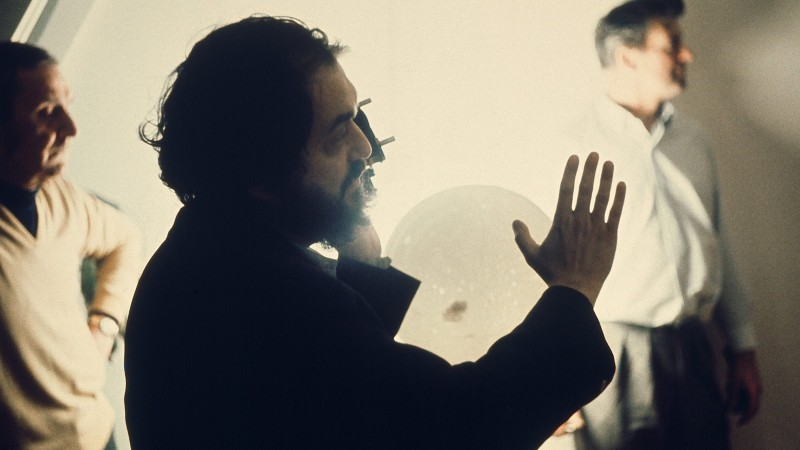
This is not to diminish director Sidney Lumet’s contribution to the film. He made more classics than perhaps any Hollywood craftsman of his generation—a short list of his best work includes 12 Angry Men (1957), The Pawnbroker (1964), Fail Safe (1964), Serpico (1973), and Dog Day Afternoon (1975)—and could unlock the emotional and thematic core of almost any story. Working across genres with an unobtrusive style, Lumet was a master of the character study, always interested in the emotional truth behind the drama. Not surprisingly, he was as eager to work with writers as he was with actors; in his wonderfully practical memoir, Making Movies, he notes, in a nod to Chayefsky, that his respect for writers “would grow so great during our working time that I’d want them in on every aspect of the production.”
Lumet’s preoccupation with finding, in his words, the “closeness needed for private, emotional revelations” imbues Chayefsky’s script with a potency that is as compelling now as it was a half century ago. Read on the page, Chayefsky’s characters can feel like ciphers—mouthpieces for his grievances about the shallow and sensationalist direction of the nation’s media and, by extension, the country at large. But Lumet’s players—chief among them William Holden, Faye Dunaway, Beatrice Straight, Peter Finch, and Ned Beatty—bring layers of humanity that ground the film in something beyond ideology.
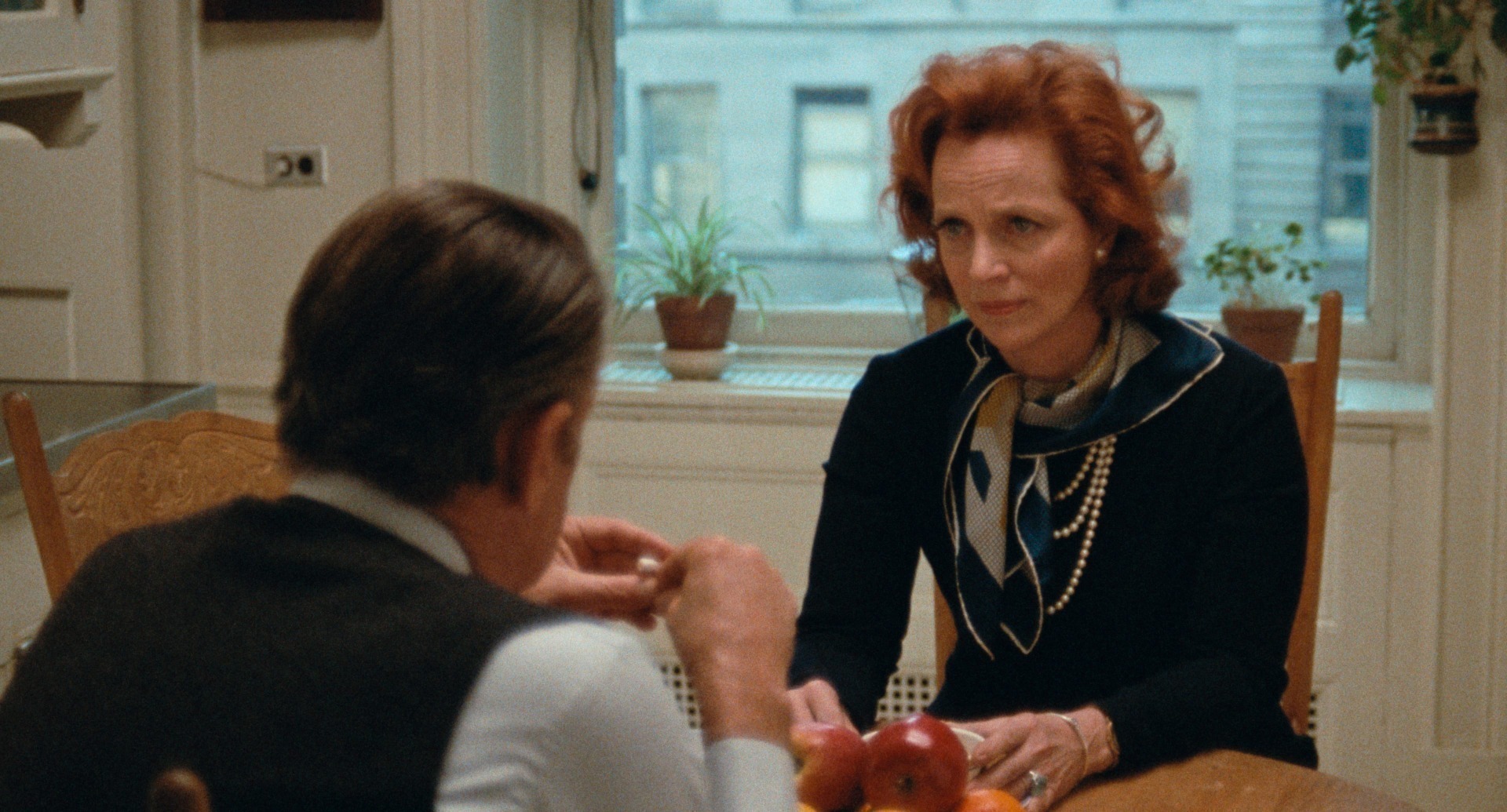
Consider a confrontation that Holden’s world-weary television news chief Max Schumacher has with his wife, played by Straight. As Holden confesses his affair with Dunaway’s news executive, Diana Christensen, Straight releases a lifetime’s worth of frustration and resentment in a short scene. It is a powerful moment that brings us, the audience, into a deeply felt emotional reality—a necessary balance for a film that reaches absurd heights. (It is also the moment that earned Straight her first and only Academy Award.)

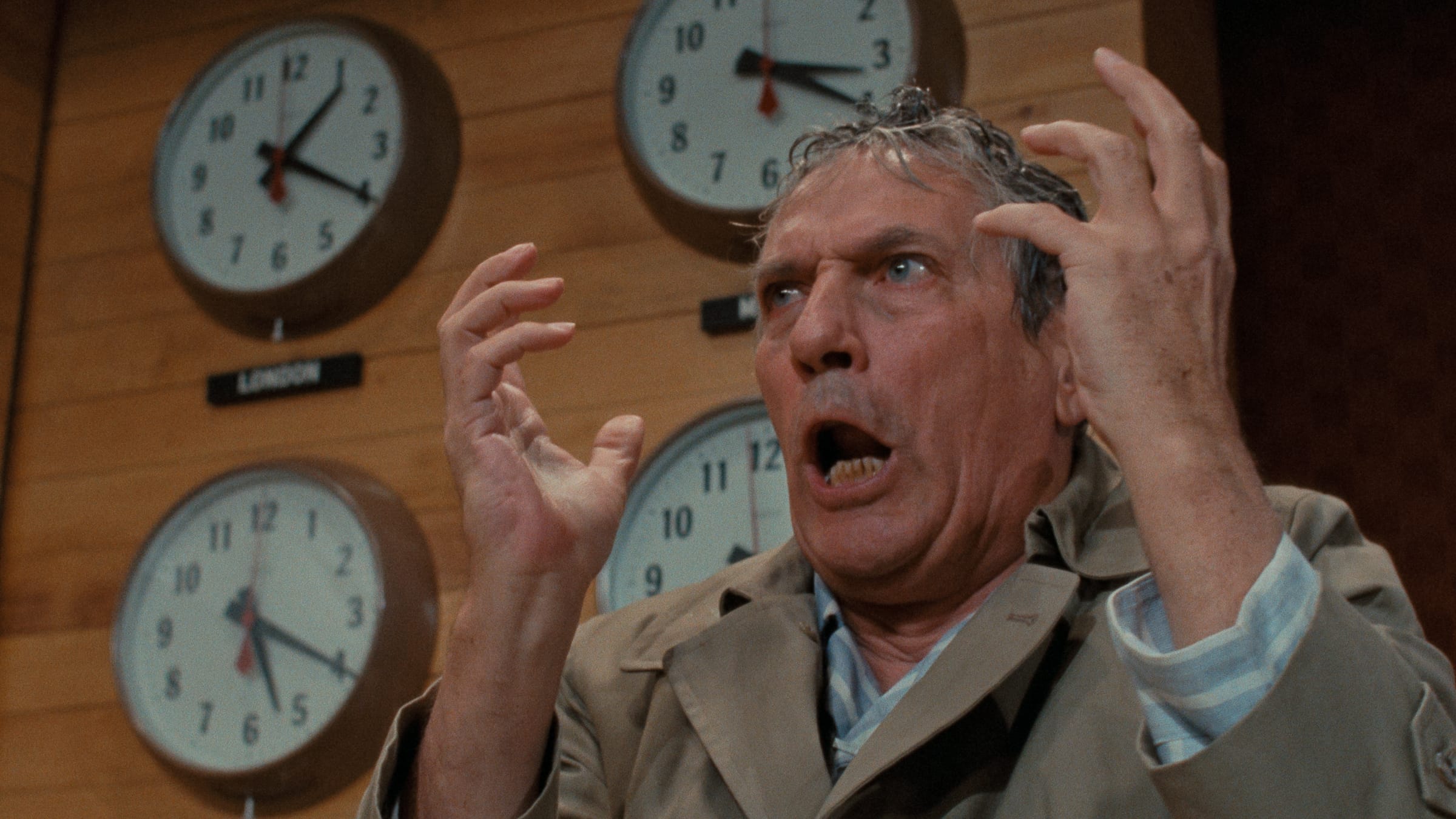
Indeed, for as much as the cultural memory of Network is understandably centered on Finch’s electrifying performance as Howard Beale, the failed newsman whose self-destructive mania is harnessed for ratings (he is “the mad prophet of the airwaves”), the film is much more a drama of alienation and generational conflict than it is a straight satire of American news, media, and corporate culture.
Network opens with an image of a more staid and stable time. Four newsmen, four news networks, delivering the day’s headlines in a measured, steady cadence of assumed authority. Three of them are faces from the reality we know—Howard K. Smith, John Chancellor, and, of course, Walter Cronkite—and one of them is the catalyst of the story we’re about to experience, Howard Beale.
“In his time,” we’re told in the film’s opening narration, “Howard Beale had been a mandarin of television, the grand old man of news, with a HUT rating of sixteen and a twenty-eight audience share.” Now he is on the decline. “In 1969 . . . he fell to a twenty-two share. The following year his wife died, and he was left a childless widower with an eight rating and a twelve share.” As our tale begins, Beale is “morose and isolated,” and on the way out. Schumacher, the head of news for Union Broadcasting Systems and an old friend of Beale’s, breaks the news. And as they drink, commiserate, and reminisce—two piss-drunk middle-aged men, ambling through a now unrecognizably deserted Midtown Manhattan—Beale says that he will, on his last day, “blow my brains out on the air, right in the middle of the seven o’clock news.”
Max laughs—but it isn’t a joke. The next evening, and to the disbelief of producers and studio executives, Beale tells his audience that he intends to kill himself on-air: “Ladies and gentlemen, I would like at this moment to announce that I will be retiring from this program in two weeks’ time because of poor ratings. And since this show was the only thing I had going for me in my life, I have decided to kill myself.”
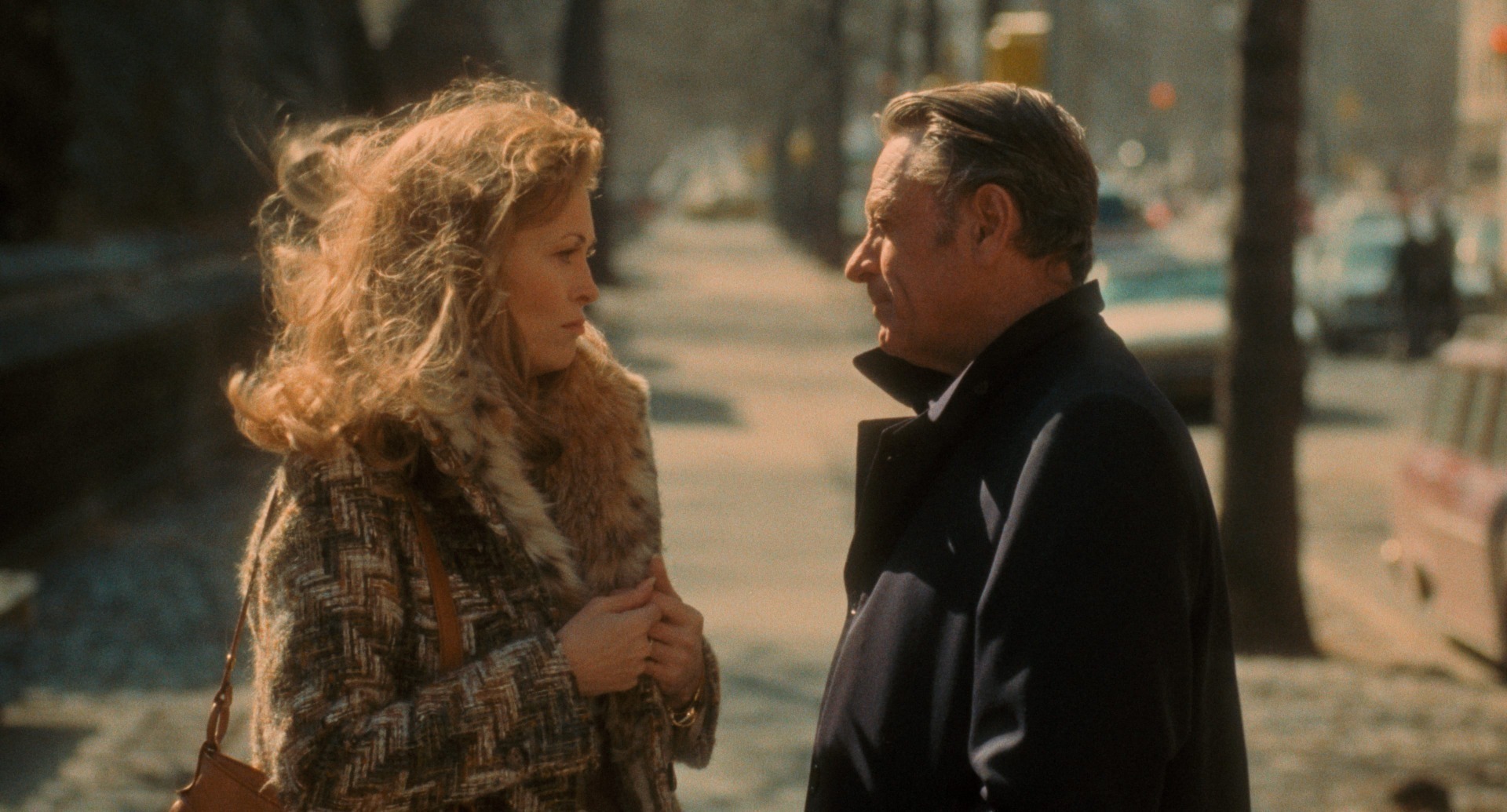
Thus begins the strange tale of Howard Beale, whose life and eventual death structure Network, which moves forward in episodic fashion. But more important to the overall narrative of the film—that is, most central to what Network appears to be saying—is the relationship between Max and Diana, a thematic stand-in of sorts for the clash between tradition and the imperatives of capital.

Sidelined from his position at UBS after the station is acquired by the Communications Corporation of America—a large, profit-maximizing company—Max is struggling to find some purpose as he enters the final chapters of his life. Diana, fully aligned with CCA, sees the news as little more than organized spectacle. Whether it informs is less important than whether it entertains, and Diana wants to bring the most absurd and bombastic material possible to television.
“Look, we’ve got a bunch of hobgoblin radicals called the Ecumenical Liberation Army who go around taking home movies of themselves robbing banks,” she quips at one point, brainstorming her next idea. “We’d open each week’s segment with that authentic footage, hire a couple of writers to write some story behind that footage, and we’ve got ourselves a series.”
Or, as she says to Max as she pitches her plan to make Beale a bona fide star, “TV is showbiz, and even the news has to have a little showmanship.”
Diana—cold, ruthless, and seemingly indifferent to old standards of decency and propriety—carries Chayefsky’s most bitter critiques of American society. She, herself, embodies what he clearly sees as a kind of nihilism. “I’m not sure she’s capable of any real feelings,” says Max, acting as author insert. “She’s the television generation. She learned life from Bugs Bunny. The only reality she knows is what comes over her TV set.” It is to her tremendous credit that Dunaway does not try to soften Diana whatsoever. She is as hard as she’s written. What Dunaway does is show the subtle cracks in the facade—and Diana’s decision to patch them back up, to stay the course for the sake of her ambition.
Diana is the next generation of American leaders, Chayefsky is screaming, a creature whose entire experience of the world is mediated by screens and broadcasts—who struggles to understand sincere human emotion and whose apparent cosmopolitanism simply enables her to appropriate and commodify an ever-growing set of materials. To that point, we see Diana try to hash out a deal with the Ecumenical Liberation Army, in a farcical scene of hard-nosed negotiation between a television producer and a group of communist radicals painted in such broad strokes that it reads as outright satire (with not a small amount of contempt for the style and posturing of the far left in that historical moment). The message, however, is clear enough: however much they might kill and steal, what matters most for Diana and the people she represents is that they can titillate and excite an audience.
A core argument of the film, in fact, concerns the power of capital to capture and co-opt any message, regardless of sincerity or original intent. There is a reason that the most memorable part of the film is Howard Beale’s famous cry, “I’m as mad as hell, and I’m not going to take this anymore.” This is remembered as a statement of populist frustration. (And accordingly, the entire speech is a distinctly American brew of both reactionary anger at social disorder and open contempt for political action.) But what’s critical, in the film, is that Beale’s anger is quickly transformed into yet another product to sell to an audience, this one in the form of the Network News Hour, featuring Sybil the Soothsayer. Viewers can tune in to hear one of Beale’s jeremiads and then turn back to their lives, made fresh through secondhand catharsis.
Nothing in the world of Network—nor, it seems, in the real world—can overcome the power of market forces. This observation forms the basis of the film’s second most memorable moment: the confrontation between Beale and Beatty’s Arthur Jensen, chairman of CCA. Possessed of the delusion that he was truly independent, Beale had begun ranting against the financial interests of the company upon learning that it was to be acquired by a Saudi conglomerate. Beatty, in a commanding monologue performed with Old Testament authority, explains to Beale that he is meddling “with the primal forces of nature.”
“You are an old man who thinks in terms of nations and peoples! There are no nations! There are no peoples!” Jensen roars. “You get up on your little twenty-one-inch screen and howl about America and democracy. There is no America. There is no democracy. There is only IBM and ITT and AT&T and DuPont, Dow, Union Carbide, and Exxon. Those are the nations of the world today.”
This, too, feels as if Chayefsky is speaking directly to his audience. That their sense of nationhood—their sense of racial or ethnic or religious identity—is nothing in the face of the relentless and all-consuming demands of capital accumulation. And that we’re heading toward a world where, in Chayefsky’s words as spoken by Jensen, “all men will work to serve a common profit” and where “all men will hold a share of stock, all necessities provided, all anxieties tranquilized, all boredom amused.”
You could even say that in Jensen’s monologue we are seeing a vision of what scholars would come to call the neoliberal order, the rise of a creed that, as the historian Gary Gerstle writes, “prizes free trade and the free movement of capital, goods, and people” and “calls explicitly for unleashing capitalism’s power.”
This gets to what is remarkable about Network and Chayefsky’s vision. With little more than a simple extrapolation of existing trends—the growing corporate ownership of news—he was able to capture something true and still-recognizable about the way American society would develop, about the way we would respond to the collapse of the old order. Not, as Harrington hoped, with a renewed solidarity but with the total collapse of standards, both for our institutions and for ourselves.
Network was received rapturously by critics and audiences, who saw the film as a sharp satire of the excesses of their time. There were dissenters—Pauline Kael thought the film was preachy and overbearing—but it went on to win three of four acting Oscars at the forty-ninth Academy Awards as well as a screenplay award for Chayefsky. And it stands as one of the great, and most prescient, films of the decade, a glimpse into our present of corporate consolidation.
Ultimately, Max and Diana cannot sustain their affair or their relationship. He is old and she is young, and however much he might love her, her worldview is simply too alien for him to live with. “You are television incarnate, Diana, indifferent to suffering, insensitive to joy. All of life is reduced to the common rubble of banality. War, murder, death are all the same to you as bottles of beer.”
He might as well be speaking to our modern purveyors of news and entertainment, the spiritual descendants of Diana Christensen who can hardly distinguish between truth and spectacle, and whose obsession with the latter brought this image-obsessed carnival atmosphere into the heart of our politics as well.
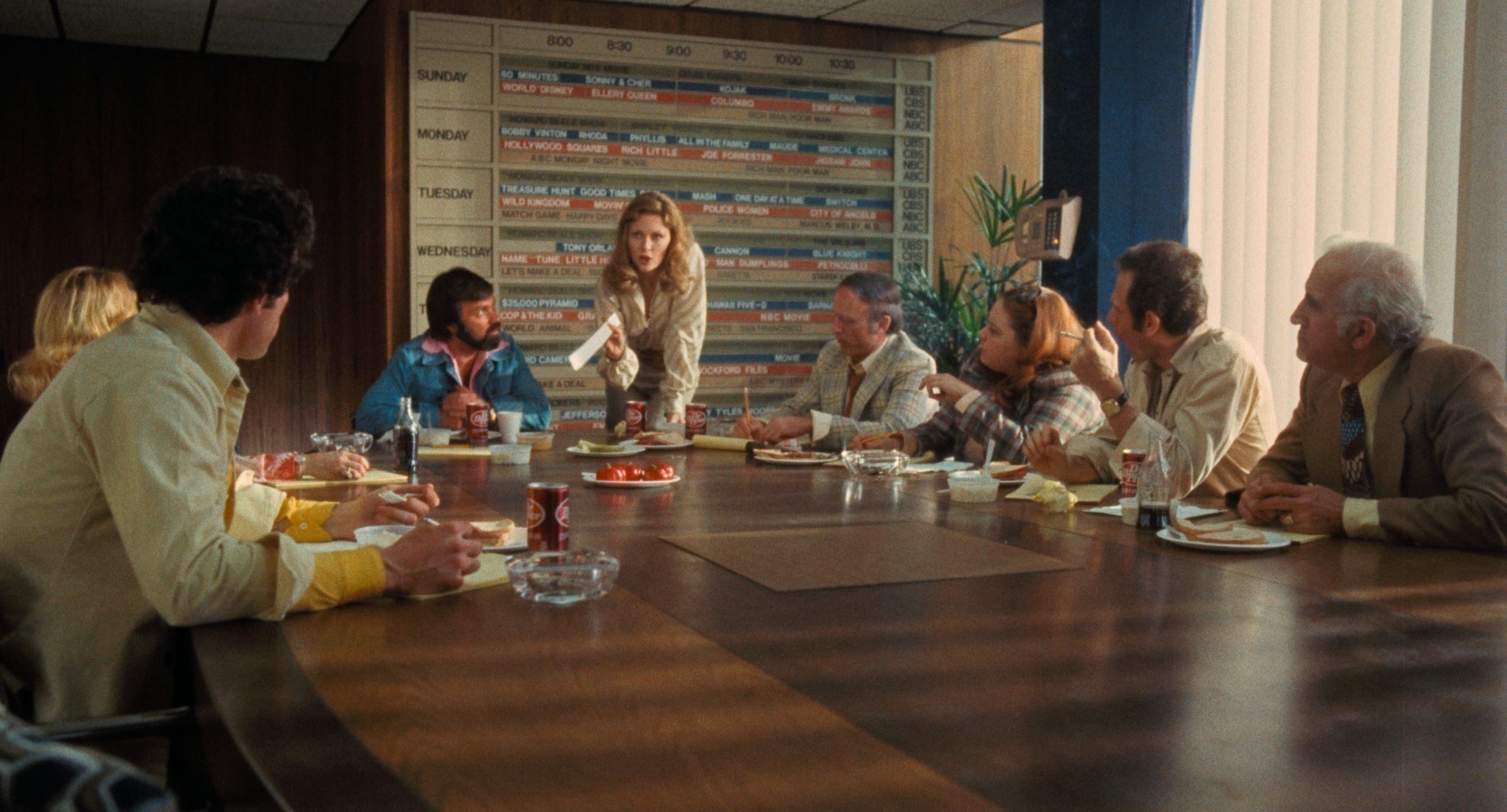
After his confrontation with Jensen, Beale returns to television yet again a new man, preaching the gospel of the shareholder—“corporate cosmology.” It is a disaster. His ratings are in free fall. Frank Hackett, a network vice president played by Robert Duvall, and the other executives at CCA agree that they must cut him loose. After a long pause, Hackett sighs that the only way to make this happen is to kill him. Diana, naturally, makes a suggestion. “Well, what do you fellows say to an assassination?”
They debate the logistics, the implications, and above all, the effect on profits. Hackett calls the question: “Well, the issue is, shall we kill Howard Beale or not? I’d like to hear some more opinions on that.”
“I don’t see we have any option, Frank,” says Diana. “Let’s kill the son of a bitch.”
As promised, Beale dies on-air—albeit not by his own hand. He is killed by the same communist revolutionaries employed by the network. And he becomes, in the words of our narrator, “the first known instance of a man killed because he had lousy ratings.”
One imagines, however, that the final show itself was a hit. The network, no doubt, was pleased.
More: Essays
The Man Who Wasn’t There: The Barber of Santa Rosa
For this existential noir, Joel and Ethan Coen drew inspiration from crime-fiction master James M. Cain’s lean, hard-boiled style and interest in the quotidian world of work.
Birth: Love Eternal
Jonathan Glazer’s enigmatic second feature explores the terrors of being desperate for love—and the vulnerability, loneliness, and difficulty in understanding other people that might drive this state.
Kiss of the Spider Woman: Revolutionary Transgressions
A resounding critical and popular success upon its release, Héctor Babenco’s adaptation of a literary masterpiece by Manuel Puig was an unprecedented cinematic fusion of a radical politics of sex with a sexual politics of revolution.
House Party: What’s Understood
Unencumbered by the white gaze, Reginald Hudlin’s groundbreaking feature-film debut is a celebration of a Black community in all its diversity, featuring fully realized characters who exist not as spectacle but as reality.