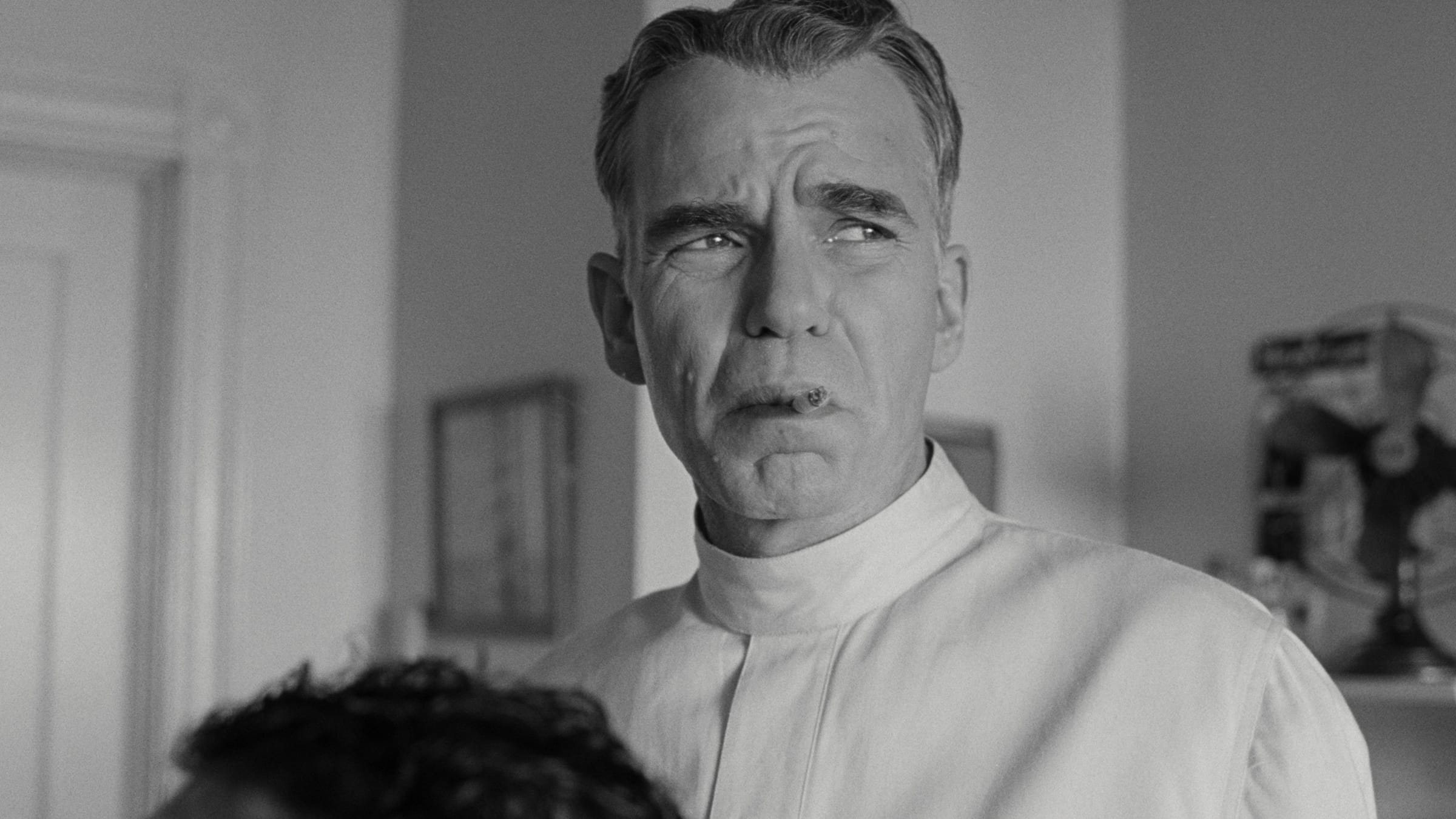
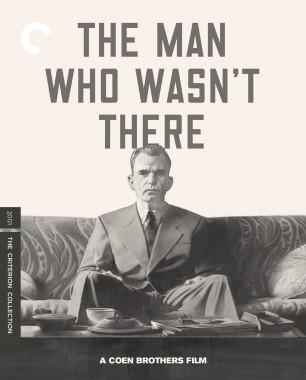
Has there ever been a more aptly named film than The Man Who Wasn’t There? The title character, Ed Crane, is as pale and insubstantial as the long ash on his ever-present cigarette. A barber by trade, he is laconic to a fault, with the kind of face that a client doesn’t recognize mere hours after a haircut. He has no vices. (Smoking isn’t a vice in 1949 Santa Rosa, California.) He has no real passions. His marriage is sexless, and he’s a cuckold. When Birdy, a teenager he is trying to mentor, attempts to fellate him while he’s driving, he screams “Heavens to Betsy!” and runs the car off the road.
Only one thing awakens desire-cum-criminality in Ed, and it’s the classic noir dream of—checks notes—co-owning a dry-cleaning franchise.
You heard that right. Not a big score. Not another man’s wife. Not a big score and another man’s wife. Ed wants to leave his brother-in-law’s barbershop behind and devote himself to the futuristic enterprise of cleaning clothes without immersing them in water.
The only catch is that it will cost $10,000—about $136,000 in 2025 dollars—to become the silent partner of the clearly shady stranger offering him this opportunity. That’s not an easy amount to come by when you’re second chair in a barbershop.
Silhouetted in a bathroom doorway, all shadow, Ed smokes while his wife soaks in the tub behind him. “Dry cleaning,” he says to himself. “Was I crazy to be thinking about it?” He continues to silently ponder the method’s too-good-to-be-true promises as he shaves his wife’s calves in a way that suggests this is a matter-of-fact routine in the Crane household. “It was clean.” (Razor stroke.) “No water.” (Razor stroke.) “Chemicals.” (Dips razor in bathwater to rinse.)
“Give me a drag,” his wife, Doris, demands. He hands over his beloved cigarette, but, as with the shaving, there’s nothing erotic or even intimate about the interaction.
Ed Crane is, in short, a schnook. But unlike most noir protagonists, he knows he’s a schnook. He has the stones to try to blackmail his way to his dream, sending his wife’s lover/boss, Big Dave, an anonymous note that threatens to expose their affair if he doesn’t come up with some cash. But when it all goes south—very, very quickly—he’s stymied.
Ed kills Big Dave when the latter confronts him over his scheme, then doesn’t come forward when Doris is accused of the murder. Eventually charged and convicted of a murder he didn’t commit, he seems resigned to his death sentence, maybe even relieved. It turns out that the voice-over throughout the film—in which Ed speaks far more than he ever did in real life—is a confession for a men’s magazine, written for a nickel a word.
“I’m glad that this men’s magazine paid me to tell my story,” Ed writes from his prison cell. “Writing it has helped me sort it all out . . . Now all the disconnected things seem to hook up . . . It’s like pulling away from the maze . . . You get some distance on it, and all those twists and turns, why, they’re the shape of your life. It’s hard to explain. But seeing it whole gives you some peace.”
The Man Who Wasn’t There was the Coen brothers’ ninth film, and it’s the only black-and-white one they have collaborated on to date. By the time they started production in 2000, they had already tackled two of the mid-twentieth century’s three literary masters of crime/noir: Dashiell Hammett (1984’s Blood Simple, 1990’s Miller’s Crossing) and Raymond Chandler (1998’s The Big Lebowski). So perhaps an homage to James M. Cain was inevitable. It’s even rumored that the Coens considered making a new adaptation of Cain’s fourth novel, Mildred Pierce.
Yet the first inspiration for The Man Who Wasn’t There was reportedly a vintage barbershop poster used as set dressing for The Hudsucker Proxy (1994). I say “reportedly” because there are only two brief barbershop scenes in Hudsucker, and no such poster is visible. A down-the-rabbit-hole search of eBay, Etsy, Pinterest, and other internet marketplaces yielded some possibilities, but none had the exact roster of haircuts that Ed wearily intones as he clips and smokes, smokes and clips: “The butch, or the heinie, the flattop, the Ivy, the crew, the vanguard, the junior contour, and, occasionally, the executive contour.”
Other named influences for TMWWT include the films Shadow of a Doubt and Detour, but Joel Coen has specified that it was the novels of James M. Cain, not their film adaptations, that were an “obvious” inspiration, especially in their attention to the quotidian world of work.
“He wrote novels about domestic murders and was very interested in people’s day-to-day existence,” Coen said in a BBC interview. “Their businesses: restaurants, insurance, banking, or being an opera singer. That was a big element in the novels he wrote, and was definitely something we were thinking about here.” In other words: Are we what we do? “I was the barber,” Ed states at one point, as if it is his only identity. A barber who, not so incidentally, is absolutely creeped out by human hair.

TMWWT is full of treats for the Cain cognoscenti—a death-house confession by a technically innocent man (The Postman Always Rings Twice), a bookkeeping scandal and a disastrous musical audition (Mildred Pierce). Nirdlingers, the name of the department store where Ed’s wife keeps the books—under the oversight of her lover, Big Dave—echoes the married surname of Phyllis, the femme fatale in Cain’s Double Indemnity. (In the film, she was Dietrichson, and a variation of that name shows up here, too, attached to a medical examiner who gives Ed disturbing news after his falsely accused wife commits suicide in jail.)
Cain, a journalist and a protégé of H. L. Mencken’s, had a lot of jobs himself—public-utility ledger clerk, road inspector, high-school principal, and Victrola salesman, to name just a few—before he found sudden literary success in 1934 with the publication of The Postman Always Rings Twice.
But the one gig he could never land was as a scriptwriter on the movies based on his work. Billy Wilder wanted Cain to write Double Indemnity with him, but Cain was under contract to a different studio at the time. Wilder ended up working with Raymond Chandler, who realized Cain’s dialogue did not work in films. “Nothing could be more natural and easy and to the point on paper, and yet it doesn’t quite play,” Chandler wrote Cain in 1944. “These unevenly shaped hunks of quick-moving speech hit the eye with a sort of explosive effect. You read the stuff in batches, not in individual speech and counterspeech. On the screen, this is all lost.” Chandler was proved right when Cain’s work came back into fashion in the 1980s; those faithful-to-a-fault adaptations tended to be laughable or inert.
TMWWT manages the same deft trick that Chandler’s screenplay for Double Indemnity did: it feels like a Cain story, but it hasn’t fallen into the trap of trying to replicate his prose or his plots. It pays homage to Cain’s early (and best) books by channeling Cain’s commitment to keeping his work lean, to the point that he famously jettisoned the word said whenever possible. (“Well, why all this saysing?” he wrote in the 1946 preface to The Butterfly. “With quotes around it, would they be gargling it?”)
In fact, TMWWT seems downright skeptical of its talky men—Ed’s brother-in-law (Michael Badalucco), who has the number one chair in the barbershop; Big Dave (James Gandolfini), whose wartime stories are all lies; the “pansy” (Jon Polito) who’s peddling dry cleaning; the expensive lawyer (Tony Shalhoub) who is bummed not by his client’s suicide but by the fact that it renders moot his brilliant arguments, which he had planned to base on the Heisenberg uncertainty principle. It’s not quite fair to say they’re all talk, especially Big Dave, but they’re mostly talk.
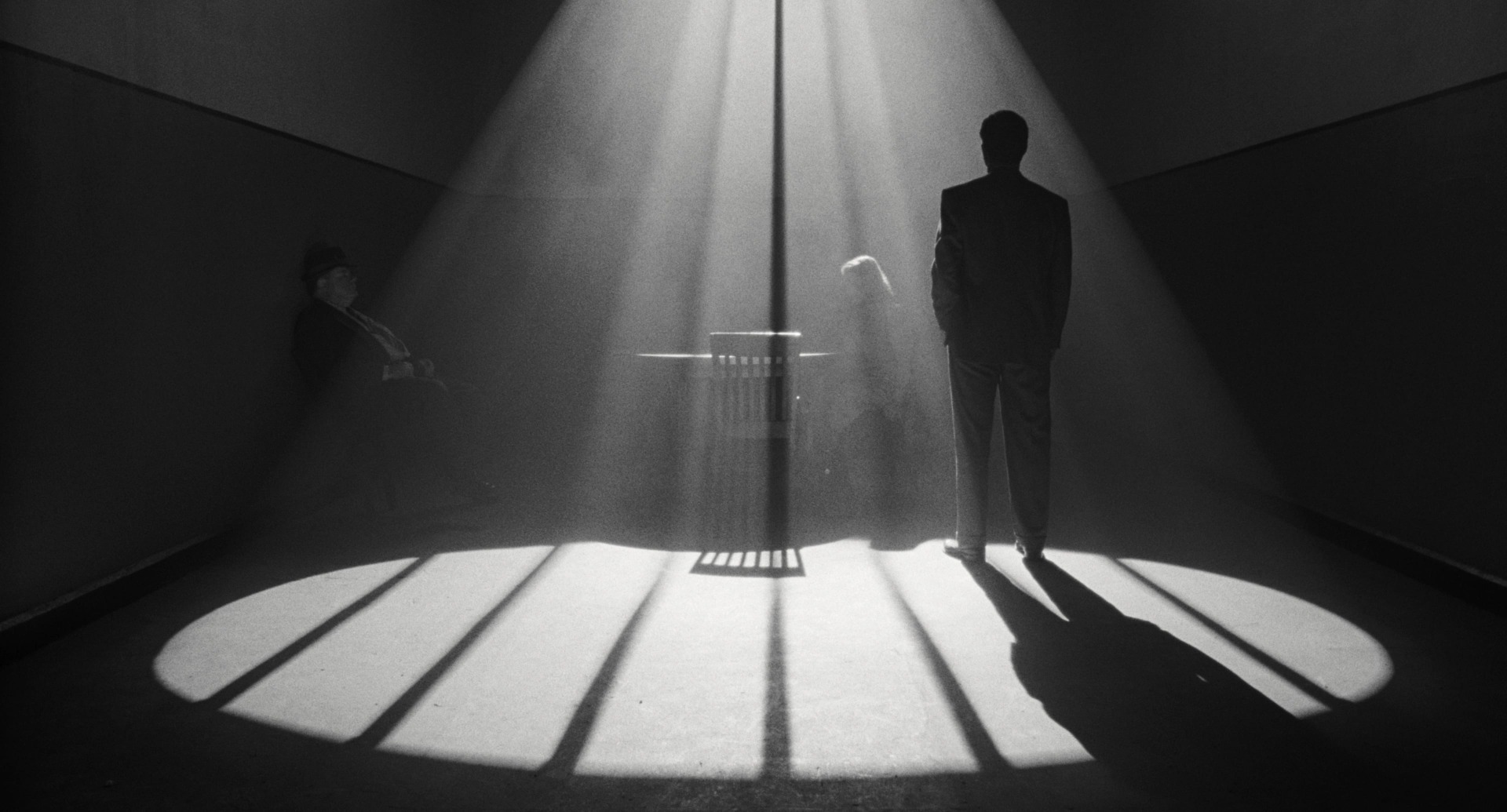
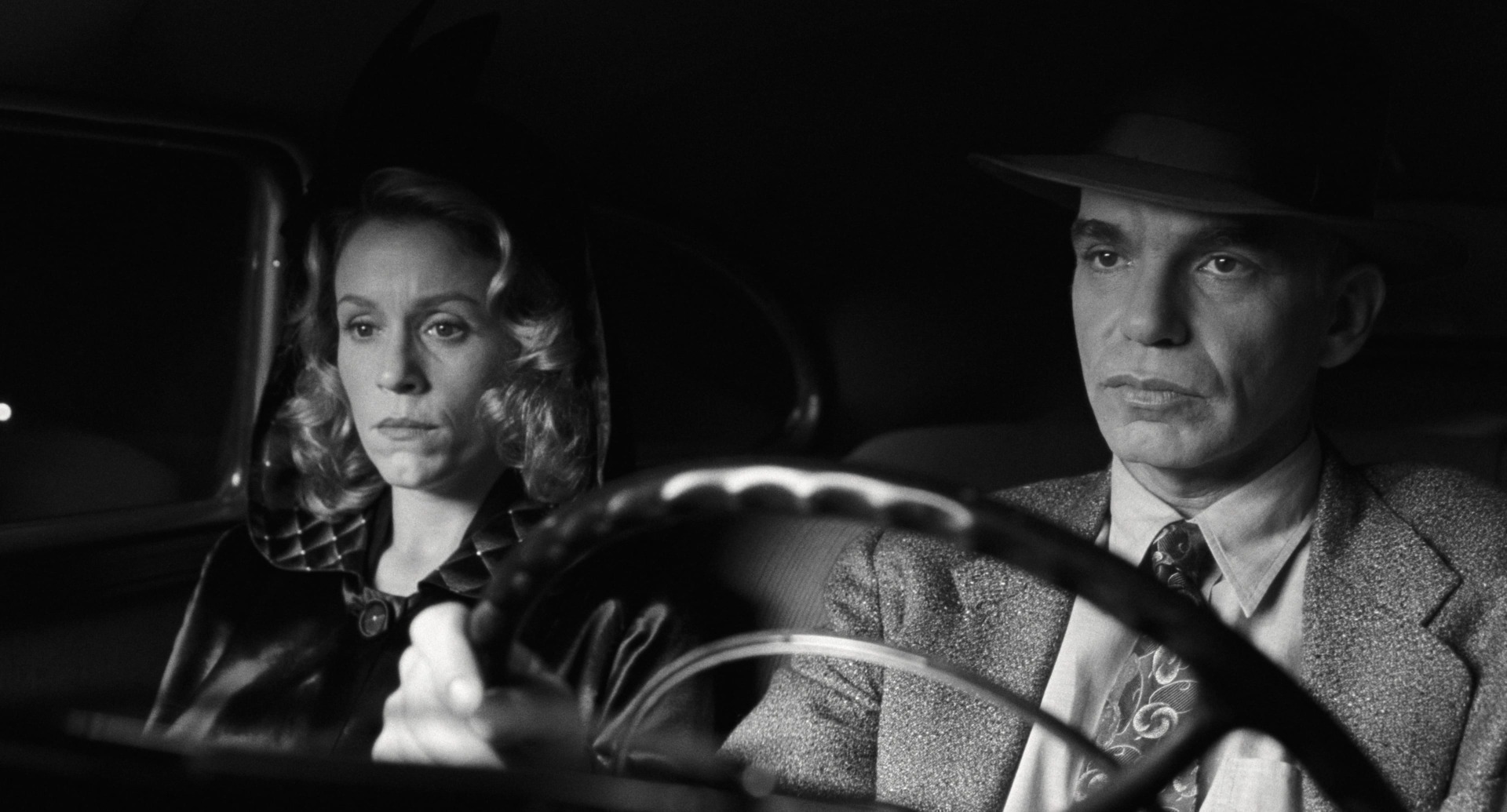
The film belongs to its two most reticent characters, Ed (played by Billy Bob Thornton) and Doris (Frances McDormand, working with the Coens for the first time since 1996’s Fargo). In their scenes, the screenplay finds devastating power in the words not said—arrangements hinted at, dreams never realized. TMWWT, which was shot by Roger Deakins on color stock, then printed in black and white, is a noir in which light—a sun-bleached meadow, a white execution chamber—is as important as shadows, maybe more so.

In one of the film’s most haunting moments, Ed returns to his home after killing Big Dave in what is arguably self-defense. He studies his wife, who is sleeping off a drunken afternoon. (Drunkenness is not uncommon for Doris, who believes there is no afterlife, and the only real reward in this one is Tuesday-night bingo.) Ed recalls how she suggested marriage after dating him for only a few weeks. “I said, ‘Don’t you want to get to know me more?’ She said, ‘Why? Does it get better?’ She looked at me as if I was a dope, which I never really minded from her.”
Some critics have argued that Ed is a closeted gay man, but that seems a little on the nose to me. (When Ed is propositioned by the man dangling the dry-cleaning franchise, his response is measured, controlled: “Was that a pass? . . . Well, you’re out of line, mister.”) His interest in the musical career of the beautiful Birdy Abundas (Scarlett Johansson) is actually just that, a belief in her talent, which he has vastly overrated. As played by Thornton in what is arguably the best performance of his career, Ed seems asexual, baffled by the dirty business of sex and the complicated codes of manhood. In this barbershop, the poster on the wall is an ad, probably ripped from a men’s magazine by his brother-in-law: “Lend Me 15 Minutes a Day . . . and I’ll prove I can make you a NEW MAN.”
What if Ed, who at one point calls himself a ghost, isn’t a man at all, but someone so alienated from the world around him that he might as well be an actual alien? TMWWT is filled with visual references to flying saucers, real and imagined. Its first shot, of a whirling barber pole, feels like a beam of light from a spaceship, lifting us up, up, up to places unknown. A hubcap loosened by an accident appears to turn into a flying saucer. While flipping through Life magazine, Ed happens on an account of the strange events in Roswell, New Mexico, in 1947.
There’s even a specific story of an alien visitation in TMWWT. After Big Dave’s murder, his wife arrives on Ed’s doorstep late at night and tells him that her husband was once abducted by “creatures” from a spaceship and subjected to treatment she refuses to describe. “Big Dave,” says the wide-eyed Ann (Katherine Borowitz), “never touched me again.” Ed looks aghast. Is he uneasy because he’s talking to the woman he made a widow, uncomfortable with her confidences, or unnerved by some other secret?
The night before his execution, Ed dreams that he is free to wander through an empty, unguarded prison. He finds his way to the yard, where a bright, starlike object is revealed to be a whirling spaceship. He is then awakened from his dream by a priest and two guards, who lead him to that improbably white, almost formless chamber where he is strapped to the electric chair. A guard shaves Ed’s legs much as Ed once shaved Doris’s—stroke, stroke, rinse.
“I don’t know where I’m being taken, I don’t know what I’ll find beyond the earth and sky, but I’m not afraid to go,” his voice-over informs us, and it’s unclear whether this is part of his paid-for confession or an interior monologue. “Maybe the things I don’t understand will be clearer there . . . Maybe Doris will be there. And maybe there I can tell her all those things they don’t have words for here.”
Where is “here”—and where is there? What does he mean by “taken,” a strange word for one’s execution? How can Doris be encountered in an afterlife in which she never believed? Has Ed found faith? Is he, in his own words, pulling away from the maze and seeing all the connections, as if from a great height? Or is he completing the classic arc of other cinematic extraterrestrials and being summoned home?
The executioner pulls the switch. (At least, he seems to—we see him reaching for it but not the actual flip.) Ed Crane heads into—no, disappears into—the light, the blindingly white light.
More: Essays
Network: Back to the Future
Centered on the emotional unraveling of a failed newsman, this darkly prescient satire envisions the collapse of American society as we knew it through an unsparing critique of corporate media and capital accumulation.
Birth: Love Eternal
Jonathan Glazer’s enigmatic second feature explores the terrors of being desperate for love—and the vulnerability, loneliness, and difficulty in understanding other people that might drive this state.
Kiss of the Spider Woman: Revolutionary Transgressions
A resounding critical and popular success upon its release, Héctor Babenco’s adaptation of a literary masterpiece by Manuel Puig was an unprecedented cinematic fusion of a radical politics of sex with a sexual politics of revolution.
House Party: What’s Understood
Unencumbered by the white gaze, Reginald Hudlin’s groundbreaking feature-film debut is a celebration of a Black community in all its diversity, featuring fully realized characters who exist not as spectacle but as reality.