May Books
Share
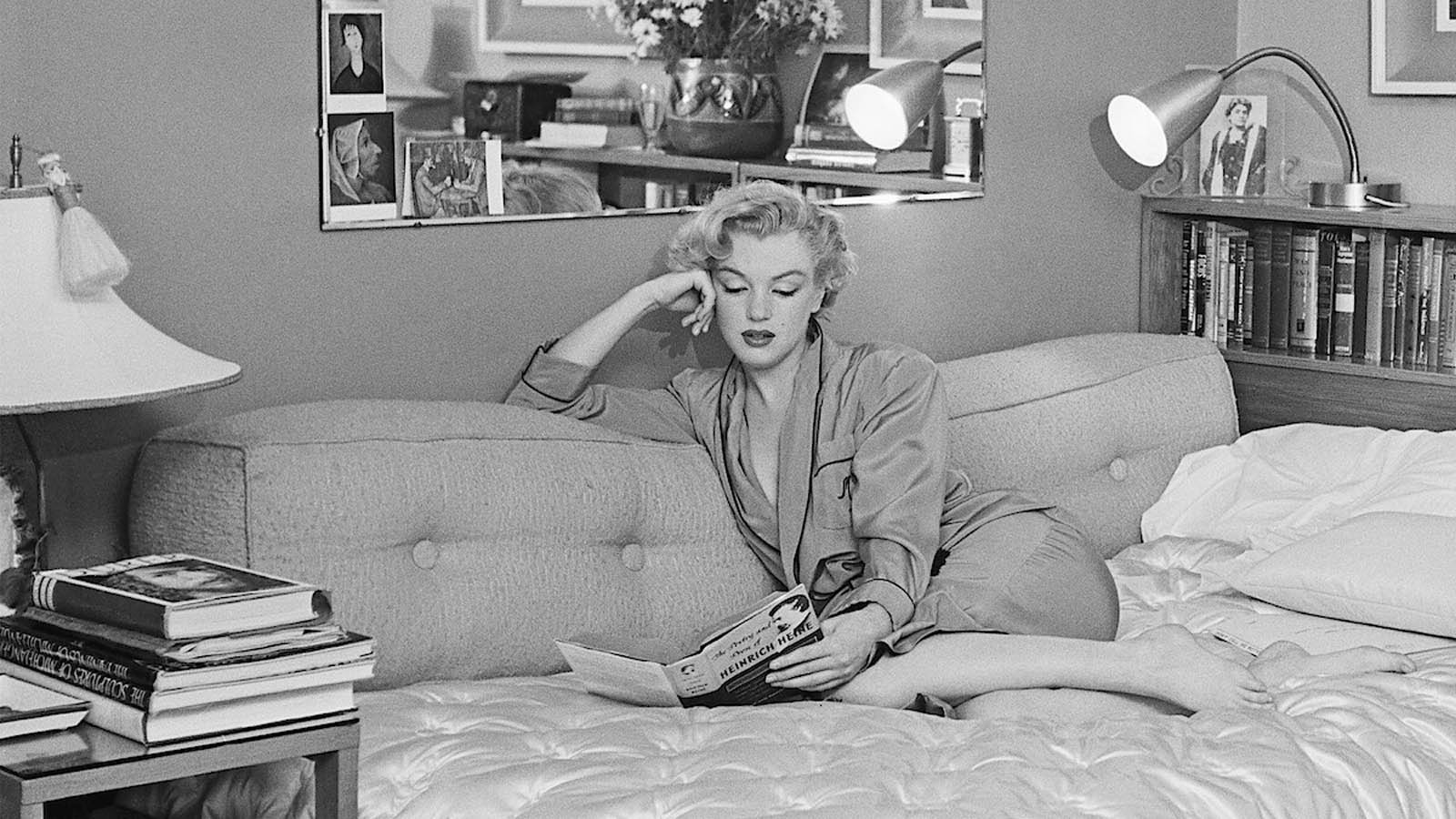
“There are more photographs of Marilyn Monroe reading than there are of her naked,” wrote Audrey Wollen in a 2019 essay for Affidavit. “The public seems permanently surprised at her literacy, even when we are making a show of not being surprised.” Wollen noted that in 1999, “Christie’s auctioned off nearly four hundred books from Marilyn’s personal library, a roster of classics ranging from Proust to Hemingway.”
An eager reader, Monroe wrote as well. Fragments: Poems, Intimate Notes, Letters appeared in 2012, and having come across the collection ten years later, Eliza Gonzalez wrote in a piece for the Paris Review that Monroe’s “choice of line often seems naive, her images are sometimes clichéd, but in places something flares, that strangeness I associate with poetry that feels open rather than finished before it begins. It is the kind of poetry that risks failing to go anywhere at all but, when it succeeds, surprises the reader, and the poet, too.”
The Monroe centenary—she was born Norma Jeane Mortenson on June 1, 1926—is being celebrated with film series and exhibitions as well as a Sight and Sound cover story by Farran Smith Nehme. And of course, there are books. IndieWire has an excerpt from The Marilyn Monroe Century: From Norma Jeane to Icon―A Story in Photographs, a collection of never-before-seen shots by Bruno Bernard. The book has sparked a conversation between Lena Dunham and Alissa Bennett at Interview.
Marilyn Monroe 100: The Official Centenary Book is precisely what the title promises, a volume sanctioned by the estate, and in the new Bookforum, Moira Donegan calls it “a dense and vivid collection.” The New Yorker is running an edited excerpt from the introduction, in which Rachel Syme writes that Monroe knew “how to befriend the camera, even when she was lonely (and she was often very lonely). She was an uncanny beauty—the sleepy, heavy-lidded eyes, the bobbed bunny-tail nose, the accentuated beauty mark, the overdrawn smile—but that wasn’t what made people rush to send pounds of fan mail. Hollywood was full of beauties. What people fell for was the way Monroe knew how to be photographed; she had the rare ability to seem, at least in still photos, both completely spontaneous and incredibly deliberate.”
“From the vantage point of 2026,” writes Donegan, “the tragedy of Monroe’s life lies in its foreclosed possibilities. What if, while being an object of desire, she had been allowed to be anything else? What if, confronted with the force of her beauty, her audience had been strong enough to see her also as a mind—grieving, brilliant, needful, and struggling?”
From Hollywood to Hungary
“Hollywood is a terrifying place,” writes author Kelly Yang (The Take). “No position is forever, no parking spot ever really secure.” For the New York Times, Yang has written up an annotated list of eight of her favorite Hollywood thrillers, including Charles Yu’s “gut punch of a novel” Interior Chinatown; Crystal Smith Paul’s Did You Hear About Kitty Karr?, the story of a Black actor who passes for white and becomes a star; Isabel Kaplan’s “darkly funny” NSFW; and May Cobb’s The Hollywood Assistant: “Sex! Scandal! Murder!”
Putting together a list of the best crime novels of 2023 for the NYT, Sarah Weinman warned readers that Everybody Knows is “as bleak as Hollywood noir gets.” The author is Jordan Harper, a screenwriter whose latest novel is A Violent Masterpiece, which chases after a live-streamer roaming the seamier streets of LA, a street lawyer hired by a pedophile producer, and a woman who works for an underground private concierge company catering to the ultrarich. “A Violent Masterpiece reads like pure rage cooled into crystalline prose,” writes Weinman. “This is the noir novel for our times.”
“The world we exist in—the world we’ve made—is all death drive, all the time,” Harper tells the NYT’s Brooks Barnes. “It’s hard to make the villains in your book as villainous or stupid or disgusting as the villains in real life. So writing at an extremely high volume was quite intentional.” Harper has joined Guide for the Film Fanatic hosts Jason Bailey and Mike Hull to talk about the novel—and about John Milius’s Conan the Barbarian (1982).
In Esther Kinsky’s Seeing Further, a nameless narrator comes across an abandoned movie theater in a small town in southeastern Hungary. She buys it, and with the help of the former projectionist and one or two other locals, she reopens it. Too few come, and by the end of a single season, the theater is closed up again. “The theater is an ‘emblem for the great truth of cinema,’ and while it represents an age of film unlikely to return,” writes Walker Rutter-Bowman in the Nation, “Kinsky’s ultimate point is that even when hope isn’t practical, it’s the right thing to do.”
New York and London
On May 21, J. Hoberman will be in Berlin to talk about his latest book, Everything Is Now: The 1960s New York Avant-Garde—Primal Happenings, Underground Movies, Radical Pop. He’ll also present three films: Stan Brakhage’s Window Water Baby Moving (1959), Barbara Rubin’s Christmas on Earth (1963), and Jonas Mekas’s The Brig (1964).
“Everything Is Now is a sweeping trove of obscure facts and colorful figures, plucked from hundreds of sources, tracing a countercultural groundswell that swiftly coalesced into mainstream myth,” writes Prudence Pfeiffer in the New York Review of Books. “The city had an embarrassment of broadside riches during the rough decade covered by this book, circa 1958 to 1971; the Village Voice, where Hoberman would later spend four decades as an influential film critic, and the East Village Other, which the Blondie musician Chris Stein once described as ‘fucking nuts,’ stand out . . . It’s a lot to move through—this is not a quick read—but often thrilling.”
“The clichés about spring in New York City are true,” writes Michael Lee Nirenberg for Time Out. “Even the most jaded, seen-it-all New Yorkers crack a smile in May.” Nirenberg offers a guide to ten movie locations in the city, and he’s also been talking about his new book, Cinematic Immunity: An Oral History of New York Filmmaking As Told by the Crews That Got the Shot, with Daniel Moran at the New Books Network and Nicolas Rapold, the host of The Last Thing I Saw.
“Not a tidy, polished monograph, but a radical collage of images, memories, and manifestos,” writes Wheeler Winston Dixon in Senses of Cinema, Duncan Reekie’s BOOM! The Exploding Cinema and the New London Underground “documents the chaotic, collective energy that gave rise to Exploding Cinema in the early 1990s and has sustained it for over three decades. It is an indispensable chronicle of a movement that stubbornly refused to play by the rules of either the commercial mainstream or the state-subsidized avant-garde.”
3 Women
The New Yorker’s Michael Schulman talks with Ellen Burstyn about Poetry Says It Better: Poems to Help You Wake Up, a collection that traces the story of her life through the poems she’s loved over the years. “I like what metaphors set off in your mind,” says Burstyn. “I like what poetry plays with.”
Lulu in Hollywood, the classic collection of eight autobiographical essays by Louise Brooks, has just been reissued and is now also available for the first time as an e-book. When it first appeared in 1982, James Wolcott, writing for Esquire, called Lulu a “tart, fleet, gossipy book, a whip-flicking display of wit and spite.” Brooks “emerges not as a white goddess wreathed in incense, but as a sassy companion, wisecracking, knowledgeable, completely free of cant and coy sentiment.”
Reading Lynn Hershman Leeson’s memoir Private I has prompted Joanne McNeil to watch or rewatch all of the artist’s work. “Each of her films and videos seems to develop from what she learned from the last,” writes McNeil for Filmmaker. “The quasi-documentary format she first explored in shorts from the 1970s and deepened in [Twists in the Cord, 1994], and Conceiving Ada [1997] builds once more in the disquietingly monumental Strange Culture (2007) . . . I can’t begin to express how inspiring it is to read Private I and to learn from Leeson how life as a woman artist can be a decades-long series of beginnings.”
A Few Auteurs
Writers on Film host John Bleasdale talks with Robert P. Kolker and David Wyatt about The Film Auteur: Angles of Vision, a history of the French theory championed by Andrew Sarris in the U.S. in the 1960s. The book also examines the work of forty-eight directors, and naturally, Jean-Luc Godard is one of them. In the new Senses of Cinema, Arta Barzanji writes that Godard’s Scénario notebooks, completed at the end of his life, “belong to a long history of Godard treating paper, print, and graphic work as parallel forms of cinema.”
Akira Kurosawa’s serialized memoir Something Like an Autobiography, first published in 1981, takes his story up to the making of Rashomon (1950). Appearing shortly after Kurosawa’s death in 1998, Long Take aimed to complete the picture by gathering the director’s writings and interviews and reflections from his daughter and colleagues. Writing in Senses of Cinema about the new translation from Anne McKnight, Tony McKibbin observes that “Kurosawa had no idea how to live in the twentieth century, yet was determined to get the lives of samurai warriors living in the sixteenth right.”
In an excerpt from A Century of Hitchcock: The Man, the Myths, the Legacy up at IndieWire, Tony Lee Moral tells the story of how Rod Taylor’s drinking almost got the production of The Birds (1963) shut down.
Theory and Practice
Montreal-based publisher caboose has begun rolling out free PDFs of its backlist electronic-only titles, beginning with scholar and critic Jacques Aumont’s Montage, a wide-ranging essay on the theory and practice of editing. Also freely accessible is Aumont’s essay “This Is Not a Theorist: Notes on André Bazin.” In the meantime, caboose is currently putting together Reading with Sergei Eisenstein, a collection structured along the lines of the 2023 book Reading with Jean-Luc Godard.
Celebrating the reissue of the late critic Greg Tate’s 1992 collection Flyboy in the Buttermilk: Essays on Contemporary America,Carl Wilson writes in Bookforum that “Tate machine-gunned gold nuggets across the page in what-the-fuck sentences with the cadences of rap—of which he was the first crucial theoretician—plus the cognitive dissonances of free jazz, a fat bassline of moral clarity, and a syncopated shuffle of cultural-political thought set in spin as if Stuart Hall and Roland Barthes were tag-teaming it behind the turntables.” Tate’s “spiritual cinematic siblings were many, such as Julie Dash and early Spike Lee (in the moment he thought She’s Gotta Have It represented a ‘coup of staggering proportions . . . a populist black post-structuralist’s dream’), but his nearest and dearest in the film fraternity was the cinematographer Arthur Jafa, whose video essays Love Is the Message, the Message Is Death (2016) and The White Album (2018) are the nearest things to a Tate essay come to full audiovisual life.”
Reviewing Cinematic Encounters with Disaster: Realisms for the Anthropocene for Senses of Cinema, Scott Robinson finds that author Simon R. Troon’s “theoretical touchstones are a mixture of classical realist film theorists like André Bazin and Siegfried Kracauer alongside post-structuralist thinkers like Donna Haraway and Deborah Bird Rose.” Troon “contends that cinema can bring us face-to-face not only with the human suffering of eco-catastrophe, but with eco-catastrophe itself, in its elemental forms.”
Don’t miss out on your Daily briefing! Subscribe to the RSS feed.