Italian Cinema, Present and Past
Share
Opening this evening with Carolina Cavalli’s The Kidnapping of Arabella, the twenty-fifth edition of Open Roads: New Italian Cinema will run through Thursday, when it segues straight into History, Italian Style, an ambitious twenty-nine-film series exploring the evolution of modern Italy from unification in the nineteenth century through the rise of Mussolini to fall of fascism in the immediate aftermath of the Second World War. Both series are copresented by Film at Lincoln Center in New York and the famed Italian studio and distributor Cinecittà.
Benedetta Porcaroli won the award for Best Actress when The Kidnapping of Arabella premiered in the Orizzonti program in Venice last fall. She plays Holly, a young woman convinced that seven-year-old Arabella (Lucrezia Guglielmino) is her younger self. Holly whisks Arabella away from her preoccupied dad (Chris Pine). In the Hollywood Reporter, Leslie Felperin found it “a bit icky to be making a farce out of child abduction,” but “young lead Porcaroli and the even younger Guglielmino show off terrific comic timing while colorful cameos from an assortment of mesmerizing character actors, especially Eva Robin’s as a kooky aging showgirl, add sparkle.”
Like Cavalli’s film, the other eleven new fictional features and two documentaries in the program are seeing either their North American or New York premieres. There are breezy comedies such as Ludovica Rampoldi’s A Brief Affair, starring Pilar Fogliati, Adriano Giannini, and Valeria Golino, and historical dramas like Primavera, written by Rampoldi and directed by Damiano Michieletto. With his debut feature, renowned opera director Michieletto tells the story of Cecilia (Tecla Insolia), a supremely talented teenage violinist who comes under the tutelage of Antonio Vivaldi (Michele Riondino) in eighteenth-century Venice.
Of the four films that premiered in last month’s Biennale College Cinema program in Venice last year, Massimiliano Camaiti’s Agnus Dei was Glenn Kenny’s favorite. “The title translates to ‘Lamb of God,’ of course, and the documentary, without recourse to voiceover or talking head interviews, follows the lives of a couple of lambs that are born in a monastery and cared for by a group of nuns,” wrote Kenny at RogerEbert.com. “Spare and simple in format—it’s shot in the square-ish 1.37 Academy ratio—it’s also elegant and humble at the same time. And what it leads up to is heartening, likely to move all but the most violently anti-clerical of viewers.”
The other documentary is Roberto Rossellini, Living Without a Script, directed by Ilaria de Laurentiis, Raffaele Brunetti, and Andrea Paolo Massara and the winner of a David di Donatello award. “While the film serves as a reminder of its subject’s status as one of the greats of world cinema—the key figure in postwar Italian neorealism—it also shows his life beyond movies,” noted Geoffrey Macnab when he interviewed Isabella Rossellini for the Guardian just before the doc’s premiere in Rome last October. “In the film, the director seems perpetually on the move: racing cars, studying biology and physics, and experimenting with TV—a medium that he embraced (unlike most of his contemporaries).”
As a tribute to Rossellini on his 120th birthday—he was born on May 8, 1906—the series will present Paisan (1946) with an introduction by Ingrid Rossellini, Isabella’s twin sister. “With this film,” writes Pietro Marcello, “Rossellini was the first to depict in such an observational way the realities of his country at a time when it had been completely destroyed by the war and needed to be rebuilt. When I think of the episode of Paisan that takes place in Naples, I see my father, who likewise grew up in the middle of the rubble. Rossellini poured his affection for his country into Paisan, and it touches me all the more when I think of my own father and the history of Italy as a whole.”
Marcello served as a consultant alongside curator Emiliano Morreale as History, Italian Style was being put together, and the series includes Marcello’s great Martin Eden (2019), which transposes Jack London’s 1909 novel to postwar Italy. History, Italian Style will open with something like an overture, the original 316-minute cut of Bernardo Bertolucci’s 1900 (1976).
“1900’s immense running time was not just a stunt,” wrote Bilge Ebiri for Senses of Cinema in 2004. “Bertolucci cut a wide swath through history, telling the story of two boys born on the same day in 1901 (the date of Giuseppe Verdi’s death)—Olmo (played by [Gérard] Depardieu as an adult) is the son of peasants and destined to be a socialist; the other, Alfredo ([Robert] De Niro as an adult) is the son of landowners and destined to be a hopeless bourgeois, an unwitting defender of fascism, and an inadvertent propagator of crimes against his laborers. The vast historical melodrama that ensues is one of Bertolucci’s most committed and audacious works.”
After Thursday’s marathon screening—there will be a second screening of 1900 in the afternoon on Sunday, June 7—the series will roll out in three parts. “Risorgimento” features films set in the tumultuous period of rebellion and revolution that began with uprisings in the early nineteenth century, culminated in the establishment of the Kingdom of Italy in 1861, and reached completion in 1871 with the establishment of Rome as Italy’s capital.
The eight films in this section include two by brothers Paolo and Vittorio Taviani, Gianni Franciolini’s satirical Ferdinand the 1° King of Naples (1958), Roberto Andò’s adventure comedy The Illusion (2025), and two operatic classics from Luchino Visconti. Opening in 1866 during the Third Italian War of Independence, Visconti’s Senso (1954) stars Alida Valli as a countess who, against all her political convictions, falls helplessly in love with an Austrian lieutenant played by Farley Granger. When Senso was finally released in the U.S. in 1968, Mark Rappaport went to see it five times. “I thought it was the most beautiful movie ever made,” wrote Rappaport in 2011, “and have had no reason during the intervening years and after many subsequent viewings to change my mind.”
Visconti’s The Leopard (1963) is “intimately faithful to the spirit” of Giuseppe Tomasi di Lampedusa’s 1958 novel, observed Michael Wood in 2010, “even when it shifts time lines and details of dialogue, and inserts a whole battle sequence. A movie audience, Visconti said in an interview, needs to see Garibaldi’s men fighting the soldiers of the Bourbon government in the streets of Palermo, and to see Tancredi Falconeri (Alain Delon), the nephew of the prince of Salina (Burt Lancaster), fighting alongside the revolutionaries, in order to perceive what is at stake—‘the disruptive power of the historical conjuncture and the real risk Tancredi is running’ as the old order is overturned and a new Italy is born.”
Nine films screen in the “Belle Époque” section, including Mid-Century Loves (1954), an omnibus film with stories directed by Rossellini, Pietro Germi, Glauco Pellegrini, Mario Chiari, and Antonio Pietrangeli; Mauro Bolognini’s The Lovemakers (1961), featuring a young Jean-Paul Belmondo and Claudia Cardinale; Laura Samani’s Small Body (2021), which the Observer’s Wendy Ide finds “as enchanting as it is unusual”; and Alessio Rigo de Righi and Matteo Zoppis’s Heads or Tails? (2025), starring John C. Reilly as Buffalo Bill.
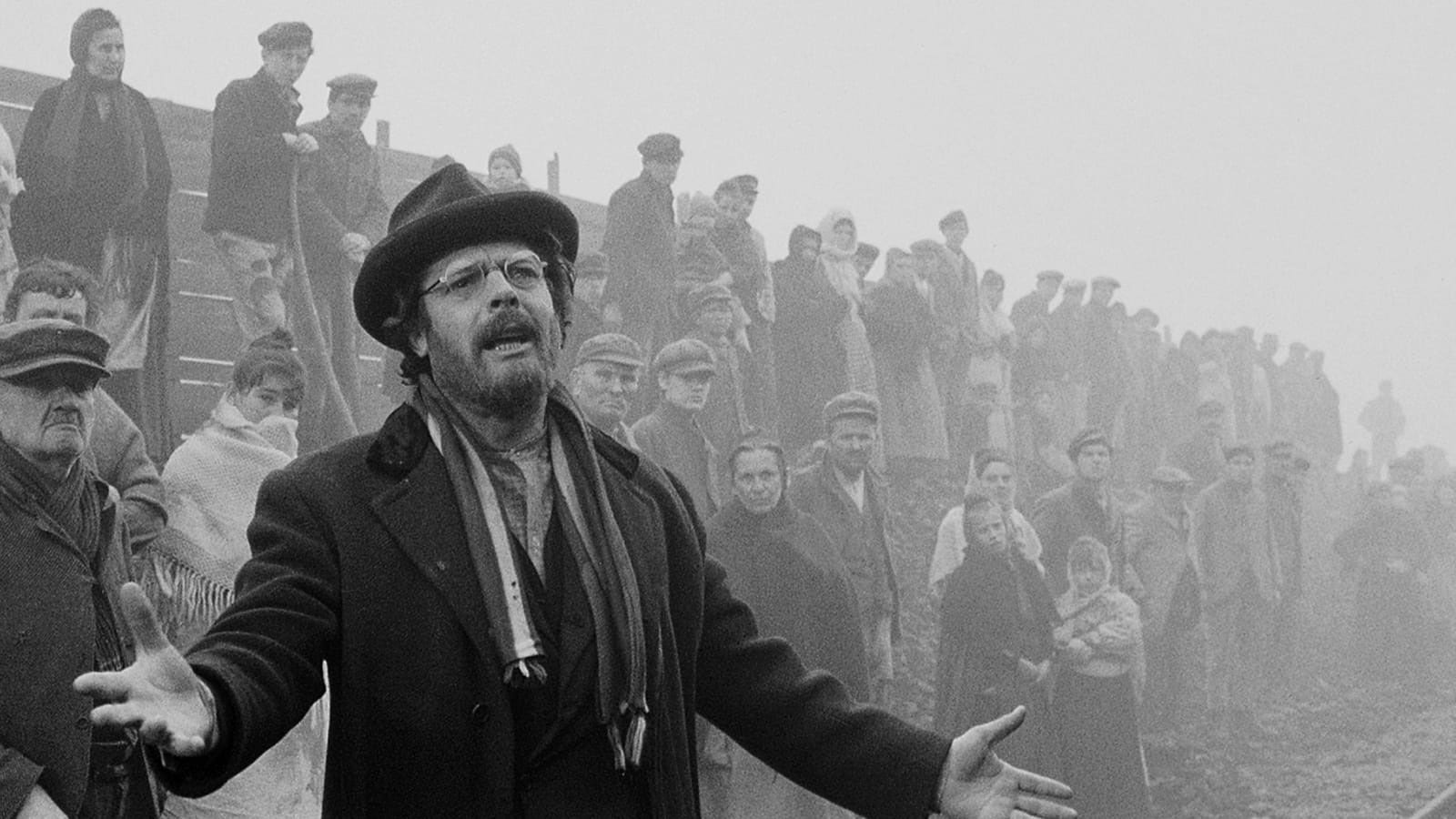
Mario Monicelli’s The Organizer (1963) stars Marcello Mastroianni as a traveling professor who becomes an advisor to striking textile factory workers in turn-of-the-twentieth-century Turin. The Organizer is “variously (and, for some, disconcertingly) jaunty, sentimental, comic, and baffling, as Monicelli applies the tonal shifts associated with the French New Wave to a straightforward saga of working-class solidarity,” wrote J. Hoberman in 2012. “Above all,” this is “a movie about how difficult it is to organize collective action, set in a period when Italian unions barely existed.”
The third section, “The Rise and Fall of Fascism,” offers Amarcord (1973), “a scathing satirical critique of Italian provincial life during the 1930s,” as Peter Bondanella, the author of The Cinema of Federico Fellini, has put it; Marco Bellocchio’s Vincere (2009), the story of Mussolini’s ascent as seen through the eyes of his first wife, Ida Dalser; and The Conformist (1970), which Calum Marsh, writing for the Village Voice in 2014, called “Bertolucci’s boldest and most expressive film: Here, protagonist Marcello Clerici (Jean-Louis Trintignant) recedes into fascism not for the authority he expects it will confer but for the comforts.”
With Love and Anarchy (1973), starring Giancarlo Giannini and Mariangela Melato, Lina Wertmüller “offers a masterpiece that stuns both visually and emotionally,” wrote Patricia Erens in Jump Cut in 1974. “Juxtaposing the power of the historical fact against the frailty of the individual, Wertmüller focuses on the struggle of a youthful Italian revolutionary to accommodate two conflicting forces: the external political realities of a fascist regime and his intimate feelings towards a beautiful young prostitute.”
Vittorio De Sica’s The Garden of the Finzi-Continis (1970), which centers on a well-to-do Jewish family in the late 1930s and early ’40s, won the Golden Bear in Berlin and an Oscar a decade after Sophia Loren won her Oscar for her lead performance as a mother seeking to protect her teenage daughter during the war in De Sica’s Two Women (1960). Loren and Mastroianni costar in Ettore Scola’s A Special Day (1977), which Deborah Young has called “one of the most telling films ever made about Italian fascism.”
Set in 1944, Maura Delpero’s Vermiglio (2024), the winner of the Grand Jury Prize in Venice and seven David di Donatello awards, including Best Film and Best Director, is “a momentous vision of everyday rural existence in the high Italian Alps,” writes Jessica Kiang in Variety. “The remarkable, raw-boned, and ravishing Vermiglio takes place in the past but operates like a future family secret playing out in the present tense.”
“Shooting started on January 18, 1945,” wrote Irene Bignardi in her 2010 essay on Rossellini’s Rome Open City. “The war in the rest of Italy was still on. There was no film stock, and so Rossellini and his team had to use abandoned scraps found here and there. It wasn’t possible to check the rushes. Rossellini, little by little, sold all he owned so that the film could go on. In Italian, as in English, there is the expression ‘to make a virtue of necessity,’ and that’s what Rossellini did here.”
The late cinematographer John Bailey found it “almost impossible to consider Rome Open City, Paisan, and Germany Year Zero as anything other than a linked narrative of the ashes of World War II and of the struggle to rise out of that dustbin of history. They are vital, raw, even primitive in style, full of nonactors who are alternately charismatic and arch; there is an aesthetic in these movies that is stripped to the bone. These films, taken together, are immediate godfather to the French New Wave.”
History, Italian Style will wrap on June 25 with an “Epilogue,” a screening of Alice Rohrwacher’s Happy as Lazzaro (2018), which begins its beguiling tale on a tobacco farm where the workers are exploited by the wealthy Marquise de Luna (Nicoletta Braschi). “Rohrwacher, writing and directing her third feature, works in a modest, rough-hewn style that nonetheless feels kissed by a strange and melancholy magic,” wrote Justin Chang in the Los Angeles Times. “Happy as Lazzaro is slow to reveal its full shape: It’s a realist snapshot of downtrodden lives that gradually takes on shadings of fable and myth, a deceptively plain story that, by the end, all but glows with wonderment and surprise.”
Don’t miss out on your Daily briefing! Subscribe to the RSS feed.