Bleak Week, Year Five
Share
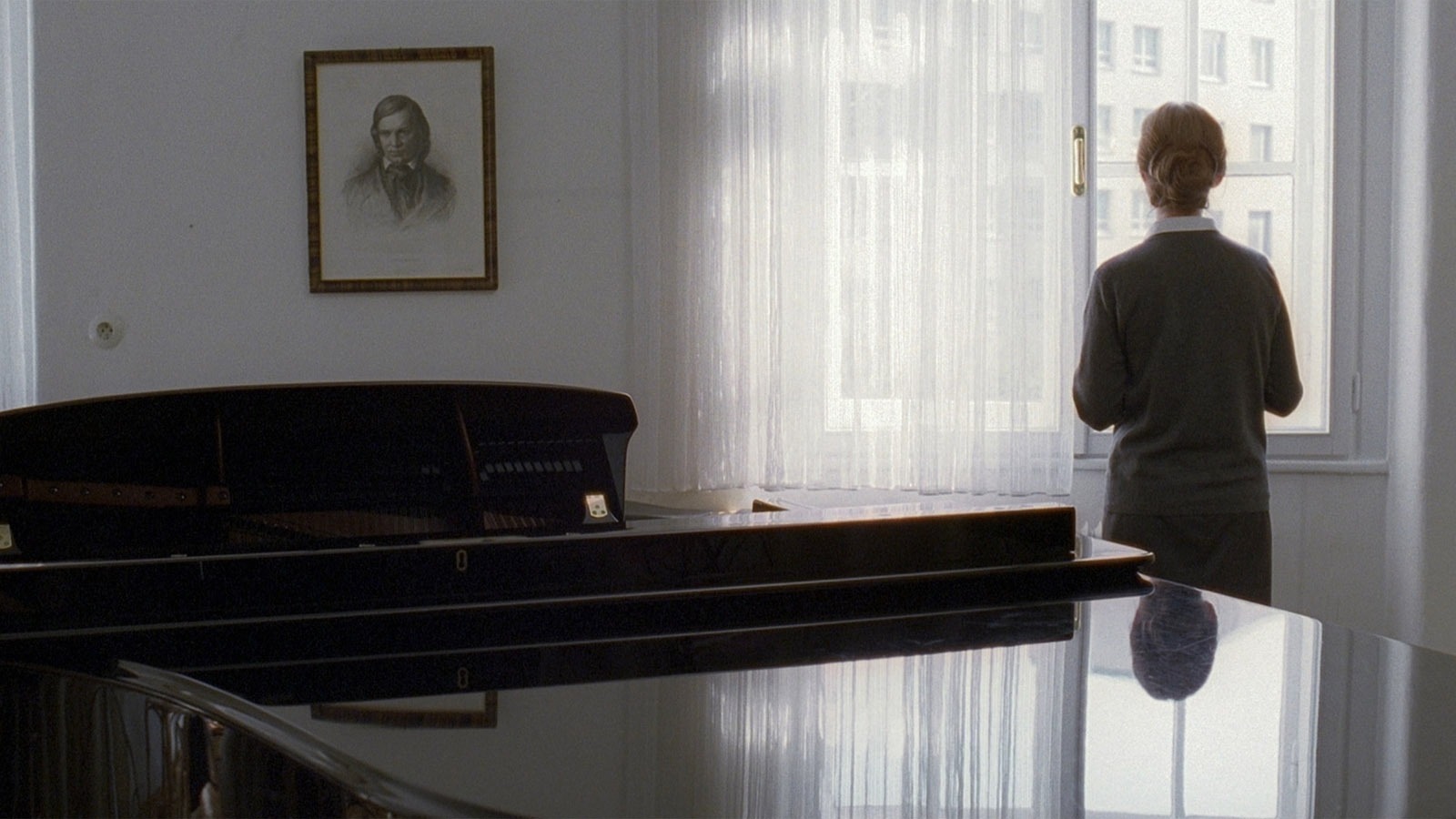
Isabelle Huppert will be in Los Angeles this evening for a twenty-fifth-anniversary screening of Michael Haneke’s The Piano Teacher, and she’ll be taking part in a Q&A moderated by the New Yorker’s Justin Chang. Tomorrow, Sophy Romvari (Blue Heron) will have questions for Huppert about Claude Chabrol’s Violette Nozière (1978) and La cérémonie (1995), and the French megastar will discuss Paul Verhoeven’s Elle (2016) on Wednesday, Haneke’s Time of the Wolf (2003) on Thursday, and Michael Cimino’s Heaven’s Gate (1980) on Friday.
In The Piano Teacher, Huppert plays Erika, a repressed professor whose masochistic urges complicate, let’s say, her relationship with a student (Benoît Magimel) who has become infatuated with her. “The film is one of the most compelling accounts I know of a life undone by desire, and of the labyrinth one can be led into by mistaking one’s desire, by having been profoundly wrong about oneself and what one wants,” writes novelist and critic Garth Greenwell. “It’s a brutal film, but also an intimate and delicate one.”
Screening at the Egyptian Theatre, The Piano Teacher is one of three films opening this year’s Bleak Week: Cinema of Despair, the American Cinematheque festival that, in just five years, has become an annual early-summer phenomenon, spreading to nearly one hundred theaters in seventy-three cities around the world. “Turning sadness, depression, and defeat into group activities to be enjoyed together has been an ingenious masterstroke of programming,” notes Mark Olsen in the Los Angeles Times.
“This is the easiest year we’ve ever programmed,” Cinematheque director of programming Chris LeMaire tells Chris Cassingham at Filmmaker. “Because once you have [Isabelle Huppert], everyone’s saying ‘yes.’ If we can have someone that big, then we can ask audiences to take a chance on some of the rarer things in the lineup. If it’s in a festival with Isabelle Huppert and Ari Aster, it must be interesting.” Tickets to the Bleak Week Aster retrospective, by the way, sold out “in just a few minutes.”
There are two other events opening Bleak Week in LA. The first is the world premiere of a new restoration of Joel and Ethan Coen’s The Man Who Wasn’t There (2001); cinematographer Roger Deakins and his collaborator and wife, James Ellis Deakins, will be on hand for the Q&A at the Aero Theatre. The second is Cinematic Void’s presentation of Dead Presidents (1995) with Allen Hughes—who codirected with his twin brother Albert—taking questions at the Los Feliz Theatre.
The guest list for the LA edition of Bleak Week 2026 is pretty impressive. Al Pacino will be there for tomorrow’s screening of Francis Ford Coppola’s The Godfather Part II (1974), and then there’s Gregg Araki (Mysterious Skin, 2004), Theresa Russell (Nicolas Roeg’s Bad Timing, 1980), Werner Herzog (Heart of Glass, 1976), Mick Jackson (Threads, 1984), Denis Villeneuve (Incendies, 2010), Louise Weard and Vera Drew (Castration Movie Chapter III, 2026), and Richard Kelly (Southland Tales, 2006). And like Huppert and Aster, Warwick Thornton (Sweet Country) will be in town throughout his retrospective.
In St. Louis Magazine, Max Havey notes that the Bleak Week program at the Hi-Pointe Theatre “features boundary-pushing arthouse classics (Persona, The Devil’s Backbone), European films soaked in existential angst (The Vanishing), and American blockbusters that confront the collapse of the American Dream (Unforgiven, No Country For Old Men, The Mist).” Director of programming Brett Smith: “Some of these films are difficult and very challenging, but I think they are incredibly meaningful experiences. They put you back in touch with your humanity in ways that other films can’t.”
“What’s extremely important to us,” LeMaire tells Cunningham, “is that we don’t impose a lineup. We don’t even say it has to be seven days. What is a ‘week’ to you? What would that look like in your programming?” Talking to Columbus Underground’s Hope Madden, David Filipi, Director of Film/Video at the Wexner Center for the Arts, says that he and his team “wanted to show some films that seemed to be real standards of the Bleak Week idea,” such as Elem Klimov’s Come and See (1985) and Lars von Trier’s Melancholia (2011). “The most interesting part of coming up with the films is coming at the theme of the series in so many different ways.” The Hughes brothers’ Menace II Society (1993) is “such a film about hopelessness and not having options.”
“In honor of the world’s current descent into madness and self-destruction, I felt it was fitting to embrace the despairing theme of combat in our selection of films,” says Glenn Heath Jr., the artistic director at San Diego’s Digital Gym Cinema. “Here you will find literal warfare, from the colorless terrain of the Volga (The Red and the White) to the sewers of Warsaw (Kanal) and the jungles of the Philippines (Fires on the Plain), and the psychological kind on the open plains of the American West (Meek’s Cutoff) and the dark canals of Venice (Don’t Look Now).”
At IndieWire, Jim Hemphill previews this year’s Bleak Week in New York, which runs at the Paris Theater from Friday through June 11. Carrie Coon and Tracy Letts have selected and will introduce Lonely Are the Brave (1962), written by Dalton Trumbo, directed by David Miller, and starring Kirk Douglas, Gena Rowlands, and Walter Matthau. Azazel Jacobs will introduce an archival 35 mm print of Sydney Pollack’s They Shoot Horses, Don't They? (1969), and Mary Bronstein (If I Had Legs I’d Kick You) will introduce Todd Solondz’s Welcome to the Dollhouse (1995).
Among those taking part in Q&As will be Steve Buscemi (Trees Lounge, 1996), Michael Almereyda (Nadja, 1994), Anthony Edwards and Mare Winningham (Miracle Mile, 1988), and composer Carter Burwell (The Man Who Wasn’t There). If Bleak Week were to have a patron saint, it would be the late Béla Tarr, and a good number of this year’s programs throughout the Americas and across the Atlantic feature at least one of his films. In New York, it’s Werckmeister Harmonies (2000).
The “magnificently miserable lineup” at the Coolidge Corner Theatre in Brookline, Massachusetts, “comes to a thunderous conclusion” with Tarr’s 439-minute Sátántangó (1994), notes Sean Burns at WBUR. “From the opening eight-minute sequence of cows milling around an empty village, the movie slows down your metabolism and bends your perception of time, turning grim monotony into an epiphany. You’ll never have another experience like this. Superfan Susan Sontag said she would be glad to see Sátántangó every year for the rest of her life. Indeed, there’s something ceremonial about these Bleak Week screenings that feels necessary and even fortifying now that the world around us is such a precipitous shambles.”
Don’t miss out on your Daily briefing! Subscribe to the RSS feed.