Cannes Classics: Highlights
Share
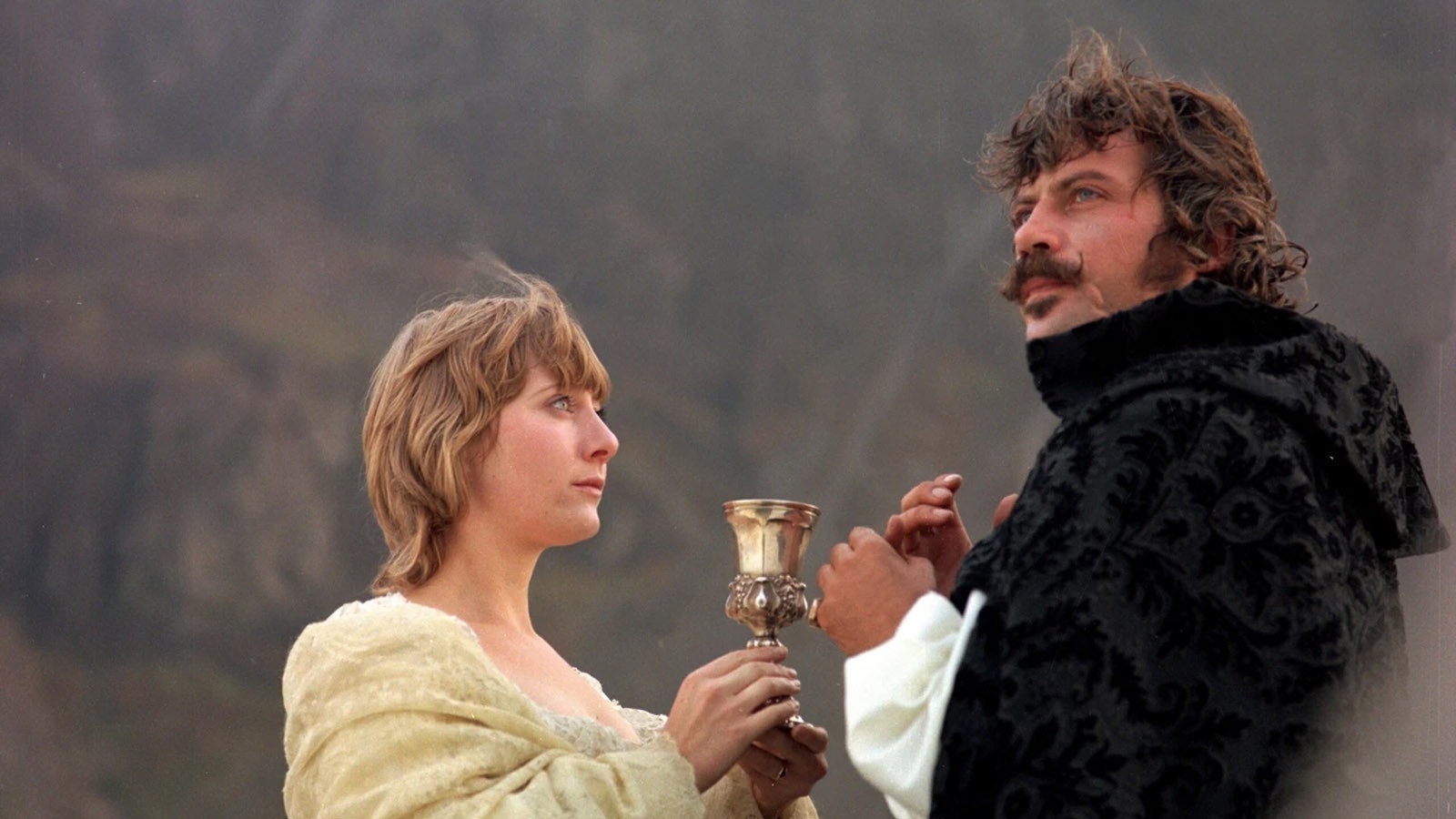
The Cannes Classics program of new restorations and documentaries on cinema is usually the quietest sideshow at the festival, but as both Tim Grierson and Variety’s Guy Lodge note, the hot ticket this year was the one-time-only premiere screening of Ken Russell’s newly restored, director-approved cut of The Devils (1971). As Deadline’s Zac Ntim reports, Cannes artistic director Thierry Frémaux noted that Peter Jackson was just one of many high-profile filmmakers who had reached out to him for a ticket to the sold-out event.
Russell’s sensationally over-the-top account of the downfall of seventeenth-century French Catholic priest Urbain Grandier (Oliver Reed)—brought about in part by accusations of witchcraft lobbed at him by the sexually repressed Sister Jeanne des Anges (Vanessa Redgrave)—was condemned by the Vatican at the get-go. Screenings at the Venice Film Festival, where Russell won the award for Best Director, had to be limited to the press.
Notorious scenes such as the “Rape of Christ,” featuring a seething swarm of naked nuns, were cut by Warner Bros. even before the studio submitted the film to the British Board of Film Classification, and various truncated versions of The Devils have been floating around ever since. In some sort of stroke of poetic justice, it’s the newly founded distributor Warner Bros. Clockwork that has picked up the new restoration, and following a screening at Il Cinema Ritrovato in Bologna next month, Clockwork will launch a North American theatrical run on October 16.
The restoration is “a stunner, in particular sharpening the film’s stylized black-and-white-and-blood-and-mud color palette to glistening effect,” writes Guy Lodge. “The great joy of The Devils remains how ripe and camp and sensual and funny it is, qualities indulged at full tilt by Russell (not a director who even knew the meaning of ‘half’) in all aspects from performance to production design to orgy choreography.”
More Restorations
Cannes Classics opened with a new restoration of Pan’s Labyrinth, which premiered twenty years ago in competition and still holds the festival’s record for the longest standing ovation—twenty-three minutes. The Hollywood Reporter’s Scott Roxborough talks with Guillermo del Toro about the long, hard road to the film’s completion and his current, monthslong effort to realize a 3D version. As for that triumphant night in 2006, del Toro, speaking to this year’s audience, said that “in spite of my great body, I’m not used to adulation, and it’s very hard for me to take in love. But Alfonso Cuarón was there with me, and he said, ‘Let it in. Let the love get in.’”
At the end of the seventh episode of the Film Comment Podcast recorded in Cannes, Devika Girish heartily recommends John Abraham’s Amma ariyan (Report to Mother, 1985), the story of Purushan (Joy Mathew), who sets out for Delhi and spots the police carrying away the dead body of an unidentified man. When Purushan discovers the man was Hari, a tabla player, he decides to inform Hari’s mother of her son’s death. All along his journey, Purushan is joined by Hari’s friends as they walk through the southern state of Kerala and bear witness to the political unrest of the 1970s.
Variety’s Naman Ramachandran talks with Film Heritage Foundation director Shivendra Singh Dungarpur about the challenges of tracking down prints of Amma ariyan and securing the rights to restore the film from the Odessa Collective that Abraham had founded in 1984. Surviving members had scattered. The budget had been raised by touring villages and putting on shows, and the idea was to skip a formal release of Amma ariyan and instead take it on a traveling road show. Ramachandran notes that writer K. M. Seethi has described Abraham as belonging to “a rare breed for whom cinema was not just an art, but a public act of resistance, thought, and love.”
Cannes artistic director Thierry Frémaux has put in time as a judo instructor, and the black belt champion has even written a book about the sport, Judoka. Frémaux tells the festival’s Charlotte Pavard that Akira Kurosawa’s first feature, Sanshiro Sugata (1943), based on Tsuneo Tomita’s novel about the rivalry between judo and jujitsu, has always had a special place in his heart—which is why he teamed up with Cannes Classics head Gérald Duchaussoy to get the film restored. “The studio, Toho, said the film wasn’t Japanese enough and it was too American,” notes Frémaux. “This criticism would follow Kurosawa his whole life. Ozu came to his defense, though, saying, ‘This film tells the story of our country.’”
Star power was a little lacking on the red carpet this year, but Cannes Classics brought at least a bit with the late addition of a restored print of Rob Cohen’s The Fast and the Furious to its lineup. The twenty-fifth-anniversary screening was attended by Vin Diesel, Michelle Rodriguez, and Jordana Brewster, and as Keva York reports for Filmmaker, Diesel unabashedly basked in the limelight and was moved to tears when he spoke to “the 2300-odd revved-up attendees.” The film itself “exuded a highly calibrated, hypnotic quality,” writes York, “a kind of Michael Mann for meatheads (complimentary).”
“I’m old enough to remember when The Fast and the Furious was merely marvelous summer trash, a tacky racing flick crammed with techno beats, booty shots, and clumsy dialogue about tuna sandwiches,” writes Amy Nicholson in the Los Angeles Times. “Yet, from the literal heights of the Grand Palais’s top balcony, it did feel like a classic—a throwback to an era when movie theaters were full of mid-budget crowd-pleasers shot on location in Los Angeles.”
New Documentaries
For all its heart-wrenching drama, another new restoration in the program, Vittorio De Sica’s Two Women (1960), is probably remembered first and foremost for Sophia Loren becoming the first actor to win an Oscar for a non-English-language performance. And this was after she won the award for Best Actress in Cannes for her turn as a widow who leaves Rome with her daughter (Eleonora Brown) during the Second World War.
In Francesco Zippel’s Vittorio De Sica: Staging Life, we hear from Brown how Loren took her under her motherly wing during the production, which comes as a welcome balm after learning about the trick De Sica pulled on Brown to get her to cry during a crucial scene. It comes as quite a surprise to learn what the man was capable of after having spent a good hour by that point watching him practically radiate genuinely human warmth and compassion.
De Sica lived enormously, both in his professional career and his private lives—plural, because he had two. In 1937, having established himself as an up-and-coming performer on stage and screen, he married Giuditta Rissone, an actor better known at the time than he was. Their daughter, Emilia, was born a year later, and in 1942, De Sica met and struck up a relationship with Spanish actor María Mercader. They would have two sons, Manuel and Christian.
Zippel’s animated interludes come off at first as superfluous frills, but it turns out that they serve his narrative well when it comes to illustrating, for example, the way De Sica would set the clock back in one household so that he could celebrate New Year’s Eve at the other and return in time to the first one. Every family member interviewed in Staging Life beams with memories of De Sica’s love and attention, and when each family finally learns of the existence of the other, every member seems to recall celebrating their own family suddenly doubling in size.
Isabella Rossellini recalls playing with the De Sica kids while their fathers talked shop, and the filmmakers brought in to discuss the impact of such films as Bicycle Thieves (1948) and Umberto D. (1952) become far more than just a parade of famous faces. Wes Anderson realizes that his nine-year-old daughter is so shaken by Shoeshine (1946) because she’s fallen into this world De Sica has conjured, and these boys have become her friends. Asghar Farhadi incisively draws lines between De Sica’s neorealist period and the Iranian films that would follow. And Jean-Pierre and Luc Dardenne are engaging and at times borderline hilarious as they ping-pong favorite scenes from the De Sica oeuvre.
There are snippets from archival interviews but no direct interviewees in Nostalgia for the Future, Brecht Debackere’s exploration of the 550 neatly ordered and numbered boxes of clippings, notes, photos, books, films, objects brought back to Paris from the farthest reaches of the globe, VHS tapes, CD-ROMs, and other assorted paraphernalia left behind by Chris Marker and now stored at the Cinémathèque française. Charlotte Rampling’s narration is a seventy-five-minute letter to Marker from Debackere, who has taken an eight-year deep dive into the archive and reemerged with a personal essay that moves not chronologically but from idea to idea, reflecting on a life lived in secret but also somehow on the page, on the screen, and online.
Barnaby Thompson’s “thoroughly exhilarating and enjoyable” Maverick: The Epic Adventures of David Lean “shows a deeply driven man, propelled by his vocational dedication to the cinema as well as by his own romantic and sexual restlessness,” writes the Guardian’s Peter Bradshaw. “Yes, he was a classicist,” writes Variety’s Owen Gleiberman, but “Lean was also a radical filmmaker, perhaps the key inventor (along with Hitchcock) of modern Hollywood cinema . . . I realized, watching clips of the two Dickens films Lean directed during the ’40s (Great Expectations and Oliver Twist), that the reason I’d never fully appreciated how original and movie-forward they were is that their influence had been so thoroughly absorbed into the language of cinema.”
The subject of Mike Mendez’s Dernsie: The Amazing Life of Bruce Dern will turn ninety on June 4. Dern is “a terrific storyteller, as blunt as you might expect but wittier and warmer,” writes Caryn James in the Hollywood Reporter. “In the way of such documentaries, the film’s tone is adoring, but Dern’s no-nonsense attitude cuts through most of the treacle.” And Dern has more stories to tell on the Doc Talk podcast cohosted by writer and director John Ridley and Deadline’s Matthew Carey and in Nicolas Rapold’s interview for Sight and Sound.
“The reason I made the documentary is I’m interested in people knowing that if you stay long enough, you’ll find people that give a shit,” Dern tells Rapold. “I’ve been doing this a long fucking time. And I know what it’s like to not be found until you’ve been in the business for years. And it’s all because I played little tiny roles. But when you look at the roles I played, I made a difference in every movie.”
Don’t miss out on your Daily briefing! Subscribe to the RSS feed.