António Reis & Margarida Cordeiro, Restored
Share
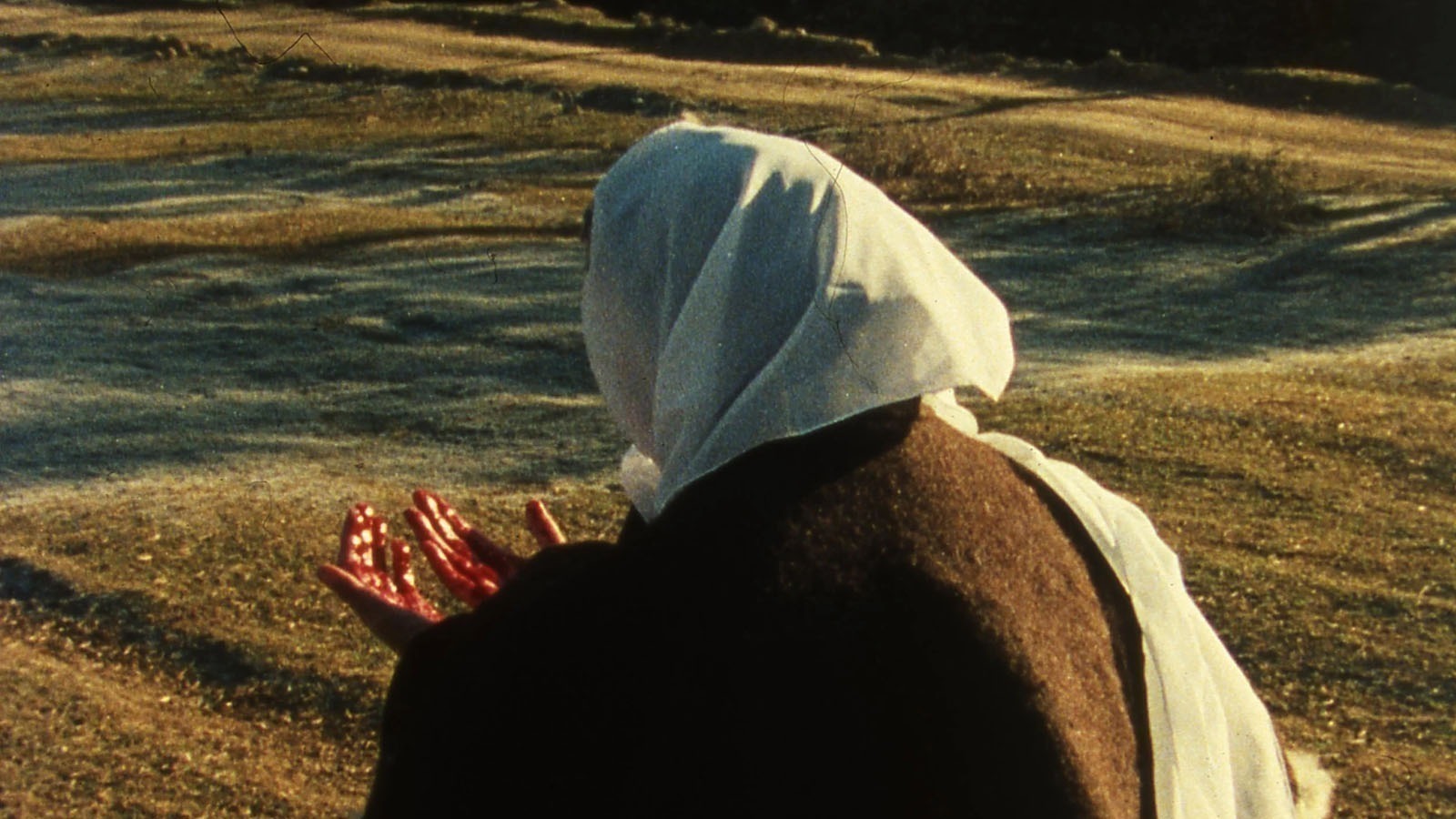
In her program notes for António Reis & Margarida Cordeiro, Restored, the TIFF Cinematheque series opening today and running through May 17, Andréa Picard writes that while their work may not be as well known as Manoel de Oliveira’s, “Reis and Cordeiro’s imprint upon successive generations of Portuguese filmmakers is arguably just as influential, with a mere four films made together. So many of the hallmarks of contemporary Portuguese cinema—whether its focus on its agrarian history, national myths, temporal palimpsests, or visionary style—can be traced back to Reis and Cordeiro’s loose trilogy shot in the remote northeastern Trás-os-Montes region of Portugal, where they elaborated a new cinematographic language.”
Toronto’s presentation of the restorations carried out by the Cinemateca Portuguesa launches Cinema Guild’s rollout of the retrospective across North America throughout the coming months. On Saturday, critic Saffron Maeve will introduce TIFF’s screening of Oliveira’s Rite of Spring (1963), which is essentially a restaging of a reenactment. Oliveira had been working on a documentary when he came across a performance of the passion play depicting the crucifixion of Christ that the residents of the Portuguese village of Curalha put on each year. Oliveira later returned to Curalha with assistant directors Reis and Paulo Rocha to have the villagers, playing themselves, dramatize the production.
Rocha’s first feature, The Green Years, was also completed in 1963, and he asked Reis to collaborate with him on the screenplay for his follow-up, Change of Life (1966), which screens on Sunday. By this point, Reis was a poet of considerable renown, and as Cordeiro recalled in a 1997 interview, when she met Reis in the mid-1960s, he “had already written the so-called neorealist Poemas quotidianos [Daily Poems, 1957], about workers, dockers, rural women, and housewives.” In Change of Life, a soldier returns to the fishing village where he grew up, and as Ela Bittencourt writes for Notebook, the characters’ lines, written by Reis, “have a fiery back-and-forth energy to them, often leaping over the music.”
Cordeiro, a psychiatrist, was working in a sanatorium in Lisbon when she came across a drawing that would lead to the first film she would make with Reis. It should be emphasized that, as Cordeiro noted in that 1997 interview, “We were both, each of us, responsible for one hundred percent of each film.” The exception is Jaime (1974), a half-hour study of the art left behind by a patient, Jaime Fernandes. Cordeiro requested that she not be given a codirecting credit because, even though she instigated the project and contributed to its production, she was still learning from Reis, who had already made a few short documentaries. Pedro Costa has called Jaime “a surprising and quite surrealist film that stands apart from his usual work. A beautiful artist’s portrait conceived in a very modern manner, like a collage.”
From 1977 until his death in 1991, Reis taught at the Escola Superior de Teatro e Cinema in Lisbon, and Costa—whose Ossos (1997) will screen in Toronto on May 15 and 17—was one of his first students. “He was somewhere between a peasant and a guy in a rock band,” Costa tells Edward McCarry in a terrific interview for Metrograph’s Journal. “He was not the usual teacher that I knew from my studies.” Trás-os-Montes (1976), the first of three features credited to both Reis and Cordeiro, “was the first Portuguese film that gave me some clues,” says Costa. “Before then, I couldn’t figure out how to make films and shoot personal things, but Trás-os-Montes opened a lot of doors and windows, in every sense.”
When McCarry and Graham Carter presented Trás-os-Montes at Metrograph, they called the film “an intensive labor of recollection, an epic of a land and a way of life on the edge of oblivion. In 1974, while traveling through villages in this isolated region, Reis and Cordeiro recruited a cast of inhabitants old and young to materialize their histories, legends, dreams, and nightmares for the camera. The rebelliousness of the peasants, their everyday existence far from the laws of church and state, their closeness to ancient things, to trees and rocks—these encounters informed the dialectical approach of the film, where fiction and reality, past and future swell in an immediate present.”
“As a poet,” writes Jonathan Mackris for Screen Slate, “Reis spent the ’50s traveling through Portugal, refining the style of his writing to match the terse regional dialects of those he lived with. This same method informed [Reis and Cordeiro’s] filmmaking, highly collaborative and completed across several years, working in off-hours and out of season. ‘We never filmed anyone without becoming their comrade or friend first,’ they told Cahiers du cinéma when asked about their approach in Trás-os-Montes.”
Reis and Cordeiro returned to the region to shoot Ana (1982), which centers on a serene matriarch played by Cordeiro’s mother, Ana Maria Martins Guerra. “Ripe with floating symbols of the ancient and modern world,” wrote Haden Guest when the Harvard Film Archive presented the series The School of Reis in 2012, “Ana is a meditation on history and human civilization and the infinitesimally small but profound role of the individual within the larger movement of longue durée. The film’s minimal and Rilke-inspired dialogue reveals Reis and Cordeiro’s interest in a deeper, nonverbal mode of communication, not only between generations but also between the land and those passing through it.”
Rosa de Areia (1989), Reis and Cordeiro’s final feature, is also their most abstractly essayistic, drawing on texts from a diverse array of writers including Franz Kafka, Michel de Montaigne, and Carl Sagan. The Theater of the Matters is running a never-before-published conversation about the film with its makers conducted by João Pedro Rodrigues and Amândio Coroado in 1989. “The film’s construction is above all elliptical,” said Reis. “There are scenes which, paradoxically, are constructed from autonomous shots. For anyone with a traditional concept of scenes as spatial, thematic units, etc., this will raise many problems of analysis.”
“People are unaccustomed to cinema that requires a bit more effort to watch,” added Cordeiro. “Either they’re used to music videos—what I call the ‘universal sauce’ system—or to the traditional narrative thread where they can easily project themselves onto one of the characters. It’s a psychological law; even we function that way.” Reis: “People have almost no senses left; they mainly have a taste for food, and even that has gone bad . . .” Cordeiro: “I’m an optimist, António is a pessimist. People are intact; they just don’t know how to use the potential they have within them.”
“The mystery when it comes to Reis and Cordeiro,” wrote Dennis Lim in an outstanding piece for Artforum in 2012, “is how works of such apparent austerity can achieve such complex effects—[Jean] Rouch even credited them with inventing ‘a new cinematographic language.’ No less than with Robert Bresson or Straub-Huillet, filmmakers who prompt similar questions, the guiding principle is distillation as revelation, an insistence on finding what Cordeiro, in an interview with Cahiers du cinéma, termed ‘literal images, images of an immediate and adequate vision.’”
Don’t miss out on your Daily briefing! Subscribe to the RSS feed.