First Look, Second Weekend
Share
April has somehow become the month for New York programmers to survey some of the most innovative films to have premiered over the past twelve months or so, many of them pretty exciting, nearly all of them at least interesting. Along with New Directors/New Films, copresented by Film at Lincoln Center and the Museum of Modern Art for more than half a century, there’s the upstart Prismatic Ground popping up at various venues across the city. And for the past fifteen years, the Museum of the Moving Image—which, as Melena Ryzik reports in the New York Times, is thriving—has presented its showcase of “adventurous cinema,” First Look.
Following a robustly programmed first weekend, the festival returns today for its second with zi, the latest feature from Kogonada (Columbus, After Yang). “Shot in just three weeks in Hong Kong, taking an off-the-cuff approach in line with the unmoored wanderings of its characters, this translucent study of a mentally addled young woman finding an unlikely ally in an American outsider begins promisingly, mixing everyday city portraiture with glitchy flashes of uncanny psychodrama,” writes Variety’s Guy Lodge.
Zi (Michelle Mao) is a concert violinist thrown off balance by time-scrambled visions when she’s approached by Elle (Haley Lu Richardson), who may or may not be a stranger just looking to help. And from a distance, Min (Jin Ha) is watching both women. “If its larger message is elusive, zi advocates for taking the world in at your own sensory pace,” writes Lodge. Dispatching from Sundance, Vulture’s Bilge Ebiri wrote that “even as I find myself scoffing at its inadequacies, at its sketchy insubstantiality, I can’t quite shake the memory of this delicate, disarming film. Kogonada wins.”
Tomorrow evening, First Look will present the world premiere of The Whole World Is a Lie, actor Charlie Birns’s attempt to capture the “spiritual experience” of a New York Method acting class. But his classmates object to the way he’s going about making this film, leading to what MoMI describes as “a tricky yet emotionally resonant, and often very funny, exploration of the difficulty of capturing the ‘truth’ within an environment of shifting power dynamics and foregrounded ego.”
Kenichi Ugana’s I Fell in Love with a Z-Grade Director in Brooklyn—a love story about a down-and-out Japanese movie star and the scrappy filmmaker who literally picks her up off the sidewalk and casts her in the lead role of his no-budget horror movie—will see its U.S. premiere tomorrow. I Fell in Love is “a charming culture-clash romcom with the added complication of the two leads being completely unable to understand one another when not using a phone to translate,” writes Jennie Kermode at Eye for Film. It’s a “classy film about a trashy film which shows respect for both extremes.”
Saturday
In 1883, the volcanic island of Krakatoa had been erupting for months when, on August 27, one of its explosions produced what remains the loudest known sound in history and a tsunami that hurls Kesuma, a fisherman played by Roni Hensilayah in Carlos Casas’s Krakatoa, onto a deserted island. His search for food and water leads him ever closer to the core of our planet. “Enmeshed in anachronism yet awash with the signifiers of a history yet to be tainted by the specter of environmental collapse,” writes Morris Yang at In Review Online, Krakatoa “mounts a brazen final act, disintegrating into the purest flickers of being and nothingness. With Nicolas Becker’s spectacular sound design approximating the very ineffability of destruction, so, too, do we prostrate before the blind embers of creation.”
Rachael J. Morrison’s documentary Joybubbles tells the story of Joe Engressia, one of the original phone phreaks who learned at an early age that by whistling, he could free up long-distance phone lines. Born blind and highly intelligent, Engressia consciously reverted back to the age of five in his thirties, legally changed his name to Joybubbles, and kept up with a vast network of friends around the world—over the phone. “Morrison is too smart to label Joybubbles as the forerunner to the titans of social media,” writes Amy Taubin for Film Comment, “although she includes a priceless clip of the young Steve Jobs and Steve Wozniak (themselves inspired by Engressia) toying with the famously illegal ‘blue box,’ which hijacked long-distance phone networks by mimicking their signal tones. Joybubbles has the making of a minor cult classic.”
G. Anthony Svatek’s Humboldt USA is “a beautifully framed and expertly composed environmental documentary with a head-spinning premise,” writes Lauren Wissot at Slant. Inspired by Alexander von Humboldt, Svatek travels to three locations bearing the name of the nineteenth-century German scientist: Humboldt County in Nevada, where biologists attempt to save endangered bighorn sheep; Humboldt Redwoods State Park in California, where engineers create “organic algorithms”; and Humboldt Parkway, a tree-lined boulevard replaced by the Kensington Expressway that now divides Buffalo, New York. “While these three narratives might at first glance seem disparate,” writes Wissot, “they’re delicately bound together by the director’s own poetic voiceover, which connects us back to Humboldt’s point of view as a radical (and queer) visionary.”
Yanis Koussim tells two parallel stories in his debut feature, Roqia, a horror movie set against the backdrop of Algeria’s “Black Decade” (1992–2002), when the government strove to drive out Islamist rebels. “Islamic terrorism is not Islam,” Koussim tells Tariq Manshi in GQ Middle East. “Islam does not tell you to put babies in the oven, slaughter people, and rape pregnant women.” Manshi notes that Koussim references what he’s learned from Jean-Jacques Rousseau, that “man is fundamentally born good and therefore evil comes from elsewhere. This is the philosophical critique that shapes Roqia.”
Saturday wraps with a showcase screening of Ildikó Enyedi’s Silent Friend, “a contemplative reverie about people, plants, the world, and their interconnections, anchored around an ancient ginkgo tree standing in the middle of a German botanical garden,” as Jonathan Romney describes Enyedi’s eighth feature in Screen. Silent Friend interweaves three stories, one set during the COVID-19 pandemic and starring Tony Leung as a Hong Kong neuroscientist and Léa Seydoux as a French botanist. Luna Wedler won the Marcello Mastroianni Award for Best Young Actor or Actress in Venice for her performance as Grete, the first female student admitted to the University of Marburg in 1908, and the third strand features Enzo Brumm and Marlene Burow as students in the 1970s.
Sunday
In one long take shot from the back seat of a car, director Hansel Porras Garcia shoots a delicate and then heated conversation between a brother and sister, Frank (Ariel Texidó) and Fanny (Lola Bosch), reunited after twenty years now that Fanny has immigrated from Cuba to live with her brother and his family in Miami. At RogerEbert.com, Monica Castillo finds that Tropical Park “paints a nuanced portrait of the Cuban and Cuban American experience, exploring the tension between generations of arrivals and the ideological differences within a community too easily lumped into a monolith. It can feel claustrophobic to watch such an explosion of pent-up emotions in a small sedan, possibly uncorking some of the audience’s own unspoken feelings. But that’s exactly what makes Tropical Park so incredibly compelling.”
Gábor Holtai’s Feels Like Home won the Méliès d’Argent Award for the Best Fantastic Genre Feature Film at Sitges last fall. Rita (Rozi Lovas) has been working at a shoe store when she’s yanked off the street, whisked off to a nearby apartment, and told that her real name is Szilvi Árpád. “She quickly discovers that the other ‘family members’—including one child—are all kidnapped loners, physically and emotionally forced to play a role at the behest of Papa (Tibor Szervét), with his dirty work carried out by Rita’s new brother Marci (Áron Molnár),” writes Olivia Popp at Cineuropa. Working with cinematographer Dániel Szőke, Holtai “cultivates a feeling of complete and utter confinement within Rita’s surroundings.” As Rita learns how and when to play along, all the while secretly planning her escape, she discovers that the terror extends beyond the family.
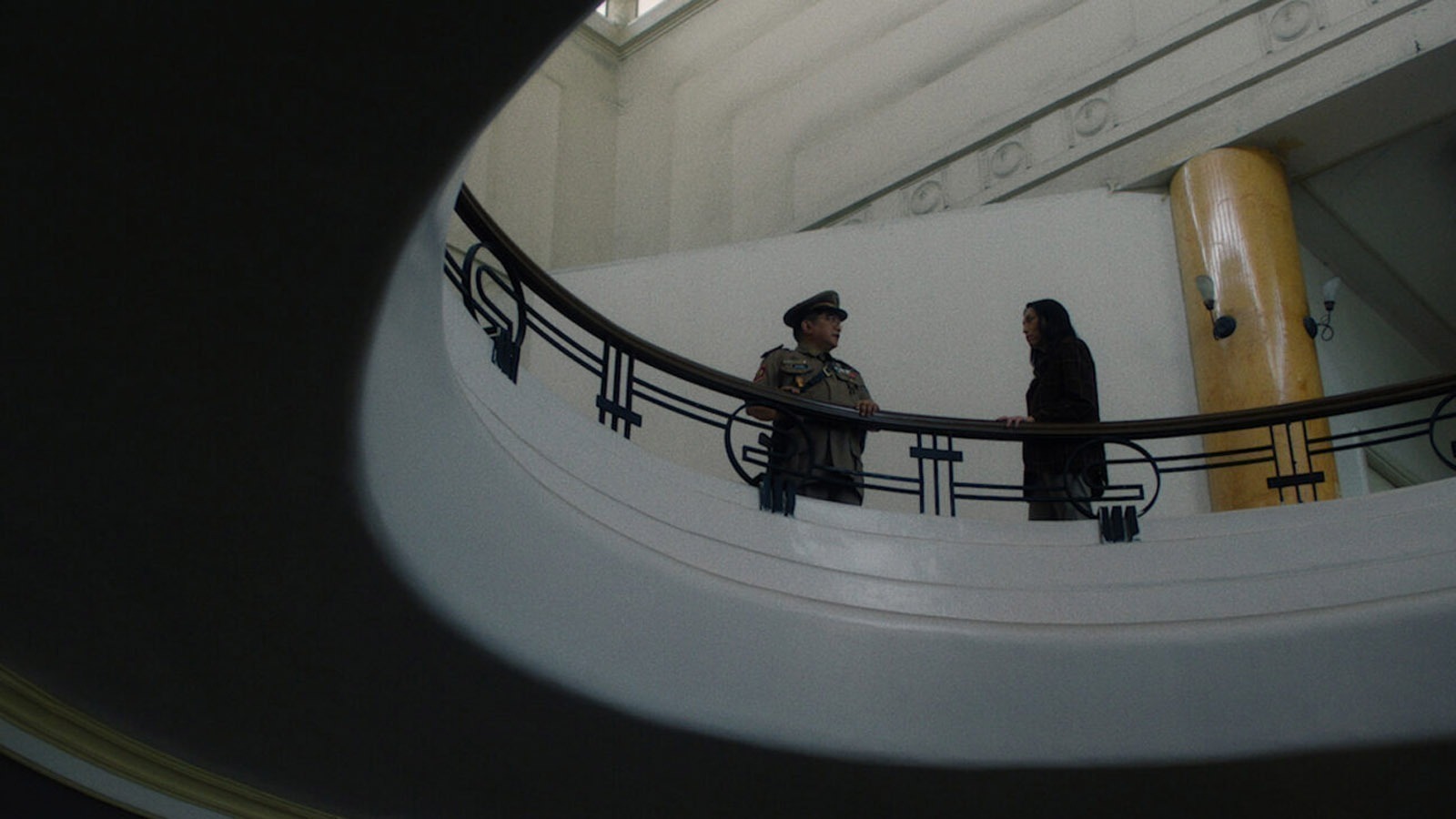
Before Sunday evening’s presentation Moonglow, the Closing Night film of First Look 2026, director Isabel Sandoval (Lingua Franca), cinematographer Isaac Banks, coeditor Daniel Garber, composer Keegan DeWitt, and producer Alemberg Ang will discuss the making of Sandoval’s fourth feature. Set in 1970s Manila, a city rife with the corruption of the Ferdinand Marcos years, Moonglow stars Sandoval as Dahlia, a police officer who funnels money stolen from her superiors to the displaced residents of a slum her colleagues have cruelly set ablaze. Police chief Bernal (Dennis Marasigan) insists that Dahlia investigate the crime she’s secretly committed and partners her with an old flame, Charlie (Arjo Atayde, a star on Filipino television and a Nacionalista Party congressman).
Talking to Jason Tan Liwag in Vogue, Sandoval describes Moonglow as “a detective thriller and crime noir by way of In the Mood for Love. My emergent sensibility is the marriage of themes with political underpinnings with a style that is lyrical, poetic, visually lush, and sensuous.” For Lé Baltar at In Review Online, Moonglow is “a subtle demolition of the heist movie in the vein of Kelly Reichardt’s The Mastermind, or, on a more niche level, a cinema of cigarettes after crime, dangling its title card late in the movie in the sexiest way possible, a stylistic flourish that might as well be a willing accomplice.”
Don’t miss out on your Daily briefing! Subscribe to the RSS feed.