Prismatic Ground, Year Six
Share

When Inney Prakash, now the Curator of Film at Asia Society in New York, issued an open call for experimental documentaries at the end of 2020, “a programmer directly engaging with his community of filmmakers with an open-hearted all-points-bulletin was the antithesis of conventional festival gatekeeping,” wrote Caroline Golum for Notebook. By April 2021, the first edition of Prismatic Ground was up and running, albeit as a primarily virtual festival. At the time, the COVID-19 pandemic was still very much a thing.
Copresented with Screen Slate and no longer strictly confined to nonfiction, the sixth edition will roll out from Wednesday through Sunday in five “waves” across five New York venues. On opening night, Ka Ki Wong will be at the Brooklyn Academy of Music to present her debut feature, I Heard That They Are Not Going to See Each Other Anymore. Stories of requited and unrequited love are intertwined in the labyrinthine streets of Taipei, and when I Heard premiered at CPH:DOX in March, Wendy Ide, writing for Screen, called it an “uninhibited and wildly original picture which deals with pain, guilt, loneliness, and romantic disappointment in the most joyful and playful way imaginable.”
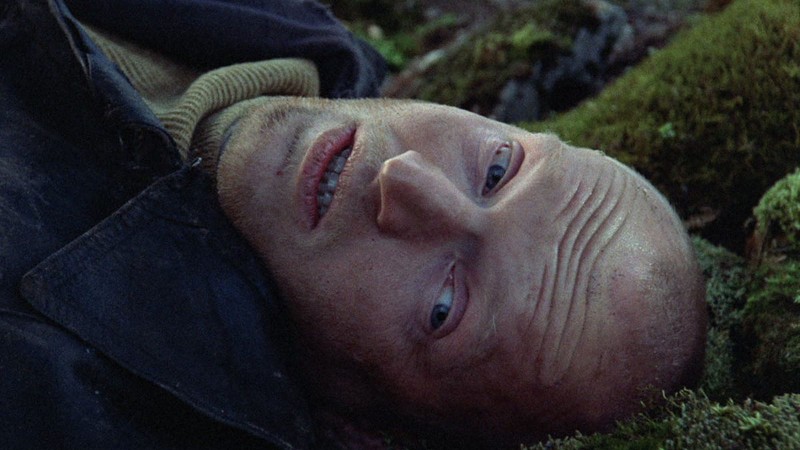
Among the highlights of wave 1 are Nicolás Pereda’s Cobre and Kevin B. Lee’s Afterlives. “A wry thriller of bureaucracy that started after Pereda learned about the suspicious death of an activist protesting labor conditions in a mining town, Cobre begins as Lázaro (Pereda regular Lázaro Gabino Rodríguez) finds a dead body on his way to work at the mines,” writes Cici Peng for Filmmaker. “As always, Pereda turns seemingly banal interactions into sly displays of power.”
Afterlives carries forward Lee’s exploration of the potential for the desktop documentary, which he calls “an emerging form of film and media making that presents the world as it is experienced through computer screens and networked interfaces.” With this one, he delves into the history of extremist propaganda and probes its possible futures, most of them likely involving a heavy reliance on AI.
“Afterlives insists on its own ambiguous relationship to visuals,” writes Savina Petkova at the Film Stage. “Perhaps this is why you will see Lee ‘leaving’ the desktop space and actually appearing in the flesh as a sort of exposure out of respectful necessity. Whatever cinematic form it inhabits, Afterlives is a dedicated, reflective documentary, the bell of its urgency ringing far into the past and into the futures of images.”
Screening as part of wave 2, Dane Komljen’s Desire Lines is “a spectral and hallucinatory landscape of bodies, which eat and gaze and desire but are also found to be frighteningly, or freeingly, insubstantial by those who inhabit them, as they shape-shift, merge, or even melt through walls,” writes Carmen Gray at the Film Verdict. Komljen’s film is “a poetic, unrushed but endlessly surprising vision, which operates according to a certain dream logic of echoing images rather than a traditional plot. Nonetheless, it has an unforced, intuitive coherence and affinity with nature (in keeping with his previous features including 2022’s Afterwater and 2024’s The Garden Cadences) that mesmerizes.”
In Isabelle Kalandar’s Another Birth, eight-year-old Parastu (Shukrona Navruzbekova) is encouraged by her mother (Kalandar) to memorize poems by Forugh Farrokhzad (The House Is Black), whose lines are recited both on-screen and off. “Saddened by her mother’s pain and the constant craving of her grandfather (Niezmamad Navruzbekov) for a missing son,” writes Clarence Tsui at the Film Verdict, “Parastu roams the land and sets off with her best friend Guliston (Shoira Abdulgaezkhonova) to look for a mythical spirit that could rejuvenate her loved ones. Through their small expeditions, the world opens up for them and for the viewers: Janis Brod’s camerawork (with additional input from Vladimir Usoltsev) presents Tajikistan’s Shakhdara Valley in the most lyrical of ways.”
On Saturday at Anthology Film Archives, the festival will celebrate the publication of June Givanni: The Making of a Pan-African Cinema Archive with author Onyeka Igwe and then throw a spotlight on the work of Kohei Ando—a pioneer of video art and experimental media and this year’s recipient of the Ground Glass Award—with the first retrospective of his work in the U.S. Ando’s 1974 short My Friends in My Address Book will screen on Sunday, preceding Every Contact Leaves a Trace, the latest feature from filmmaker and poet Lynne Sachs. In 2021, Sachs received the first Ground Glass Award, and this year, on Wednesday, she will be honored at the San Francisco Film Festival with the Persistence of Vision Award.
The title of Every Contact Leaves a Trace refers to a principle of forensic science that Sachs reinterprets as the marks the many strangers she has befriended or forgotten have left on her life. The starting point is a stack of around six hundred business cards she’s collected over the years.
As Sachs sifts through them, “narrating associations or confronting blank spots in her recollection, the cards’ standardized form gives way to the unruliness of relation,” writes Delaney Holton for Screen Slate. “Sachs layers a restless flow of images, animations, and superimpositions over a diaristic voiceover, while frequent collaborator Stephen Vitiello’s omnipresent score hums beneath. She stages new encounters with select figures represented in her collection: a textile artist, a therapist, a refugee and mother who once cooked for her. Conversations always seem to turn toward days gone by, though the governing insight is less about recovering evidence of what ‘really’ happened than observing how the past is continually remediated through its recounting and the subtle gravity people exert upon one another’s lives across space and time.”
A 35 mm print of Andrew Bujalski’s Computer Chess (2013), shot on analog video with three Sony AVC 3260s, will screen with Blair Barnes’s sitrep (2026), a twenty-minute short which “uses the 3250 as its foremost camera, with the Sony FX6 as the digital intermediary,” as Barnes explains. “The common denominator is the two-thirds-inch tube.”
Further Prismatic Ground 2026 highlights include several short film programs; three newly restored films by Iraqi Lebanese filmmaker Parine Jaddo; Adam and Zack Khalil’s Aanikoobijigan, the winner of an audience award at Sundance; “Horror, or the Splendour Of,” an evening of film and poetry; Jack Auen and Kevin Walker’s Chronovisor, fresh from its screening in Los Angeles; and a program of contemporary Chinese experimental films.
The festival will wrap at Metrograph on Sunday with Gangsterism, the latest feature from Isiah Medina, who will deliver a lecture, “From ‘Images and Sounds’ to ‘Frames and Cuts,’” on Friday at Light Industry. In Gangsterism, film director Clem (Mark Bacolcol) sends his cinephilic associates looking for the culprit who has been leaking his work.
Writing for In Review Online, Dylan Adamson senses in Gangsterism “a certain family resemblance with the Godard of the 1980s, but a point of origin for the spirit of the work might rather be In Praise of Love (2001), a framed poster for which sits prominently in many of Gangsterism’s sets. With that film’s abrupt cut from celluloid to blown-out miniDV colors for its final thirty minutes, Godard asserted that a new digital cinema had arrived, whether we were ready for it or not. Medina accepts this as a challenge, developing a cinematic idiom that shirks all debts to the dominant twentieth-century modes.”
Don’t miss out on your Daily briefing! Subscribe to the RSS feed.