Rendez-Vous in New York
Share
Writing for the New York Review of Books around a dozen years ago, Claire Messud noted that Albert Camus’s 1942 novella The Stranger “carries, for American readers, enormous significance in our cultural understanding of midcentury French identity. It is considered—to what would have been Camus’s irritation—the exemplary existentialist novel.”
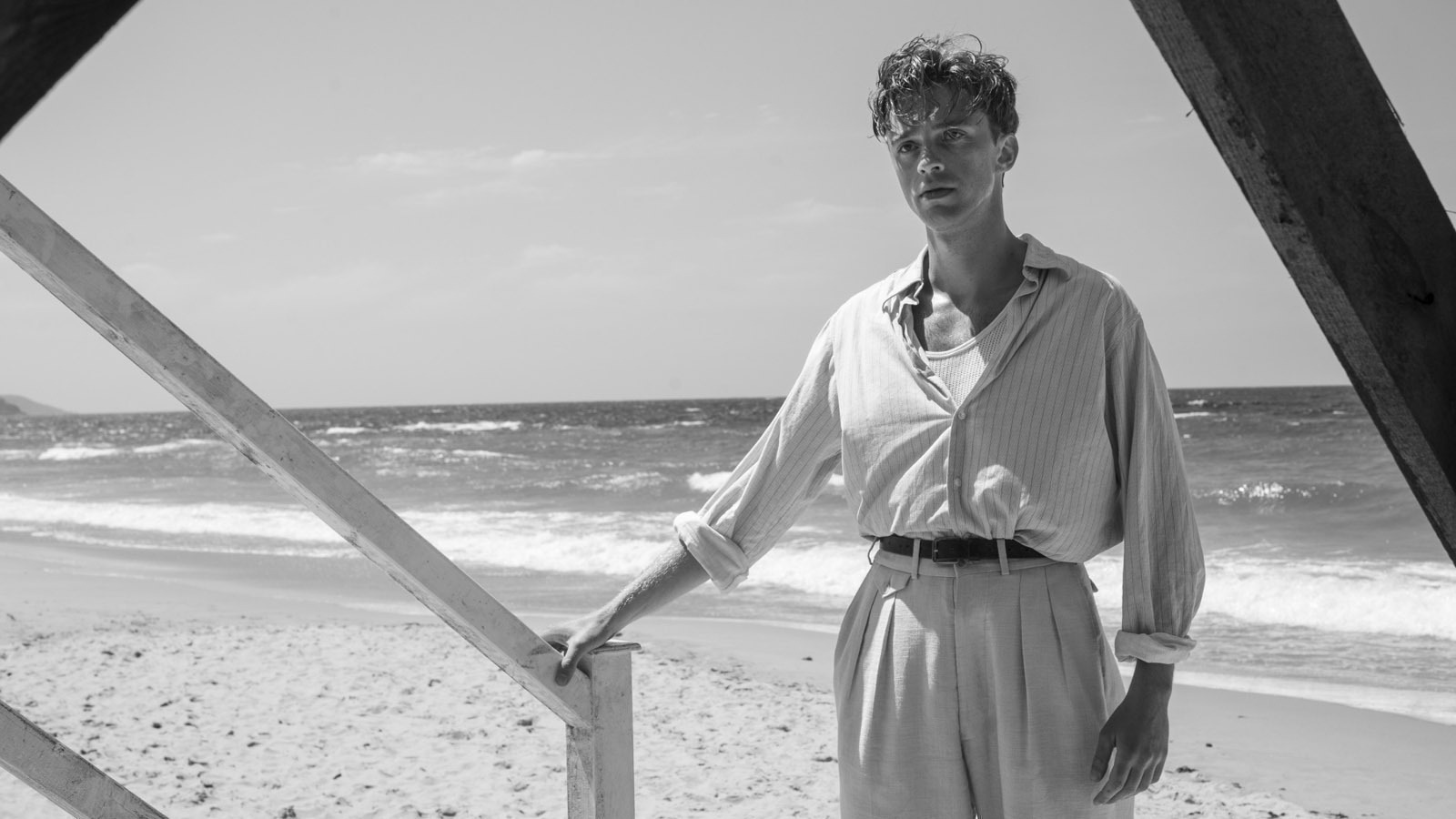
With a disconcerting detachment, Meursault, a settler living in French Algeria, narrates his own simple story. A few days after his mother dies, Meursault shoots and kills a man on a beach. He is tried and found guilty, and the last page finds him awaiting his public execution.
Benjamin Voisin stars as Meursault in François Ozon’s adaptation of The Stranger, and when it premiered in competition in Venice last fall, Jessica Kiang wrote in Variety that “the book’s bracingly straightforward descriptions of often inexplicable behaviors and thought processes become the hard, stark edges of a sculptural black-and-white photography that is all the more mysterious for apparently having nothing to hide.”
Ozon’s twenty-fourth feature will open this year’s Rendez-Vous with French Cinema this evening at Film at Lincoln Center. The series of twenty-two films screening through March 15 will bring several high-profile filmmakers to New York, including Arnaud Desplechin, who will be taking questions about his Two Pianos tomorrow evening. François Civil stars as a pianist returning to Lyon to duet with his mentor (Charlotte Rampling) and bumps into an old flame. Desplechin’s “suave and responsive filmmaking, characterized here by Paul Guilhaume’s light-sensitive and fine-grained cinematography,” writes Mark Asch at Little White Lies, “usually works as a suave smile to belie the bitter ambivalence of his drama, but Two Pianos simply goes down smooth.”
Olivier Assayas, in the meantime, will be at Metrograph, talking with Kent Jones about Demonlover (2002) and introducing a screening of Roberto Rossellini’s The Taking of Power by Louis XIV (1966). He’ll discuss his latest feature, The Wizard of the Kremlin, on Saturday. It “could have been called The Taking of Power by Vladimir Putin, echoing Roberto Rossellini’s masterpiece,” says Assayas. “Even though one is about events relating to a twenty-three-year-old king, living in the seventeenth century, and the other describes the rise of a former KGB agent after the fall of Soviet Russia, it’s one and the same story. How to tame the opposition to absolutism?”
On Sunday, FLC will host Stéphane Demoustier (The Great Arch), Fabienne Godet and Salif Cissé (Guess Who Is Calling?), and Jean-Paul Salomé (The Money Maker). Later that evening, Claire Simon will be at Metrograph to discuss her 2021 feature I Want to Talk about Duras with Kirsten Johnson (Cameraperson, Dick Johnson Is Dead) and then introduce screenings of the late Frederick Wiseman’s Public Housing (1997) and her own 2016 documentary, The Competition. Simon’s new film, Writing Life: Annie Ernaux Through the Eyes of High School Students, will screen on Tuesday, and she will be taking questions.
Fresh from premiering in competition in Berlin, Leyla Bouzid’s In a Whisper stars Eya Bouteraa as Lilia, who returns to Tunisia for her uncle’s funeral. Her family knows nothing of her life back in Paris and certainly nothing about her girlfriend. “Bouzid’s ability to capture the complexities and contradictions of familial affection is what makes In a Whisper so impressive,” finds Diego Semerene at Slant. “She never resorts to villainizing the mouthpieces of homophobia or lets the film tip into the saccharine, and she understands the dysfunction of the family to be structural and its fears to be mechanisms of defense. If the family is everything, then losing it is an unfathomable proposition.” Bouzid will take part in a Q&A on Wednesday.
On Friday, March 13, Dominik Moll will be on hand to talk about Case 137, starring Léa Drucker as the lead investigator into an incident of police abuse during a Yellow Vests protest in Paris in 2018. When Case 137 premiered in competition in Cannes, Notebook’s Daniel Kasman called it “a grounded and quite literally by-the-books policier,” noting that it “follows [Moll’s] excellent, low-key Zodiac-alike, The Night of the Twelfth (2022), both being bullshit-free exemplars of the kind of satisfying procedurals that were common in cinema for decades before finding a larger audience on television.”
A final round of Q&As is slated for Saturday, March 14, with Maxime Matray and Alexia Walther on Affection Affection, starring Agathe Bonitzer; Pascal Bonitzer on the two features he completed last year, Maigret and the Dead Lover, adapted from a 1960 novel by Georges Simenon, and Hugo, written by Bonitzer’s late wife (and Agathe’s mother), Sophie Fillière; and Julia Ducournau on Alpha, starring Mélissa Boros as a teenager being worried over by her mother (Golshifteh Farahani), a doctor overworked at the height of a strange epidemic.
Alpha did not go over well when it premiered last year in competition in Cannes, where her second feature, Titane (2021), won the Palme d’Or. But Alpha did find at least one champion in Elena Lazic, who wrote at the Playlist that the film “freely uses elements of the coming-of-age story, the melodrama, body horror, and fantasy to forge its peculiar throughline—carrying the viewer on a wave of pure feeling and visceral sensation.”
Don’t miss out on your Daily briefing! Subscribe to the RSS feed.