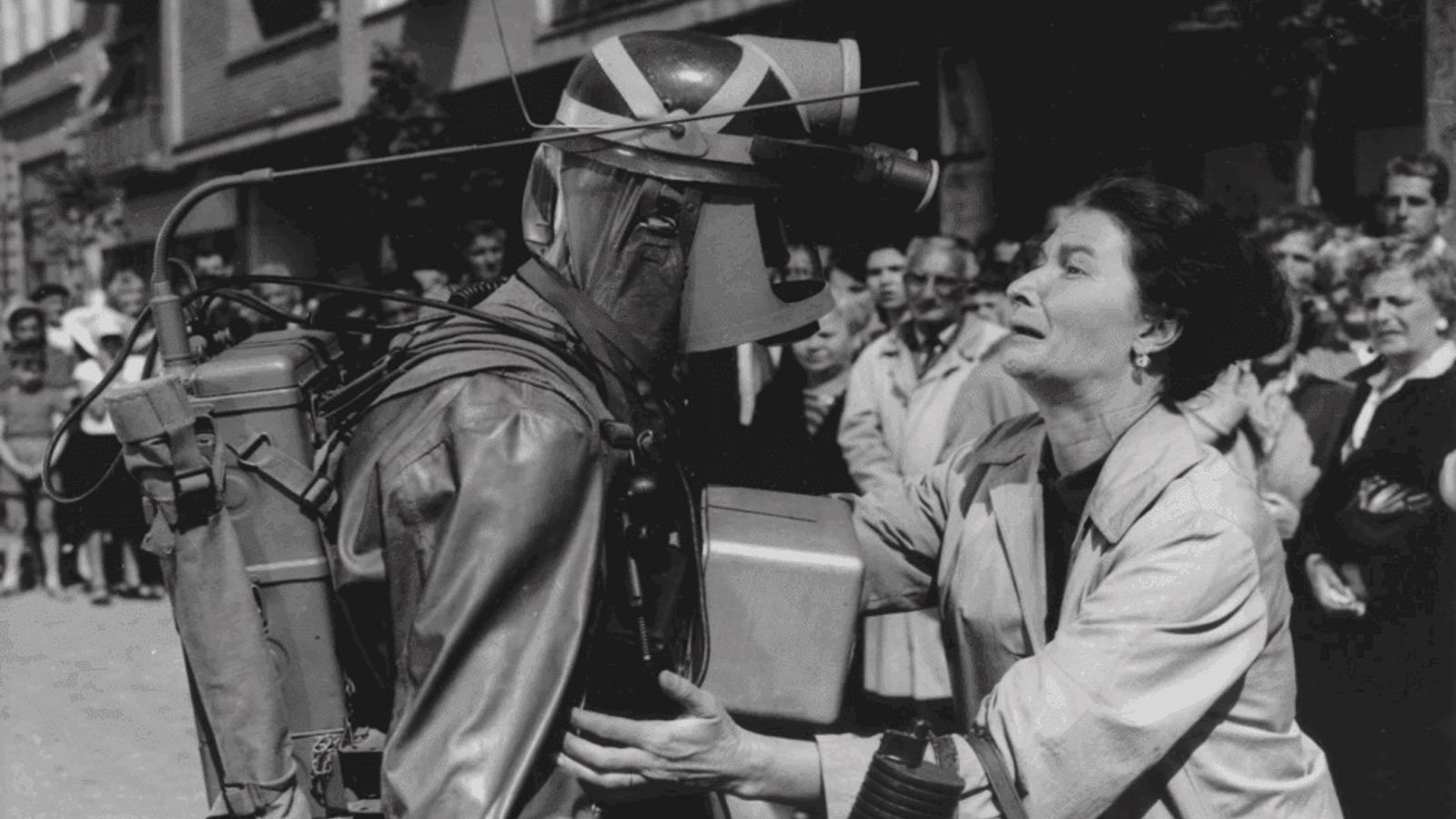
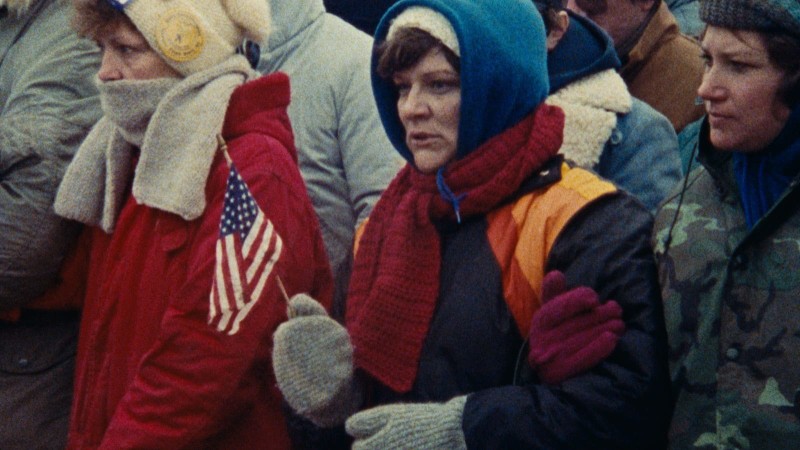
Lynne Littman’s Testament (1983) depicts death’s slow and quiet encroachment on a northern Californian town after a nuclear bomb is detonated sixty miles away. Our recent release has revived some discussion of other postnuclear scenarios: Stanley Kramer’s On the Beach (1959) and Peter Watkins’s The War Game (1966)—and by the way, Devika Girish and J. Hoberman’s conversation about Watkins and his work on the latest Film Comment Podcast is very much a recommended listen—as well as the searingly impactful made-for-television movies The Day After (1983), directed by Nicholas Meyer, and Threads (1984), written by Barry Hines and directed by Mick Jackson. Threads premiered on the BBC on September 23, 1984, a date that has been described as “the night the country didn’t sleep.”
All of these films are drenched in the dread felt throughout the Cold War—but only on one side of the Iron Curtain. A seven-film series opening tomorrow at the Barbican in London and running through April 29, Cold War Visions: Nuclear Anxiety in Eastern Bloc Cinema, will probe the other side. Curator Teodosia Dobriyanova will introduce the opening night presentation, a new restoration of Jindřich Polák’s Ikarie XB-1 (1963).
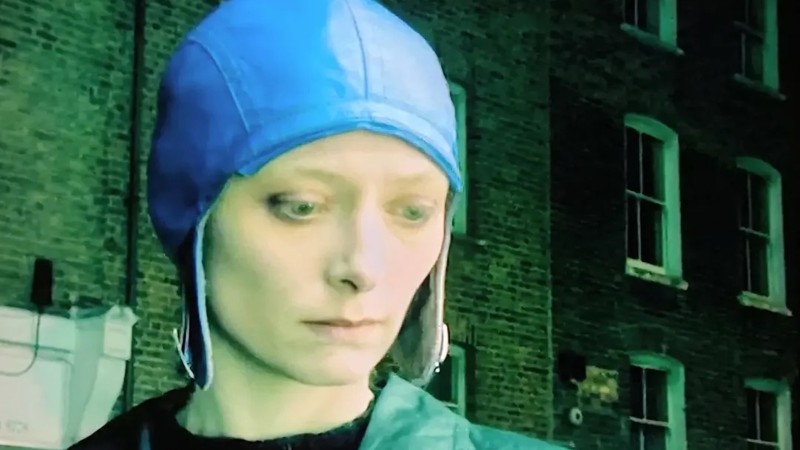
Set in 2163 and loosely adapted from Stanisław Lem’s 1955 novel The Magellanic Cloud, the Czechoslovak production “remains one of the most original and exciting science fiction films ever made,” wrote filmmaker Alex Cox for the Guardian in 2011. A multinational crew of forty sets out on the spaceship Icarus for a mysterious White Planet, a journey that will take them a little more than two years while fifteen years pass back on Earth.
Obstacles along the way include a rogue twentieth-century spaceship loaded with nuclear weapons and a “dark star” whose radiation saps energy from the crew and drives one of them mad. “Yet the outcome of this strange sleeping sickness is splendid,” wrote Cox, “perhaps the best finale of any science-fiction film, ever.”
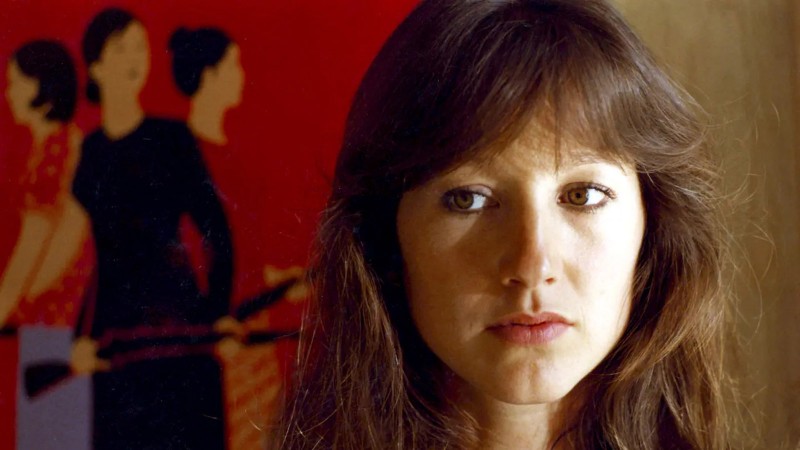
Directed by Rangel Vulchanov, who has been described as the “Bulgarian Fellini,” the rarely screened 1962 film The Sun and the Shadow (1962) stars Anna Prucnal—who would eventually work with the actual Fellini when she costarred with Marcello Mastroianni in City of Women (1980)—as a translator touring Bulgaria. On the beach, she meets a fine young man (Georgi Naumov), and the two hit it off. But the more they get to know each other, the more a nagging fear of an imminent nuclear attack tugs at the translator.
Dobriyanova has selected two films by Andrei Tarkovsky, and here we should mention that the “Nuclear Anxiety” in the title of the series refers to more than World War III. In Stalker (1979), a hired guide (Aleksandr Kaidanovsky) leads a writer (Anatoly Solonitsyn) and a professor (Nikolai Grinko) to the Zone, a forbidden area in ruins, perhaps following some sort of alien incursion. Deep in the heart of the Zone, the Room awaits, promising to fulfill the desires of anyone who steps inside.
Stalker was a famously troubled production whose location was eventually moved to an industrial area in Estonia, where the toxic waste is widely believed to have been the source of the cancer that eventually killed Tarkovsky, Solonitsyn, and Tarkovsky’s wife and assistant director, Larisa Tarkovskaya. Chernobyl’s Reactor No. 4 blew up seven years after Stalker was released, and in 2006, designer John Coulthart pointed out that “the 1,400-square-mile quarantined area around the power station is referred to as the Zone of Alienation, the Chernobyl Zone, the 30 Kilometer Zone, the Zone of Exclusion, or the Fourth Zone. Scientists who study the forbidden region (and guides who take people there illegally) have referred to themselves as ‘stalkers.’” And Dobriyanova notes that in 2007, “Kyiv-based game development studio GSC Game World released a video game called S.T.A.L.K.E.R.: Shadow of Chernobyl.”
With The Sacrifice (1986), Tarkovsky’s final film, we’re back to the threat of the war to end all wars. Shot by Sven Nykvist and starring Erland Josephson, both known for their collaborations with Ingmar Bergman, The Sacrifice takes place on the birthday of Alexander (Josephson). Celebrations are underway when the remote house in rural Sweden shudders and a news broadcast announces an imminent nuclear attack. “The members of the household and their guests are on the verge of a collective breakdown as they face the end,” writes the New Yorker’s Richard Brody, “but Alexander’s friend Otto (Allan Edwall), a postman and retired history teacher, offers him a metaphysical bargain to save the world. The blend of midlife crisis and existential terror is reminiscent of the films of Ingmar Bergman, but Tarkovsky makes it a world of his own. His images have a transcendental glow and a hieratic poise.”
Veljko Bulajić’s Atomic War Bride opened in the summer of 1960 in Tito’s Yugoslavia and then screened in competition in Venice. It’s since been largely forgotten, and in fact, April 15 and 22 will mark the first screenings in the UK. Antun Vrdoljak and Ewa Krzyzewska (Ashes and Diamonds) star as John and Maria, whose wedding day is rudely interrupted by the outbreak of global nuclear war. Cesare Zavattini, who worked with Vittorio De Sica and Luchino Visconti, wrote the screenplay.
The series will wrap with a nonfiction double bill. Ukrainian filmmaker Oleksiy Radynski’s 2023 short Chornobyl 22 features footage clandestinely shot of Russian troops discussing their takeover of the Chernobyl Zone in 2022. And Zhanana Kurmasheva’s We Live Here (2025) focuses on one of countless families living in villages near the Semipalatinsk Test Site in Kazakhstan, where more than four hundred nuclear tests were conducted by the Soviets between 1949 and 1991. More than 1.5 million people have been diagnosed with ailments linked to the fallout.
When We Are Here screened at Hot Docs last summer, Rachel Ho, writing for Point of View Magazine, called it “a stoic film, landing the final warning for an increasingly divisive world whose countries no longer find themselves in an arms race, but locked and loaded with a nuclear arsenal ready to be deployed at the touch of a button.”
Don’t miss out on your Daily briefing! Subscribe to the RSS feed.