Béla Tarr: Lamentation and Laughter
Share
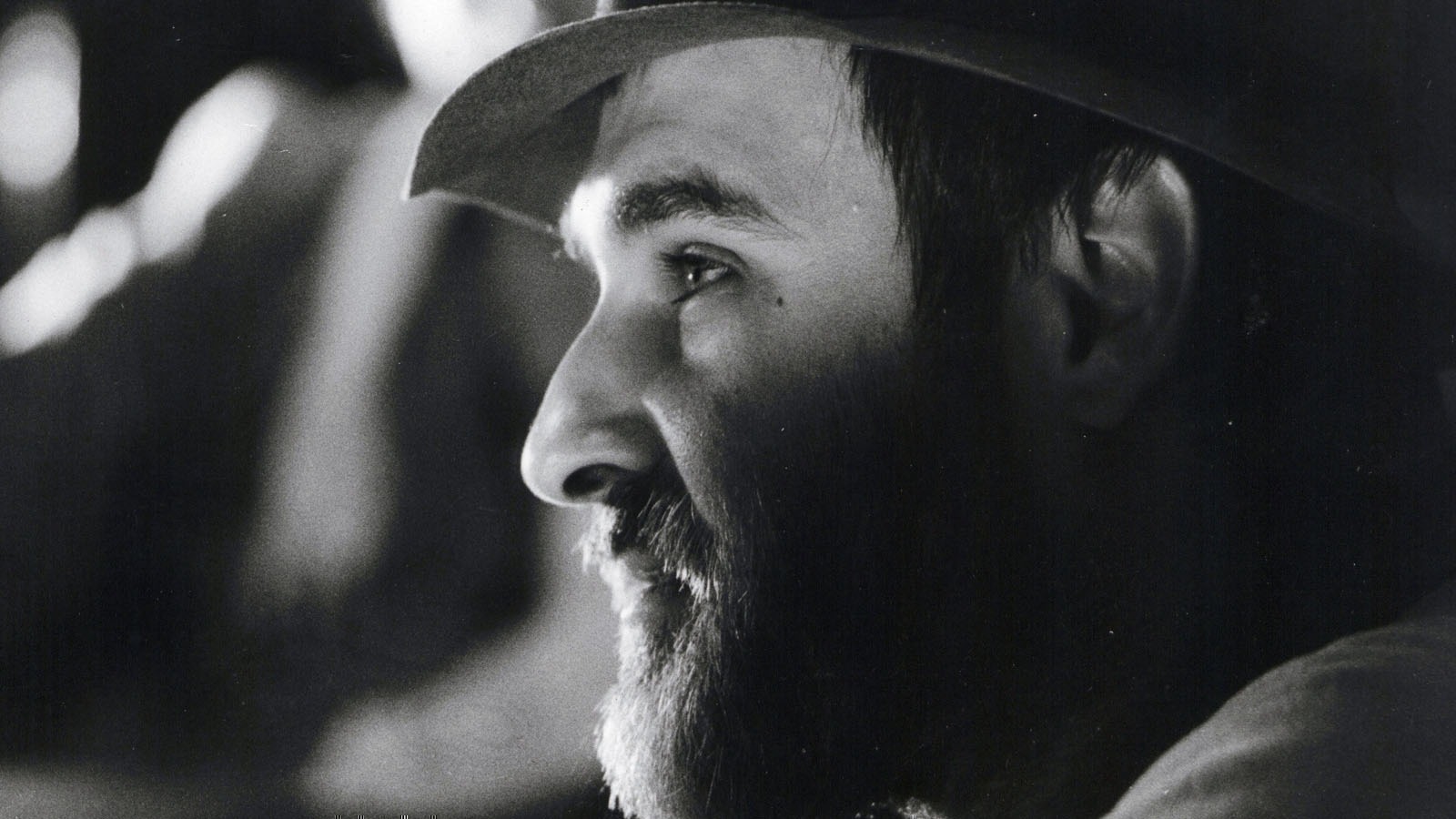
“All my movies are comedies!” declared Béla Tarr when R. Emmet Sweeney interviewed him for Film Comment in 2012. “Except The Turin Horse.” That ninth and final feature from Tarr, who passed away on Tuesday at the age of seventy, was, as Justin Chang later put it in the Los Angeles Times, “as complete a closing statement as any artist has made, a benediction not only for a great career but also perhaps for humanity itself.”
Codirected with Ágnes Hranitzky, the editor and partner with whom Tarr had been working since The Outsider (1981), and cowritten with László Krasznahorkai, the winner of last year’s Nobel Prize for Literature and a Tarr collaborator from Damnation (1988) on, The Turin Horse (2011) features a soundtrack by Mihály Víg, who had scored every Tarr film beginning with Almanac of Fall (1984), and was shot in absorbing black and dirty off-white by Fred Kelemen, a former student of Tarr’s who took over as director of photography during the troubled production of The Man from London (2007).
The Turin Horse opens with a cheeky epigraph about Friedrich Nietzsche witnessing the thrashing of a horse, throwing himself around its neck and sobbing before going for a lie-down and announcing that he had lost his mind. Viewers are then thrown into a furious run across the Great Hungarian Plain as the horse pulls a coach driven by the farmer Ohlsdorfer (János Derzsi), the wind raging, dead leaves scattering, strands of fog wisping through the frame, Víg’s score thundering, and the traveling shot galloping on and on and on.
“The Nietzsche story is like an absurd punch line placed ahead of an extended joke,” wrote A. O. Scott in his New York Times review of The Turin Horse, “and what follows—seven days in the life of the horse, his owner, and the owner’s daughter—is a kind of Genesis story in reverse, an account not of the world’s apocalyptic destruction but rather of its step-by-step de-creation.”
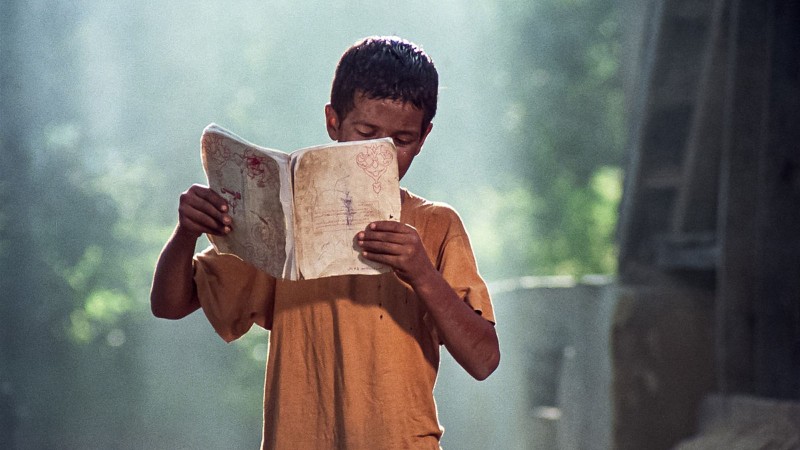
When Ohlsdorfer arrives at his hut, his daughter (Erika Bók) prepares the nightly sparse supper of boiled potatoes. Derzsi had previously appeared in five of Tarr’s films, and Bók was an orphan Tarr discovered when he was casting Sátántangó (1994). In that transposition of Krasznahorkai’s daunting 1985 debut novel to the screen, Bók plays Estike, a haunted and haunting waif who tortures and poisons her cat before taking her own life. “She really looked like a wild girl,” Tarr told Sweeney. “But she had these beautiful eyes and looked like a small rabbit. She was always in the corner, always afraid. She has grown up, and has a special presence, and [it] was an amazing experience working with her.”
The horse stops working. And eating. A neighbor drops by to rant about some catastrophic goings-on in a nearby town. A roving band of vagabonds sweeps through, issuing vague threats and generally acting like there’s no tomorrow. The well runs dry, and the horizon seems to be seeping into the encroaching dark.
More than a grand summation for which Tarr had called on his family of cast and crew, The Turin Horse is a happy atheist’s final word on the ultimate theme. Death is death. We are incapable of imagining the nothing that awaits us, but The Turin Horse comes as close as any work of art has to fully expressing its abstraction and its intimacy.
It’s telling that reviewers of Tarr’s films are tempted to reference as many literary figures as filmmakers. Tarr’s “cinema had its precursors in Antonioni, Tarkovsky, and an earlier Hungarian master of the long take, Miklós Jancsó, an avowed influence,” writes Jonathan Romney for the BFI. “But his oeuvre also stood in the lineage of Dostoevsky and Kafka in terms of its determination to gaze implacably into the face, or the abyss, of the human condition.”
“Whatever affinities might be found between Tarr and Tarkovsky, Jancsó, Angelopoulos, or even David Lynch,” wrote Damon Smith for Reverse Shot in 2009, “his closest analogues in the realm of artistic practice might be midcentury novelists like Bruno Schulz or Thomas Mann.” For A. O. Scott, Tarr “seemed like a time traveler in modern cinema, an émigré from an older, middle-European world of literature and philosophy or, to go a little further, a medieval stone carver who happened to get his hands on a camera.”
Born in the Hungarian city of Pécs to parents who worked in the theater, Tarr grew up in Budapest and started experimenting with an 8 mm camera when he was fourteen. He founded a filmmaking collective, Dziga Vertov, named after Jean-Luc Godard and Jean-Pierre Gorin’s Dziga Vertov Group, and made Guest Workers (1971), a now-lost documentary about the Hungarian Socialist Workers Party.
The government disapproved of Tarr’s early work, barring him from attending university, so after a few years spent working in a ship factory, the aspiring philosopher chose the route offered by the Balázs Béla Studio, which helped finance his first feature, Family Nest (1977). At the peak of Hungary’s housing crisis, a factory worker and her young daughter are forced to move into her husband’s cramped apartment.
“Shot in five days for around $10,000 with a cast of nonprofessionals,” writes Jeremy Carr for Senses of Cinema, “Family Nest scratches the surface of a profound despair that will permeate Tarr’s cinema to come, but it also manages to elicit moments of levity, with pop music and amusement park outings, and it even prompts some degree of dark humor in the family’s petty squabbling.”
The Outsider and The Prefab People (1982) run in the same vein of kitchen-sink social realism, but Tarr’s 1982 adaptation of Macbeth for Hungarian television signaled a decisive stylistic change. A five-minute shot precedes the main titles, followed by a single, fifty-seven-minute take. In Almanac of Fall (1984), five people bicker, work it out, and butt heads again over a period of a few days in a claustrophobic apartment.
Shot in “strikingly anti-realist color,” writes Jonathan Romney, Almanac of Fall “remains an anomaly in his career, vaguely comparable to Bergman, Fassbinder, or Raúl Ruiz.” Jeremy Carr notes that the film “opens its contained setting by way of choreographed tracks, pans, and tilts, and simultaneously restricts the visual plane with obstructed compositions and slowly revelatory movements that seem to emerge from some hidden location, peering into a room like a voyeuristic bystander.”
Tarr was immediately taken with Sátántangó when a friend of his handed him a manuscript, and when he met Krasznahorkai, they hit it off right away. The Hungarian authorities who were put off by Almanac of Fall were not about to give the go-ahead for an adaptation of Sátántangó, so Tarr and Krasznahorkai decided to write a screenplay for a project on a smaller scale. In Damnation (1988), Karrer (Miklós B. Székely) arranges to have the husband of the singer he’s in love with disappear for a few days by signing him up for a risky smuggling operation.
Writing about Damnation for Reverse Shot in 2007, Nick Pinkerton noted that Tarr is “less concerned with narrative machinations than the play of light off of bodies in bed, a face while shaving, Karrer’s musings on the universal order of things, rain drenching the concrete walls and debris-ridden courtyard of a crumbling apartment block, wonderfully drunken revelry in the cabaret, or its final image: Karrer on all fours, snarling and swirling around a belligerent wild dog. Damnation may be, in the end, primarily a mood piece, an exemplar of the fading art of tonal control.”
After Damnation screened at the Berlinale, the Hungarian authorities assured Tarr that he would never make another film, so he moved to Berlin—in time, as it happened, to see the Wall fall. He was then free to make Sátántangó, a gorgeous and enrapturing endurance test in twelve chapters that move, like a tango, six steps forward and six steps back, over the course of more than seven hours. In 2002, Brendan Boyle wrote a marvelous short story, “The Long Movie,” about a guy named Henry who devotes a full Saturday to preparing to see, then seeing, and then decompressing after seeing Sátántangó.
In a piece on marathon viewing experiences that the Baffler ran in 2019, Nick Pinkerton recommended Sátántangó to anyone who, “like myself,” might “find hysterically funny the prospect of casting a hippopotamus-sized Peter Berling as a nosey and sedentary village drunk, and of making an epic event of that drunk’s journey into town to refresh his exhausted stock of plum brandy, watching him in an uninterrupted tracking shot on an interminable trundle, huffing-and-puffing along the miserable, sodden, muddy road that leads to the local tavern. This is an experience that, by its nature, has a niche appeal, and between those who submit themselves to it, there exists a sort of camaraderie, a knowledge of belonging to the ranks of the hardcore.”
There are only thirty-nine shots in Werckmeister Harmonies (2000), a film that runs nearly two and a half hours. “A long take has a lot of cuts, but inside,” Tarr told a cluster of journalists, including Steve Macfarlane, in 2016. Tarr traced the movement of an imaginary camera from a close-up on one journalist to a wider shot that took in another, and then the space of the room before settling on the face of a third journalist with the image of the first reflected in his glasses.
“It’s a lot of ‘takes,’ but it’s one movement,” said Tarr. “Sometimes when you do a long take, the people—the actors, the dolly guy, the cinematographer—are breathing in sync. It’s like good sex: When everybody is in sync, the actors have no chance to leave the situation because the camera is rolling. This is what I discovered, slowly, doing long takes: A film is written in pictures, human faces, reactions. It’s a very complex string of things.”
In Werckmeister Harmonies, a circus arrives in a nondescript town, bearing with it the stuffed carcass of a whale and a charismatic performer who drives the townspeople mad. The film arrived as “a concrete manifestation of free-floating millenarian dread,” wrote Dennis Lim in 2024. “Tarr’s career, which began during the final stretch of Communist rule in Hungary, has coincided with the toppling of various regimes and ideologies, as well as sundry pronouncements about the end of history, the decline of faith, and the death of cinema. His sardonic, luxuriantly bleak laments are nothing if not movies for an apocalyptic age, and Werckmeister Harmonies, a mesmerizing chronicle of collapse, is his most nightmarish vision of how things fall apart.”
The Man from London (2007), an adaptation of the 1934 novel by Georges Simenon, “feels somehow smaller than Sátántangó or Werckmeister Harmonies, but the film’s more obvious negative attributes can be misleading,” wrote Reverse Shot coeditor Jeff Reichert in 2008. “His choice of material may be disappointing, but Tarr’s still brought the full force of his cinema to bear in translating it to the screen.” For Michael Brooke, writing in a 2009 issue of Sight and Sound, The Man from London is “as typically uncompromising as his other work.” A few years later, Tarr capped the oeuvre with The Turin Horse.
“I arrived at the point where the work is complete, the language is done,” he told Geoffrey Macnab in Screen. “I don’t want to use my film language for repeating something. I can’t. I don’t want to be boring.”
He never was. In 2013, he founded film.factory, a workshop in Sarajevo for budding filmmakers led by mentors that included Gus Van Sant, Carlos Reygadas, Apichatpong Weerasethakul, Pedro Costa, Guy Maddin, Tilda Swinton, and Cristian Mungiu. When Peter Bradshaw interviewed him for the Guardian in 2024, he found that “in person Tarr was witty in an exuberant yet somehow deadpan way, droll and wisecracking, fiercely engaged with the world, unstinting in his criticism of the intellectual mediocrity of the far right in his native Hungary and elsewhere.”
Jonathan Romney emphasizes that “for all the emphasis on the stygian aspect of Tarr’s work, it is worth remembering how much comedy, how much beauty, and how much music—literal and figurative—it contains. Listen to Mihály Vig’s hypnotic scores, blending folk themes and minimalist repetition; and watch the complex weavings of a dancing group of barroom drunks in Sátántangó, a scene shot with the entire cast genuinely off their faces. The bacchanalian chaos of such scenes contains as much joy as it does abjection.”
Don’t miss out on your Daily briefing! Subscribe to the RSS feed.