Cinema Revival at the Wexner
Share
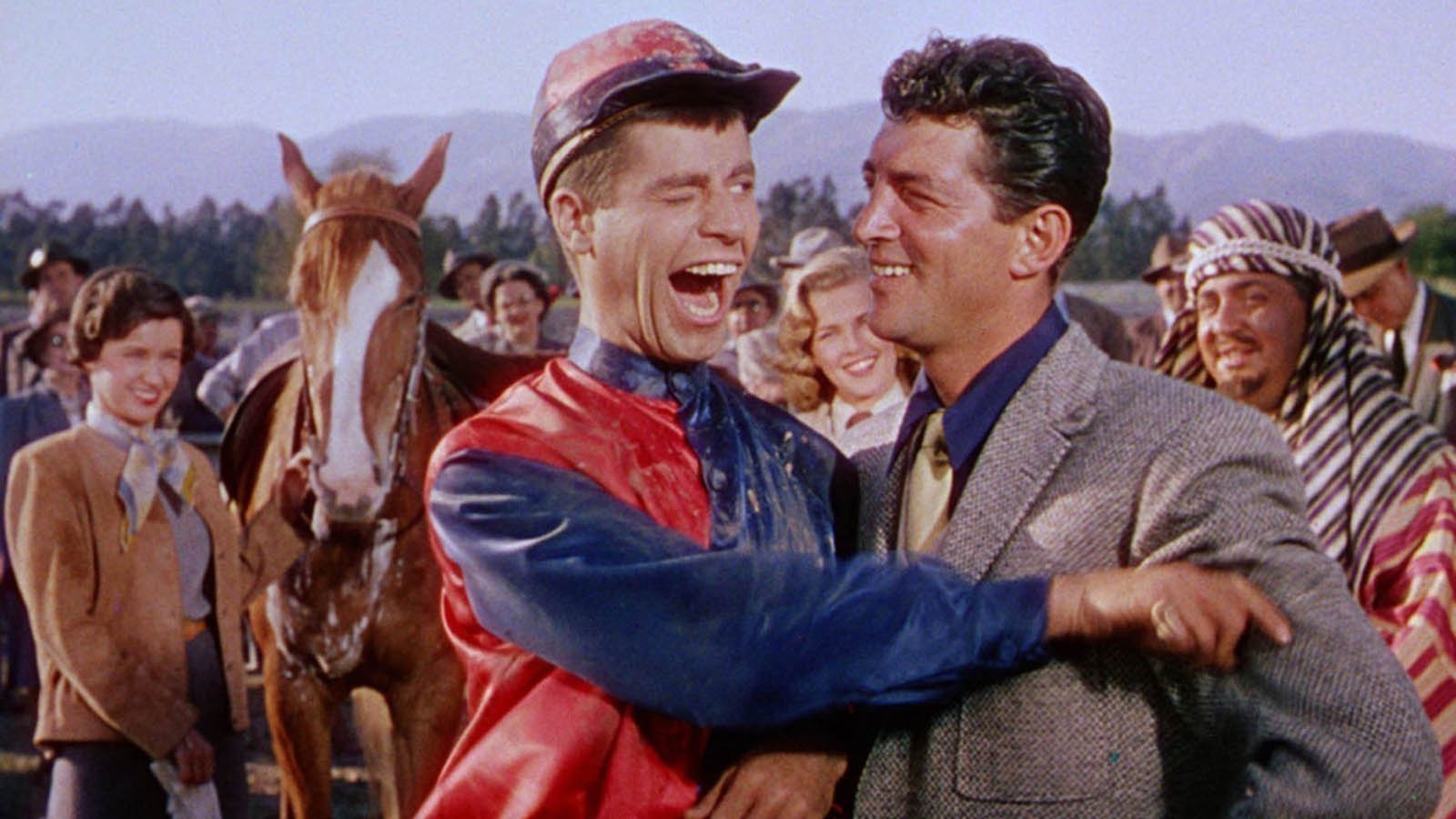
For years, 3D Film Archive founder Bob Furmanek and his team have been working on their biggest project yet, the restoration of George Marshall’s Money from Home (1953). The comedy set in 1920s New York was the first feature in color to star Dean Martin and Jerry Lewis—and the only film the comedy duo made in 3D.
The restoration will finally see its world premiere tomorrow, presented as part of the twelfth edition of Cinema Revival, the festival of film restoration at the Wexner Center for the Arts in Columbus, Ohio. “Part of the reason it took so long is that it’s Technicolor,” Dave Filipi, the head of the Wex’s film department, tells Hope Madden in the Columbus Underground. “So, that’s three film elements per scene because Technicolor has three-strip color separation. And then on top of that, it’s 3D. So you’re basically restoring six strips of film for every single second of the film. So, it took them a really, really, really long time.”
The festival opens this afternoon with Tim Lanza and Sarah Hartzell of the Ohio State University Libraries presenting a program of historical shorts, and in the evening, Ei Toshinari, the founder of the distributor Small Sensations!, will introduce animation legend Mamoru Oshii’s 1987 live-action feature The Red Spectacles. At Screen Slate, Emerson Rosenthal has called the film “a noir nightmare that’s halfway between detective story and farce, live-action and human cartoon, serious and scatological, and Seijun Suzuki and Jean-Luc Godard.”
Besides Money from Home, Friday offers Flora Gomes’s first feature, Mortu nega (1988), known to some as Those Whom Death Refused. Divided into three distinct parts, Mortu nega tells the story of the war that brought Guinea-Bissau independence from Portugal in 1974, the celebrations that followed, and the sobering postliberation reality. “Giving equal emphasis to war as to what comes after, Gomes refuses to romanticize or simplify the complexities of its subject and instead takes a critical appraisal of his country’s independence,” wrote Haden Guest when Mortu nega screened at the Harvard Film Archive in 2022.
Saturday morning will be given over to cartoons from the UCLA Film & Television Archive before Dennis Doros and Amy Heller of Milestone Films introduce Queen Kelly (1929), directed by Erich von Stroheim, starring Gloria Swanson, and produced by Swanson’s lover at the time, Joseph Kennedy, the patriarch of an American political dynasty. Swanson plays a convent girl who falls for a prince engaged to a mad queen. Production shut down when Stroheim overspent and fell behind schedule. “In this case,” writes Sean Burns for WBUR, “half of a movie is better than most in full. Queen Kelly is a film of dazzling breadth and grandeur, with a naughty modernity that reportedly caused clashes on the set between filmmaker and star.”
Writer and producer David Stenn will introduce the late-afternoon screening of Lewis Milestone’s Rain (1932), starring Joan Crawford as a sex worker who poses something of a challenge to a missionary and his wife on the island of Pago Pago. “For the combination of the daring, the unsentimental, and the erotic,” wrote Molly Haskell in the Village Voice in 1972, “the films of the early ’30s, just before the big crunch of the Production Code, can’t be beat. Rain may well be one of the high water marks of Joan Crawford’s career, both in terms of her beauty and her electrifying pre-star presence.”
Saturday wraps with an evening screening of a new 70 mm print of Steven Spielberg’s Close Encounters of the Third Kind (1977). When Reverse Shot held a Spielberg symposium in 2012, Eric Hynes called Close Encounters “a film of colossal ambition that plays as intimate, of heart-thumping sensations that register as cosmic, of wondrous spectacle that in the end just sings.”
Sunday begins with Lumière, Le Cinema! (2025), a collection of more than a hundred newly restored short films made by August and Louis Lumière 130 years ago. Cannes artistic director Thierry Frémaux has done the selecting and arranging and narrates as well.
Otto Preminger’s Saint Joan (1957) follows. The adaptation of George Bernard Shaw’s play written by Graham Greene and starring seventeen-year-old Jean Seberg as Joan of Arc is “not a great movie,” writes David Sterritt for TCM, but “it’s definitely a good one.”
Bob Rafelson’s Five Easy Pieces (1970), starring Jack Nicholson and Karen Black, will close out the evening. “Like Warner Bros. at the dawn of sound or Preston Sturges at his blindingly brilliant peak,” wrote Kent Jones in 2010, “Five Easy Pieces speaks with eloquence and simplicity from and to the America of its time, from melancholy opening to ineffably sad closing shot. In 1970, it was a revelation. Today, it remains a shattering experience, in part because it contains an entire way of life within its ninety-eight minutes.”
This year’s Cinema Revival will close on Monday afternoon with El grito (The Scream, 1968), a documentary on the uprisings in Mexico City in the summer of 1968 shot by film students under the direction of Leobardo López Aretche. As the movement swelled in the run-up to the Summer Olympics, the government panicked and opened fire on the protesters. The disaster became known as the Tlatelolco massacre. El grito is “an abrasive, declamatory film,” wrote Felix Bazalgette for Sight and Sound in 2018, “especially to an outsider—it feels as though it were made in anger, and anguish.”
The film “has a roughness to it of the immediacy of people running around in the streets with chaos all around them,” Dave Filipi tells Hope Madden. “The second I saw it, I thought, yeah, this will be perfect.”
Don’t miss out on your Daily briefing! Subscribe to the RSS feed.