Tom Stoppard’s Deep-Hearted Puzzles
Share
On Tuesday evening, West End theaters in London will dim their lights for two minutes in remembrance of one of the most vital playwrights of our era, Tom Stoppard. For Guardian drama critic Michael Billington, Stoppard’s great achievement was “to take seemingly esoteric subjects—from chaos theory to moral philosophy and the mystery of consciousness—and turn them into witty, inventive, and often moving dramas. Theater, Laurence Olivier once said, is a great glamorizer of thought. Stoppard confirmed that with his capacity to make ideas dance.”
Reviewing Hermione Lee’s 2021 biography Tom Stoppard: A Life for the New Yorker, Anthony Lane picks out a quote from playwright Simon Gray: “It is actually one of Tom’s achievements that one envies him nothing, except possibly his looks, his talents, his money, and his luck. To be so enviable without being envied is pretty enviable, when you think about it.” Lane has another one, too, a little more jolting, from director Mike Nichols, who “thought of Stoppard as ‘the only writer I know who is completely happy.’”
When news of Stoppard’s passing at the age of eighty-eight reached Mark Harris over the weekend, the author of Mike Nichols: A Life recalled seeing a Broadway production of Stoppard’s The Real Thing (1982) directed by Nichols and featuring a cast led by Jeremy Irons and Glenn Close. Harris was nineteen at the time. “No single production did more to shape my understanding of what modern theater could be.”
The Real Thing is widely perceived as a turning point in Stoppard’s body of work. “The bloodline of Stoppard’s early hits might be described as ‘out of Beckett by The Goon Show,’ though ‘Pinter meets Beyond the Fringe’ catches something, too,” wrote Stefan Collini in the Guardian a few years ago. “One of the main lessons Stoppard learned from Beckett and Pinter was the dramatic effectiveness of withholding information. Audiences become puzzled, discomfited, but also engaged. ‘I like them to sit with their backs to the engine, and only later to find out where they were going’ . . . Congratulating oneself on keeping up has been one of the major pleasures of spending an evening in Stoppardia.”
Plays such as Jumpers (1972), depicting a philosopher’s struggle to prove the existence of God, and Travesties (1974), conjuring 1917 Zurich and the meeting of James Joyce, Vladimir Lenin, and Tristan Tzara in the wavering memories of an octogenarian, “led some critics and audiences to conclude that his plays were chilly, heavy on the head, light on the heart,” writes Bruce Weber in the New York Times.
The Real Thing “raises a whole host of questions,” writes Michael Billington, “such as whether any public commitment is the result of private derangement and whether concepts such as justice and patriotism exist outside our perceptions of them. But behind this—and what makes the play so relatable—is a heightened awareness of the ecstasy of love and the agony of betrayal.”
One oft-quoted quip has Stoppard referring to himself as “a bounced Czech.” He was born Tomáš Sträussler in 1937 in what was then Czechoslovakia. Less than two years later, with the Nazis closing in, his father, a doctor, moved the family to Singapore. As the Japanese occupation loomed just a few years later, Stoppard, his mother, and his older brother fled to British India. His father intended to follow them, but the ship from Singapore he was on was bombed.
In 1945, Stoppard’s mother married a major in the British Army, Kenneth Stoppard, who moved the family to England. At seventeen, Stoppard left school to take a job in Bristol as a journalist, and his theater reviews led him to the Bristol Old Vic and to friendships with Peter O’Toole and director John Boorman. By 1960, Stoppard had completed his first play, A Walk on the Water, which was quickly optioned, then staged in Hamburg, and eventually broadcast on British television in 1963. The following year, Stoppard landed a grant that allowed him to write a one-act, Rosencrantz and Guildenstern Meet King Lear, that—rewritten and fleshed out—became his first hit.
Remembering Stoppard in the New Yorker, Helen Shaw writes that Rosencrantz and Guildenstern Are Dead, “his 1966 Shakespearian meta-theatrical puzzle, about tertiary characters grappling with their inexorable fate, mainstreamed conversations about probability and droll ennui (‘Life is a gamble, at terrible odds. If it were a bet you wouldn’t take it’). It hit the theater like a comet. Even in an alternate reality in which Stoppard wrote only Rosencrantz, we’d still be in the impact crater of that one masterpiece.” Stoppard “loved Hamlet so much he wrote our greatest work of criticism about it, which just happens to be a bleak, funny play.”
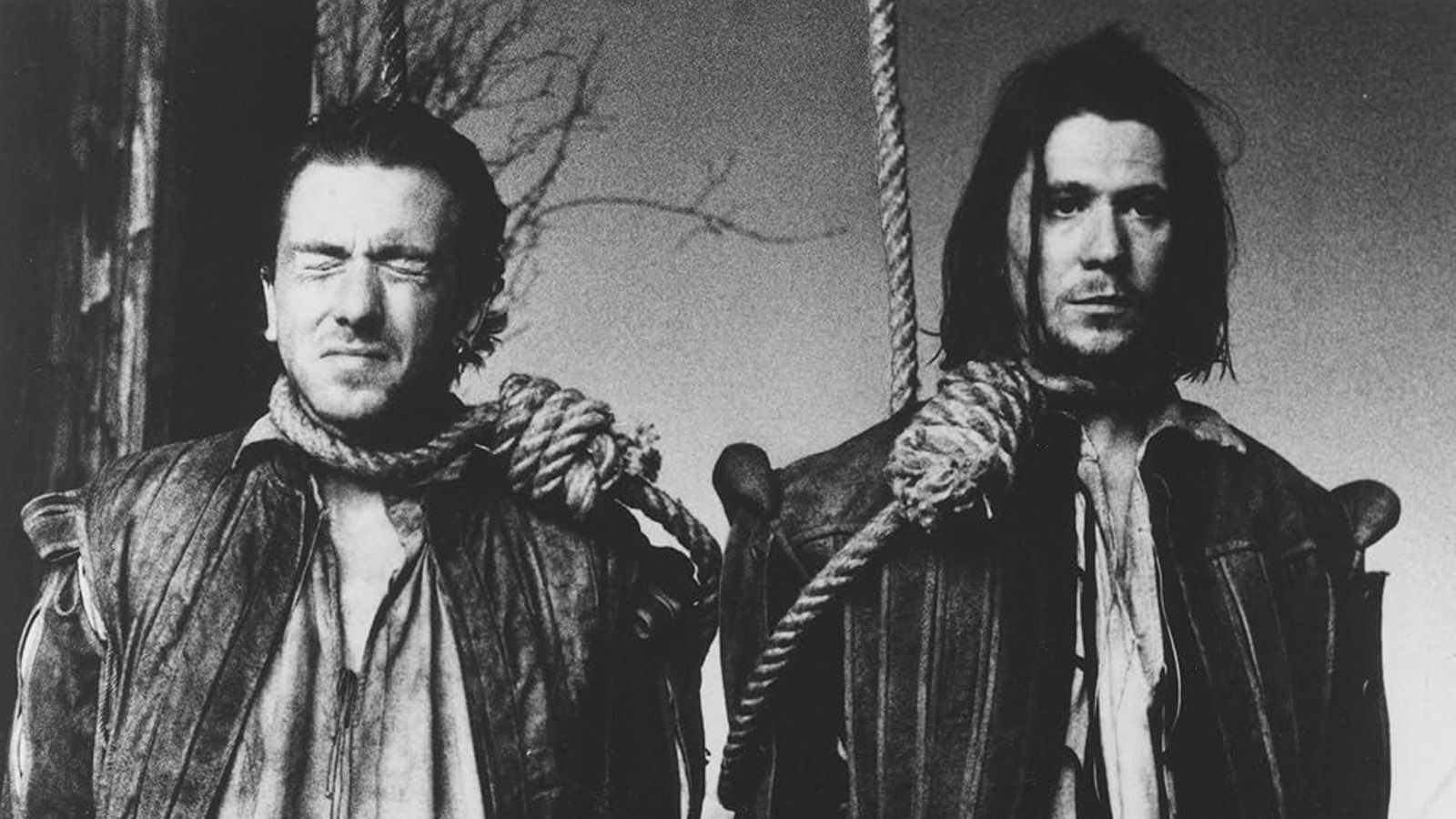
In 1990, Gary Oldman and Tim Roth starred in Stoppard’s adaptation, the only film he directed. Not everyone was pleased when Gore Vidal’s jury in Venice decided to award the Golden Lion to Rosencrantz rather than to, for example, Martin Scorsese’s Goodfellas, Jane Campion’s An Angel at My Table, or Claire Denis’s No Fear, No Die. Reviews were mixed. “The original play is such a triumph,” wrote Roger Ebert, but “this material was never meant to be a film, and can hardly work as a film.”
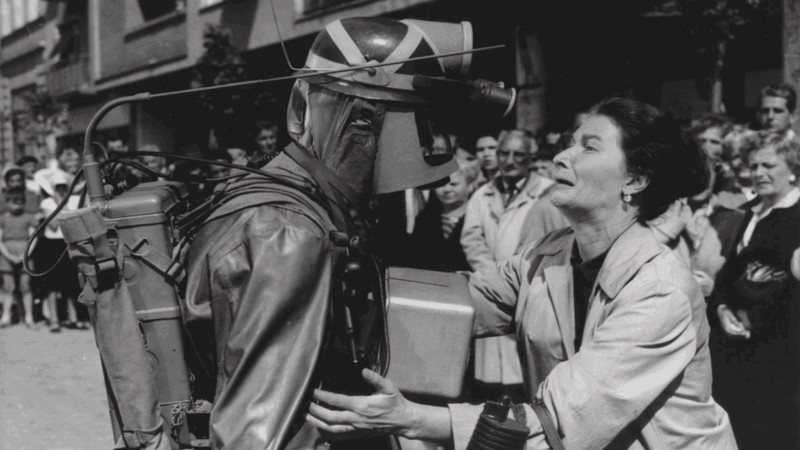
Years earlier, John Boorman had been attached to direct. “I remember then sitting down writing a script for John and realize looking back I had no idea what a screenplay was,” Stoppard told Susan King in the Los Angeles Times in 2016. But beginning with a 1975 adaptation of Jerome K. Jerome’s Three Men in a Boat for the BBC, he got the hang of it. He adapted Vladimir Nabokov’s Despair for Rainer Werner Fassbinder in 1978, Graham Greene’s The Human Factor for Otto Preminger in 1979, and cowrote Brazil (1985) with Charles McKeown and director Terry Gilliam. “Shared authorship doesn’t dilute a distinct Stoppardian tone,” writes Mark Lawson of Brazil in the Guardian, “a sort of Kafkaesque-Pythonesque, uniting his native and adopted cultures.”
For Steven Spielberg, Stoppard wrote the first draft of the J. G. Ballard adaptation Empire of the Sun (1987) and the final draft of Indiana Jones and the Last Crusade (1989). When an opportunity to turn Rosencrantz into a movie turned up again, “I realized pretty soon that if this was going to be adjusted and adapted, I was the person who would be the least defensive about it,” he told Susan King. “I felt it needed a bit of disrespect.”
Stoppard became a go-to adaptor, turning John le Carré’s The Russia House into a screenplay for Fred Schepisi’s 1990 film and adapting E. L. Doctorow’s Billy Bathgate for Robert Benton the following year. Shakespeare in Love (1998), directed by John Madden, scored thirteen Oscar nominations and seven wins, including Best Picture and Best Original Screenplay for Stoppard and cowriter Marc Norman—beating Spielberg’s Saving Private Ryan in both categories. Shakespeare’s big night led to a sour controversy over the heavy-handed awards campaign conducted by Harvey Weinstein.
As played by Joseph Fiennes, young Will Shakespeare is just another struggling Elizabethan playwright, but when he meets his muse (Gwyneth Paltrow), he turns the comedy he’s working on, Romeo and Ethel, the Pirate’s Daughter, into an immortal tragedy, Romeo and Juliet. “At the beginning,” Stoppard told Patrick Pacheco in the Los Angeles Times in 1998, “there were moments when the challenge became, How does Shakespeare speak when he’s just speaking to a friend? Does he sound like Shakespeare?” So, “in the opening scene, I gave him a line of verse as his first line of dialogue, a quotation from Hamlet, I think, ‘Doubt thou the stars are fire, doubt that the earth doth move . . . ’ To which Henslowe [the producer] says, ‘We haven’t got time for that, talk in prose.’ I felt that got us through the gate.”
Subsequent Stoppard adaptations include Enigma (2001) from the Robert Harris novel, Tolstoy’s Anna Karenina for Joe Wright’s 2012 film, and Parade’s End (2012), a five-part BBC series based on Ford Madox Ford’s tetralogy set against the backdrop of the First World War and starring Benedict Cumberbatch and Rebecca Hall. For the Independent’s Grace Dent, Parade’s End is “one of the finest things the BBC has ever made.” Stoppard’s credited work for film and television is “major,” comments Mark Harris, “but he was also one of the most in-demand rewriters, fixers, and polishers in movies. We still don't know everything he did.”
The plays, though, will endure for all to see. According to Hermione Lee, Stoppard felt that Arcadia (1993), set in a Derbyshire country house and moving between stories unfolding in the early eighteenth century and the present, would be considered his best play. But his personal favorite was The Invention of Love (1997), based on the life of poet and classicist A. E. Housman.
“Chekhovian in spirit, and Tolstoyan in scale,” wrote William Grimes in the New York Times in 2006, The Coast of Utopia “requires three linked plays, more than seventy roles and a fictional time span of more than thirty years to cover the politics, the literature, and the tangled personal relationships that animated Russia in the mid-nineteenth century.” Further late career highlights include Rock ’n’ Roll (2006), which tackles the churn of politics and culture in late-twentieth-century Czechoslovakia, and Leopoldstadt (2020), Stoppard’s last play and one of his most personal, as it traces the story of a Jewish family in Vienna from 1899 to 1955.
“I aspire to write for posterity,” Stoppard told Douglas Murray in a 2019 interview for the Spectator. “I would like my plays to be done occasionally, not just be done when they’re brand new. I like the idea of them being part of the furniture. Which of course isn’t true of all of them. You’re just lucky if you have one or two which are there.”
Don’t miss out on your Daily briefing! Subscribe to the RSS feed.