November Books
Share
We need to flag a few events right at the top of this month’s roundup on new and noteworthy titles. On December 2, 4Columns film editor Melissa Anderson will be at Light Industry in Brooklyn to talk with writer Wayne Koestenbaum about Arthur J. Bressan Jr.’s landmark documentary Gay USA (1977) and about her new book, The Hunger: Film Writing, 2012–2024. Then on December 12, Anderson will introduce a screening at the Museum of the Moving Image of D. A. Pennebaker and Chris Hegedus’s Town Bloody Hall (1979), a film she wrote about for us a few years ago, noting that it documents “one splashy moment in the cresting and crashing of American feminism’s second wave.”
Anderson’s previous book, Inland Empire, focuses more on Laura Dern’s multifaceted performance than on David Lynch’s direction of his final feature. Introducing her interview with Anderson for Screen Slate, Saffron Maeve notes that “Anderson’s writing is enduringly attuned to the ‘acteurist’ dimensions of a film—performance, stardom, comportment, affiliation—and the sensuous/sensual impressions actors leave on the screen.”
For Nathan Lee, who talks with Anderson for Notebook, The Hunger is a testament to “the practice of film criticism not as service journalism, rush to judgment, or think-piece doodling, but first and foremost as writing, the considered and calibrated composition of words. Anderson’s appraisal of Wonder Woman [2017] may or may not incline you to watch the film itself. We have dozens of other critics on that beat. You read Anderson to relish the characterization of Paradise Island, ancestral motherland of Wonder Woman, as a separatist enclave that ‘could form an archipelago with the Isle of Lesbos and Cherry Grove.’”
On December 4, n+1 film critic A. S. Hamrah will be at McNally Jackson Books on Fulton Street to talk with K. Austin Collins about his two new books, Algorithm of the Night: Film Writing, 2019-2025 and Last Week in End Times Cinema. Anyone who’s read The Earth Dies Streaming: Film Writing 2002–2018 will be eager to get their hands on Algorithm. Recommending Last Week in Harper’s, Dan Piepenbring notes that from March 17, 2024, to March 16, 2025, Hamrah put together a weekly list of Hollywood news items “that struck him ‘as pathetic and ridiculous. Not just absurd, but also indicative of the postpandemic world of slop into which the film industry was descending.’” The Paris Review is running the entry from April 28, 2024.
“Both of these books strike me as some of the most depressing things I’ve ever read, but in an invigorating and almost existentially hopeful way,” the Globe and Mail’s Barry Hertz tells Hamrah. “It can get a little depressing,” admits Hamrah, “especially when we get to the L.A. wildfires, the death of David Lynch.” Studios have seemed determined to “do away with the cinema altogether by turning it into a fully automated assembly line using, at every step in the process, artificial intelligence, with as few humans involved as possible . . . So many people who write about films have turned to writing about older films now, classic Hollywood, avant-garde films. But I think it’s the obligation of the critic to write about the films of their time, and I’m very dedicated to doing that.”
On a more celebratory note, Metrograph invites cinephilic readers to the Lower East Side on December 6 and 13 during its Holiday Book Fair. And in Brooklyn, Pioneer Works will present Press Play 2025, “a weekend-long fair of books, records, art, ephemera, talks, and workshops,” on December 13 and 14.
Beyond New York, UCLA Film & Television Archive senior programmer Paul Malcolm and cartoonist and illustrator Nathan Gelgud have put together a series running through December 20 that’s inspired by Gelgud’s new book, Reel Politik. In the Los Angeles Times, Mark Olsen notes that Gelgud tells “the story of a group of small-town movie theater employees who form a revolutionary cadre. (They hijack the Criterion Closet van.) Movie lovers will likely recognize themselves in the characters’ small-stakes bickering over such topics as assigned seating and film formats.”
One more event for those across the Atlantic. On December 4 in Vienna, Lisl Ponger, Elisabeth Streit, and Dietmar Schwärzler will present the new collection Lisl Ponger: Semiotic Ghosts at the Austrian Film Museum.
Two Biographies
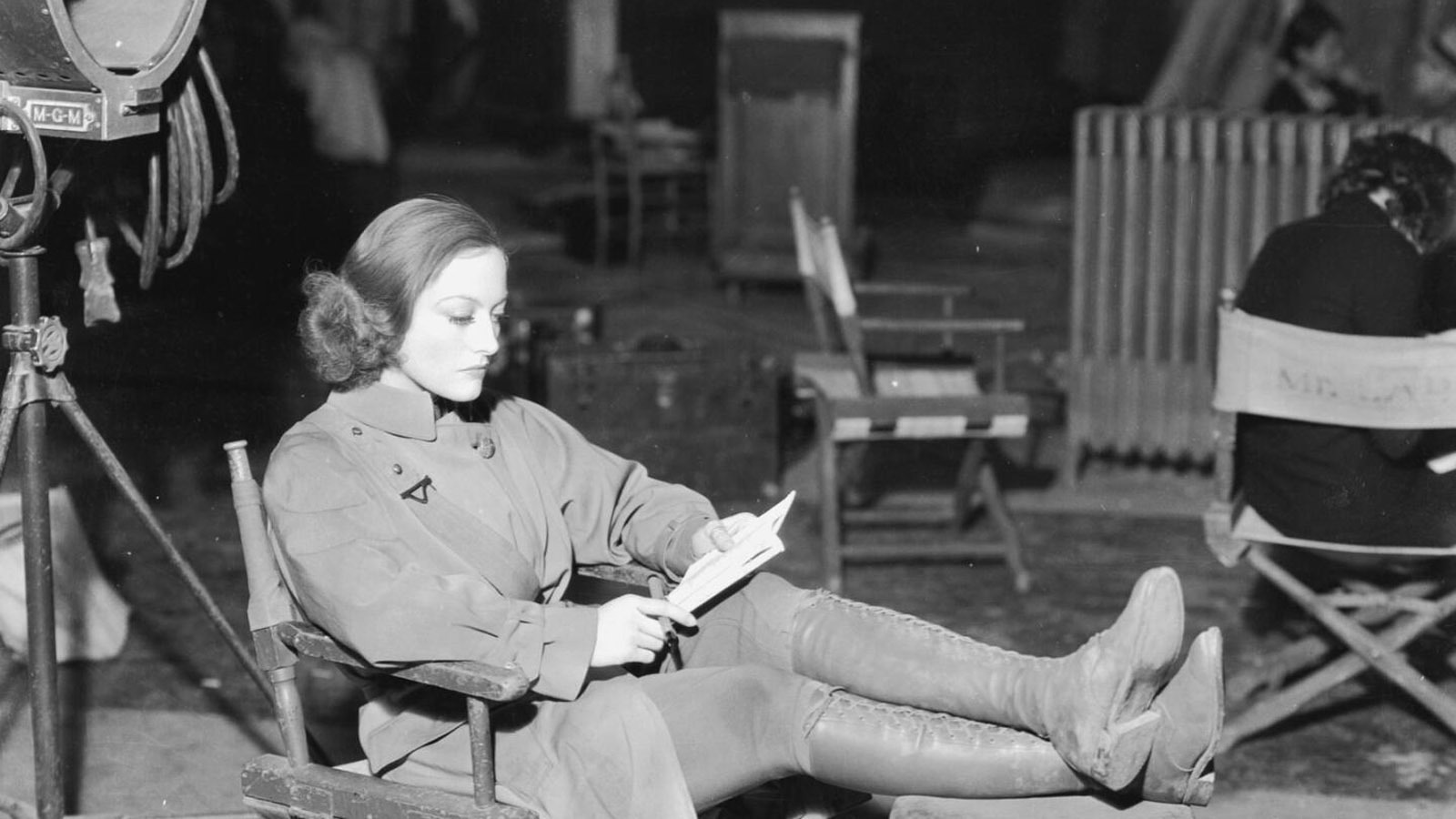
Scott Eyman’s Joan Crawford: A Woman’s Face is “a trove of anecdotes, quotes, and insights,” writes the New Yorker’s Richard Brody, “but, above all, it’s the energetic pursuit of an idea: Eyman presents the story of Crawford’s rise to fame as the story of Hollywood stardom itself.” Writing about his “favorite classic-Hollywood actress,” Brody observes that Crawford “took all that was unsayable in Hollywood—all that was unspeakable, all that was ineffable, and all that was unrepresentable in what she’d learned of life, as a child, a clawing outsider, and a star—and brought it all out, one burning fury at a time, in a form of performance that was a music of images. For decades, every time her eyes flashed onscreen, they brought live heat fiercer than the projector bulb that would burn film on contact.”
In Robert M. Dowling’s Coyote: The Dramatic Lives of Sam Shepard, the playwright and striking yet intriguingly subdued on-screen presence emerges as “a tangle of confusions, with his life shaped by frustration and failure and self-destruction as much as success on the world’s stages and movie screens,” writes Mark Athitakis in the Los Angeles Times. Dowling “expertly untangles the history of a man who contained multitudes—‘country boy, playwright, lover, rocker, husband, father.’ (And, in no small measure, alcoholic—his drinking clouds the latter chapters of his life, wrecking friendships, affairs, and work along the way.) The author has the benefit of Shepard’s writing, which encompasses reams of plays, short stories and essays, as well as candid insights from friends and collaborators like Johnny Dark and Ethan Hawke.”
Seven Memoirs
In an excerpt from the late Robbie Robertson’s memoir Insomnia up at the Hollywood Reporter, the former Band singer and songwriter looks back on a volatile situation that very nearly got seriously out of hand during the final phases of postproduction on Martin Scorsese’s The Last Waltz (1978). Infuriated by the way his reading of a poem was truncated in an early cut, Hell’s Angel Sweet William threatened to violently abuse two production assistants. “I was trying to gather my thoughts as Marty paced in front of me,” writes Robertson. “What do you do in a fucking case like this?”
When she passed away in April 2024, Eleanor Coppola had completed one last book, Two of Me. In the introduction, Sofia Coppola writes that her mother “taught me how to be in charge without being loud, and the importance of being real.” Much of Two of Me chronicles her life after she decided to forgo conventional treatment for a tumor in her chest that one doctor told her was “about the size of a large lemon.” In the New Yorker, Naomi Fry writes that Two of Me is “a small-scale cri de coeur, animated by Coppola’s tenacity—by her insistence on tracing the contours of her own world, in writing.”
With balls of wax and a cassette recorder, multimedia artist Lynn Hershman Leeson made one of her earliest works, Breathing Machine, sixty years ago. In the 1970s, she created an alter ego, Roberta Breitmore, who became a CybeRoberta in the late 1990s, when she began working with Tilda Swinton on Conceiving Ada (1997), and later, Teknolust (2002). “What’s astonishing” about her new book, Private I: A Memoir, writes Mark Amerika in the Brooklyn Rail, “is the sheer variety of technologies Hershman Leeson has engaged with across her career: video, interactive laser disc, bio-art, artificial intelligence, robotics, genetic science, virtual agents, feature film. Few artists have moved so fluidly across so many platforms, and fewer still have done so while making the technology itself the subject of critique.” Michelle Handelman finds that Private I “sharpens her ever-more-timely warnings of technology’s power to surveil. In Private I, Lynn tells us what it’s like to have the art world catch up to her after all these years.”
Anthony Hopkins has been talking about his memoir, We Did OK, Kid, with the New York Times’ David Marchese and the Guardian’s Steve Rose, among many, many others. In the New Yorker, Anthony Lane finds the book to be “a patchy affair, to be honest, which omits entire swaths of his achievement, yet its wayward momentum exerts a certain charm, as if Hopkins were only just in control of his reminiscences.”
Interview has brought together Cameron Crowe and Judd Apatow. Both directors have new books out, and for Dwight Garner in the New York Times, Crowe’s The Uncool “reads like a novelization” of Almost Famous (2000), starring Patrick Fugit as a slightly fictionalized version of Crowe’s younger self, the teenage Rolling Stone journalist. “God help me,” writes Garner, “I read this book quickly and enjoyed it anyway: The backstage details alone keep this kite afloat. It got to me in the same way Almost Famous always gets to me, despite the way that movie sets off my entire bank of incoming sentimentality detectors. If you can watch the ‘Tiny Dancer’ scene without blinking back a tear, you’re a stronger person than me.”
For the Los Angeles Times, Robert Lloyd talks with Apatow, whose Comedy Nerd: A Lifelong Obsession in Stories and Picturesis “a thick, glossy, photo-filled, endlessly browsable scrapbook that covers the entirety of a life and career—from fanboy to mogul, as writer, director, and producer—that shaped twenty-first-century comedy, encompassing the highlights, the lowlights, and the never-lit.”
Roger Deakins’s Reflections: On Cinematography is “a chronological, narrated sourcebook of stills, lighting diagrams, storyboards, and gearhead minutiae,” writes Nicolas Rapold for Air Mail. “At seventy-six, Deakins sounds eager to get all of his trade secrets down on paper—analyzing everything from the oil-field infernos of his Gulf War drama, Jarhead, to the bowling-ball cam of the stoner classic The Big Lebowski.”
Extended Conversations
Reading I Only Believe in Myself: Conversation with Murielle Joudet, a collection of the film critic’s interviews with Catherine Breillat, “I found myself underlining nearly the entire book,” writes Claire Marie Healy in AnOther Magazine. “It’s clear that most of what we find shocking in [Breillat’s] work comes from inside the house.” Writing for the New Left Review, Alice Blackhurst finds the book to be “a manifesto less for solipsistic self-interest than for a kind of extreme, at times painful, attention.”
The Theater of the Matters is running a different translation of João César Monteiro’s 1974 interview with António Reis than the one that appears in the 2024 collection In the Midst of the End of the World: António Reis and Margarida Cordeiro. And Bright Lights Film Journal is running a hefty excerpt from I Loved Movies, But . . . , a collection of Danny Peary’s interviews with Joseph McBride, a film historian, screenwriter, and the author of books on John Ford, Frank Capra, and Steven Spielberg.
“There was a schism in the membership between what were called ‘Politicos’ vs. ‘Aesthetes,’” recalls McBride, looking back on his days overseeing a film society at the University of Wisconsin–Madison in the 1960s. “Broadly speaking, those were the hardcore radical Jean-Luc Godard vs. the classical Ford-John Wayne factions. I was in the latter group (I wasn’t radicalized until after I went to Hollywood and was operating within the heart of what I realized was a criminal enterprise).”
Updates
Since we took a first look at The Silver Book a couple of weeks ago, Jane Ciabattari has spoken with author Olivia Laing about their novel set in Rome against the backdrop of the making of Fellini’s Casanova (1976) and Pier Paolo Pasolini’s Salò, or The 120 Days of Sodom (1975). In the Guardian, Sam Byers finds The Silver Book “fatally undermined by all the things it invokes without daring to depict,” but Harry Stecopoulos, writing for the Los Angeles Review of Books, discovers “a compelling narrative in the creation of sketches, props, costumes, sets, and reels. Shimmery and dreamlike, The Silver Book lives up to the promise of its name.”
For Notebook, Ryan Meehan writes about recent tendencies in cinephilia and Will Sloan’s Ed Wood: Made in Hollywood USA, “the first effort at a truly critical biography, tonally straightforward and with close accounting of Wood’s entire narrative oeuvre—supplemented by scenic detours into a prolific literary career, as well as the heterogeneous film culture that is his legacy. Collected here are the undisputed facts of his life and his filmography, shored up by original investigation and informed inference.”
Restorationist Ross Lipman’s new essay collection, The Archival Impermanence Project, “aims to pull back the curtain, exploring in detail the decision-making and technical processes behind many of his landmark projects,” writes Lily Grossbard for Film Comment. “Along the way, Lipman provides a much-needed meta-analysis of the film-preservation discipline in 2025, outlining a series of questions about the nature of archives, the ephemerality of cultural objects, and the history of cinematic technology.”
Endnotes
Bodies and Things: Selected Writings by Lesley Stern is the latest book from caboose, the independent publisher that has given us invaluable translations of writing by André Bazin and Jean-Luc Godard. “Always the exhilarating artist of the dynamic image,” wrote Marion May Campbell for Senses of Cinema when Stern passed away in 2021, “she addresses the full gamut of sensations—beyond the merely visual—the kinetic, tactile, olfactory, and auditory senses are all keening when reading her, whether the text at hand be a homage to classic Hollywood cinema or a dramatic rendering of a childhood memory.”
Even as a Shadow, Even as a Dream is not a chronicle of the making of Hamnet but rather “a quiet companion,” featuring writing by director Chloé Zhao and one of her stars, Jessie Buckley, as well as photos by Agata Grzybowska. Another new handsome volume from MACK is Short Form: 40 Years of Music Videos, Ads, and the Art of Moving Images. “From the hypnotic video to Radiohead’s ‘Karma Police’ and the trio of cinematic turn-of-the-millennium Guinness adverts, all made by Jonathan Glazer, to Walter Stern’s iconic video for the Verve’s ‘Bittersweet Symphony,’ some of the most memorable and enduring short-form films from the past four decades were created by renowned London-based production company Academy Films,” writes Emily Dinsdale for AnOther Magazine.
Recent guests on the New Books Network podcast include Dustin Condren (An Imaginary Cinema: Sergei Eisenstein and the Unrealized Film), Lester D. Friedman (Citizen Spielberg), Christina Lane (Phantom Lady: Hollywood Producer Joan Harrison, the Forgotten Woman Behind Hitchcock), C. Yamini Krishna (Film City Urbanism in India: Hyderabad, from Princely City to Global City, 1890–2000), and Jakob Gortat (Remembering National Socialism in Austrian Postwar Film, 1945–1955). And Writers on Film host John Bleasdale talks with Tom Shone about The Greengrass Papers, his study of the work of Paul Greengrass (The Bourne Supremacy, Captain Phillips).
The Los Angeles Review of Books has posted video and a transcript of a conversation that took place last year between Viet Thanh Nguyen (The Sympathizer), Jonathan Ames (You Were Never Really Here), Anna Dorn (Perfume & Pain), and cultural critic Jane Hu about what it’s like to have something you’ve written adapted for the screen.
We naturally want to wrap with a reminder that our curatorial director, Ashley Clark, will have a new book out in February. The World of Black Film: A Journey Through Cinematic Blackness in 100 Films is “more than a survey,” writes filmmaker Julie Dash (Daughters of the Dust). “It’s a love letter to the artists who dared to dream in celluloid and digital, who transformed limited resources into limitless vision, and who understood that our stories matter not just to us, but to the world.”
Don’t miss out on your Daily briefing! Subscribe to the RSS feed.