Alexander Horwath’s Henry Fonda for President
Share
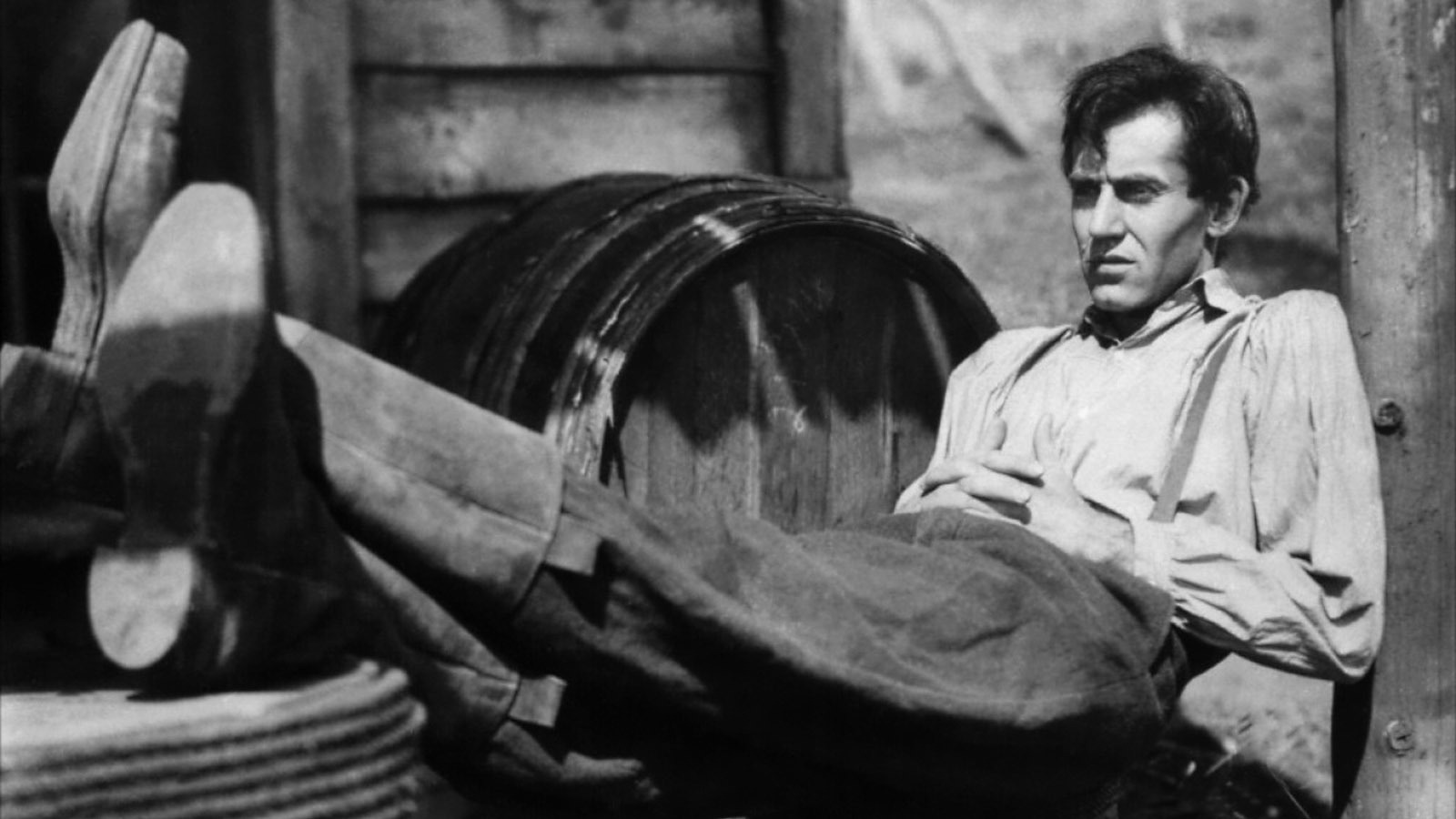
As a novice lawyer dispensing down-home wisdom with judicious modesty in John Ford’s Young Mr. Lincoln (1939), Henry Fonda embodied the decency Americans once liked to believe defined their character. Playing Oklahoma sharecropper Tom Joad in Ford’s The Grapes of Wrath (1940), Fonda gave voice to the Depression-era fury of the working class.
He stood firm in defense of the rule of law in William A. Wellman’s The Ox-Bow Incident (1943), Ford’s My Darling Clementine (1946), and Sidney Lumet’s 12 Angry Men (1957), but in Alfred Hitchcock’s The Wrong Man (1956), the down-on-his-luck musician he plays discovers the terrifying outcomes the system’s flaws can set in motion. Fonda was an honest naval officer in Ford and Mervyn LeRoy’s Mister Roberts (1955), a president pulling the world back from the brink in Lumet’s Fail Safe (1964), and an endearingly grumpy old man in On Golden Pond (1981), directed by Mark Rydell and costarring Fonda’s daughter Jane.
Fonda “personified New Deal democracy, Cold War liberalism, and—thanks to his rebellious children—the 1960s generation gap,” writes J. Hoberman for Artforum. “Was he also, as more than one person puts it in Alexander Horwath’s erudite, entertaining three-hour meta-biopic, Henry Fonda for President, the ‘quintessential American’? Embraced by cinephiles at festivals from Berlin to Buenos Aires and beyond, HFFP more than makes the case for Fonda’s centrality in the American imaginary—what Norman Mailer called the nation’s dream life.”
As A. S. Hamrah put it when he interviewed Horwath for Screen Slate, HFFP is “at least three things: a study of Fonda’s career, a social history of his films as they relate to developments in American history from the eighteenth century to the present, and a clear-eyed, coast-to-coast travelogue by a European, in the tradition of Alexis de Tocqueville and Jean Baudrillard. It succeeds in all three.”
Horwath, the former director of the Viennale and the Austrian Film Museum and the author of books on Michael Haneke, Josef von Sternberg, and the New Hollywood, will be on hand for a screening of HFFP this afternoon at the Yale Film Archive, where he’ll also introduce Young Mr. Lincoln tomorrow evening. He’ll be at the New Plaza Cinema in New York on Saturday, the National Gallery of Art in Washington on Sunday, the Speed Art Museum in Louisville next Thursday, the Siskel Film Center in Chicago on September 20, and the Lightbox Film Center in Philadelphia on September 21.
At In Review Online, Chris Cassingham calls HFFP “an example, wrapped in film essay clothing, of extremely thoughtful and surprising curation.” Brad Hanford at Slant admires “the unity of thought [Horwath] maintains despite his expansive, kaleidoscopic approach. Far from a trivial cataloging of coincidences, the myriad echoes between art and history are used to build a deeply considered critique of the Hollywood machine’s ideological underpinnings, of the real forces behind the images that machine produces.”
“Horwath isn’t out to critique U.S. policy so much as survey the impression those policies left on the cinema of the era and the man who, for many, came to be seen as a symbol of the nation’s conscience,” writes Jordan Cronk for Film Comment. “Fonda pushed back on that idea, frequently claiming that he never saw much of himself in the characters he portrayed. John Steinbeck once observed of the actor (in a quote also featured in the film) that ‘his face is a picture of opposites in conflict.’ More than any text or historical account I’ve come across, Horwath’s film gets close to squaring those contradictions, without simplifying or dispelling the ambiguity so crucial to the Fonda persona.”
Throughout HFFP, Horwath underscores archival images and footage from his own travels through America with passages from Lawrence Grobel’s twelve-hour, in-depth interview with Fonda recorded in 1981. A Hollywood actor of an entirely different stripe, Ronald Reagan, had just moved into the White House, and Fonda warns that his country was entering a dark phase that would last for a very long time.
When Imogen Sara Smith saw HFFP at Il Cinema Ritrovato last year, she found it to be “a rich case study in the fraught relationship between Hollywood fantasy and real life. Throughout the film, Horwath uses Reagan’s soothing, God-on-our-side triumphalism as a foil for Fonda’s near-pathological honesty and skepticism; Fonda bluntly said that listening to Reagan’s speeches made him want to throw up. The film builds a persuasive case that the actor known as an American archetype was really a powerful demythologizer of America and a living embodiment of ‘reasonable doubt.’”
In her excellent piece for Notebook on HFFP, Farran Smith Nehme zeroes in on a clip from the speech Reagan delivered when he accepted his nomination at the 1980 Republican National Convention, noting that with his folksy delivery, Reagan was “indicating. This is the term actors use for someone performing calculated, surface gestures that tell the audience which emotion is being evoked. In Reagan’s case, we have the furrowed brow, the pauses, the feigned hesitation. Good acting is fundamentally interior; bad acting, indicating, is exterior. Contrasting Reagan with Fonda’s deep, fiery interiority makes it obvious what Fonda had as an artist, and what Reagan lacked. Not that it mattered when playing on a national stage. Indicating is a mortal sin in acting; in politics, it’s a way of life, and it works.”
Don’t miss out on your Daily briefing! Subscribe to the RSS feed.