The Grandmaster: Tony Leung
Share
Before he presides over the jury at the Shanghai International Film Festival next month, Tony Leung Chiu Wai will be in New York this coming Tuesday to talk about several of the landmark roles he’s played in the thirteen films screening from today through May 7 in Film at Lincoln Center’s retrospective, The Grandmaster: Tony Leung. Chronologically, the series begins with Bullet in the Head (1990), one of three films in the program directed by John Woo.
Leung costars with Jacky Cheung and Waise Lee, all of them outlaws fleeing Hong Kong authorities to Vietnam, just as the war is heating up in 1967. “Almost immediately,” writes Jake Cole at Slant, “the magnitude of their mistake becomes clear as they find themselves in the middle of guerrilla raids, terror campaigns, and clandestine activities by various foreign agents using the chaos to make a quick buck . . . The sequences depicting U.S. and North Vietnamese assaults on villages demonstrate a gift for massive-scale action choreography that Woo would bring to his subsequent Hard Boiled, but here the staging emphasizes not a clarity of motion but the overwhelming chaos of being caught in the crossfire of war.”
Hard Boiled (1992) gives us Leung as Alan—a nod to Alain Delon and the killer he played in Jean-Pierre Melville’s Le samouraï (1967)—an undercover cop posing as a high-ranking triad assassin and being trailed by Chow Yun-fat’s Inspector “Tequila” Yuen. Leung delivers “all the handsome melancholy he’d later bring to the films of Wong Kar Wai,” writes Sean Burns for WBUR. “Like a lot of John Woo movies, Hard Boiled is a bromance about professionally violent men being tender with each other, clinging to outdated codes of honor as a crass and ruthless new generation makes a mockery of their morality.”
On Thursday and Sunday, FLC will present 35 mm screenings of Woo’s 287-minute war epic Red Cliff, originally released in two parts in 2008 and 2009. Leung stars as Zhou Yu, the general who led his troops to victory over the numerically superior forces of the warlord Cao Cao at the Battle of Red Cliffs in 208 AD. Red Cliff is “a grand, old-fashioned spectacle, with massive armies wreaking massive havoc in strategically ingenious ways,” wrote Scott Foundas in the Village Voice, and Leung is “at his most balletic as [warlord] Sun Quan’s magisterial viceroy.”
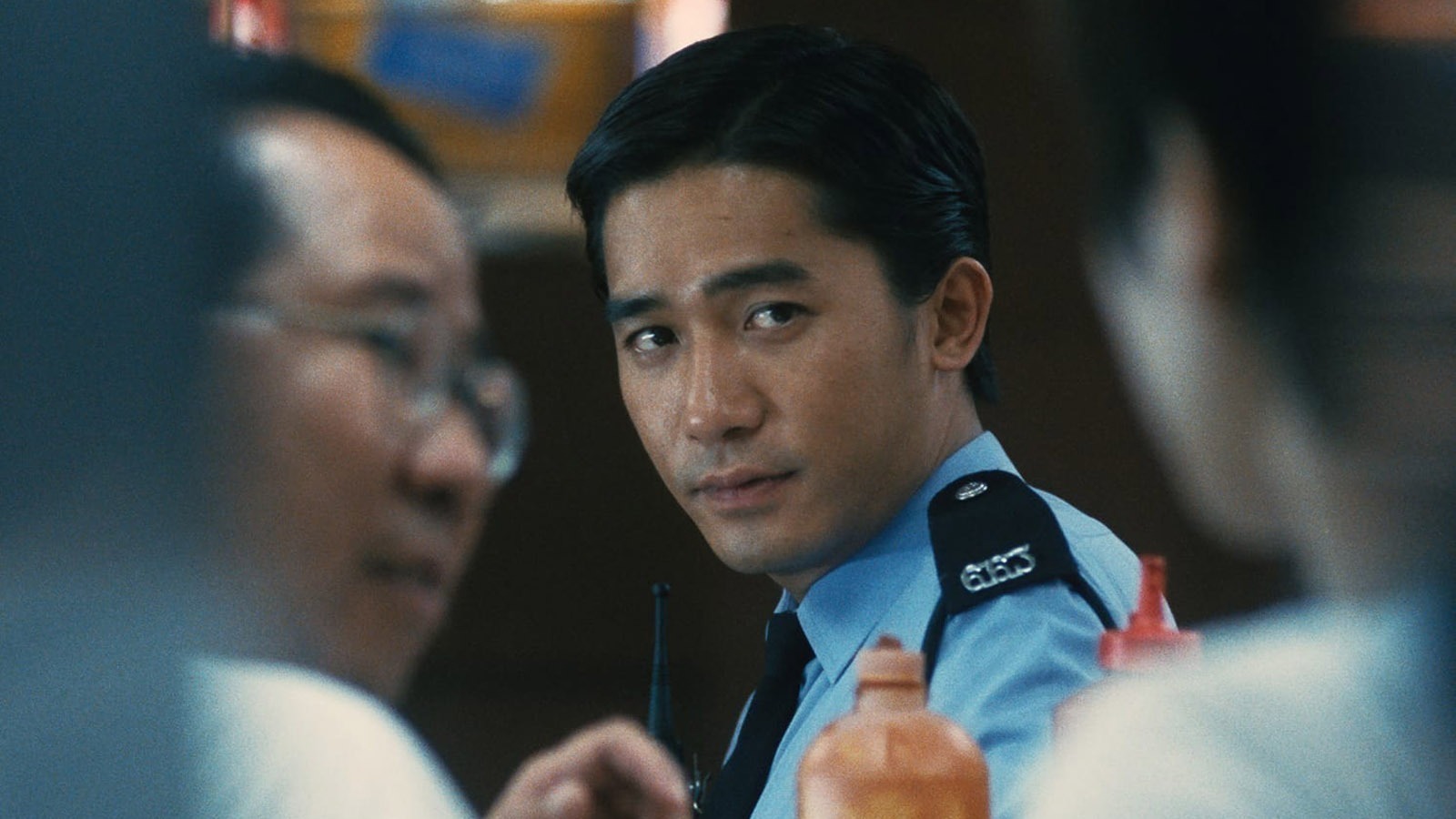
FLC will screen five films directed by Wong Kar Wai, probably the first filmmaker to come to Westerners’ minds when thinking of Leung. In Chungking Express (1994), “Wong gives Leung, who will become his filmic alter ego, an entrance to die for,” wrote Amy Taubin in 2008. “The shot is ostensibly from [Faye Wong’s] point of view, but as Cop 663 walks into close-up, she’s not the only one instantly smitten by the most soulful set of peepers in contemporary cinema.”’
Love breaks down in Happy Together (1997), costarring Leung and Leslie Cheung. “Wong has placed the utmost demands upon them, and they in turn make this harrowing, disintegrating relationship seem absolutely authentic,” wrote Kevin Thomas in the Los Angeles Times. Happy Together is “a take-no-prisoners movie from one of Hong Kong’s most idiosyncratic, shoot-from-the-hip filmmakers that’s the very antithesis of sentimental gay love stories. Don’t say you weren’t warned.”
Leung won the Best Actor award in Cannes for his performance in In the Mood for Love (2000) as Chow Mo-Wan, a journalist drawn to his new neighbor, Su Li-Zhen (Maggie Cheung), particularly when they both realize that their spouses are having an affair with each other. Set in Hong Kong in 1962, In the Mood for Love is widely regarded not only as one of the greatest films of this century so far, but also, as shot by Christopher Doyle and Mark Lee Ping-bing, one of the most breathtakingly beautiful.
A few years ago, we published a series of author Charles Yu’s notes on In the Mood for Love, and in one of them, he writes of Leung: “His eyes doing all the talking. Breaking into a slow smile, a smile that takes its time, moves from lips to eyes to temples and then back to the mouth, where it seems to soften and then turn into something else. The saddest smiles.”
“It’s hard to think of another actor who has made the self-negating effort of not wanting—of not needing anyone, while at the same time keeping the door of his battered heart slightly ajar—as sexy as Leung does in Wong’s films,” wrote Andrew Chan that same year. “These are luxurious romances filled with pleasure and possibility, but the questions at their core all have to do with pain: What is the right way to respond to the elusiveness of love, its cruel fictitiousness? How do we go on? More than any other star in Wong’s constellation, Leung wears these questions on his body. Looking at his face, you recognize the discipline required to carry on while holding all that ache inside yourself.”
Saturday’s screening of In the Mood for Love (2000) will be followed by a nine-minute coda, In the Mood for Love 2001, which in turn will be followed by 2046 (2004), a vision of a possible future in which Leung’s Mr. Chow has become a writer of erotic science fiction. “Sporting a Clark Gable mustache,” wrote John Powers in 2021, Mr. Chow “works his charm on several of Asia’s most famous leading ladies, including Carina Lau (playing another Mimi/Lulu), Gong Li (playing yet another Li-Zhen), and the Chinese Madonna, Faye Wong. His seductiveness reaches its peak in his erotic encounters—first delightful, then cruel—with Ziyi Zhang as Bai Ling, in a heartbreakingly passionate performance.”
Leung trained for four years to play kung fu master Ip Man in Wong’s The Grandmaster (2013), a “martial arts movie, though to describe it as such is somewhat like calling L’avventura a thriller about a missing woman,” as Manohla Dargis wrote in the New York Times. “Predictably, The Grandmaster is, given this filmmaker, less a straight biographical portrait of Ip Man and more an exploration of opposing forces like loyalty and love, horizontal and vertical, and the geometry of bodies moving through space and time.”
In Infernal Affairs (2002), the first film in a trilogy directed by Andrew Lau Wai-keung and Alan Mak, Leung’s Chen Wing-yan, a cop posing as a gangster, is swept up in a dangerous dance with Andy Lau Tak-wah’s Lau Kin-ming, a gangster posing as a cop. “Leung—who had already played a cop (in Chungking Express), a gangster (in 1990’s Bullet in the Head), and a cop pretending to be a gangster (in 1992’s Hard Boiled)—here slips into one of his finest roles with commanding ease,” writes Justin Chang. “He is suitably roughed-up for the part, looking scruffier than usual in open-necked shirts and a black leather jacket, and sporting unkempt bangs that partially obscure his famously expressive eyebrows. But in his rare off-the-clock moments, Chen exudes a surprising lightness, warmth, and even flirtatiousness—especially in scenes with his sympathetic therapist, Dr. Lee Sum-yee (Kelly Chen Wai-lam)—that further compound the tragic weight of his personal sacrifice.”
The series also features Trân Anh Hùng’s Cyclo (1995), which won the Golden Lion in Venice and offers Leung as the mysterious Poet, who also happens to be a gang leader in Ho Chi Minh City. In Hou Hsiao-hsien’s Flowers of Shanghai (1998), Leung is Master Wang, a wealthy patron of elegant nineteenth-century brothels.
Leung costars with Maggie Cheung, Jet Li, and Donnie Yen in Zhang Yimou’s dazzling Hero (2002), a Rashomon-like clash of conflicting narratives divided into five color-coded sections and shot by Christopher Doyle. And Ang Lee, who won a Golden Lion for Brokeback Mountain (2005), won a second one for Lust, Caution (2007), an erotically charged tale of World War II espionage. In her first feature, Tang Wei plays an actress recruited to set a honey trap for Leung’s Mr. Yee, a collaborator in Japanese-occupied Hong Kong in 1938 and in Shanghai in 1942.
The FLC retrospective will segue into a theatrical run for Silent Friend, in which Ildikó Enyedi wraps three stories around an ancient ginkgo tree in the university town of Marburg, Germany. Leung is “ideally cast as Tony Wong, an introverted Hong Kong neuroscientist on a visiting professorship,” finds Variety’s Guy Lodge. “Few actors can play ruminative solitude with Leung’s degree of restless, unspoken intensity.”
Don’t miss out on your Daily briefing! Subscribe to the RSS feed.