Kent Jones’s Late Fame
Share
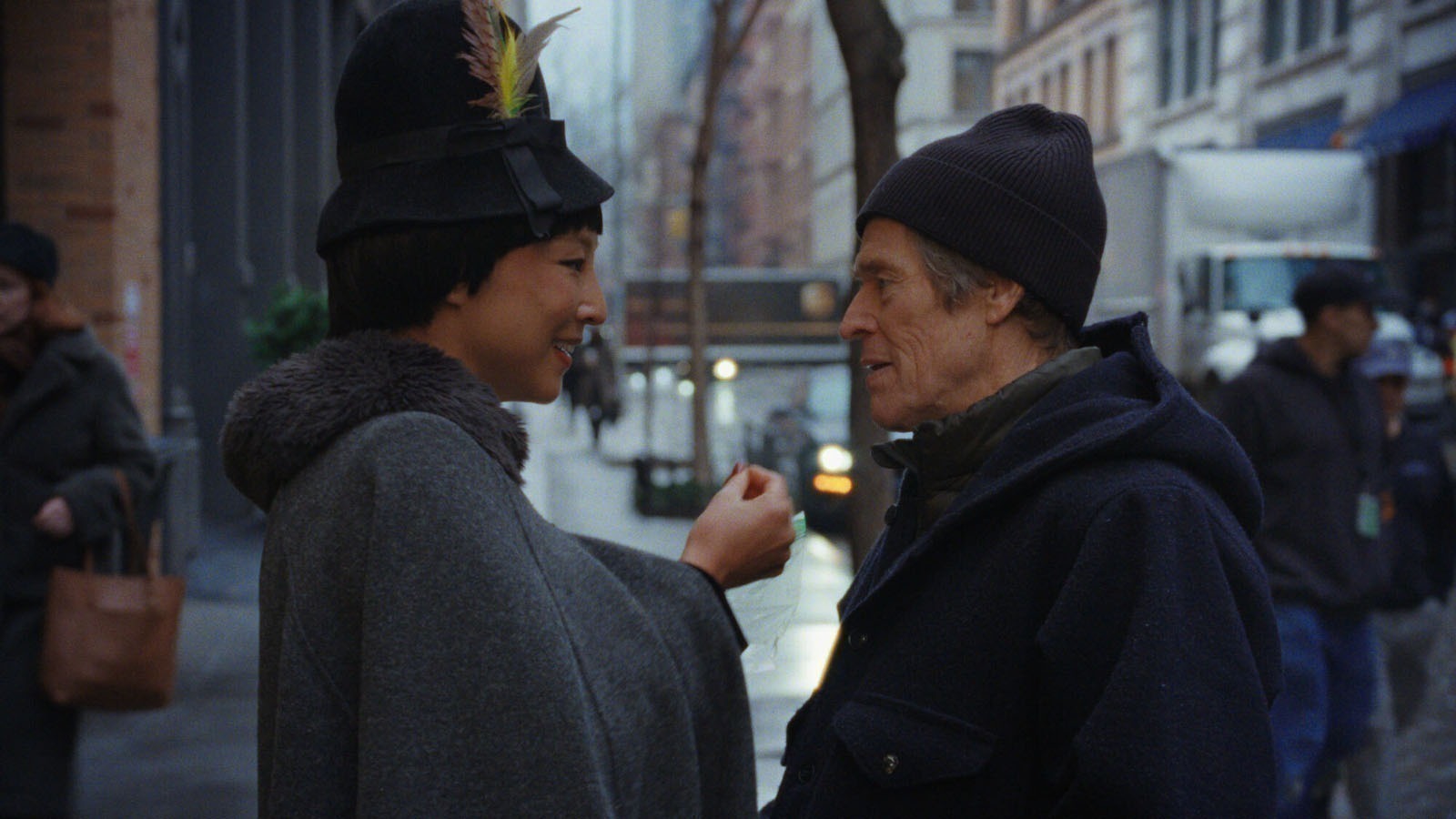
Talking to Variety’s Ellise Shafer, Kent Jones recalls finding himself seated on plane next to Willem Dafoe about a year ago. “We just basically talked for five hours, about everything but Late Fame,” says Jones, referring to his new feature, an adaptation of Arthur Schnitzler’s 1895 novel written by Samy Burch (May December). When Dafoe received the screenplay, “he realized that as we were speaking on the plane, he had a copy of the novella in his backpack. He was in the middle of reading it. It was just amazing.”
Dafoe stars in Late Fame as Ed Saxberger, a postal worker who arrived in New York at around the same time as Dafoe himself did, the mid-1970s, when he became a cofounding member of the experimental theater company the Wooster Group. His career trajectory has been on the up-and-up ever since. This season alone, he’s leading the casts of Miguel Ángel Jiménez’s The Birthday Party, which premiered last month in Locarno; Gastón Solnicki’s The Souffleur, which, like Late Fame, is launching in the Orizzonti program in Venice; and Nadia Latif’s The Man in My Basement, slated to premiere in Toronto on Friday.
Ed Saxberger’s path swerved in the opposite direction. In the late 1970s, he saw a collection of his poetry, Way Past Go, published and immediately forgotten. He lives a solitary life, working the early shift and occasionally shooting pool with a few regulars in a local haunt. One morning, he’s approached by a young man who tells him that he’s read Way Past Go and considers it to be a masterpiece. He’d like to introduce Ed to a group of fellow fans who call themselves the Enthusiasm Society.
“Led by the wealthy and snobbish Wilson Meyers (Edmund Donovan), who makes sure to tell Saxburger he bought his book at ‘Foyle’s on Charing Cross Road’ with ever the slightest of fake English accents,” writes Vulture’s Bilge Ebiri, “these pampered dandies ‘stand against negativity’ and the monetization of everything. They speak of the old virtues, they call each other by their last names, they discuss Big Important Literary Ideas over expensive wine dinners, and they rail against influencer culture and technology and cellphone addiction. But of course, they’re just as glued to their devices and obsessed with their brand.”
The Guardian’s Xan Brooks notes that Ed’s poetry is “ecstatic and gritty in the style of Frank O’Hara, conjuring the sounds and flavors of the old New York, and the authentically voracious hunger of youth. The Enthusiasm Society is a joke; its members’ approach to art is all wrong. But they are right about Saxberger, which means there may be some hope for them yet.”
Dafoe’s Ed is “halting, eager, resilient, defeated in many ways, but still a figure of buried yearning, and just maybe someone who’s waking up a part of himself he should never have allowed to go to sleep,” writes Variety’s Owen Gleiberman, who notes that Jones’s Diane (2018) gave us “a revelatory performance” from Mary Kay Place, who plays “an aging boomer negotiating a past that was so alive to her you could almost touch it. Watching Late Fame,” writes Gleiberman, “I felt the same bittersweet sting of humanity—except that what’s special about Jones’s voice came into even higher relief for me this time . . . In Late Fame, Jones fills the screen with people he wants to know more about.”
Perhaps especially Gloria, a flamboyant actress and the only female member of the Enthusiasm Society. As played by Greta Lee (Past Lives), Gloria has more than a few critics name-checking Sally Bowles, the Weimar-era singer and dancer played by Liza Minnelli in Bob Fosse’s Cabaret (1972). Gleiberman suggests that Gloria is “a cross between Louise Brooks and Lydia Lunch (with Tura Satana’s eye makeup).”
Late Fame “may be Ed’s story, but it’s Gloria who steals the film whenever she’s on screen,” writes Wendy Ide in Screen. “Ed’s journey in the film is more or less a circle . . . Gloria, however, is hurtling at light speed toward disaster. Or at least toward regional theater. And if there’s one criticism of this perceptive, light-footed drama, it’s that we don’t get to join her on the ride.”
In the Hollywood Reporter, Sheri Linden observes that the connection between Ed and Gloria is “intimate but tentative as she sets the shifting boundaries and he fumbles across them. Their amble through SoHo after taking mushrooms is an especially lovely sequence, intensely in the moment and alive with the downtown ghosts that infuse the story. Jones uses audio recordings of poets reading their work to poignant effect, and the lower Manhattan that he and cinematographer Wyatt Garfield capture is lived-in, not romanticized.”
For Vikram Murthi at IndieWire, what “saves Late Fame at almost every turn is Jones’s direction, which infuses even simple dialogue scenes with breezy maturity and palpable longing.” A renowned critic and programmer who worked with Martin Scorsese on My Voyage to Italy (1999) and A Letter to Elia (2010) before making his own documentary, Hitchcock/Truffaut (2015), Jones was the artistic director of the New York Film Festival from 2013 to 2019, and Late Fame heads next to the NYFF’s Main Slate.
Don’t miss out on your Daily briefing! Subscribe to the RSS feed.