Eisenstein in Vienna
Share
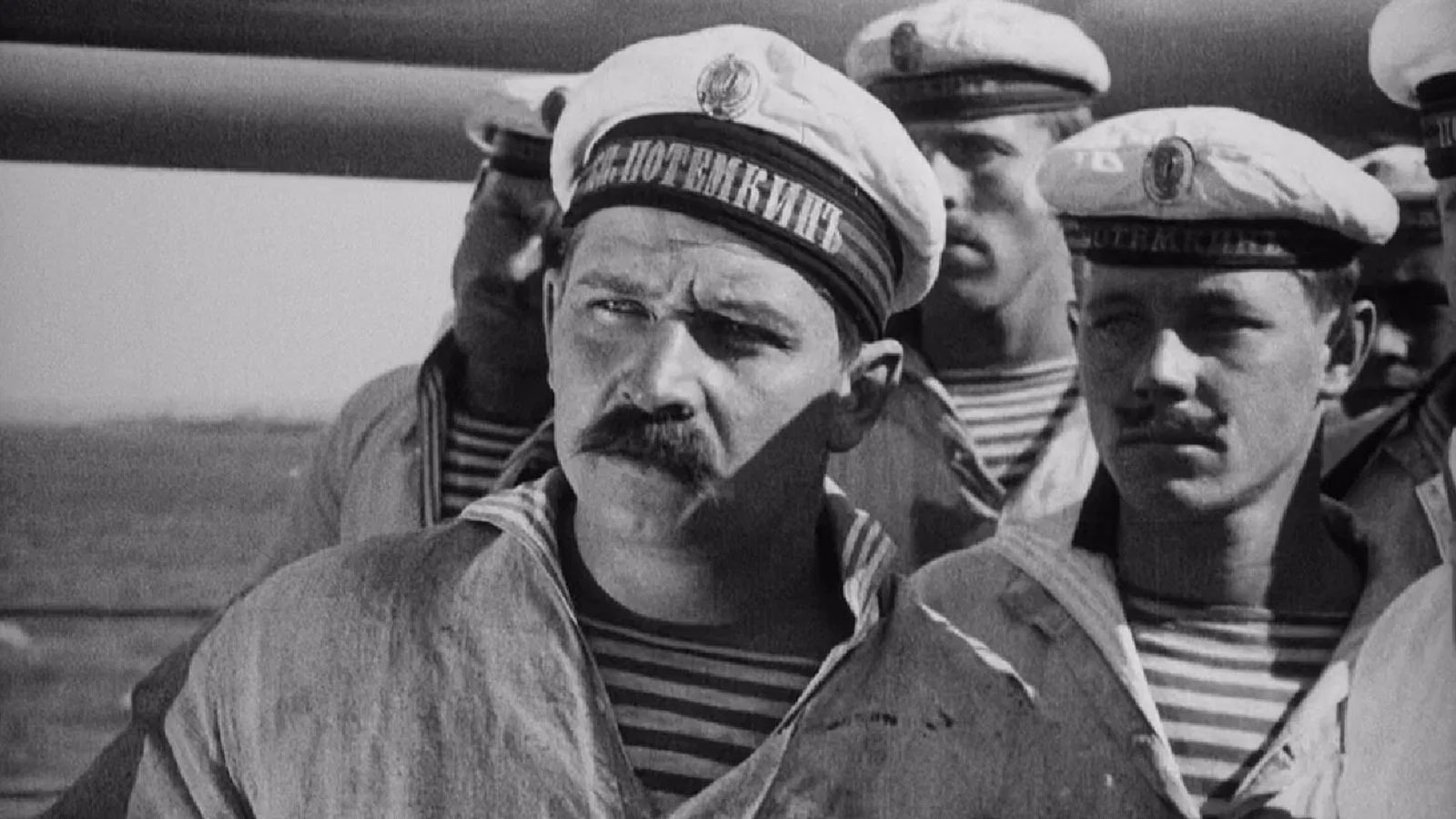
In Steps (1987), an ahead-of-its-time, twenty-six-minute short by the brilliant multimedia artist Zbigniew Rybczyński, the Soviet government, strapped for cash, takes a group of garishly dressed Americans on a tour inside the Odessa Steps sequence from Sergei Eisenstein’s Battleship Potemkin (1925). Chomping burgers and snapping souvenir photos, the Americans gape and gawk as Cossack troops mow down unarmed civilians, including a mother whose baby bounces in the carriage sent bounding down the steps.
Brian De Palma paid homage to the sequence in The Untouchables (1987) and Woody Allen parodied it in both Bananas (1971) and Love and Death (1975). In 2010, Christian Blauvelt wrote in Slant that Battleship Potemkin, considered one of the greatest films ever made by admirers as divergent as Charlie Chaplin, Luis Buñuel, and Joseph Goebbels, had become “cinema’s equivalent to the Tocatta and Fugue in D-minor, the Mona Lisa, Romeo and Juliet, works the public knows are famous without quite understanding why.”
From Thursday through January 5, the Austrian Film Museum in Vienna will celebrate the centennial of this “staple of undergraduate film courses” (Blauvelt) with Sergei Eisenstein: 100 Years of Potemkin, a series that includes all of the features “as well as rare short films, incomplete works, and other rarities.” The program opens with the first feature by one of the essential theorists of Soviet montage. Eisenstein was twenty-six when he made Strike (1925), a six-part depiction of a workers’ uprising in a Russian factory in 1903.
“If you try and forget everything you know about the Soviet story and its boot-on-the-throat history and instead look at the film as a filmmaker’s zesty freshman attack on the medium itself, then it is revealed as Eisenstein’s most personal film, the one he had the most fun making, the man’s 400 Blows or Citizen Kane,” wrote Michael Atkinson in a 2016 essay for the San Francisco Silent Film Festival. “For one thing, this razor-crisp blast from the past isn’t quite as burdened with grim, commanding Communist purpose as Eisenstein’s subsequent silents. It is, in fact, sprightly, jaunty, ceaselessly inventive and, surprisingly enough if you haven’t seen it in a few decades, witty.”
Potemkin was commissioned to mark the twentieth anniversary of the first Russian revolution. Lenin had taken a 1905 mutiny on a battleship returning from the war with Japan as a clear sign that the military would join the proletariat in the overthrow of the old order. Eisenstein juxtaposes shots of terrified faces and anonymous lines of uniformed troops with raised bayonets. “Much has been made of his dialectical approach to montage,” writes Blauvelt, “that the meaning created from two shots spliced together is greater than or different from the meaning of the two shots individually—an almost perfect cinematic metaphor for Hegel’s (and later Marx and Engel’s) view of history as synthesis. But every bit as important is Eisenstein’s ordering of his shots for poetic effect.”
October: Ten Days That Shook the World (1928), a bombastic dramatization of the 1917 revolution featuring a real-life factory worker as Lenin, is “a reinvention of documentary and historical films, a master class in rhythmic forms, a grand political cartoon,” writes Fernando F. Croce. “Stalin was not amused, but Godard certainly was.”
Eisenstein spent the next few years on tour, first in Europe, and then in the States, where he met one of his favorite filmmakers, Walt Disney. Chaplin introduced Eisenstein to Upton Sinclair, the socialist journalist and author of the novels The Jungle (1906) and Oil! (1927). Sinclair and his wife, Mary, set up a trust that would fund a film Eisenstein would shoot in Mexico, where the filmmaker hung for a time with Frida Kahlo and Diego Rivera.
A series of mishaps, financial and otherwise, put an end to the shooting in 1932. ¡Que viva México! was never fully realized as Eisenstein intended, though various versions have been released over the years. Eisenstein had set out “to document the mythic struggle of a Mexican people in a perpetual state of unrest,” wrote Slant’s Ed Gonzalez in 2003. “Despite the devastating, elegiac tone of its images, ¡Que viva México! is still every bit as unnerving and aesthetically confrontational as October. And just as the film would inform later works by Orson Welles (It’s All True), Alejandro Jodorowsky (El Topo) and Sergio Leone (A Fistful of Dollars), many of its images anticipate later works by Eisenstein.”
“Steeped in xenophobia and a scarcely unwarranted fear of foreign aggression, Alexander Nevsky [1938] was equally synchronized to the world situation in which it was produced,” wrote J. Hoberman in 2001. Prince Alexander (Nikolay Cherkasov) wards off a thirteenth-century invasion of Novgorod by Teutonic Knights, whose helmets resembled those worn by the Germans in the First World War.
As Hoberman notes, “the heart of the movie is the thirty-minute Battle on the Ice sequence. A triumph for Eisenstein as well as for Nevsky, this strategically under-cranked and brilliantly-edited mix of massing soldiers and slashing close combat—alternately horrifying and carnivalesque—would serve as a prototype for the battlefield scenes in Laurence Olivier’s Henry V, Akira Kurosawa’s Seven Samurai, and Stanley Kubrick’s Spartacus . . . Arguably the most propagandist film Eisenstein ever made, Alexander Nevsky remains a remarkably rhapsodic and dangerously stirring call to arms.”
Eisenstein was working on the third part of Ivan the Terrible when he died in 1948. The completed first and second parts make for an epic and “mad history of Russia’s first czar [that] just gets more ridiculously fascinating and baroque as the minutes mount,” finds Guy Maddin.
For Jonathan Rosenbaum, Eisenstein’s Ivan is “one of the most complexly nuanced works in cinema history, simultaneously celebrating, critiquing, and analyzing Ivan, Stalin, and himself.” When he watched it again in 2009, Rosenbaum was especially struck by “its shameless embrace of excess on all these fronts, registering both as a giddy kind of pop art and as a morbid exercise in medieval history. Despite its discarding of Eisenstein’s earlier montage aesthetic, I don’t think he ever made anything else in his career that was more personal or more expressive.”
Don’t miss out on your Daily briefing! Subscribe to the RSS feed.