A Kind of Requiem
Share
“What a year the past week has been in the battle for Warner Bros. Discovery,” writes Josef Adalian at Vulture. Even cinephiles who don’t make a habit of giving much thought to the business end of the art they love have been weighing the pluses and minuses of the studio winding up in the hands of either Netflix or Paramount, and the New Yorker’s Richard Brody places the standoff in the context of past crises in Hollywood history.
“It’s bad for the industry if Warner Bros. winds up a ‘content’ producer in a streaming empire out to crush the theater business,” writes Ben Schwartz in the Nation. “It’s equally bad if the studio ends up as a production company within a conglomerate following marching orders from the White House to make Rush Hour 4, 5, and 6. The best possible result would be for Trump to block both offers—a reasonable scenario in a normal administration—but who could afford to write him the check to do it?”
Best of 2025
As if to hammer home the stakes, a Warner Bros. release, Paul Thomas Anderson’s One Battle After Another, carries on topping lists of the best films of 2025, including the new polls of contributors to Film Comment and Screen Slate. For FC, Abby Sun writes that the film’s “paranoia-driven, pulsating action sequences illustrate not ideology but rather the infrastructure of allegiance—the signals, lingo, plans, and solidarity that sustain any embattled collective.” One Battle tops a list of twenty-five films at Slant and a list of fifty at the Film Stage—and it’s won a record nine awards from the Chicago Film Critics Association.
At Slate, Dana Stevens’s list is alphabetical, and among her ten is Kleber Mendonça Filho’s The Secret Agent, “both a heartfelt tender drama about a family separated by the threat of state violence and a deftly drawn group portrait of an underground resistance network finding ways to congregate and celebrate even in the worst of times.” At the Hollywood Reporter, The Secret Agent tops the lists from David Rooney and Jon Frosch and comes in at #2 for Sheri Linden, who puts Kaouther Ben Hania’s The Voice of Hind Rajab in the top spot.
Variety’s Owen Gleiberman has One Battle at #1, while Peter Debruge has been won over first and foremost by Dag Johan Haugerud’s Dreams. The Telegraph’s Robbie Collin is most impressed by Josh Safdie’s Marty Supreme: “Imagine a soul-of-America statement piece as grandly mounted as The Godfather or Chinatown, but packed with the mad comic cadenzas of vintage Laurel and Hardy, and you’ve just about got the measure of this madcap period comedy set in 1950s New York, in which Timothée Chalamet’s rascally ping-pong prodigy schemes his way towards the sport’s World Championship in Japan.”
The clear favorite for WBUR critic Sean Burns is Carson Lund’s debut feature, Eephus, which “follows the last game played by two adult Sunday league baseball teams on a public field slated for demolition in Douglas, Massachusetts. Eephus is a funny, melancholy marvel of emotionally constipated New England masculinity, full of characters who can only communicate by busting each other’s chops. One of them asks, ‘Is there anything more beautiful than the sun setting on a fat man stealing second base?’ Nothing I saw this year came close.”
Goings On
In festival news, Wim Wenders will preside over the International Jury of the seventy-sixth Berlinale (February 12 through 22). And Slamdance (February 19 through 25) will open in Los Angeles with The Projectionist, directed by Alexandre Rockwell (In the Soup) and produced by Quentin Tarantino and Jack Auen.
This evening in New York, Anthology Film Archives will screen Encore, the 1988 film by Paul Vecchiali, the founder of Diagonale et Co., a production company that was also for a time a vibrant collective, even an extended family. The second issue of Narrow Margin will be the first dossier in any language on the company’s complete roster of works, and to celebrate the publication, the quarterly will present two films by Jean-Claude Biette, Far from Manhattan (1982) and The Complex of Toulon (1995), at Light Industry on Sunday.
Biette wrote criticism for Cahiers du cinéma and cofounded Trafic with Serge Daney. In the inaugural issue of La Lettre du cinéma, Serge Bozon wrote: “The cinema of Jean-Claude Biette is, for many young people, far away from Franco-French traditionalism, an area of freedom.”
Filmmaker and former Lettre du cinéma editor Axelle Ropert wrote a primer on Diagonale for Screen Slate two years ago: “What these films made by huge cinephiles, music lovers and, from a social perspective, ‘obscure’ filmmakers have in common is an acute sense of class relations, a taste for heartrending lyricism inherited from Pagnol and Grémillon, an affection for actors as eccentric as they are brilliant (Hélène Surgère, Sonia Saviange, Jean-Christophe Bouvet), a confidence in the endless unfolding of dialogue, a love of popular chansons of the 1930s, a loathing for the routine screenplay, and an infinite trust in mise-en-scène, which ‘does everything.’”
At Metrograph on Saturday, Tone Glow will host a screening of Albert Lewin’s Technicolor wonder Pandora and the Dutchman (1951) preceded by a performance from singer and pianist Eliana Glass. Later that same evening, Nicolas Rapold and Mark Asch will record an episode of The Last Thing I Saw and present Seijun Suzuki’s Eight Hours of Terror (1957).
This Week’s Highlights
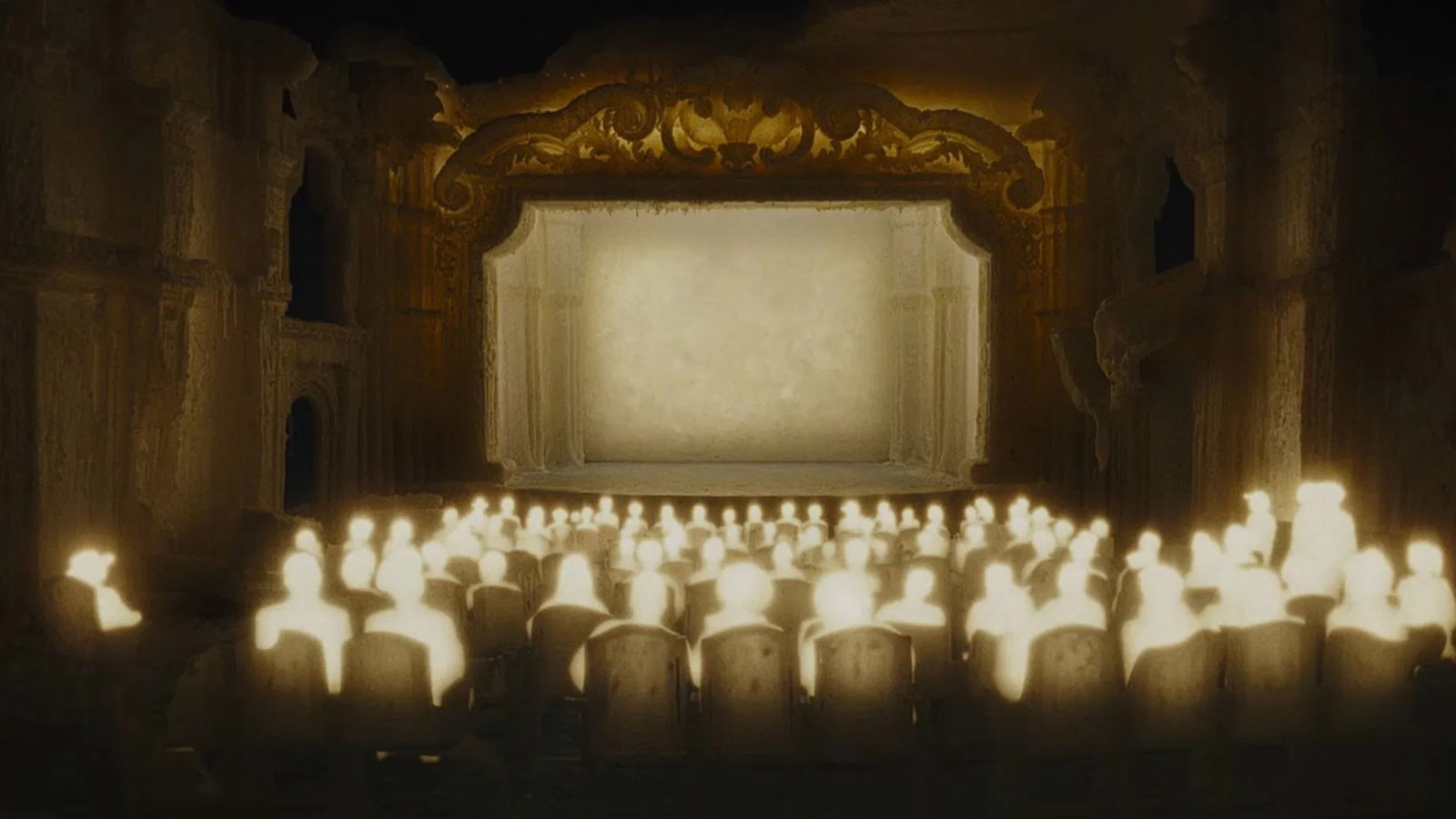
- Bi Gan is on the Next Best Picture Podcast and at Notebook, talking to Leonardo Goi about Resurrection, starring Jackson Yee as a shape-shifting dreamer wandering through a hundred years of cinema history. “Bi is an art-film savant, but he’s also an entertainer, and he keeps things moving as he floods the screen with beauty, playful visual associations, and references to diversions like hand shadows, puppets, protocinematic machines, and old movies,” writes Manohla Dargis in the New York Times. “There’s a melancholic cast to Resurrection; yet while it’s easy to see it as a kind of requiem for cinema, Bi’s filmmaking remains too dynamic to inspire funereal tears.”
- “Though not as immediately obvious as warning signs detected by sight, smell, taste, or touch, hearing has its omens,” writes Darran Anderson at the Quietus. “The moment the forest turns silent. The growl of an apex predator . . . Then there are sounds that defy even the parameters of our fears, boundless horrors which filmmakers, editors, and sound designers are adept at creating.” Anderson listens in on Francis Ford Coppola’s The Conversation (1974), Jerzy Skolimowski’s The Shout (1978), Brian De Palma’s Blow Out (1981), and Peter Strickland’s Berberian Sound Studio (2012). “Sound might well be the sense that accompanies us longest,” notes Anderson. “Sound appears to be the last sense to go at death, and, before then, songs are among the last surviving memories for those with cognitive decline.”
- For Screen Slate, Steve Macfarlane talks with Robinson Devor and Charles Mudede (Police Beat, Zoo) about their latest collaboration, Suburban Fury, which Richard Brody calls “a paranoid masterwork, depicting deception morphing into self-deception and principle twisting into delusion.” Its subject is the late Sara Jane Moore, the film’s sole interviewee and a former FBI informant who tried—and failed—to assassinate President Gerald Ford in San Francisco in 1975. “It was important to us to stress that, while everyone’s talking about how divided this country is, a lot of those divisions have always been there,” says Mudede. Moore “sort of exemplifies this America that keeps going back and forth, except in her own personality.”
- Radu Jude’s Sleep #2 (2024) “began as a joke—a pun on Andy Warhol’s notorious 1964 durational film Sleep—but quickly evolved into something stranger, richer, and more resonant,” writes Pip Chodorov for e-flux. “Filmed entirely from a static EarthCam pointed at Warhol’s grave in a Pittsburgh cemetery and recorded from Jude’s own desktop computer in Romania, Sleep #2 is a film of quiet observation and deep implication . . . What at first seems like a conceptual prank becomes a meditation on death and life, surveillance and authorship, the aesthetics of glitch, and the unexpected comedy of passersby paying tribute to a Pop art icon. Like Warhol, Jude embraces repetition, but he also adds a layer of meta-awareness and seasonal change—haikus, weather, animals, visitors, accidents—marking time with the patience of a philosopher and the humor of a sly cinephile.”
- In the new Film Quarterly, Maggie Hennefeld looks back on this year’s Il Cinema Ritrovato, where her “wayward travels encompassed Nordic (or ‘Norden’) noir, queer Hollywood, Lebanese antiwar docufiction, Sri Lankan lyricism, Italian diva melodrama, Tunisian experimental cine-theater, Japanese prewar satire, and French zoomorphic acrobatics—among other genre mutants and interspecies hybrids!” Ramzi Fawaz writes about the politics of the Star Wars series Andor, which FQ editor J. M. Tyree calls “an intriguing case study in a franchise that has been embraced critically and publicly as a clear rebuke to the authoritarian drift in American life.” And Joseph Pearson tells the story behind The Big Lift (1950), a Hollywood production shot on location in Berlin, directed by George Seaton (Miracle on 34th Street), and starring Montgomery Clift.
Don’t miss out on your Daily briefing! Subscribe to the RSS feed.