Eddington City Limits
Share
Set in the summer of 2020 at the height of the pandemic, a presidential election, and Black Lives Matter protests inflamed by the killing of George Floyd, Ari Aster’s Eddington “brings the feeling of that time back with the sharp sting of a cotton swab jabbed into the back of your nose,” wrote Slate’s Sam Adams when he caught the film’s premiere in Cannes. Eddington split the critics in May, and since it opened in theaters last month, its effect on audiences has been much the same.
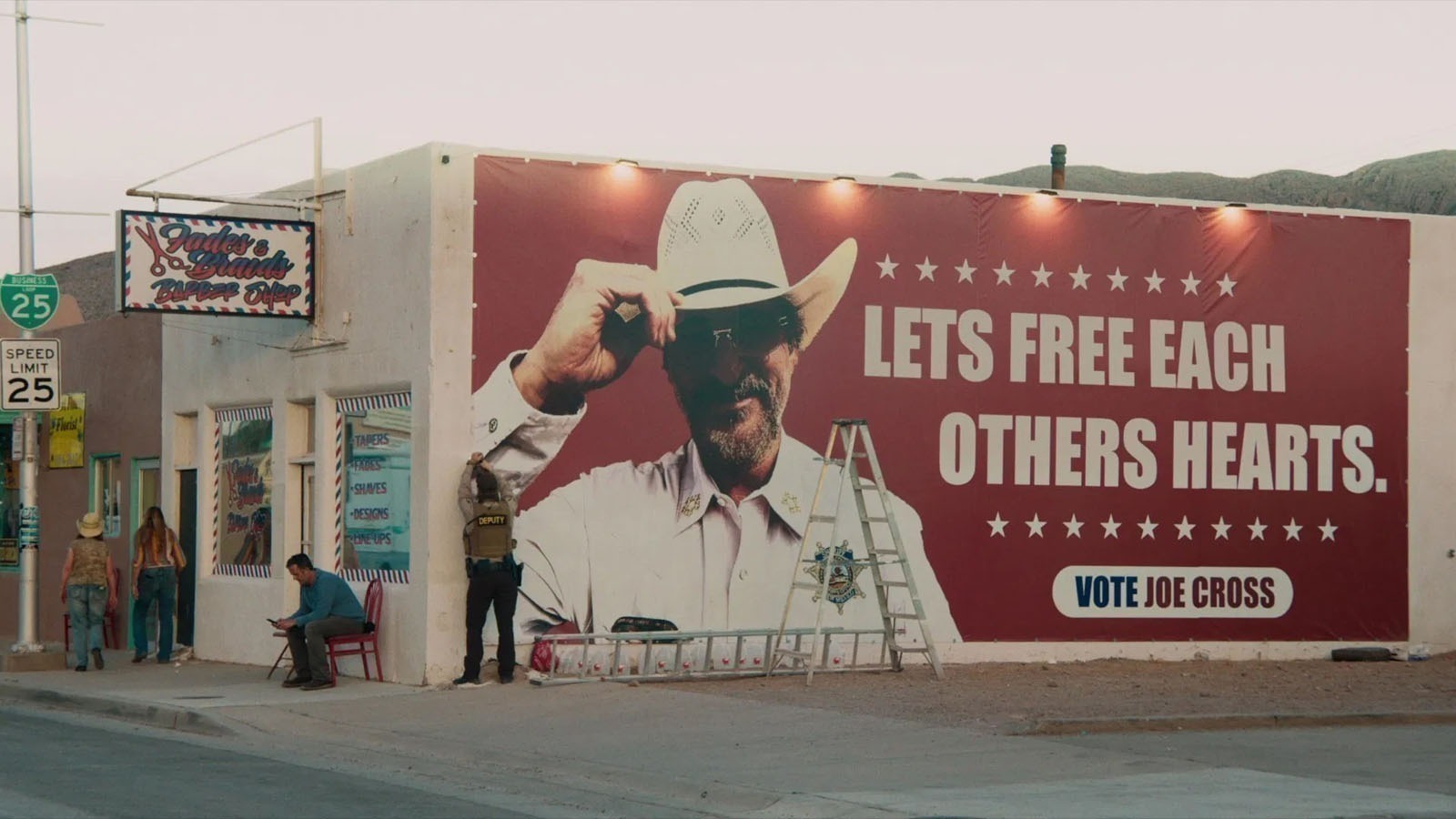
Like Vanity Fair’s Richard Lawson, Adams has found that a second viewing has enhanced his appreciation for what Aster is up to with his depiction of a showdown between Joe Cross (Joaquin Phoenix), the mask mandate–resistant sheriff of a small town in New Mexico, and Ted Garcia (Pablo Pascal), the sleek mayor running for reelection on a platform of boosting Eddington’s economy by ushering in an AI company’s data center. Joe’s wife (Emma Stone) is falling under the spell of a cult leader (Austin Butler), his mother-in-law (Deirdre O’Connell) is tumbling down every rabbit hole that opens up online, and out on the streets, white social-justice warriors are demanding that the town’s lone Black cop (Michael Ward) pick a side.
“At its worst,” wrote Blake Williams in a dispatch to Filmmaker from Cannes, “Eddington evokes the facile social commentary of Don’t Look Up (2021), while at its best it calls to mind the violent and unrelenting nihilism of Cormac McCarthy. I won’t be joining any chorus decrying Aster’s ‘self-indulgence’ here—as if art, and indeed cinema, would have ever evolved at all without our most indulgent artists’ flights of fancy—but I do think he’d benefit from being a little less comprehensive.”
“Take away the Covid masks, and this mix of modern-day western, political satire, and several other genres mashed into one manic panic attack could be set last week,” wrote Rolling Stone’s David Fear. “Same divisiveness, same finger-pointing, same inability to agree on a consensual reality, same constantly present anxiety, same president.”
A second viewing hasn’t done much for the New Yorker’s Justin Chang. In Cannes, he found that the film “descends into sniggering superiority, cartoonish violence, and generally stultifying tedium.” In July, while recognizing the “propulsive craft and cunning” of Aster’s Hereditary (2018) and Midsommar (2019), he noted that he found Beau Is Afraid (2023) “ungainly” and wrote: “The times grow worse and worse; must his movies follow suit?” But for the Los Angeles Times’ Amy Nicholson, Eddington is “such a superb social satire about contemporary America that I want to bury it in the desert for twenty years. More distance will make it easier to laugh.”
And so it goes, back and forth. Aster is fully aware that Eddington is an equal opportunity offender, and he’s been talking through his motivations, strategies, and the film’s reception with Bill Hader (A24 Podcast), Babygirl director Halina Reijn (Interview), film essayist Adam Curtis (Guardian), Sam Fragoso (Talk Easy), Vikram Murthi (Filmmaker), Matthew Jacobs (Vulture), Rocco T. Thompson (Slant), Elena Lazic (Animus), and many more for weeks on end now. Earlier this month, he dropped by the Criterion Closet for a second time to spotlight some of the films that have been on his mind during the making and rollout of his fourth feature.
Starting Friday, a series he’s coprogrammed with the Museum of the Moving Image, Eddington City Limits, will showcase five films that might be mapped somewhere in the same neighborhood. The small-town pressure cooker of Lars von Trier’s Dogville (2003) and the cacophonous sprawl of Robert Altman’s Nashville (1975) both lead to violent ends, while mass hysteria is played for laughs in Steven Spielberg’s 1941 (1979). Aster will be on hand to discuss Oliver Stone’s JFK (1991), which is practically an ode to Americans’ propensity for spinning labyrinthine conspiracy theories, and Sam Peckinpah’s bloody revisionist western The Wild Bunch (1969) will wrap the series on August 31.
In the meantime, Aster’s own movie is still in theaters. “Ultimately,” writes Adam Nayman at the Ringer, “Eddington is not as much a cautionary tale about American psychosis as an immersion in it, and, as such, it gradually takes on the form of a stress dream, gaining in resonance the further it plunges into a fugue state. That wobbly, twilight-zone quality of reality folding in on itself is probably Aster’s sweet spot as a filmmaker.”
At Reverse Shot, Guy Lodge observes that most art made during the pandemic “projected a hope that we’d pull through and that everything would be okay. Eddington wields a half-decade of perspective to instead assure us that we didn’t, and that everything is pretty much fucked.”
Don’t miss out on your Daily briefing! Subscribe to the RSS feed.