Silent Movie Week 2025
Share
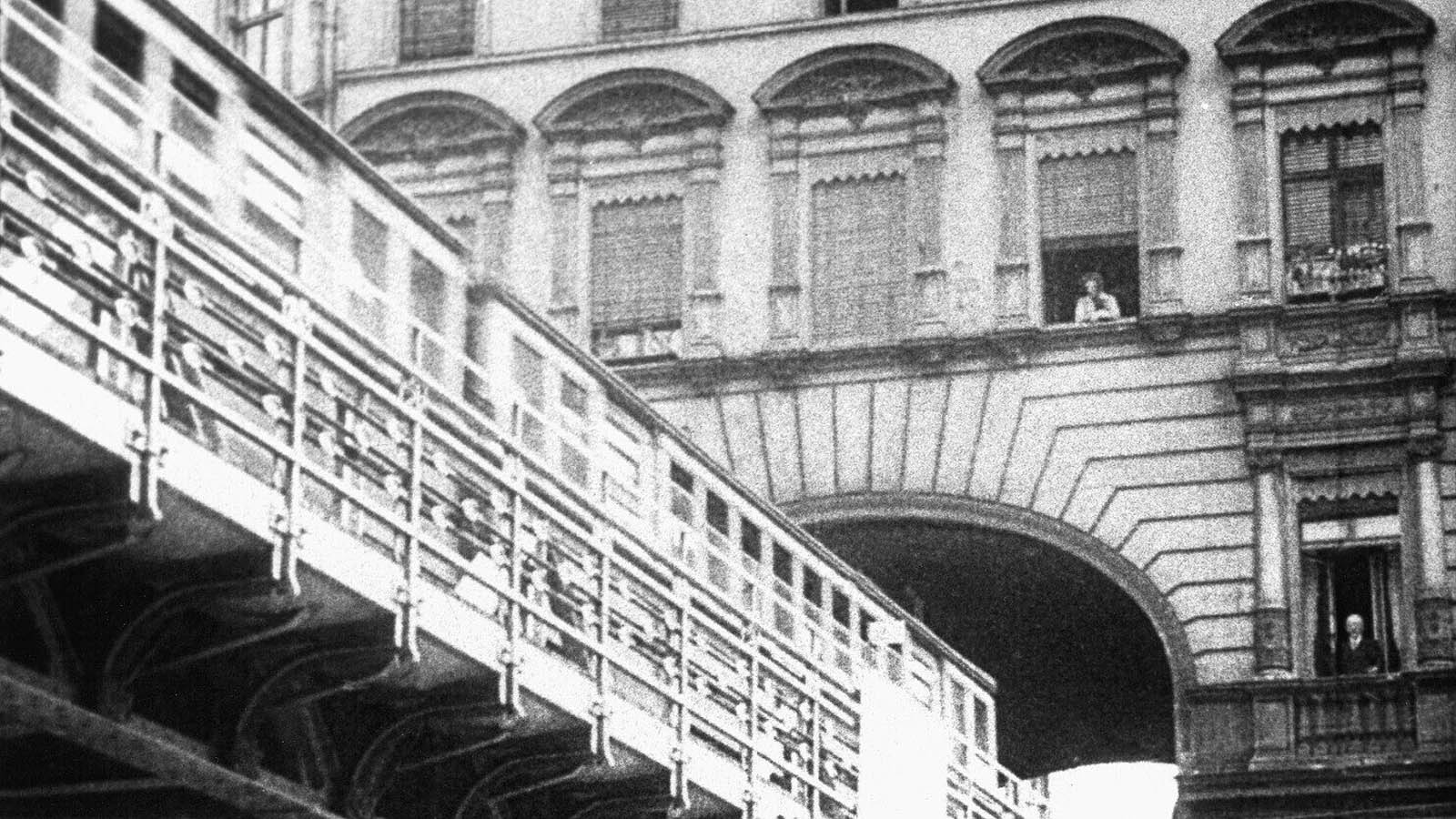
Three of the seven recently restored films screening in this year’s Silent Movie Week are German productions made during the Weimar era, that precarious period between two world wars when nights were danced away in cabarets while Nazis and communists went at each other on the streets. The series opens at the Museum of Modern Art on Wednesday with Berlin: Symphony of a Great City (1927), Walter Ruttmann’s eclectic chronicle of a day in the life of the once and future capital informed by his interest in Soviet montage and the work of Dziga Vertov.
“Almost overnight,” wrote Otto Friedrich in his 1972 book Before the Deluge, “the somewhat staid capital of Kaiser Wilhelm had become the center of Europe, attracting scientists like Einstein and von Neumann, writers like Auden and Isherwood, the builders and designers of the Bauhaus school, and a turbulent colony of more than fifty thousand Russian refugees. Vladimir Nabokov gave tennis lessons here, and young daredevils forced their cars to more than a hundred miles an hour on the new Avus speedway, and ladies in evening dress would proceed directly from the theater to the pandemonium of the six-day bicycle races. Berlin’s nightclubs were the most uninhibited in Europe; its booted and umbrella-waving streetwalkers the most bizarre. Above all, Berlin in the 1920s represented a state of mind, a sense of freedom and exhilaration. And because it was so utterly destroyed after a flowering of less than fifteen years, it has become a kind of mythical city, a lost paradise.”
One of those streetwalkers lures a married man into a seedy underworld where he’ll lose all his money and get framed for murder in Karl Grune’s The Street (1923). “Somewhere between a city symphony, a kammerspiel, an expressionist nightmare, a proto-noir, a morality tale, and Eyes Wide Shut,” wrote David Cairns for Notebook in 2010, The Street is “pungent, spicy, and rich. Grune’s playground is an enormous artificial street, and a diorama of the city laid out across a river, creating a stylized reality which isn’t quite in the domain of pure expressionism, but sometimes sidles up to it with a sly look.”
Shot at the Johannisthal Studios in Berlin, the breezy comedy Miss Saxophone (1928) was directed by Czech filmmaker Karel Lamač and features an international cast led by Czech star Anny Ondra. Lamač and Ondra were an item at the time, and in 1930, they cofounded the production company Ondra-Lamač Film. By this point, Ondra had starred in The Manxman and Blackmail, both released in 1929 and both directed by a young British upstart, Alfred Hitchcock. In 1933, Ondra married boxer Max Schmeling, and the Nazis did all they could to turn the couple into fascist superstars—but Schmeling resisted and even secretly helped save the lives of two Jewish children. Ondra and Lamač remained friends, and he died in her arms in 1952.
In Miss Saxophone, Ondra stars as Anni von Aspen, an aristocrat destined to attend a boarding school in London. Mary Parker plays Susi Hille, the daughter of a stage mother. Susi would rather study than tread the boards, and Anni yearns for the limelight. So they trade identities. “Ondra is radiant in the film,” wrote Michal Večeřa and Lou Burkart when the restoration screened at the Pordenone Silent Film Festival, and “her eccentric dance number is amazing.”
A Silent Hooray for Hollywood
In May, a new restoration of Charlie Chaplin’s The Gold Rush (1925) premiered in Cannes, and on June 26, the hundredth anniversary of the classic comedy was celebrated with hundreds of screenings in more than seventy countries. When MoMA curator Dave Kehr reviewed “Chaplin’s best-loved film” for the Chicago Reader in 1984, he noted that the “blend of slapstick and pathos is seamless, although the cynicism of the final scene is still surprising. Chaplin’s later films are quirkier and more personal, but this is quintessential Charlie, and unmissable.”
In 2019, Kehr wrote the notes for the Il Cinema Ritrovato screening of Street Angel (1928), which reunited director Frank Borzage with the stars of his Seventh Heaven (1927), Janet Gaynor and Charles Farrell. A Neapolitan waif (Gaynor) poses for an artist (Farrell), lands in jail, and after her release, “she finds her portrait hanging in a church, reframed as a Madonna,” wrote Kehr. “Once again, Borzage conflates the romantic and the religious to devastating effect. The final images, in which Farrell carries Gaynor through the swirling fog of the Bay of Naples, constitute one of the most magnificent and moving passages in all of silent film.”
Herbert Brenon’s Beau Geste (1926), starring Ronald Colman as the eldest of three English brothers who enlist in the French Foreign Legion, was the first of many adaptations of P. C. Wren’s novel. For Jim Hemphill at IndieWire, it remains “a truly awe-inspiring spectacle.”
John M. Stahl’s Memory Lane (1926) “moves easily back and forth between witty humor and bittersweet melancholy,” writes Imogen Sara Smith. Eleanor Boardman stars as Mary, a woman engaged to a devoted but not particularly exciting fellow (Conrad Nagel). Her first love (William Haines) rolls back into town, “tormenting her with second thoughts and casting a shadow over the start of her marriage,” writes Smith. “It is a simple story without dramatic twists of fate, but it is daring in the way it forces us to like and feel for both men, and to accept that life rarely supplies resolution, truth, and justice. Here Stahl has matured into a filmmaker who ranks with Mikio Naruse as an artist of tender irony and heartbreaking reserve.”
Don’t miss out on your Daily briefing! Subscribe to the RSS feed.