July Books
Share
We just have to note at the top of this month’s books roundup that we’re very much looking forward to David M. Stewart’s There’s No Going Back: The Life and Work of Jonathan Demme. It will be out on July 29, and Sean Burns calls it “exactly the kind of funky and collegial biography this great artist deserves.”
Clint: The Man and the Movies, in the meantime, is “an intelligent and energetic chronicle that encompasses high-flown critique, lowdown tabloid gossip, and savvy show-business reportage,” writes A. O. Scott in the New York Times. “Hollywood used to be more solidly in the business of minting global stars and world-class auteurs, but nobody else since the advent of sound has succeeded so completely, or lasted so long, in both roles. To contemplate Eastwood’s career, with the help of Shawn Levy’s brisk and capable new biography, is to marvel anew at the man’s uniqueness. It’s as if John Ford were also John Wayne, or Tom Cruise had a side gig as Steven Spielberg.”
Levy’s assessments of the films are “routinely insightful,” writes Jonathan Russell Clark in the Washington Post, but Eastwood is “also compelling for the less-public aspects of his personality, and the book’s focus on the films—which, again, can be astute—sits uncomfortably next to personal incidents involving intense violence, rampant infidelity, petty vindictiveness, and even coerced sterilization.” The goal of the standard biography, “exemplified by Levy’s book, is still to attempt a comprehensive treatment. The genre might be due for an existential reckoning.”
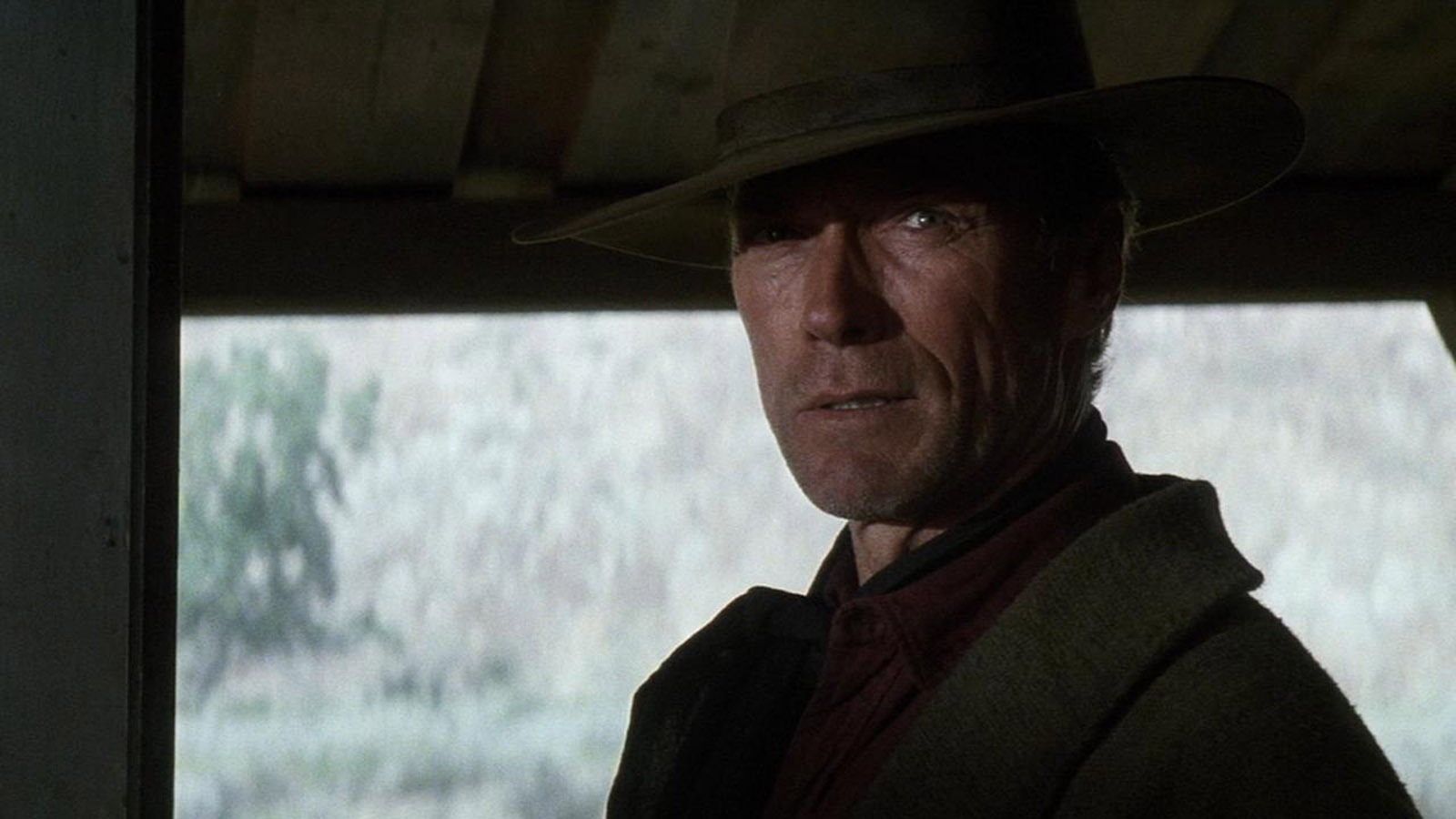
Vanity Fair is running an excerpt in which Levy tells the story of the making of Unforgiven (1992) and quotes from several “goggled-eyed” reviews. “Watch it again and again,” writes Levy, “and what you might once have thought of as a rum choice—a music cue, a shot of landscape, a moment of acting—blends in more seamlessly each time. Is it a perfect movie? Perhaps not. But its imperfections live in choices, not lapses, and are thus matters of taste, not competence. It is thoroughgoing, potent, real, and true.”
The NYT’s Jason Zinoman talks with writer and director Larry Charles about his work in television (Seinfeld, Curb Your Enthusiasm) and movies (Masked and Anonymous, Borat) and about his new memoir, Comedy Samurai: Forty Years of Blood, Guts, and Laughter, which Zinoman calls “a must-read for comedy nerds.” Charles’s career, “which began by selling a joke to Jay Leno, is a pocket history of modern comedy, anchored by surprisingly melancholy portraits of his two most fertile artistic relationships—with Larry David and Sacha Baron Cohen.”
For Film International, William Blick chats with Carl Rollyson about his latest biography, Ronald Colman: Hollywood’s Gentleman Hero. The conversation also touches on a few of Rollyson’s previous subjects, including William Faulkner, Sylvia Plath, and Susan Sontag. And at Wellesnet, Ray Kelly has a few questions for Dave Wain, one of the three coauthors of “We Must Shoot!” The Life and Art of Gary Graver, the cinematographer and director who began working closely with Orson Welles in 1970 and stuck by his side until Welles died in 1985.
Big Ideas
Downtime: The Twentieth Century in Slow Motion is cultural scholar Mark Goble’s new book on what he calls “the very least special effect” in cinema and a literary technique put to effective use by writers as varied as Faulkner, Don DeLillo, and W. G. Sebald. Sketching a quick history of slo-mo in the movies in his review for the New Republic, Scott W. Stern suddenly declares: “Our world is, obviously, ending.” He cites climate change, the rise of authoritarianism, and the threat of future pandemics before quoting Goble: “Slow motion is what modernity looks like as it is dying.”
Tom Gunning’s new collection The Attractions of the Moving Image: Essays on History, Theory, and the Avant-Garde “provides not only an accessible and unpretentious historical overview of cinema’s origins,” writes Paul Attard for Notebook, “but also a comprehensive exploration of the myriad directions moving-image art has taken since the likes of the Lumière brothers and Méliès, and what new directions remain available to it . . . How many academics now carry Gunning’s torch, not merely in terms of the content of their research, but in their relentless, probing curiosity?”
Singular Movies
Filmmaker’s Scott Macaulay talks with Nicholas Rombes about Gerry, an analysis of Gus Van Sant’s 2002 film that launches Timecodes, a new series coedited with Nadine Boljkovac. Each volume is a minute-by-minute breakdown and rumination on a single film, and future titles include BlacKkKlansman (Alex Zamalin), Twin Peaks: The Return Part 8 (Jeff Wood), and Neptune Frost (Steven Shaviro). Van Sant’s hundred-minute film “generates from Rombes meditations on many topics,” writes Macaulay, “including the arcs of Van Sant’s career, the long shot as found here as well as in Jeanne Dielman, Touch of Evil, and Rope, and how knowledge of industry genres affects the way we apprehend movies.”
We Were the Scenery, the winner of this year’s Short Film Jury Award: Nonfiction at Sundance, is directed by Christopher Radcliff and written by Cathy Linh Che, whose second volume of poetry is Becoming Ghost. “The film and the book draw from the same story,” she tells J. M. Tyree, a contributing editor at the New England Review. In 1975, her parents fled by boat from Vietnam to the Philippines, where they were hired as extras during the making of Francis Ford Coppola’s Apocalypse Now (1979). Central to the book is “my desire to provide an alternative to what has dominated the American imagination of the Vietnam War. The overall imagery and language in the Vietnam War canon lack Vietnamese voices, perspectives, stories, complexity, and agency.”
Curious Fictions
Danzy Senna’s Colored Television, Justin Taylor’s Reboot, Porochista Khakpour’s Tehrangeles, Patrick Nathan’s The Future Was Color, and Taffy Brodesser-Akner’s Long Island Compromise are among the titles Lisa Borst considers in her irresistibly engaging survey for n+1. “These new TV novels are texts in which the publishing and entertainment industries explicitly jockey for cultural dominance, in which TV is examined from within a form it’s assaulted,” writes Borst. “Like Didion’s restless stars in Play It as It Lays, or Gore Vidal’s lusty acting instructors in Myra Breckinridge, or Evelyn Waugh’s expat script doctors in The Loved One, the subjects of these texts are entertainment workers, anxiously adapting their white-collar labor to suit the demands of a volatile industry.”
For the Los Angeles Review of Books, Ilana Masad talks with Katharine Coldiron about her fifth book. “Blending fiction, criticism, and memoir to great effect,” writes Masad, Out There in the Dark “explores heady ideas—the nature of truth, the mythologized West, ambition—all while grounding them in the author’s experiences, in film history, and in imagined scenes that give voice to what might have been.” Coldiron says that she had been reading John Haskell’s I Am Not Jackson Pollock, “a collection of stories that fictionalize specific moments in film and cultural history—for instance, he invents a behind-the-scenes moment in [Welles’s 1958 film] Touch of Evil. I didn’t know you could do that. And as soon as I learned you could do that, I thought, well, I’ve got to do that.”
Updates
Featured in last month’s books roundup, J. Hoberman’s Everything Is Now: The 1960s New York Avant-Garde—Primal Happenings, Underground Movies, Radical Pop is “a blueprint to an explosion, the schematic to a zeitgeist,” writes John Anderson in the Wall Street Journal. In the Brooklyn Rail, Conor Williams calls Everything Is Now “an indispensable account of the cultural trailblazers who made pivotal use of their moment,” and in the Nation, Andrew Marzoni notes that “the gossip is juicy and the details are rich.” Jacobin is running an excerpt.
“A child of the ’60s himself, J. Hoberman writes authoritatively on harmolodic jazz, censored comedians, the Fluxus art movement, experimental film, immersive theater, political protest and the birth of rap,” writes Evelyn McDonnell in the New York Times. Hoberman—“the dazzled bystander who became a participant in, and then a chronicler of, and now the authoritative historian of a brilliant and disturbed place and time”—discusses his book with Mark Asch at the Film Stage, Paul Attard at Screen Slate, and with R. Emmet Sweeney.
For the Brooklyn Rail, Jadie Stillwell reviews film preservationist Ross Lipman’s new collection, The Archival Impermanence Project: “Though there is hardly a masterwork of American independent cinema Lipman hasn’t had a hand in restoring (his case studies encompass such giants as John Cassavetes’s Faces, Barbara Loden’s Wanda, and Charles Burnett’s Killer of Sheep, among countless other experimental and studio works), these collected works hardly offer a highlights reel. Rather, as essays in the truest sense—to mean efforts, or attempts—each case study works to ground the field-defining ethical and aesthetic quandaries Lipman has been exploring for the better part of two decades in the practical terms of specialized labor.”
In Sick and Dirty: Hollywood’s Gay Golden Age and the Making of Modern Queerness, Michael Koresky “charts the inception and death of the Hays Code, the fascinating stories behind films like Alfred Hitchcock’s Rope, and the ever-shifting adaptations of works by writers like Tennessee Williams,” and Nicholas Russell talks with him about all that and more for the Defector. In Prospect, Sukhdev Sandhu writes that Ryan Gilbey’s It Used to Be Witches: Under the Spell of Queer Cinema “has great range—Indian and Kenyan directors, experimentalists such as Barbara Hammer and Shirley Clarke—and is associative, nonlinear, autofictive: it aims, in its very form, not to be tagged as straight film criticism.”
Writing for the Atlantic, Hillary Kelly suggests a few films that Bruce Handy might have included in Hollywood High: A Totally Epic, Way Opinionated History of Teen Movies once his narrative turns to the twenty-first century. “Digging into movie backstories, budgets, ticket sales, and social trends,” she writes, Handy is for the most part “interested in how the films repeatedly glamorize adolescent acting-out in charged and timely ways.”
In the London Review of Books, Blake Morrison writes that the “crux” of Daniel Kehlmann’s latest novel, The Director, “is whether it’s weakness or necessity that makes [G. W.] Pabst compromise” and cooperate with the Nazis. And in his memoir, Sonny Boy, Al Pacino “comes across as possessing a curious mixture of ambition and lack of it; of swagger and self-effacement,” writes Bee Wilson.
New and Forthcoming
If you’re tackling the Michael Haneke collection on the Criterion Channel, you may want to supplement your viewing with Haneke on Haneke, a series of conversations with Michel Cieutat and Philippe Rouyer. In another collection of conversations, Cinema Then and Now, Craig S. Simpson talks with the renowned critic and author James Naremore.
Both titles come from Sticking Place Books, which has also recently released Circle of Lions, a memoir by Anthony Ray, the son of Nicholas Ray and writer Jean Evans. The book was written when Anthony Ray was twenty-one, around the time that he appeared in John Cassavetes’s Shadows, which was shot in 1957 but not properly released until 1959. In 1960, Anthony Ray, an accomplished producer, famously married Gloria Grahame, the second of his father’s four wives.
In Los Angeles Magazine, Chris Nichols recommends La Bamba: A Visual History, a collection of black-and-white photos snapped by street photographer Merrick Morton during the making of Luis Valdez’s 1987 Ritchie Valens biopic. Book of Dreams gathers more than ninety collages by Mark Rappaport, the filmmaker best known for Rock Hudson’s Home Movies (1992) and From the Journals of Jean Seberg (1995).
We should also mention two titles out now in languages other than English in the hope that we can look forward to translations. Radu Jude: La fin du cinéma peut attendre is a collection edited by Cyril Neyrat with contributions from Jude, João Pedro Rodrigues, and others, and a QR code on the back cover will take you to Sleep #2 (2024), Jude’s hour-long homage to Andy Warhol. Carlo Alberto Petruzzi’s Carmelo Bene a Cannes (1969–1973) focuses on the actor, poet, and filmmaker’s years at the festival, which led to wider recognition of his work throughout Europe.
Endnotes
Just before Sabzian went on its summer break, the journal posted Tillo Huygelen’s outstanding roundup of notes on new books by critics and scholars Jonathan Rosenbaum, Jules O’Dwyer, and Clara Rowland and filmmakers Heiny Srour, Philippe Grandrieux, and Sylvain George as well as new collections of writing by Pier Paolo Pasolini. Also featured here are studies of work by Jean-Luc Godard, François Truffaut, Guy Debord, Pedro Costa, Sarah Maldoror, Jean Epstein, and Andrei Tarkovsky—and a collection of interviews with John Carpenter. Christopher Schobert’s latest roundup for the Film Stage includes notes on Matt Zoller Seitz’s book on Wes Anderson’s Asteroid City and Jason Bailey’s James Gandolfini biography.
Turning to podcasts—and speaking of Bailey—his and Mike Hull’s recent guests on Guide for the Film Fanatic include Grady Hendrix and Chris Poggiali, the coauthors of These Fists Break Bricks: How Kung Fu Movies Swept America and Changed the World, and Max Evry, whose A Masterpiece in Disarray is an oral history of David Lynch’s Dune (1984). And Writers on Film host John Bleasdale talks with D. Harlan Wilson about Strangelove Country, a study of Stanley Kubrick’s Dr. Strangelove (1964), 2001: A Space Odyssey (1968), and A Clockwork Orange (1971) as well as Kubrick’s collaboration with Steven Spielberg on A.I. Artificial Intelligence (2001).
Don’t miss out on your Daily briefing! Subscribe to the RSS feed.