Karlovy Vary 2025 Awards
Share
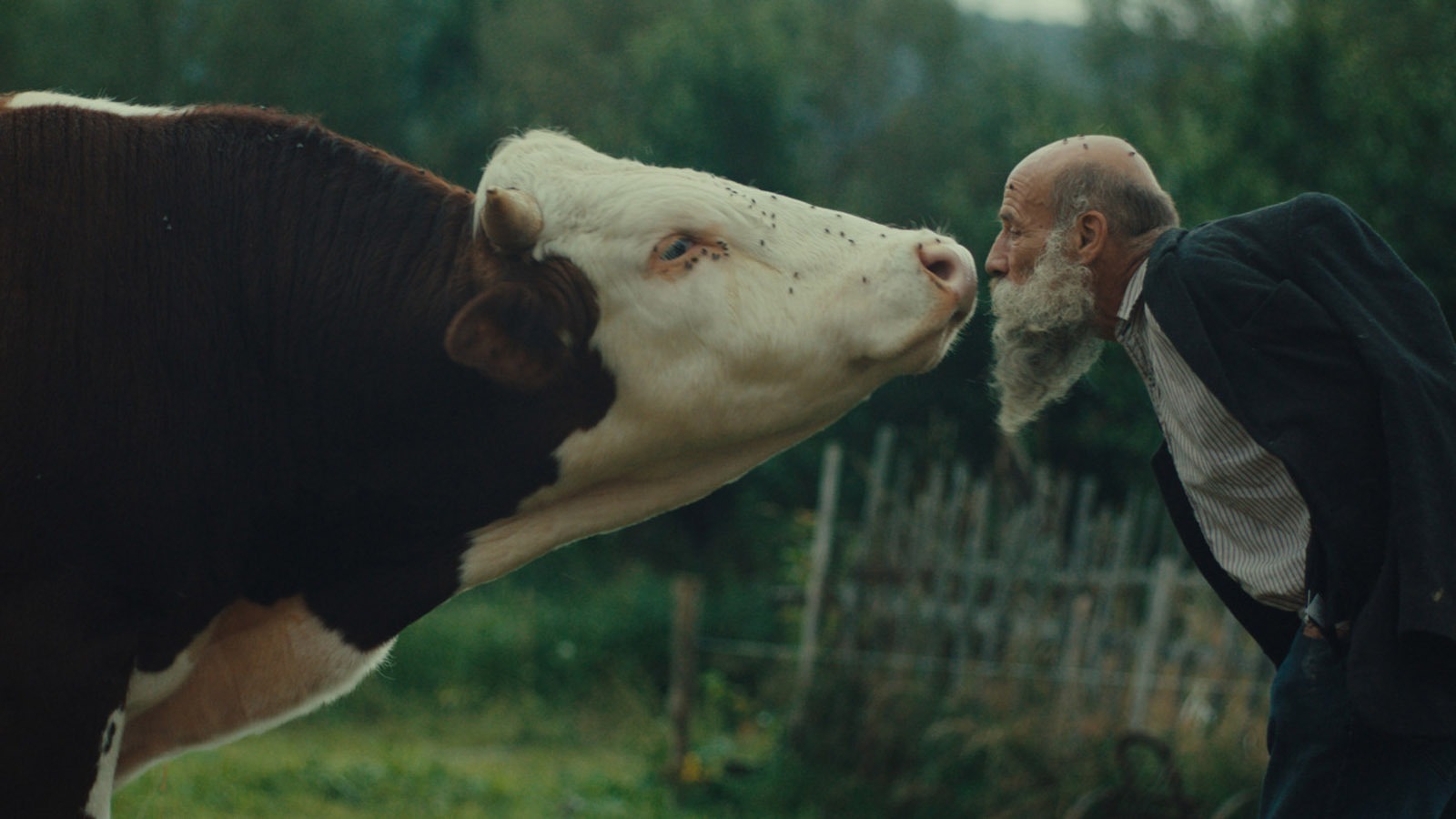
Over the weekend, just hours after Better Go Mad in the Wild won the Crystal Globe, the top award at the Karlovy Vary International Film Festival, František Klišík was found dead in a pool in a town not far from Prague. Klišík and his twin brother, Ondřej, are the subjects of Slovak director Miro Remo’s dramatic and documentary hybrid portrait, and as Remo tells Marta Bałaga in Variety, he thinks of his latest feature as “a fairy tale for adults.”
On the Czech side of the Bohemian Forest, Šumava—the region the Germans just across the border call the Böhmerwald—Franta and Ondra, as the bearded and balding sixty-two-year-old men call each other, bicker and make up, labor and kick back on their isolated farm. Remo and his tight team spent sixty days with the brothers over a period of five years.
“Neither strictly observational nor essayistic in its approach, the film instead marries scenes of the twins’ day-to-day existence to poetic interludes of his own invention, alongside existential narration adapted from a book of the same title by Czech journalist and author Aleš Palán,” writes Guy Lodge in Variety. “These reflections don’t, however, feel loftily imposed on the Klišíks, whose own alternately romantic and fatalistic sensibilities mesh seamlessly with the film’s philosophical flow. It all works to the extent that even the flagrantly whimsical device of a voiceover attached to the twins’ majestic, long-suffering bull Nandy feels natural to this world.”
“Bohemian does not begin to describe the brothers,” writes Deadline’s Damon Wise. “They talk about life and poetry in unusually sophisticated ways, despite their frequent drunkenness and their gleefully filthy hands-on approach to working the land. Nandy the bull gives the game away, revealing that the siblings, embarrassed after flunking school, became voracious autodidacts. Not only that, it turns out they were major players in the Velvet Revolution of 1989, producing anti-regime pamphlets for the Movement for Civil Liberty.”
In the immediate wake of František Klišík’s passing, Chase Hutchinson’s review for TheWrap now resonates more sorrowfully than he could have intended. He calls Better Go Mad in the Wild “an evocative exploration of the remote existence [the brothers] lead together and, most potently, a mirthful musing about what it is that gives life value.”
More KVIFF 2025 Awards
Founded in the fourteenth century and now a UNESCO World Heritage Site, the city of Karlovy Vary itself has something of a fairy-tale-for-adults air about it. On the latest episode of Writers on Film, John Bleasdale and Laurence Boyce namecheck a few of the must-see local attractions and discuss the film festival’s fifty-ninth edition as well as the winners of this year’s awards.
A Special Jury Prize went to Soheil Beiraghi’s Bidad, the story of Seti, a young singer who defies the Iranian regime’s refusal to allow women to perform in public. “Portrayed by Sarvin Zabetiyan (Terrestrial Verses) in a powerhouse turn mixing live performances with moments of private turmoil,” writes the Hollywood Reporter’s Jordan Mintzer, “Seti goes from unknown artist looking for a few gigs to viral sensation symbolizing Iran’s rebellious youth, and she pays a hefty price for her dissidence. Shot without official authorization, Bidad (which means ‘outcry’ in Farsi) reveals an underside of Iranian life that rarely gets past the censors—a clandestine world of musicians, punks, and potheads trying to stay afloat in a country where the powers-that-be do all they can to contain the rage.”
Two filmmakers share this year’s Best Director Award. A woman dedicated to her career unexpectedly finds herself caring for her estranged sister’s two young children in Nathan Ambrosioni’s Out of Love.At twenty-five, Ambrosioni “has already made three feature films,” notes Isaac Feldberg at RogerEbert.com, and “in this one, he reveals an emotional acuity beyond his years, both in his understated crafting of mise-en-scène and empathetic treatment of characters.”
In Vytautas Katkus’s first feature, The Visitor, a new father leaves his family in Norway to sell his parents’ apartment in Lithuania—and he’s in no hurry to return. “Katkus draws our attention to fleeting encounters and conversations that are often the first ones to be forgotten because of their seeming inconsequentiality,” writes Olivia Popp at Cineuropa, “but these ultimately make up the bedrock of our sensorial memory. Here, they are recognized in their profundity.”
Pia Tjelta, who plays a teacher drawn to an eighteen-year-old refugee in Don’t Call Me Mama, won the Best Actress Award. For Damon Wise, Tjelta’s “performance in Nina Knag’s feature debut—a hard-hitting psychological drama posing as a Sirkian love story—is next-level stuff. As the saying goes, her performance turns on a dime, sending what first appears to be a pretty standard, well-meaning story about the global refugee crisis somewhere much more personal and much, much darker.”
Gaia (Claud Hernández), an archaeology student, struggles to put her life back together following a sexual assault in Pere Vilà Barceló’s When a River Becomes the Sea.Guy Lodge finds that the film “sets out to be an imposing and even testing work, but it’s also an emotionally involving one—warmed by the intimately drawn relationship between Gaia and her desperately aggrieved single father, beautifully played by Àlex Brendemühl,” who won the Best Actor Award.
The jury—producer Nicolás Celis, filmmaker Babak Jalali, critic Jessica Kiang, actor and screenwriter Jiří Mádl, and actor and director Tuva Novotny—gave a Special Mention to Kateřina Falbrová, who plays a thirteen-year-old singer in one of this summer’s most anticipated films in Czechia, Ondřej Provazník’s Broken Voices. “Inspired by the true story of the Bambini di Praga (Children of Prague), a renowned Czech youth chorus whose director was convicted in 2008 of sexually abusing dozens of teenage girls,” writes Jordan Mintzer, “the film follows a rather foreseeable path but does so with plenty of honesty and heart.”
Proxima
In the Proxima Competition, which “offers space to the world’s new voices from across the vast cinematic spectrum,” the winner of the Grand Prix is Sand City, the first feature from Mahde Hasan. In Dhaka, Bangladesh, one of the largest and most densely populated cities in the world, Emma steals sand for her kitty litter box while Hasan steals it with an eye toward opening a glass factory. Their paths never cross, and Screen’s Wendy Ide finds Sand City to be “an unexpected and slightly confounding film but also, thanks to Mathieu Giombini’s vibrant photography, a strikingly beautiful one.”
The Proxima Special Jury Prize went to Forensics, Federico Atehortúa Arteaga’s three-part essay on the search for the more than one hundred thousand people who went missing in Colombia from 1948 to 2016, when the government and FARC guerrillas signed a peace accord. A Special Mention was awarded to Manoël Dupont’s Before / After, which tracks a trip undertaken by Jérémy and Baptiste, two men who meet by chance and decide to go to Istanbul together for hair transplants. “This light yet fascinating Belgian film thrives inside liminal spaces, capturing a sense of stasis, caught between ideas, possibilities, lives,” finds Redmond Bacon at Journey into Cinema.
Don’t miss out on your Daily briefing! Subscribe to the RSS feed.