Rossellini in Melbourne
Share
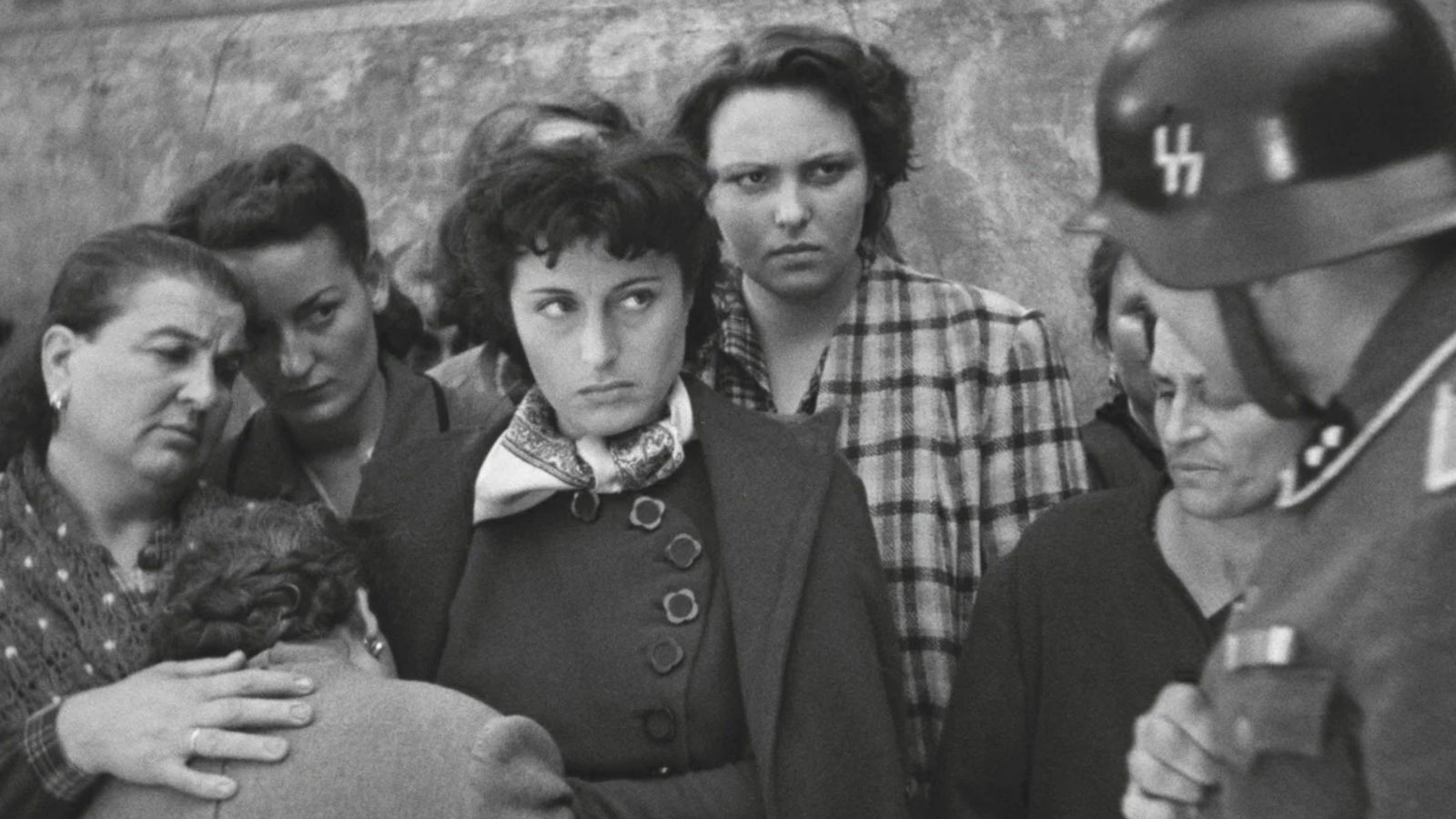
Over three consecutive Wednesdays, starting tomorrow, the Melbourne Cinémathèque will present The Past Is Always Present: The Evolutionary Career of Roberto Rossellini. Introducing the series, the programmers divide the profoundly influential oeuvre into four “phases.”
The films Rossellini made in fascist Italy are “sometimes naive but fascinating commercial products of their time.” After spearheading the postwar movement that became known as Italian neorealism, Rossellini moved into his third period with his collaborations with Ingrid Bergman. And in the late 1950s, Rossellini declared cinema dead and, driven by a convert’s feverish enthusiasm, began recreating great moments in European history for television.
The earliest film in the lineup is A Pilot Returns (1942), the second entry in a “Fascist Trilogy” preceded by The White Ship (1941) and followed by The Man with a Cross (1943). Based on a story by Vittorio Mussolini, the son of Il Duce, and cowritten with Michelangelo Antonioni (among others), A Pilot Returns stars Massimo Girotti as an Italian pilot shot down by British forces and held in a POW camp run by the Greek military. There, he meets and falls in love with the daughter of an Italian doctor.
“Is it possible to see in this early film any seeds of the multi-hued floral arrangement that constitutes metaphorically the remainder of Rossellini’s film output?” asks Joseph Sgammato at Senses of Cinema. “The answer is yes.” A Pilot Returns, long believed to have been lost but rediscovered in 1978, is “propaganda, yes, but far from the false image of happy luxury exhibited by the so-called ‘white telephone’ films of the ’30s.”
The depiction of war as hell, the attention to capturing in detail “the process of aerial battle,” and even the casting of the leading actor point ahead to Rossellini’s next phase. Girotti “had that same year starred in Ossessione (1943), Luchino Visconti’s gritty version of James M. Cain’s novel The Postman Always Rings Twice, with its own claims to early neorealist labeling,” notes Sgammato.
Set during the Nazi occupation, Rome Open City (1945) stars Anna Magnani in her breakthrough role as a resistance member’s fiancée working with a priest (Aldo Fabrizi) for the partisan cause. The late cinematographer John Bailey found it “almost impossible to consider Rome Open City, Paisan, and Germany Year Zero as anything other than a linked narrative of the ashes of World War II and of the struggle to rise out of that dustbin of history. They are vital, raw, even primitive in style, full of nonactors who are alternately charismatic and arch; there is an aesthetic in these movies that is stripped to the bone. These films, taken together, are immediate godfather to the French New Wave.”
In 1948, at the pinnacle of her Hollywood stardom, Ingrid Bergman wrote an admiring letter to Rossellini. They met and struck up a working partnership as well as an affair that sparked a notorious scandal that blazed through a marriage that lasted until Rossellini fell for screenwriter Sonali Senroy Dasgupta in 1957. Melbourne will screen India: Matri Bhumi (1959)—a blend of documentary and fiction cowritten with Dasgupta and Iranian diplomat Fereydoon Hoveyda—and two of Rossellini’s films starring Bergman, the 1953 short The Chicken and Joan of Arc at the Stake (1954).
“In the five features they did together over five years,” writes Richard Brody, Rossellini “turned to a kind of reflexivity—personal refractions of Hollywood that joined documentary and artifice in a way that simultaneously called attention to both—that made the cinema itself their very subject and broke down the barrier between fiction and reportage, between performance and life. The modern cinema begins here.”
Vittorio De Sica stars in Il Generale Della Rovere (1959) as a small-time con man arrested by the Nazis and charged with passing himself off in prison as the resistance hero General Della Rovere. Once he gets to know the targets he’s supposed to rat on, he undergoes a crisis of conscience. “A fascinating crossroads in Rossellini’s career,” writes Fernando F. Croce at Slant, “the film looks back at the furious urgency of his earlier postwar sketches and ahead to the contemplation of his later, stylized portraits. Artifice mingles with rawness: grainy newsreel views of wartime depredations segue into the reconstructed rubble of Cinecittà studio sets, location filming coexists with rear projection. Some critics saw this mix as a betrayal of neorealist ideals, yet it’s a strategy that strikingly reflects the impulses increasingly at odds within the protagonist.”
As James Monaco points out, these “flourishes foreshadow the historical essays that would absorb Rossellini for the rest of his career.” In Viva l’Italia (1961), the film of which Rossellini was most proud, Renzo Ricci plays revolutionary and national hero Giuseppe Garibaldi paving the road to Italian unification. “Rossellini’s efforts, from 1959 until halted by death in 1977, would yield some forty-two hours of ‘didactic’ movies,” writes Tag Gallagher. “To say, as many have, that these movies lack acting, psychoanalysis, Murnau-like expressionism, overwhelming emotions, and the richest cinematic art is akin to closing one’s eyes at high noon and claiming the sun no longer exists.”
Don’t miss out on your Daily briefing! Subscribe to the RSS feed.