In 1968, soon after he graduated from the Film and Television Institute of India, Mani Kaul made an arresting short titled Forms and Designs. It observes artisans at work across the country, some swimming alone against the tide of mass production, others pitched up at government centers for handicraft revival. Several times the camera tilts from hands chiseling (or painting or weaving) up to faces gathered in concentration. There is an admiring sequence on village cooperatives. These are set beside dour images of industrial machines and advertisements for home appliances, as a starchy voice warns that the “wheels of mechanization” are accelerating. “He is the last in his family,” it’s said of eighty-five-year-old Imtiaz Ali Khan. “With his passing, the art of brass engraving will wither away.”
Kaul took a keen interest in India’s shastriya kala, or traditional arts. A formally restless director, he found much inspiration outside cinema. In a four-decade career he released twenty-odd films; on the side, he studied Sanskrit aesthetics, wrote about medieval miniature painting, and trained in dhrupad, a form of Hindustani classical music. When he died of cancer in 2011, the obituaries mentioned friendships with dancers, singers, writers, and painters. “His creative intellect was so prodigious that all these art forms were refracted through his own practice,” novelist Sharmistha Mohanty wrote. “He was my guru in the traditional sense of the word,” poet Udayan Vajpeyi recalled. “He will go on living in his students of cinema, in his students of literature, in his students of music.”
Part of Kaul’s achievement was to open cinema to these other art forms. Each of his movies has its own style, though they share certain habits: flat, painterly compositions that seem to abstract movement and action; nonlinear narratives, which unfold like an improvisation on a raag, or scale; ample use of music, from Hindustani suites to folk songs. In contrast to these formal effects, which are lush and expressive, Kaul’s approach to storytelling is restrained, even ascetic: performances are muted, slipping into monotone; activity is quotidian, frequently domestic; dialogue is spare, leaving much unsaid. Asked about his aversion to theatrics, Kaul cited the influence of Robert Bresson, whose films came to him as a revelation. “This is a man who actually sees,” he recalled thinking when he saw Pickpocket in college, “and everyone else is creating drama.”
Kaul’s cinematic idiom is enriched by these sources: old and new, local and foreign. Yet some critics have found his work hermetic. Unlike his mentor Ritwik Ghatak, whose epics unfold on the plane of history, Kaul shied away from depicting political events. Full of ideas about time and memory, his films say little about class and caste. Tellingly, he excelled in nonrealist genres, like the parable and the period drama, in which society can be roughly drawn. Satyajit Ray put it pungently when he attacked Kaul’s “wayward, fragile aestheticism,” which he felt betrayed a “lack of concern for social issues.”
For these and other reasons, it is tempting to dismiss Kaul as a kind of Brahmin avant-gardist. Yet he is not so easily pinned down. As a storyteller, he placed women front and center, casting a subtle light on fraught relationships. As a stylist, he used lighting, editing, sound, and color to paint characters’ inner lives. Often linked with the parallel cinema movement, known for its well-intentioned realism, he in fact charted a path of his own, bringing the medium closer to music and visual art—innovations that now seem ahead of their time. To revisit his extraordinary early films five decades later is to enter a new way of seeing. (He often shot close-ups of eyes, and made a movie entitled Nazar, or “The Gaze.”) In the words of one of his protégés, director Gurvinder Singh, Kaul was a “master explorer of cinematic form.”
Kaul was born in 1944 to a line of Pandits, Kashmir’s upper-caste Hindu elite. His family had relocated to Rajasthan a few generations earlier amid an uptick in forced conversions to Islam. Kaul grew up in the obscure town of Jalore, where his father worked in the civil service, a cushy middle-class job that came with a bungalow, servants, and the rest. Fond memories of a provincial childhood can be found in Uncloven Space, an absorbing book-length interview conducted by Vajpeyi in 1991. At age eleven, Kaul was fitted out with spectacles, after years of struggling to see the classroom blackboard. It was “as if somebody had jolted me out of my sleep and made me stand up in my waking state,” he says:
My life had been so fundamentally altered that I would spend the whole day just staring at different things. You could say that “to see” became an obsession for me. I kept on looking outside while travelling in a bus, or from the car in which my father used to take us around, or even if I was just standing anywhere . . . I started drawing. After getting those spectacles, I started doing many strange things.
Art cinema was little more than a rumor when Kaul enrolled in the Film and Television Institute of India in 1963, not long after it was set up. Back then most students had their eyes fixed on the misty peaks of commercial film. The journey up looked easy for Kaul, who had the right family connections: one uncle, Mahesh Kaul, was a successful director, and another was the prolific actor Raaj Kumar. Yet he fell in with a group of gifted students that gathered around vice principal Ritwik Ghatak, who led them on obscure side-trails away from realism. “I served him with the same devotion as a disciple serves his guru,” Kaul recalled.

After paying his dues to the state Films Division with a few nonfiction shorts, Kaul was granted money for a feature. Released in 1970 when he was twenty-five years old, Uski roti (“His Bread”) is a freakishly sophisticated debut—and a landmark of Indian cinema. The script is based on a Hindi short story by Mohan Rakesh, though Kaul plays fast and loose with the source material, much to the movie’s benefit. The original sticks close to Balo, a rural Punjabi housewife who from morning to evening waits by the highway to hand over dinner to her husband, bus driver Succha Singh. Kaul places this pen portrait, now richly textured and shaded, against a wider canvas, sketching in relatives and neighbors, while keeping one eye on Succha’s visits to nearby towns.
The film gathers its power from a central formal constraint. From start to end, the compositions are strikingly flat, with space compressed by long lenses and perspectival lines cut off by the frame. Women tend to be seen in cramped close-ups, lost in inner struggles, while men perform some or other action with blank intent. In a marvelous shot, Succha and another man roll across an open field, locked in a messy brawl. They are observed from a distance, as if by a bystander, their legs slowly rising and falling, dry leaves cracking underneath—the whole motion charged with a strange intimacy. In moments like this, the film approximates the effects of Mughal miniature painting, which Kaul cited as an influence. In the brilliant essay “Seen from Nowhere,” he observes that miniatures, like those in Emperor Akbar’s graphic biography, “abstract the physical to the extent where it may both anchor the viewer’s sensuous attention as well as absorb the so-called distortions, enabling him to enter into the picture.”
From the close-ups of hands to its use of offscreen sound, Uski roti takes a lot from Bresson. Kaul’s style of editing is his own, however. His films abandon chronology, moving backward and forward in time, often revisiting the same event from different perspectives. (“All my life I have tried different ways to do away with a linear narrative,” he told Vajpeyi.) They are more fluid than Bressonian constructions, in which meaning is made through the repetition and counterpoint of discrete images. Shooting out of sequence, with little regard for the script, Kaul assembled—rather, discovered—his stories on the editing table, piecing together extended, apparently self-contained sequences, each governed by an internal logic of its own. The approach owes something to Hindustani music, about which Kaul made two documentaries. “Meaning in dhrupad seems to reside in the specificity and clarity of every individual note,” the critic Mantra Mukim astutely writes. “This is what prompts Kaul to also see cinematic meaning as a continuous process, which ends and is reborn with every scene.”
This idea is well illustrated by a sequence at the half-hour mark. It begins with an exchange between Balo and a passing villager, who alludes to Succha’s notoriety in the next town, without elaborating further. As he moves away, Balo is seen frontally, leaning against a tree trunk, open fields visible in the background. Kaul cuts to the man, now walking between the fields, away from the camera, slowly, hardly moving it seems. Meanwhile, the pistons of a train are heard gathering speed. When we return to Balo, she is seen again in close-up, this time from a slight angle, with her eyes downcast, the very image of disquiet. Kaul cuts back to the reverse angle as the engine grows louder, and presently compartments cross the frame, barely visible on the horizon through mist. The slow steps, the mounting engine, the train passing: these have taken on the aspect of Balo’s racing thoughts, which have nowhere to go. The sequence as a whole does not inflect the story or develop character in a specific way. It could have been placed elsewhere. The crisis passes and Balo returns to waiting.
Kaul’s next two films are also about women trapped in relationships with absent men, forming a sort of trilogy. Both are based on literary texts. One Day in the Rainy Season (1971) is adapted from a historical play, again by Rakesh, inspired by the life of Kalidas, the fifth-century poet and dramatist who towers over Sanskrit literature. In the first of three acts, Kalidas is offered the position of court poet at Ujjain, a distant royal seat. His muse, Mallika, convinces him to accept, knowing it will separate them. Over the next two acts, which are spaced years apart, she falls deeper and deeper into a pit of listlessness, growing distant from her mother, letting their house go to pieces, rejecting suitors—and pleasure of any kind. What explains her behavior? One clue is to be found in the way she pores over Kalidas’s new epics, while ignoring the gifts he sends back. Her own literary talent stifled, Mallika is living through his creations, an aspiration that has gotten mixed up with love.
This time around Kaul sticks close to the source material, with its archaic, Sanskritized language, which the actors deliver in a haunting monotone. The story plays out as a chamber drama set in a drab hut, where Mallika, her mother, and a few neighbors deliver grave, increasingly desperate monologues. Most shots are close-ups, though not always on the person talking. A key image, drawn from the figures in ancient Buddhist cave paintings at Ajanta and Ellora, is a double portrait: people seen side by side, sometimes with minimal lighting, as if swimming in blackness. This composition is most poignant when Mallika stands beside Kalidas, her bursting with emotion, him steely calm. “I know your leaving will fill my inner world with emptiness,” she tells him, both looking just offscreen. “Yet I do not fool myself. I tell you from the heart, you must go.”

The camera at last leaves the hut in a gorgeous closing sequence, which recalls the final minutes of Ghatak’s The Cloud-Capped Star. Kalidas has returned to Mallika, abandoning his governor’s post in Kashmir. “Our ties cannot be broken so easily,” he says, as if they had not broken her. “You once said we were very alike . . . In these past years, I have not let that closeness grow any less.” These words are part of a long, affecting speech about art and desire. As it’s heard over the soundtrack, Kaul cuts to a series of static shots of the surrounding mountains, which are caressed by monsoon clouds. Here the title’s meaning reveals itself. In Sanskrit aesthetics, the two rasas, or essences, of the monsoon are vipralambha shringara and sambhoga shringara—the erotic thwarted and the erotic fulfilled.
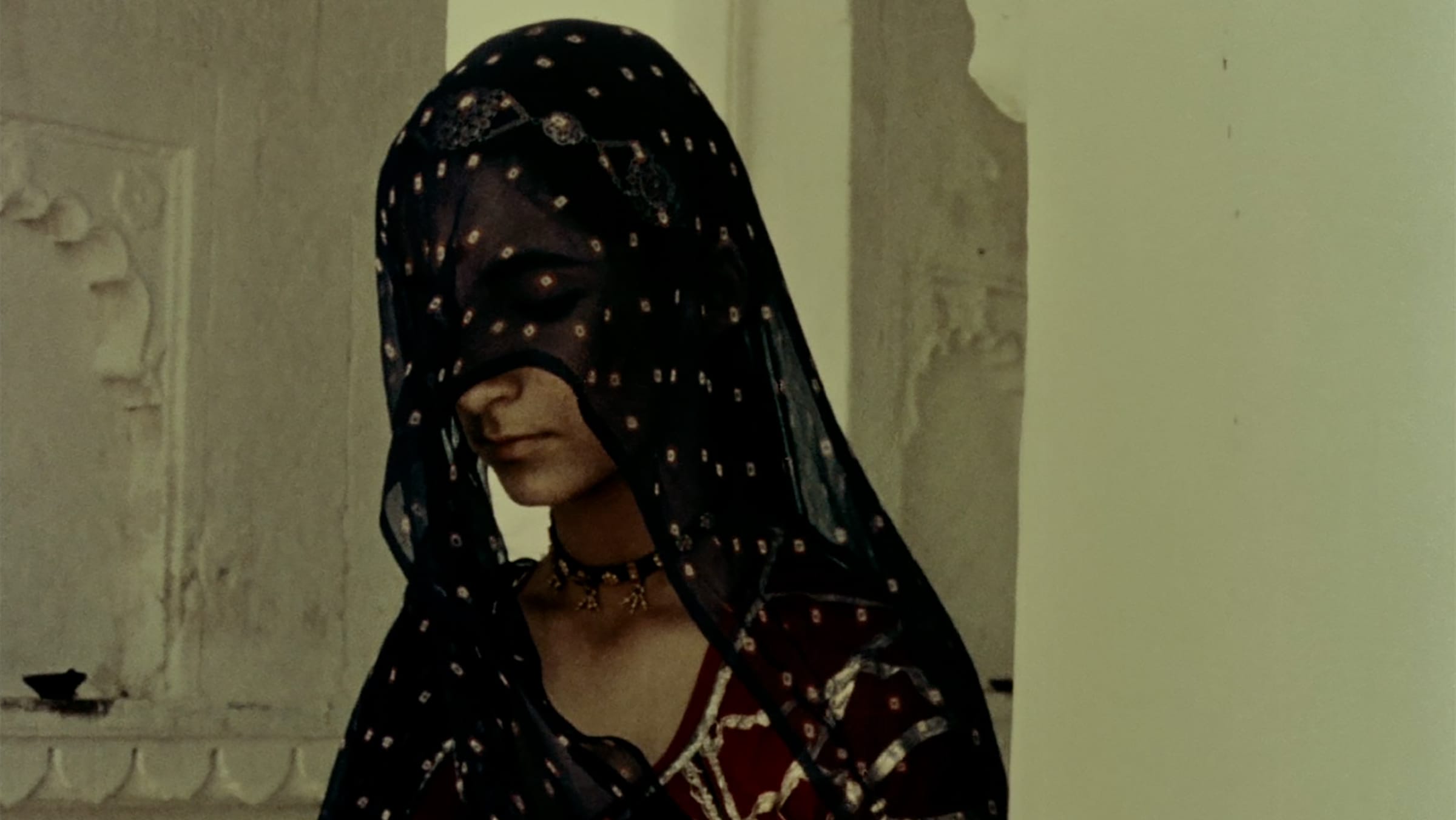
Kaul traded monochrome for color with Duvidha (“The Dilemma,” 1973), based on a Rajasthani folktale recorded by the author and folklorist Vijay Daan Deta. The plot is as simple as it is tart. A child bride is abandoned on their marriage day by her husband—a baniya, or merchant. “Perhaps you do not know,” he tells her. “But such an auspicious time for trading will not return for seven years,” which is how long he plans to be away on business. Meanwhile, a spirit, referred to simply as a bhoot, or ghost, takes the baniya’s spitting form and comes to live with his wife, it seems in happy matrimony. Matters come to a head when she becomes pregnant, news of which reaches the miser, who returns to confront his double. Kaul commits wholly to the folktale’s logic, without straying into exoticism, which cannot be said of the story’s Bollywood remake, Paheli (“The Riddle,” 2005).
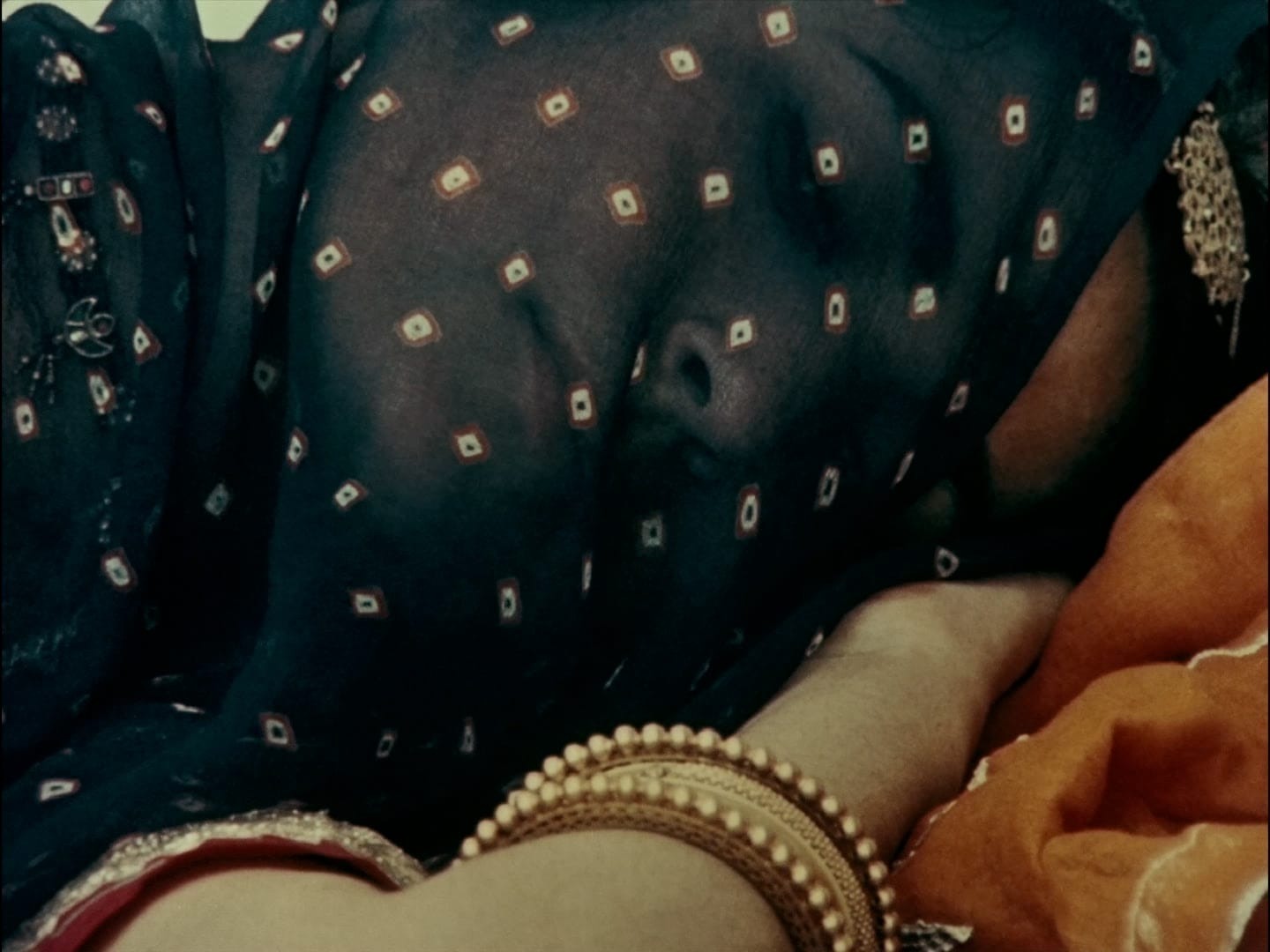
Kaul shot Duvidha on the smallest of budgets, making do with a tiny crew, limited 16 mm Kodachrome reels (loaned by the painter Akbar Padamsee), and a novice cinematographer. Even the village electricity supply was too weak for proper lighting. Despite these constraints, the film’s visual surface is delicate and frequently astonishing. Most of the frames combine red, orange, and white, a warm palette that mocks the bride’s grim predicament. The narrative unfurls in a weave of jump cuts, repeated fragments, and freeze frames, freely mixing action, reverie, and recollection—with Kaul opening time up “like an accordion player,” as the critic Srikanth Srinivas notes. All along, different characters are heard in voice-over, putting their own spin on events. As the viewer is drawn into a labyrinth of competing accounts, the bhoot turns into a metaphor for the husband’s split personality. “I crave for love and affection,” the ghost says in a late scene, accusing the baniya of caring only about “trade and profit.”
The mystery is at its deepest when the bhoot first enters the bride’s bedroom. At the door’s threshold, he turns to face the audience, like a new groom nervous that he might not perform. Inside the dark chamber, he is seen in a series of stills, the last of which finds him seated on the bed, lit dramatically from below. “First make sure I am not another,” he says as he paces around. “Maybe I have taken your husband’s form and am someone else.” Then a different voice appears on the soundtrack, informing us that the bhoot has come clean about his disguise. The bride is more intrigued than frightened by her spirit visitor. As the rattle of crickets rises, Kaul cuts between portraits of boy and girl, inching closer each time. A lengthy shot holds on the bride’s eyes, looking searchingly at the bhoot. “I still cannot decide,” she says, “whether it was good you told me, or better if you hadn’t. Sometimes knowing pleases me. At other times not knowing.” This is as close as she comes to letting her guard down. Mostly she remains silent, aware that any words will be held against her.
Satyajit Ray was foul on Duvidha when Films Division released it. In “Four and a Quarter,” an essay on contemporary Hindi directors, he laid into the film’s experiments, from the patterned colors to the stylized gestures, concluding that “Kaul’s impatience with conventional narrative leads him to a visual style replete with clichés of another sort.” The Bengali master, who took his cue from neorealism, was appalled by Kaul’s distaste for “strong situations” and “full-blooded characters,” which revealed a “plain lack of interest in human beings.”
As this essay has hopefully shown, Ray was quite hopelessly wrong in his assessment. Kaul’s quiet leads might not resemble the “full-blooded” bourgeois heroines of Charulata and The Big City, or for that matter the female saints of Ghatak’s The Cloud-Capped Star and Subarnarekha. Yet they retain a sense of dignity under trying situations, and bring grace to routine, apparently mindless tasks—cooking, eating, walking, resting, and above all, waiting. More mysteriously, they possess a sense of inwardness, which the director does not pry on, affording them a privacy usually denied to women in Hindu society. That restraint is one lasting feature of Kaul’s legacy. Another is the sensory world he evoked, which in turn enriches our own.
The story of his reception is less consoling. A decade after his death, Kaul remains largely unknown outside art-house circles in India, where he was revered by artists and left a mark on younger directors as different as Amit Dutta and Gurvinder Singh. None of his films were widely released. Retrospectives have been few and far between, and mostly held abroad, where some critics found him “impenetrable” and “incoherent” (both adjectives come from the New York Times). In Uncloven Space, he speaks, longingly, of Hindustani classical concerts, where the audience notices each shift within the scale. “The greatest challenge is to create an audience who can see it in this way,” he says. “Just like people would do in a music concert, they might exclaim, ‘Wah! What a pan!’”