Robert Greene’s Too Much Sugar
Share
“Simply put,” wrote Robert Greene for Sight and Sound in 2020, “all movies are hybrids.” By that point, Greene had made a string of features—Fake It So Real (2011), Actress (2014), Kate Plays Christine (2016), and Bisbee ’17 (2018)—that delved further and further into the conviction that he expressed in a 2014 essay for the same magazine, namely, “that I prefer to see the relationship between fiction and nonfiction more as an unstable continuum.” And as “the kind of marketing term” that “might be useful in some vague branding sense,” hybrid is “ultimately reductive and potentially damaging to the films to which it becomes attached.”
In 2021, Greene pressed deeper into a realm where fiction and nonfiction are doing much more than blurring the lines between them with Procession, in which six men who had been abused by priests collaborated with Greene and his crew to create reenactments of the most traumatic episodes of their lives. Now, with Too Much Sugar, which has premiered in the Orizzonti program in Venice, Greene is enriching his collaborative process with his subjects.
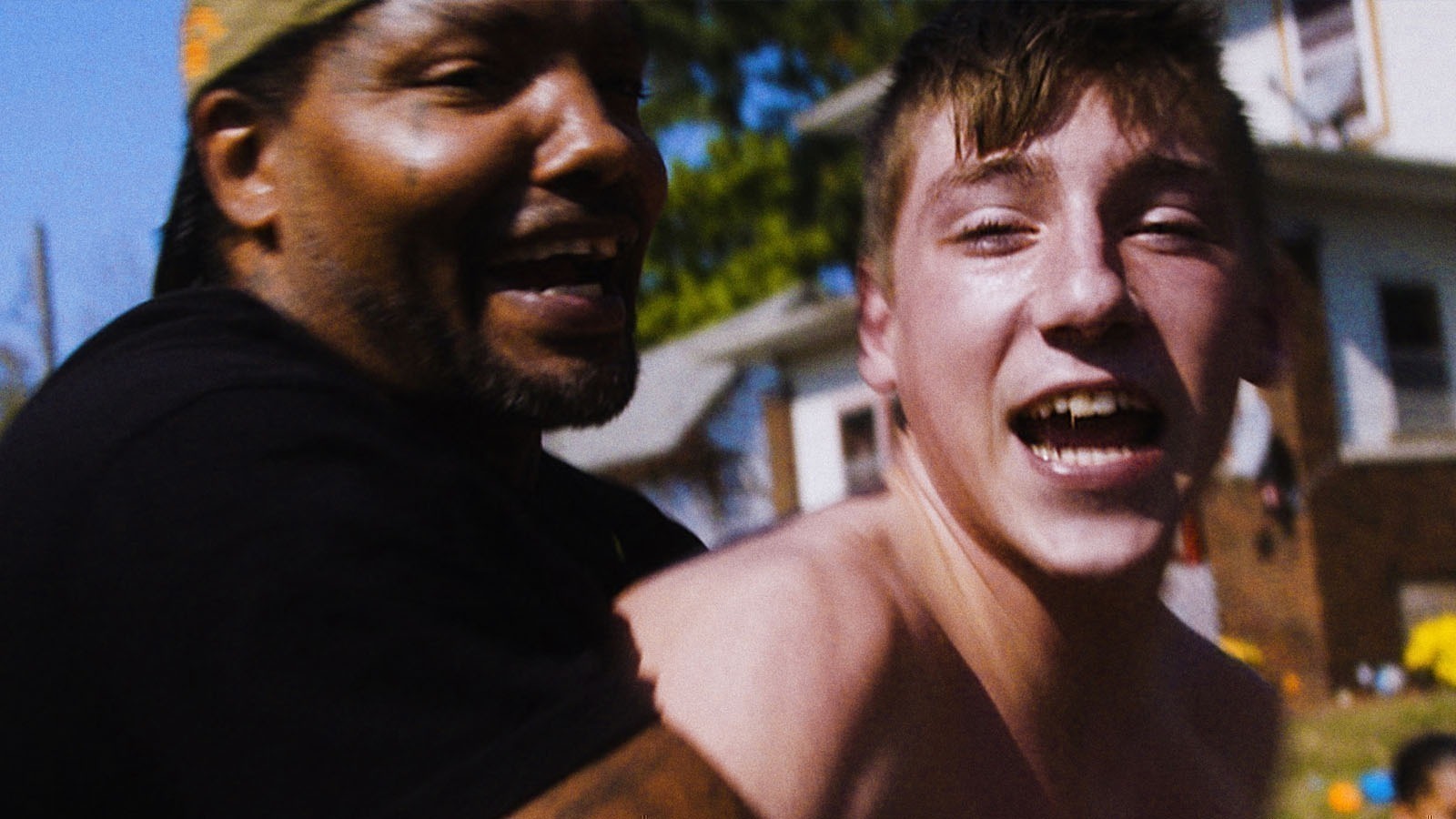
Or, as Jordan Mintzer puts it in the Hollywood Reporter, Greene is “creating a unique form of cine-therapy that has become the indie auteur’s trademark. Here, he turns the camera on a pair of friends from the tiny rural enclave of Moberly, Missouri, revealing working-class men marked by euphoria and heartbreak, love and family trauma, pranks and pathos in a seldom-depicted pocket of small-town America.” Greene encourages ex-convicts and best buds Ryan “Holli-wood” Holliger and Michael “AccRite” Midgyett as well as members of their families to make short films depicting their own lives as they wish they could be.
“We might see Holliger yelling instructions to his son as he teaches him how to punch,” explains Vulture’s Bilge Ebiri, and “a few minutes later, we see the son doing the same to Holliger, a role reversal for the movie they’re making. Elsewhere, a realistic fight breaks out—until someone yells cut. Pretend tears become real tears. The movies these people make have one foot in genre and another in the awful truth. One kid wants to make a supernatural fantasy, another a gangster movie, another a boxing movie. Holliger’s mom, diagnosed with breast cancer, wants to make a horror movie about her cancer, called Die Cancer, Die!”
For Matt Zoller Seitz at RogerEbert.com, what ultimately makes Too Much Sugar “powerful, as opposed to merely intriguing, is its mid-narrative pivot toward AccRite. He’s been a broken husk ever since he lost one of his sons, then sixteen, in a senseless shooting after a house party. AccRite wants to make a time-travel thriller in which he rescues his son and brings him forward into the future where he can live a full life. The agony emanating from AccRite’s haunted face and often watery eyes is almost too much to take . . . That so many of these moments could be either real, caught-on-camera eruptions of pure pain, or improvisational theater exercises that mutate into primal scream therapy further emphasizes the film’s belief that, deep down, everyone knows how to act, and would use it for therapeutic purposes all the time if they only knew how.”
“By the time I got to seventh grade, when I was about twelve years old, I had lived in fifteen different places,” Greene tells Nataliia Serebriakova in an interview for the International Cinephile Society. “So when you move around that much as a kid, you learn that you are a different person in every single one of those places . . . That was something that, through the process of making these films, I realized I had done, and I realized that is why I was obsessed with it. Through making films that are about people’s realities, but then watching them perform what they want to be, what they hope to be, what they dream to be, and all these other things, you realize that that is what we all do. That is survival.”
Don’t miss out on your Daily briefing! Subscribe to the RSS feed.