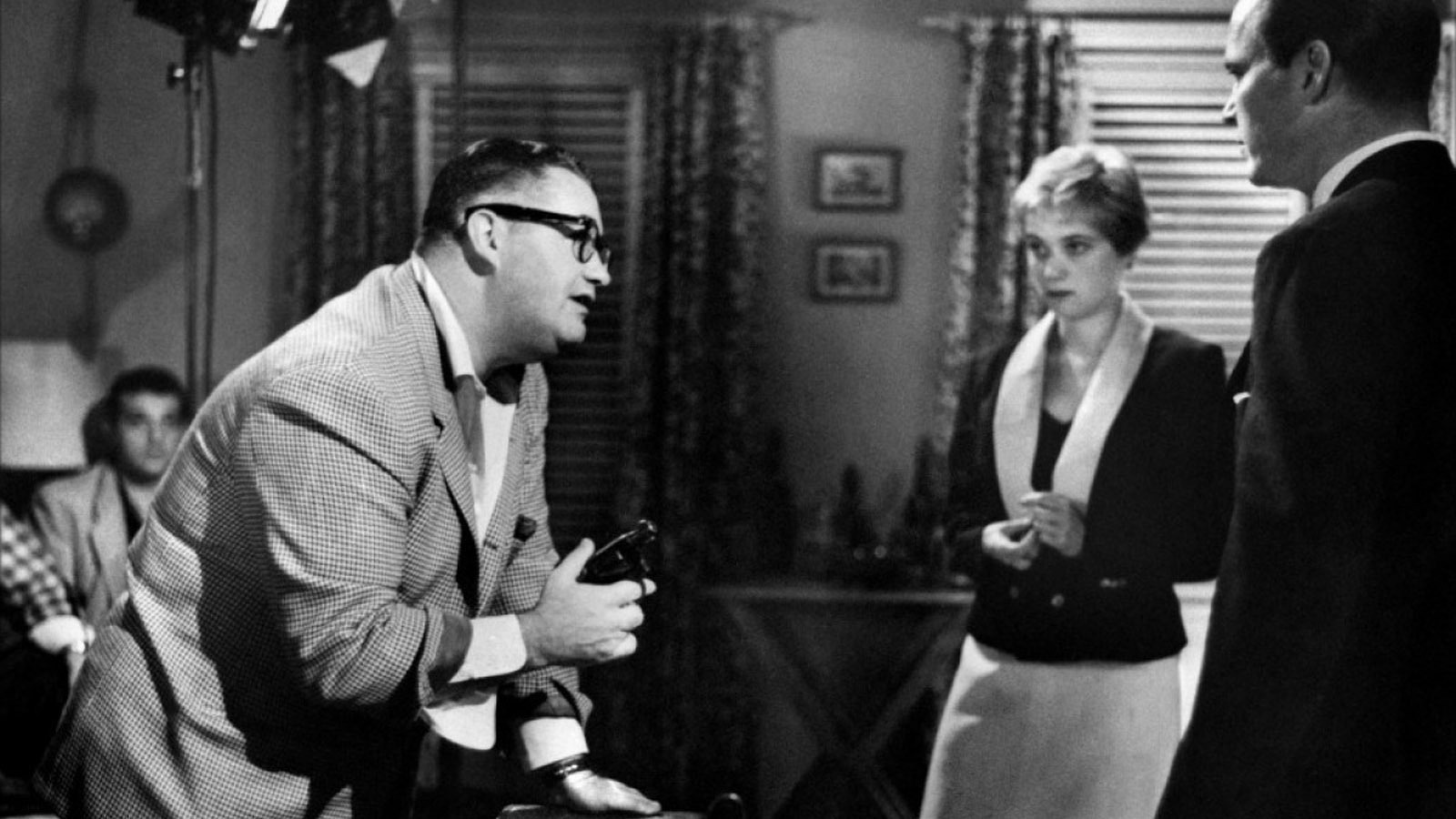
Robert Aldrich in Vienna
Share
Claire Denis, Radu Jude, Ryusuke Hamaguchi, Pedro Costa, and Joanna Hogg are among the directors who have made trailers for the Viennale over the past few years. This year, the festival has turned to Kelly Reichardt. The new trailer, screening with Forever . . . Forever, a twenty-one-minute short from experimental filmmaker Johann Lurf that Michael Sicinski has called “a testament to deep observation,” is opening the sixty-fourth Viennale this evening.
Through November 3, 260 films—plus one surprise film that will be revealed in the coming days—will screen in five cinemas. And talks, roundtables, and parties—including a DJ set from Lars Eidinger—are sprinkled throughout the program. There are series dedicated to Jocelyn Saab and Abbas Kiarostami and a selection of revivals that includes Kon Ichikawa’s Ten Dark Women (1961), Paula Delsol’s La dérive (1964), John Abraham’s Report to Mother (1986), and two programs of films by Artavazd Pelechian.
Copresented with the Austrian Film Museum, the Robert Aldrich retrospective will run through November 30. “Spanning almost three decades and thirty films,” writes Museum curator Christoph Huber, Aldrich’s “directorial career was crowned by a series of global hits, including such famous titles as Vera Cruz (1954), What Ever Happened to Baby Jane? (1962), The Dirty Dozen (1967), and The Longest Yard (1974). In between, he redefined entire genres with masterpieces like the apocalyptic film noir Kiss Me Deadly (1955) and the world-weary late-phase western Ulzana’s Raid (1972).”
Huber, Dominik Graf, and Christian Petzold will be introducing some of the twenty-nine features, most of them presented in 35 mm, and Sunday will see the launch of Huber’s new bilingual book, Robert Aldrich: Hollywood Rebel / Rebell in Hollywood. In the first episode of the newly relaunched Viennale Podcast, Huber and festival director Eva Sangiorgi discuss Aldrich’s career, which began in the early 1950s. Cahiers du cinéma and Positif, “which were otherwise often at loggerheads,” notes Huber, “were unanimous in declaring 1955 the ‘Year of Aldrich.’”
That was the year of Kiss Me Deadly, “which, briefly described,” wrote J. Hoberman in 2011, “tracks one of the sleaziest, stupidest, most brutal detectives in American movies through a nocturnal, inexplicably violent labyrinth to a white-hot vision of cosmic annihilation. A crass private eye looking for the big score, Mike Hammer plays with fire and gets burned. From the perversely backward title crawl (outrageously accompanied by orgasmic heavy breathing) through the climactic explosion, Kiss Me Deadly is sensationally baroque, eschewing straight exposition for a jarring succession of bizarre images, bravura sound matching, and encoded riddles the likes of which had not been seen in Hollywood since Orson Welles kissed the industry good-bye.”
The Big Knife, also from 1955, is “the director’s earliest stab at the Hollywood psychodrama he continued to perfect in bleak, mordant satires like What Ever Happened to Baby Jane? and The Killing of Sister George [1968],” writes Screen Slate’s Jon Dieringer. Jack Palance stars as an actor whose career and marriage are falling apart, and the cast also features Ida Lupino, Rod Steiger, and Shelley Winters. “As Castle pugilistically fumes around his chic Bel Air pad,” writes Dieringer, “a carousel of assistants, attachés, hangers-on, and friends revolve in and out to level with him, press his thinking, and offer new revelations while boxing him into an increasingly untenable position.”
Baby Jane, starring Bette Davis and Joan Crawford as former child stars who have soured in their rivalrous adulthood, remains a perennial favorite in part because its over-the-top energy is fueled by rumors of a feud between its stars. “While Baby Jane has long been appropriated by gay men, its most famous line (‘But you are, Blanche! You are in that chair!’) repeated in bars and drag shows for decades,” wrote Melissa Anderson for Film Comment in 2009, “Sister George remains a lesbian cult classic that has the distinction of being the first ‘serious’ film to receive an X rating.” And it “endures not because it’s an example of bad, pre-Stonewall homo images but because of its sly way of celebrating dykes.”
“Aldrich often corralled an assortment of icons into close spaces and mined their charismatic visages for tableaux of striking emotional power, mixing neurotic expressionism with a smooth sense of studio craftsmanship,” wrote Chuck Bowen for Slant in 2017. “The films are the efforts of a working man’s artist: of someone who’s in touch with his uncanny side as well as with the practicalities of telling a three-act story in which the trains run on time, each incident revealing subtext and portraiture.”
Aldrich “made war films, westerns, noirs, melodramas, comedies, and more,” writes Gena Telaroli in her essay on The Flight of the Phoenix (1965). “But he returned to a particular kind of situation time and again: the struggle of an individual or a group of people to survive and to maintain their sense of themselves within wildly inhospitable circumstances, whether natural or created by other humans. As the director once described the characters he was drawn to, they ‘find their own integrity in doing what they do the way they do it, even if it causes their own deaths.’”
Don’t miss out on your Daily briefing! Subscribe to the RSS feed.