October Books
Share
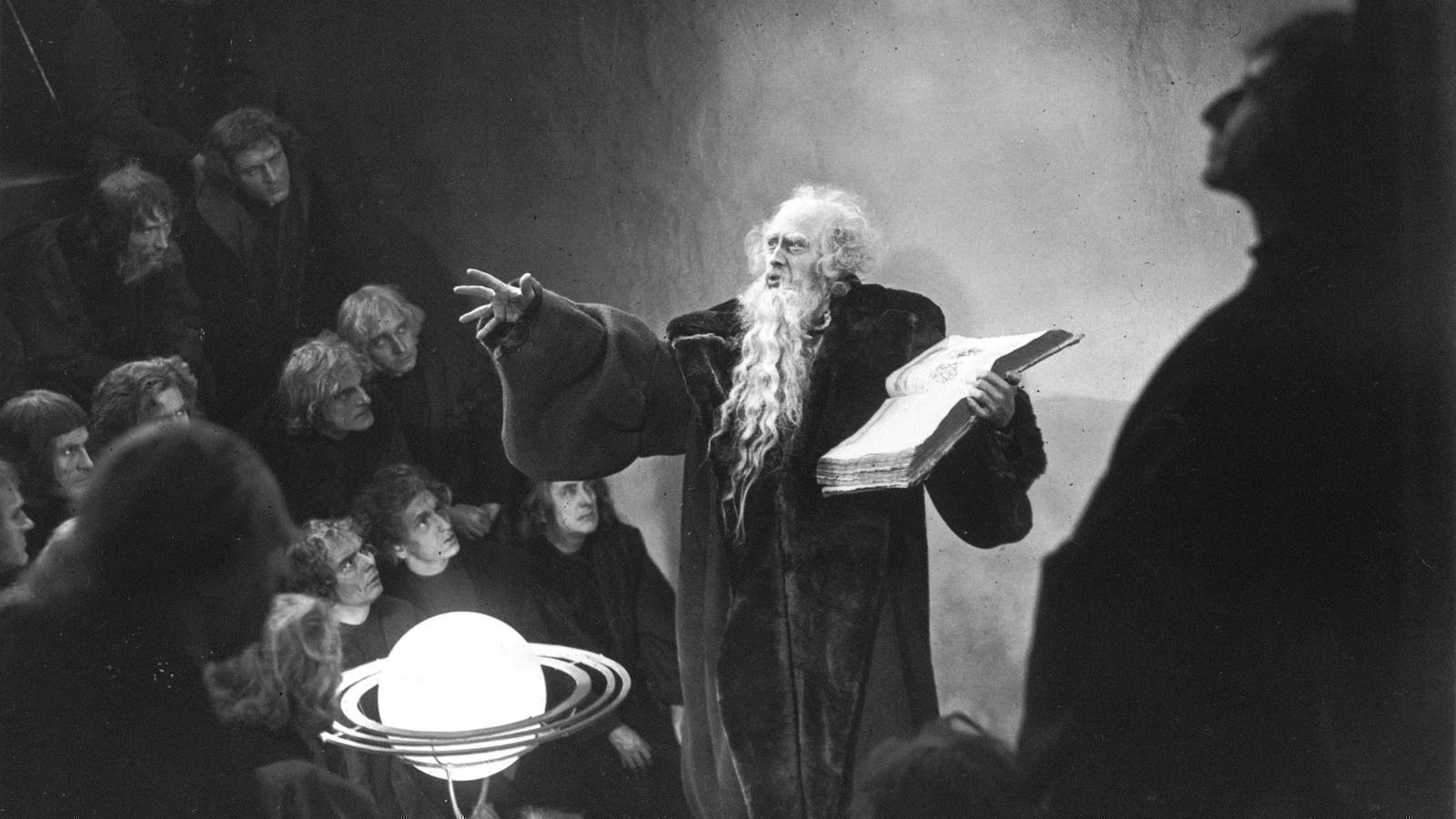
A plague has struck a village in sixteenth-century Germany, and Faust, an aging alchemist, turns to prayer and science in his attempts to put a stop to the agony. To no avail. In a fit of desperate rage, he throws his books—including a massive leather-bound Bible—into a fire. The Bible was more than a prop in F. W. Murnau’s Faust (1926). It was also a scrapbook of production photos, notes, and illustrations that Murnau’s team was putting together to present to the director at the end of the shoot.
Murnau left the Bible behind in his apartment in Berlin when he went to Hollywood to make Sunrise: A Song of Two Humans (1927). He fully intended to return, but on March 10, 1931, his car overturned on the Pacific Coast Highway. He died the next day at the age of forty-two.
“Murnau’s brother stashed his belongings in various city-center basements, which were susceptible to flooding, and worse, once the bombs began falling on Berlin during the Second World War,” writes Pamela Hutchinson in the Guardian. Somehow, the Bible survived, eventually passing through the hands of a restaurateur and then a curator before being acquired by the Cinémathèque française in 2017.
“I went to see it this summer,” writes Hutchinson, “and it is appropriately grand in scale, an unusually majestic scrapbook. Restored by the cinema’s director of heritage Laurent Mannoni and his team, the book looks good for an abandoned, hundred-year-old prop. The water damage has been smoothed out, leaving only a few scuffs, and the shadows where some enterprising thief has prized the metal crucifix and corner pieces from the leather.”
Surely the most spectacular new publication in this month’s roundup, The Faust Bible: The Making of F. W. Murnau's Masterpiece is a handsome facsimile and the second title in the MUBI Editions Projections series. MUBI has produced a nine-and-a-half-minute video introduction, and for Notebook, Adrian Curry has put together a gallery of posters for the film. On Sunday, Faust will screen in Munich with live musical accompaniment from Sabrina Zimmermann and Mark Pogolski and then in Los Angeles on November 1 at the Academy Museum with a live score by Julianna Barwick.
Reading Oeuvres
Sticking Place Books has just published a revised and expanded third edition of Joseph McBride’s essential study Orson Welles. McBride, who appears as a young film critic in Welles’s The Other Side of the Wind (1970–2018), has written more than twenty books, including Frank Capra: The Catastrophe of Success, which might be read as a corrective to Capra’s own autobiography, The Name Above the Title.
“Now we have a fresh take on the issue,” writes the New Yorker’s Anthony Lane. “Frank Capra: A Life, by Sam Wasson, is hefty and dense, like The Catastrophe of Success, but altogether less corrosive in its tone.” Lane does grant that, while watching the trailer for Capra’s Meet John Doe (1941), “you get the feeling that, as far as he was concerned, his name belonged not just above the title but before, after, and practically instead of it. It is the puff of that self-belief, in part, that provokes the ire of Capra’s detractors. ‘One man, one film,’ he said, and in that preemptive claim to the status of an auteur he left himself open to censure. Yet Capra’s movies from his golden years do look and sound like his and nobody else’s, with their signature blend of blends: the loner and the bunch of pals, the cracker-barrel and the wisecrack, and the accelerating narrative that finds time to stop and stare.”
Jason A. Ney’s Richard Fleischer: Journeyman, a biography of the director of such disparate hits as 20,000 Leagues Under the Sea (1954), Fantastic Voyage (1966), The Boston Strangler (1968), Soylent Green (1973), and Mandingo (1975), “trudges through each Fleischer production as if through a minefield where aesthetics and morals are made to seem equally irrelevant, or at least incidental, to many uphill skirmishes,” writes Jonathan Rosenbaum in the Baffler. “If his oeuvre doesn’t add up to anything more than production anecdotes, pursuing a recurrent theme, style, or genre to give his work more identity becomes hard to resist, even when it seems far-fetched. Rosenbaum also notes that Fleischer “remains a particular favorite of the film critic I regard as the most serious and thoughtful one currently alive, Shiguehiko Hasumi.”
Parker Finn (Smile) is currently remaking Andrzej Żuławski’s Possession (1981) with Margaret Qualley and Callum Turner, and “a remake, unfortunately, makes sense,” writes Charlotte Landrum at Little White Lies, especially at a time when “external chaos seeps into the home, often without us even realizing, as we’re left wondering why a loved one in front of us is now a stranger, and how a life that should have been simple came to resemble a haunted house at a theme park.” There couldn’t be a better time, then, for Samm Deighan’s new feature-by-feature study Hysterical Excess and Inhuman Ecstasy: The Cinema of Andrzej Żuławski.
“When he was ten years old,” writes Richard Skinner for 3:AM, “Simon Roy was home alone in Quebec skipping through the TV channels when he alighted on a scene from a film where a man is showing a woman and her young son around a huge food storeroom in a hotel and, as he’s showing them around, he telepathically asks the young boy, ‘How’d you like some ice cream, Doc?’ Freaked out, Roy ran to a house on the other side of the street where his mother was playing cards with neighbors. The movie was The Shining and this first viewing started a lifelong obsession with the movie.” Roy’s Kubrick Red, first published in 2014, is “one of the most fascinating and original memoirs I’ve ever come across,” writes Skinner.
The latest additions to the growing body of critical work on the late David Lynch include Scott Meslow’s A Place Both Wonderful and Strange: The Extraordinary Untold History of Twin Peaks and Philippa Snow’s forthcoming essay Everything You Always Wanted to Know About Sex (But Were Afraid to Ask David Lynch),a study of seven films in twenty-four pages. Also forthcoming is Alicia Haddick’s Archive: Shinya Tsukamoto, with a foreword by Gaspar Noé.
Critics and Collections
For Screen Slate, Mark Asch talks with J. Hoberman about his new book, Across the Movi-verse: Writing on Film, 2011–2021, and about the challenges of becoming a freelancer after decades spent as the chief film critic at the Village Voice, Chantal Akerman in the 1970s, “a certain sense of immediacy” in some recent documentaries and in “vernacular video,” AI, and of course, the state of the art. “For me,” says Hoberman, “the key piece was written by Rudolf Arnheim in 1931 or ’32, when all these people were mourning the death of cinema because sound had come in, and he, in essence, says, you’re right. It’s something else now; accept it. I think that that’s the truth.”
Michael Atkinson is still writing for the Voice. He started out there in 1994, and just last week, he turned in a review of You Can See Everything—but don’t read it until you’ve seen Nathan Fielder and Lance Oppenheim’s movie. And now Atkinson has a whopping new collection out. Five hundred pages and a deep-breath title, This Is How You Fight the Battle for Movies: Diatribes, Hosannas, and Wild Talk on the Semi-Lost Craft of Cinephilia, 2001–2026.
Erika Balsom and Genevieve Yue coedit Cutaways, a series of books for Fordham University Press. Each volume focuses on a single motif, theme, or device in a discussion of an idiosyncratic selection of films. Yue’s Trains is the fourth entry, and she and Metrograph programmer Edo Choi have put together a two-part film series. Trains: Local Routes is running through November 1.
In Metrograph’s Journal, Yue tells Erika Balsom that she “enjoyed being able to experiment in this book. The Cutaways series is meant to be an experimental space for scholars, critics, filmmakers, and programmers to come together and play in a space. But yes, it is still published by a university press and because of that it goes through a rigorous review process.”
Sabzian is running an excerpt from Balsom’s own new book, The Edges of Cinema: Essays on Twenty-First Century Film Culture, a piece on Harun Farocki’s Parallel I–IV (2012–2014). The Institute of Contemporary Arts is celebrating the book’s publication with the London premiere of James Benning’s little boy (2025) on October 30 and a panel discussion on October 31.
“Rarely,” writes Tom de Lancy Green in his review for Cinema Year Zero, “has there been a more perspicacious acknowledgement in feminist film criticism that, ‘like it or not, voyeurism is the very ground of cinematic fascination and cannot be escaped that easily,’ an attitude that carries through to Balsom’s review of two all-timers in Bette Gordon’s Variety (1983) and Marie-Claude Treilhou’s Simone Barbès, or Virtue (1980). Balsom’s affection for these free, pencil-sketchy films is analogous with the book’s approach to the margins of the form. She called it Edges of Cinema to emphasize her burrowing inquisitiveness as much as the strident heterodoxy of the films covered here.”
The ICA has marked the publication of Arrows of Desire: Selected Writings 1963–2002, a collection of work by Peter Wollen—e-flux has an excerpt—with a screening of Wollen’s Friendship’s Death (1987), based on his own short story, which Equator has just republished, and featuring Bill Paterson and Tilda Swinton. On October 28, the ICA will launch the second edition of Who Are You Dorothy Dean?, a collection edited by Anaïs Ngbanzo. The ICA will screen a forty-minute excerpt from Andy Warhol’s Prison (1965) that features Dean, and a Q&A with Ngbanzo will follow.
A. S. Hamrah’s Last Week in End Times Cinema, a collection of notes on some of the most unfortunate film industry developments making news between March 2024 and March 2025, has been updated with a fresh round from Hamrah and Will Tavlin at n+1, and it takes us to about a month ago. Hamrah will be discussing the book with Adina Glickstein in San Francisco on Friday, and in Los Angeles, he’ll present Stuart Gordon’s Stuck (2007) on Sunday and Nicholas Ray’s They Live by Night (1948) on Monday. On November 5, Hamrah will be talking about his other new book, Algorithm of the Night: Film Writing, 2019–2025, at Lost City Books in Washington DC, where he’ll present Mario Bava’s A Bay of Blood (1971) at Suns Cinema the following evening.
“Become a better and more voracious reader, and becoming a better critic will follow,” writes Justine Smith at the top of an annotated list of eight recommendations. A few are for undeniable standards you might expect: Manny Farber,Hitchcock/Truffaut, Robert Bresson’s Notes on the Cinematograph. Others are less commonly cited: Giuliana Bruno’s Atlas of Emotion: Journeys in Art, Architecture, and Film and Michel Chion’s Film, a Sound Art. And if you only have time for one, writes Smith, “make it this one”: Nicole Brenez’s On the Figure in General snd the Body in Particular: Figurative Invention in Cinema.
Two and a Half Stars
At the top of her interview with Michael Douglas for the Los Angeles Times, Maddie Connors notes that his new memoir, One Helluva Ride, “details his movie-making career as a prolific producer and actor, along with his affair with his Romancing the Stone costar Kathleen Turner, mudslides in Mexico, snorting cocaine with O. J. Simpson, encounters with Princess Diana and screaming matches with Paul Verhoeven that end in blood. In short: the life of a movie star.” Douglas has also been chatting with Elisabeth Egan in the New York Times and Tonya Mosley on Fresh Air, and Deadline is running an excerpt.
Sylvester Stallone’s memoir, The Steps,“asks us to accept the author as a real-world Rocky, the lowly everyman who hauled his way to the summit,” writes the Guardian’s Xan Brooks. “That’s not a lie; it’s a life story to be proud of. But he is also Apollo Creed, the wily showboater and self-promoter, who knows that a David and Goliath story is good for business and that the best American heroes are self-directed, self-made, and still a little rough around the edges.”
Dave Abramson’s Your Time Is Now: The Sammy Petrillo Story arrives with enthusiastic blurbs from Quentin Tarantino and Patton Oswalt and a foreword by screenwriter Scott Alexander, who cowrote Ed Wood (1994) and Man on the Moon (1999) with Larry Karaszewski. Petrillo was briefly famous in the 1950s for one thing and one thing only, his uncanny ability to impersonate Jerry Lewis. His show business career rolled on into the early 1990s, but his fame did not. “Abramson, a onetime WFMU DJ and an encyclopedic pop culture enthusiast, doesn’t get too hifalutin about it,” writes Glenn Kenny, “but his book clearly understands Petrillo’s dilemma as existential.”
Forthcoming
Fireflies Press, best known for its outstanding Decadent Editions, has teamed up with Porto’s Batalha Cinema to publish From where do you start when drawing a flower?, a collection of writing and art by Matías Piñeiro. Coming out next month, the book features not only an introduction by Mariano Llinás but also a conversation between Piñeiro and New York Film Festival artistic director Dennis Lim.
Piñeiro will deliver a masterclass and host screenings at Batalha Cinema on October 29 and 30 before he returns to New York to present his 2016 feature Hermia & Helena at Metrograph on November 8, offer a lecture and performance at Light Industry on November 17, and screen a 35 mm print of John Ford’s The Man Who Shot Liberty Valance (1962) at the Museum of the Moving Image on December 6.
After the Kino-Eye: An e-flux Film Reader will be out in February, and Canongate has announced that it has acquired Tilda Swinton’s first book, Material Evidence. Due in the fall of 2028, the book will trace Swinton’s life, but: “Rather than moving chronologically from childhood to the present, the book proceeds object by object: a christening dress, a letter, a wooden leg, a sweatshirt, a length of embroidery silk, a photograph.”
Endnotes
The Light Industry Benefit Book Sale is happening in Brooklyn on Sunday: “Also on offer that afternoon, amplifying the pleasant vibes which are sure to prevail, will be a survey of film music’s central place within the once-popular genre of easy listening, assembled by Light Industry’s Ed Halter from his personal record collection.”
From November 10 through 28, the Austin Film Society will present a special screening series in conjunction with the release of Mark D. Cunningham’s new book, Once Upon a Time in South Central LA: John Singleton’s Hood Trilogy. Ten years ago, Ashley Clark, our curatorial director, reported for Filmmaker on a conversation between Singleton and novelist Walter Mosley. Clark has programmed The World of Black Film: Revolutions, a series running on Saturdays at the Yerba Buena Center for the Arts in San Francisco from November 14 through January 16, and he’ll be taking his new book, The World of Black Film: A Journey Through Cinematic Blackness in 100 Films, on the road.
Clark will introduce a screening of Perry Henzell’s The Harder They Come (1972) at Film Forum in New York on October 29, and he’ll be on hand when the Sag Harbor Cinema Festival of Preservation presents Med Hondo’s West Indies: The Fugitive Slaves of Liberty (1979) on November 7. The following day, he’ll be talking about the book with Rachell Morillo in Philadelphia, and then on November 9, he’ll discuss Julie Dash’s Daughters of the Dust (1991) with Be Reel Black Cinema Club founder Stephanye Watts at Two Locals Brewing Company.
Don’t miss out on your Daily briefing! Subscribe to the RSS feed.