Small Town, Big Money: Capitalism Runs Amok in Turumba

In 1972, on the occasion of the Summer Games in Munich, the first-ever Olympic mascot made its debut. Waldi, a cheerful, bright-blue dachshund, was heavily merchandised, with over two million toys, keychains, T-shirts, and other memorabilia created in its image. Among these products were twenty-five thousand handcrafted Waldis made in the Philippines and brought to Munich by a not-yet-filmmaker named Eric de Guia, who had recently left his job as an analyst at the Organization for Economic Cooperation and Development in Paris, and would soon rename himself Kidlat Tahimik (“quiet lightning” in Tagalog).
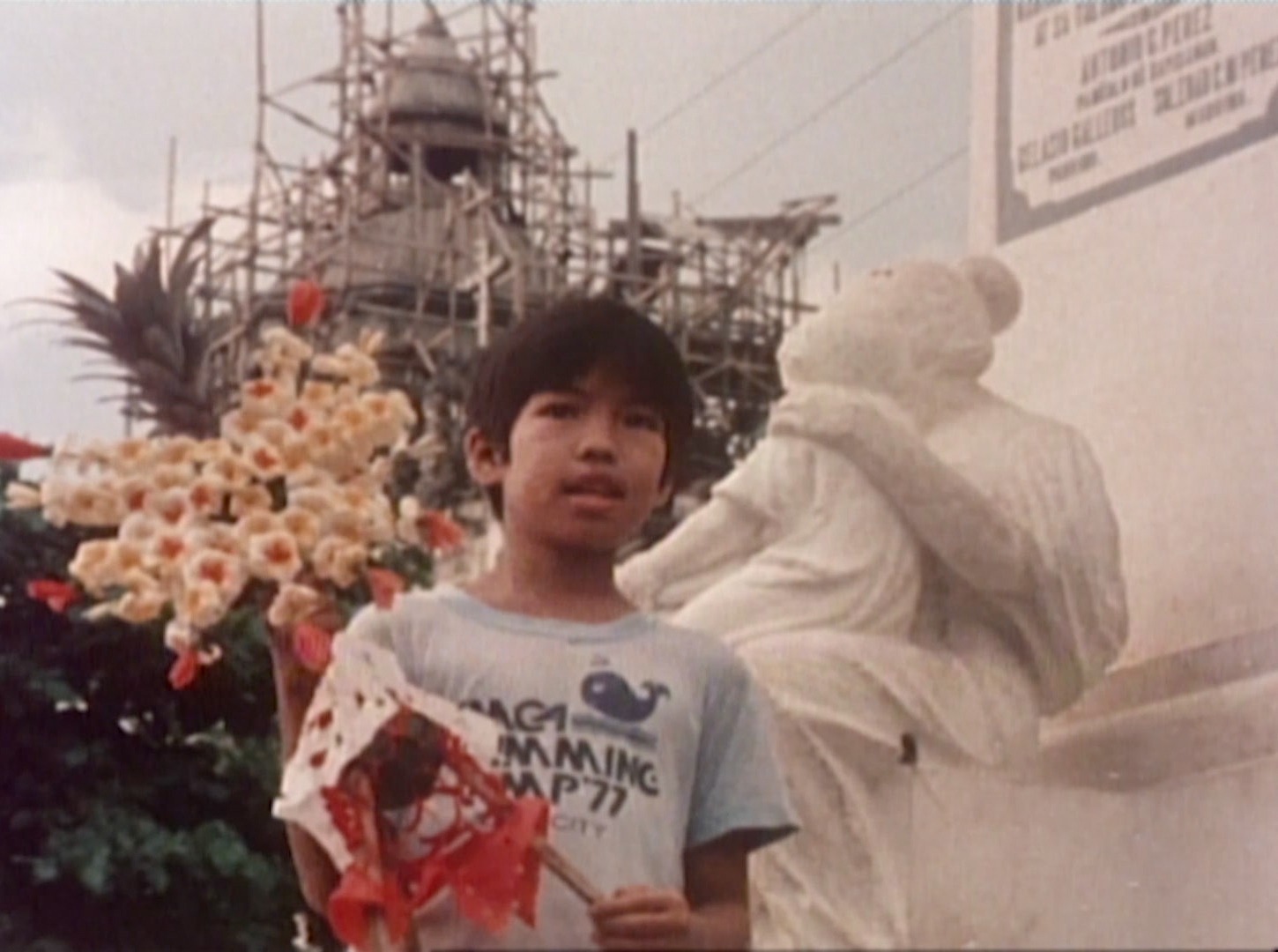
The Munich Games are remembered for a much darker incident, in which eleven members of the Israeli team were killed by a Palestinian militant group. The violence cast a pall over the Games and, for thirty-four hours, all competition was suspended. With no one in the mood to purchase Waldi souvenirs, a now-bankrupt Tahimik decamped to an artist commune outside the city. These events turned out to be pivotal for him, and they form the basis of his second feature, Turumba, a playful and unpredictable blend of fiction and documentary that follows a Filipino character who manufactures Waldi souvenirs for the Munich Olympic Games.
At the commune, Tahimik met his wife, Katrin, and the couple had their first child, whom they named Kidlat. The future filmmaker also made the acquaintance of Werner Herzog, who cast him in a small part in The Enigma of Kaspar Hauser (1974). Tahimik’s interest in film was piqued, and in 1977 he completed his first feature, Perfumed Nightmare, about a Filipino jeepney driver whose dream of becoming an astronaut in the West is dashed after a dispiriting visit to Europe and America. This debut—which was championed by the likes of Susan Sontag and Fredric Jameson, and is now considered a foundational work of Third Cinema—established the director’s reputation as a sharply critical and scrappy auteur of postcolonial film.



More: Features

Jacques Rivette Envisions a More Human Joan of Arc
Anchored by an extraordinary performance from Sandrine Bonnaire, the epic historical drama Joan the Maid strips away its saintly protagonist’s mythic aura and gives us a humbler, more intimate version of her life story.

Anthologized: The World of W. Somerset Maugham On-Screen
The elegantly crafted portmanteau films Quartet, Trio, and Encore adapt twelve spellbinding tales of deception and passion from one of the best-selling authors of the twentieth century.

The Inner Worlds of Neon Genesis Evangelion
A Japanese-television phenomenon that sparked a boom in anime production and fandom, Hideaki Anno’s magnum opus is a mind-bending mix of kinetic action, sci-fi spectacle, and introspective human drama.

James Baldwin Looks Back
The illuminating 1982 documentary I Heard It Through the Grapevine follows the celebrated author on a journey through the American South, as he attempts to reckon with the legacy and losses of the civil rights movement.