A Reluctant Farewell to Nathalie Baye
Share
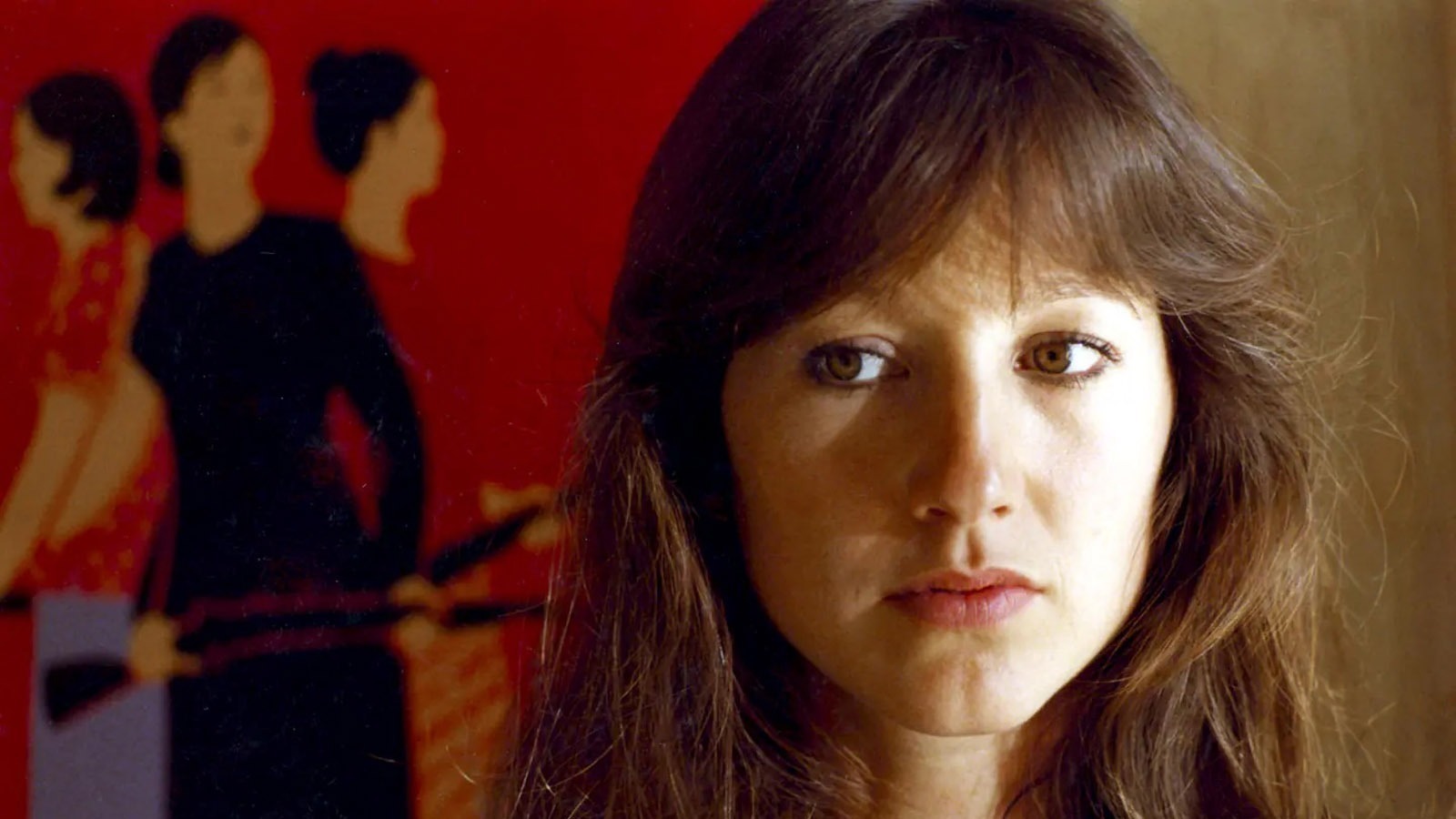
“I try to be watchful and make sure that I do not repeat myself,” Nathalie Baye told critic and French Film Festival UK founding director Richard Mowe in 2017. Baye, who has passed away at the age of seventy-seven, had broken through in François Truffaut’s Day for Night (1973), playing Joëlle, the script girl who assists Ferrand, the film director played by Truffaut himself, in maintaining some semblance of order on a set teaming with overblown yet fragile egos.
Surrounded by dazzling and dashing stars such as Julie (Jacqueline Bisset) and Alphonse (Jean-Pierre Léaud), Joëlle is a rather plain yet calmly anchoring presence. “There was no way I wanted to be typed as the girl next door,” Baye told Mowe. “I saw myself playing dangerous and unsympathetic women.” In a career spanning more than fifty years, she managed to run the gamut, appearing in more than eighty films, garnering ten nominations for César awards—France’s rough equivalent to the Oscars—and winning four.
Born in Normandy, Baye grew up as the only child of a couple of starving artists “who, according to Nathalie, spent their lives ‘in a perpetual state of adolescent crisis,’” as Kim Willsher notes in the Guardian. She struggled with dyslexia and dyscalculia and found respite in dance, which led her to decide that her future would be in the theater. She often credited Truffaut with instilling in her a passion for cinema instead.
When Olivier Père, the director of Arte France Cinéma, interviewed Baye in 2021, he was primarily interested in hearing her talk about just a handful of the many directors she’d worked with: Truffaut, Maurice Pialat, Claude Chabrol, Xavier Beauvois, and Xavier Dolan. There was a brief detour in the conversation when Père asked about Catch Me If You Can (2002), featuring Baye as the mother of Leonardo DiCaprio’s con man, but what Père wanted to know was whether she and Steven Spielberg swapped stories about Truffaut, who played a French scientist in Close Encounters of the Third Kind (1977). They did.
Baye was particularly struck by what the two directors had in common. Driven by essentially upbeat, can-do spirits, both men, she said, lived for cinema. As Acquarello has noted, Truffaut’s The Green Room (1978), starring the director as a death-obsessed journalist and Baye as a secretary he befriends, is “an atypically static and somber film,” but Baye remembers the two of them constantly cracking each other up, which seems to have irritated assistant director Suzanne Schiffman no end.
Probably to the surprise of very few, Baye found Pialat to have a much “darker” outlook. In The Mouth Agape (1974), she plays one of four main characters, Nathalie, the wife of the son of a woman who is dying while her husband makes moves on other women. The director of “one gloriously uncomfortable film after another,” as Phillip Lopate has put it, Pialat was “a complicated humanist whose sympathies for his characters ran so deep that he felt no obligation to sugarcoat their flaws.” (Here we should mention that, starting on Wednesday, New York’s Film at Lincoln Center will present the U.S. theatrical premiere of La maison des bois, a 1971 series Pialat made for French television, along with three of his features.)
Baye was impressed with the way Chabrol involved so many members of his own family in the making of his fiftieth feature, The Flower of Evil (2003), and she had nothing but high praise for her fellow cast members. Bernard Le Coq plays the husband of her Anne, a candidate in an upcoming local election, and their kids from previous marriages (Benoît Magimel and Mélanie Doutey) are encouraged by their aging aunt (Suzanne Flon) to become lovers. “Another tastefully baroque roasting of petty bourgeois rites within suffocating domestic environs,” wrote Jessica Winter in the Village Voice, Chabrol’s “impassive melodrama begins with a prowl up a winding staircase that, as in La cérémonie and his previous effort, Merci pour le chocolat, can only portend corkscrewing revelations of murder and deceit.”
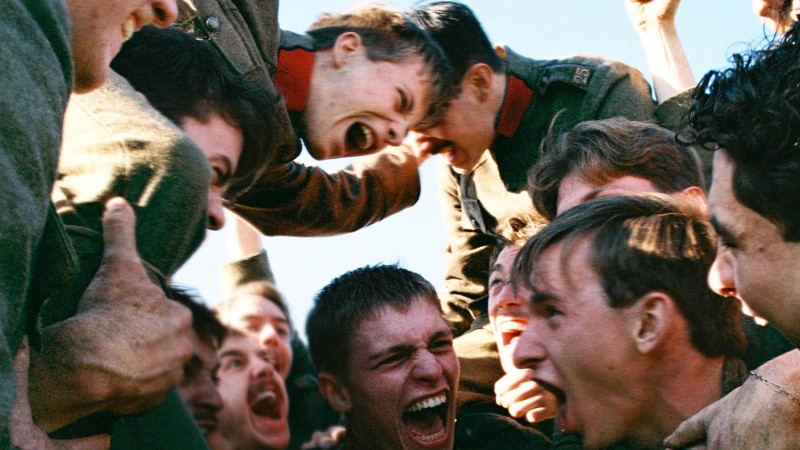
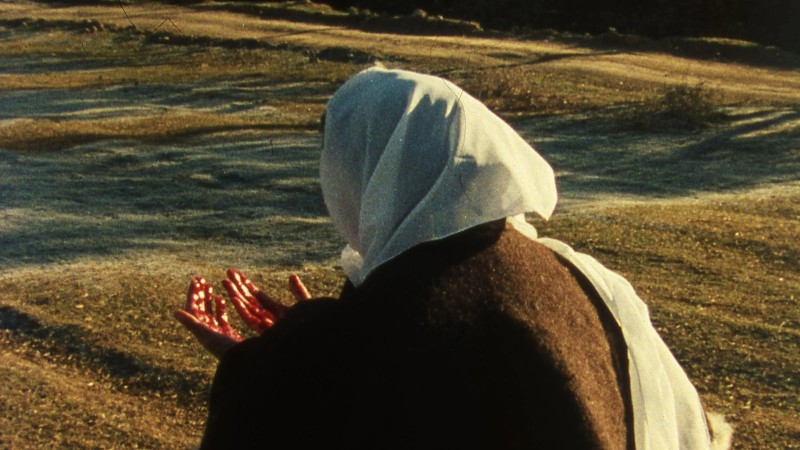
Baye won a César for her portrayal of a recovering alcoholic who heads up a Parisian police squad in The Young Lieutenant (2005), and Xavier Beauvois cast her again in the lead of his 2017 feature, The Guardians. Baye’s Hortense runs a farm while the men are off fighting in the First World War, and her daughter is played by Laura Smet, the real-life daughter of Baye and Johnny Hallyday, the hard-drinking rocker and occasional movie star who admitted to being taken by surprise himself when he and Baye fell for each other. Their parting nearly five years later was amicable, and they remained friends until Hallyday’s death in 2017. In 2015, Baye and Smet appeared together as comedically skewed versions of themselves in an episode of Call My Agent! directed by Cédric Klapisch.
Xavier Dolan was twenty-three when he directed Baye in his third feature, Laurence Anyways (2012), but he’d been acting since he was four, and as Baye told Père, that experience set him apart from many of the other directors she’d worked with. In Dolan’s It’s Only the End of the World (2016), the winner of the Grand Prix in Cannes, Baye plays the garishly outfitted mother of a playwright who informs members of his family that he hasn’t seen in twelve years that he has a terminal illness. The cast is stellar—Gaspard Ulliel, Marion Cotillard, Léa Seydoux, Vincent Cassel—but on the whole, reviews were scathing.
A conspicuous absence in Père’s interview is Jean-Luc Godard, who directed Baye in Every Man for Himself (1980), which Godard called “my second first film,” and Détective (1985), “a rich comedy about the age of video” (Fernando F. Croce) dedicated to John Cassavetes, Edgar G. Ulmer, and Clint Eastwood and costarring Hallyday, Laurent Terzieff, Jean-Pierre Léaud, Claude Brasseur, Emmanuelle Seigner, and in her first role, Julie Delpy.
For her supporting performance in Every Man for Himself, Baye won her first César, and she was nominated that same year for the Best Actress César for playing an exhausted public school teacher in Bertrand Tavernier’s A Week’s Vacation (1980). The following year, she won another Best Supporting Actress César for her turn as a troubled wife in Pierre Granier-Deferre’s Strange Affair (1981), and the year after that, won her first Best Actress César for her portrayal of a Parisian sex worker in Bob Swaim’s La balance (1982).
As news of Baye’s passing broke over the weekend, French president Emmanuel Macron remembered her as “a constant presence in French cinema over the past few decades, from François Truffaut to Tonie Marshall.” Outside of France, Marshall is not exactly a household name, but in 1999, she had a tremendous box-office and critical hit with Venus Beauty Institute and became the first woman to win the César for Best Director.
Marshall wrote her comedy set in a Parisian salon with Baye in mind as the lead, Angèle, whose coworkers are played by Bulle Ogier, Mathilde Seigner, and then-newcomer Audrey Tautou. Cast in lesser roles are even bigger names: Emmanuelle Riva, Edith Scob, Claude Jade, Marie Rivière, and Claire Denis. “Venus Beauty Institute has more than an unexpectedly playful and pointed sense of humor,” wrote Kenneth Turan in the Los Angeles Times, and Baye delivers “one of her strongest performances. Sadness, anticipation, pity, fury, frankness, humor, and love, all these emotions and more play across her face as Angèle tries to cope with the choices life has given her.”
Don’t miss out on your Daily briefing! Subscribe to the RSS feed.