Sixties Shinoda
Share
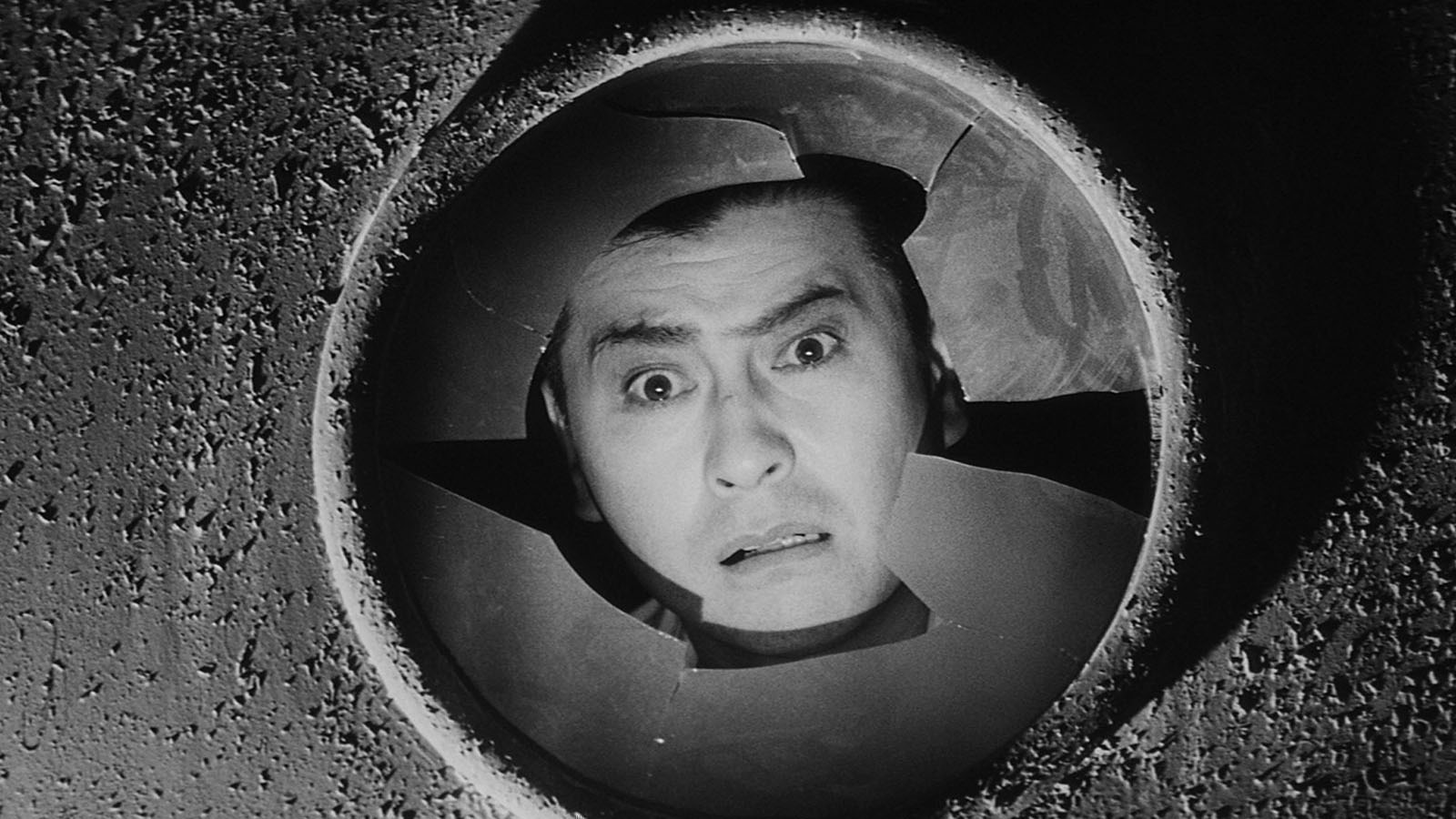
Masahiro Shinoda, a key figure of the Japanese New Wave, passed away one year ago today. From Friday through April 24, the Harvard Film Archive will present Sixties Shinoda, a six-film series celebrating the first decade of a multifarious career that stretched into the new millennium. Shinoda “reinvented himself several times, sometimes as often as from one film to the next,” writes Chris Fujiwara in his program notes. “A will to innovation unifies his work, which is also marked by a sympathy for rebellion and a taste for secrecy and conspiracy.”
The program opens with one of Shinoda’s most critically acclaimed features, Pale Flower (1964), a widescreen noir starring Ryo Ikebe as Muraki, a yakuza hit man fresh out of prison when he finds himself drawn to a mysterious gambler, Saeko (Mariko Kaga). Writing for Slant in 2011, Chris Cabin noted that “the ubiquitous despair that Shinoda felt and imbued through his careful compositions and movements, through Kaga and Ikebe’s beautifully drawn, emotionally acute performances, is palpable from those very first shots of Japan, with Muraki’s voiceover providing solemn philosophies for a country in existential tumult.”
Dry Lake (1960), also known as Youth in Fury, “marks Shinoda’s first collaboration with three other artists who would become regular partners throughout his career,” wrote Marc Walkow for Film Comment in 2017. “Avant-garde poet, playwright, and future filmmaker Shuji Terayama contributes a cynical and complex screenplay which not only casts a skeptical eye on the political scene in general, with its lead character alienated from both the left and the right, but also incorporates contemporary events like the then-current, massive protests against the renewal of the Japanese-American Joint Security Treaty.”
Composer Toru Takemitsu “turns in a jazzy score as perfectly in sync with the contemporary events of the film as his later dissonant works were with Shinoda’s more existential explorations,” wrote Walkow, adding that Takemitsu “eventually scored sixteen Shinoda films in all. Finally, actress Shima Iwashita here makes her first appearance in one of the director’s films; she went on to appear in nearly every one of his subsequent works and the pair were married in 1967.”
In 2011, David Phelps conducted a rare, long-distance interview with Shinoda. One of the films the director dwelt on at considerable length is Double Suicide (1969), an early production from the radically independent Art Theatre Guild and an adaptation of Chikamatsu Monzaemon’s 1721 puppet play The Love Suicides at Amijima. Black-clad stagehands guide the characters—Jihei (Kichiemon Nakamura) is a paper merchant who abandons his wife (Shima Iwashita) and family for a courtesan (also Iwashita)—through a tragic story of doomed love.
“Because we, the artists, auteurs living in the twentieth century, were going to tell the story of a love affair taking place in the seventeenth century in Osaka,” Shinoda told Phelps, “and because we were not just approaching the play, but approaching it through the author, Chikamatsu, and approaching it through his inner landscape, I feel the way we were able to bring the classic into modern times was itself a trip, and one that left very different tracks from the normal way you would recreate a classic for contemporary times.”
In Punishment Island (1966), Saburo (Nitta Akira) returns to an island where he had been used and abused as a teenager by a sadistic farmer. “More so than Shinoda’s other early films,” wrote Aaron Cutler for Slant in 2010, Punishment Island “not only focuses on violence’s psychological effects, but lets violence play out in extended fashion that showcases its effects on the body. Over and over, men beat each other with whips or crutches or even live eels, a close handheld camera chasing both assailant and victim, and the color photography contrasts gushing welts, blood, and bruises with bright green grass.”
Tetsuro Tanba stars in Assassination (1964) as Hachiro Kiyokawa, the real-life swordsman who founded the Roshigumi, a group of more than two hundred masterless samurai in 1862. This was a period of upheaval and shifting alliances sparked by the 1853 arrival of U.S. Navy Commodore Perry in 1853. Sent by President Millard Fillmore, Perry’s mission was to put an end to more than two hundred years of Japanese isolation.
Writing about Assassination for Senses of Cinema in 2011, Dan Harper noted that Donald Richie, “the doyen of Western critics of Japanese film, called it Shinoda’s best film, as did his fellow director Kon Ichikawa. The historical context of the film is extremely complex, and Shinoda further complicates matters by recounting events in Kiyokawa’s life from the perspective of several different characters. The film’s plot also moves backwards and forwards in time. The end result is a little confusing but these complications make it that much harder to take one’s eyes off the screen.”
Set in the early seventeenth century, Samurai Spy (1965) tracks a ninja’s hunt for a spy while a mysterious figure seems to be keeping a close eye on both. “The plot is a twisting labyrinth with a large cast of characters,” wrote Nicholas Rucka for Midnight Eye in 2011. “Likewise, the shooting style is inconsistent: at times it is jarring, beautiful, experimental, playful, abstract, conventional, and just about everything else.” Rucka pointed out that Shinoda claimed that he was responding to the “bright and cheery filmmaking” that prevailed at his studio, Shochiku. As Rucka put it, in 1965, Shinoda “was young and full of piss and vinegar; no one was going to tell him what to do.”
Don’t miss out on your Daily briefing! Subscribe to the RSS feed.