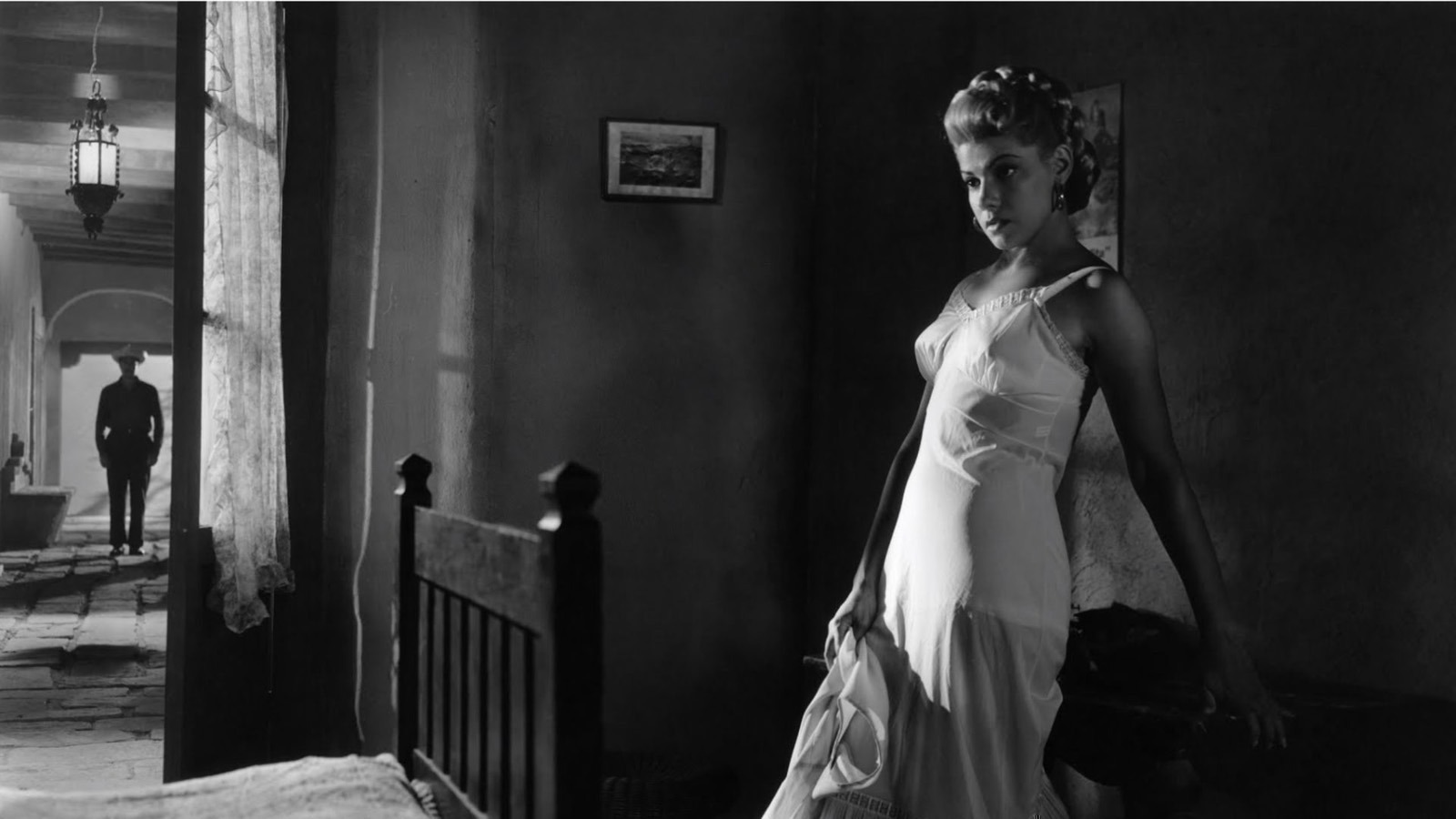
Ninón Sevilla in Julio Bracho’s Take Me in Your Arms (1954)
Reviewing The Seventh Veil of Salome, the tenth novel by Silvia Moreno-Garcia (Mexican Gothic), Lauren LeBlanc wrote in the New York Times: “No matter the genre—gothic, horror, noir—she’ll embody its essence with a verve all her own.” The Seventh Veil is set in 1950s Hollywood, when the Motion Picture Production Code was still being strictly enforced by the censorious Joseph Breen.
As Moreno-Garcia points out in a brief essay for the Vancouver International Film Festival, there was no such code at the time south of the border. “Although Mexican studios would ultimately punish femme fatales and criminals,” she writes, “noirs explored themes of crime, sexuality, and moral ambiguity with more freedom than their Hollywood counterparts.” The essay accompanies Mexico Noir, a fifteen-film VIFF series curated by Moreno-Garcia and running from Thursday through April 8.
The opening night film is La otra (1946), one of four features in the program directed by Roberto Gavaldón. Dolores del Río stars as twin sisters, María, a meek manicurist, and Magdalena, a millionaire’s widow. María kills Magdalena in order to take her place—and her newfound wealth—but she then discovers that the life she’s stepped into is preloaded with unforeseen perils.
“It’s an almost Shakespearean arc, yet Gavaldón keeps the passions under cool control,” writes Ela Bittencourt for Notebook. Sets are “lit with high contrasts and deep shadows,” and the “evocative cinematography by Alex Phillips also plays with reflections, with crossed glances, doubles and multiples, since María is never certain that she can fully pass as her sister’s doppelgänger—a cinematic approach that is both visually and psychologically compelling.”
“Gavaldón possessed a true populist touch and a well-rounded sense of how to construct robust, emotionally charged stories in a variety of genres,” wrote Steve Dollar for the New York Sun in 2008. The Night Falls (1952) is “a beautifully shot, crisply executed drama in which the philandering jai-alai hero Marco (Pedro Armendáriz) impregnates one of his girlfriends, then takes the heat when her angry brother uses the information to force him into throwing a match. Marco defies the mob, at considerable peril. With its elegant nightclub sequences and tough-guy locker-room jousting, duplicitous sweet talk and lethal glares, the film emanates an authentically pulpy aura.”
Moreno-Garcia has selected three films directed by Julio Bracho, a cousin of both Dolores del Río and Ramón Novarro and a founding member of the experimental Teatro Orientación in Mexico City. Bracho’s films are “distinguished less by the director’s personality than by the interest in filmed theatricality he shared with Jean Renoir, Douglas Sirk, and Orson Welles,” wrote J. Hoberman for Artforum in 2017. Another Dawn (1943), “the movie generally considered Bracho’s finest, was a markedly progressive political noir,” while Crepúsculo (1945) “has a surplus of artistic aspiration: The lighting is expressionist, the decor modernist, and a prominent consulting credit is given to the celebrity criminal psychologist Dr. José Quevedo.”
Bracho’s Take Me in Your Arms (1954) stars Ninón Sevilla, the fiery Cuban singer and dancer whose finest hour may well have been Victims of Sin (1951), directed by Emilio Fernández and shot by one of the greatest cinematographers of Mexican cinema’s golden age, Gabriel Figueroa. As Jacqueline Avila has written, Victims of Sin is “one of the very best examples of the cabaretera film, an offshoot of the popular ‘prostitute melodrama’ genre set in cabarets.”
At the center of these films is “a rumbera, a female protagonist and figure of escapist fantasy who exhibits her liberation through her sexuality and uninhibited dancing,” writes Avila. “But unlike other cabareteras from this period, Victims of Sin provides a twist: the film does not punish the rumbera. This unconventional narrative, on top of its extraordinary star power and musical and dance performances, has put Victims of Sin in a class of its own.”
Fernández’s Salón México (1949) is “essentially a film noir version of Stella Dallas, with the added delight of musical numbers that take place in the nightclub of the title,” wrote Farran Smith Nehme in the Village Voice in 2018. “The dancing is explosively sexy, full of gyrating pelvises that would have given the Hollywood censors a stroke.”
Discoveries await in films by lesser-known directors, but Moreno-Garcia has also included two features by the internationally renowned Luis Buñuel. Él (1953) stars Arturo de Córdova—who by this point had worked with Gavaldón, Bracho, and Fernández—as an obsessively jealous husband. “Buñuel pushed de Córdova to the limits of his ability to project irrationality,” writes Fernanda Solórzano. “One gets the impression that the filmmaker and the star understood each other intuitively. The actor, for his part, discovered that Francisco was, on some level, Buñuel; critics even observed that the actor’s heavy gait was similar to the director’s.”
The Criminal Life of Archibaldo de la Cruz (1955), starring Ernesto Alonso as a would-be serial killer whose victims keep dying before he has the chance to murder them, is “central Buñuel, midway between the early savagery and the later urbanity, a most dapper derangement of normalcy,” writes Fernando F. Croce. “The figure sauntering down the road at the close might be the auteur himself, the mischievous maniac reconciled with the world’s endless reserves of comic horror.”
Don’t miss out on your Daily briefing! Subscribe to the RSS feed.