Sergei Loznitsa in Los Angeles
Share
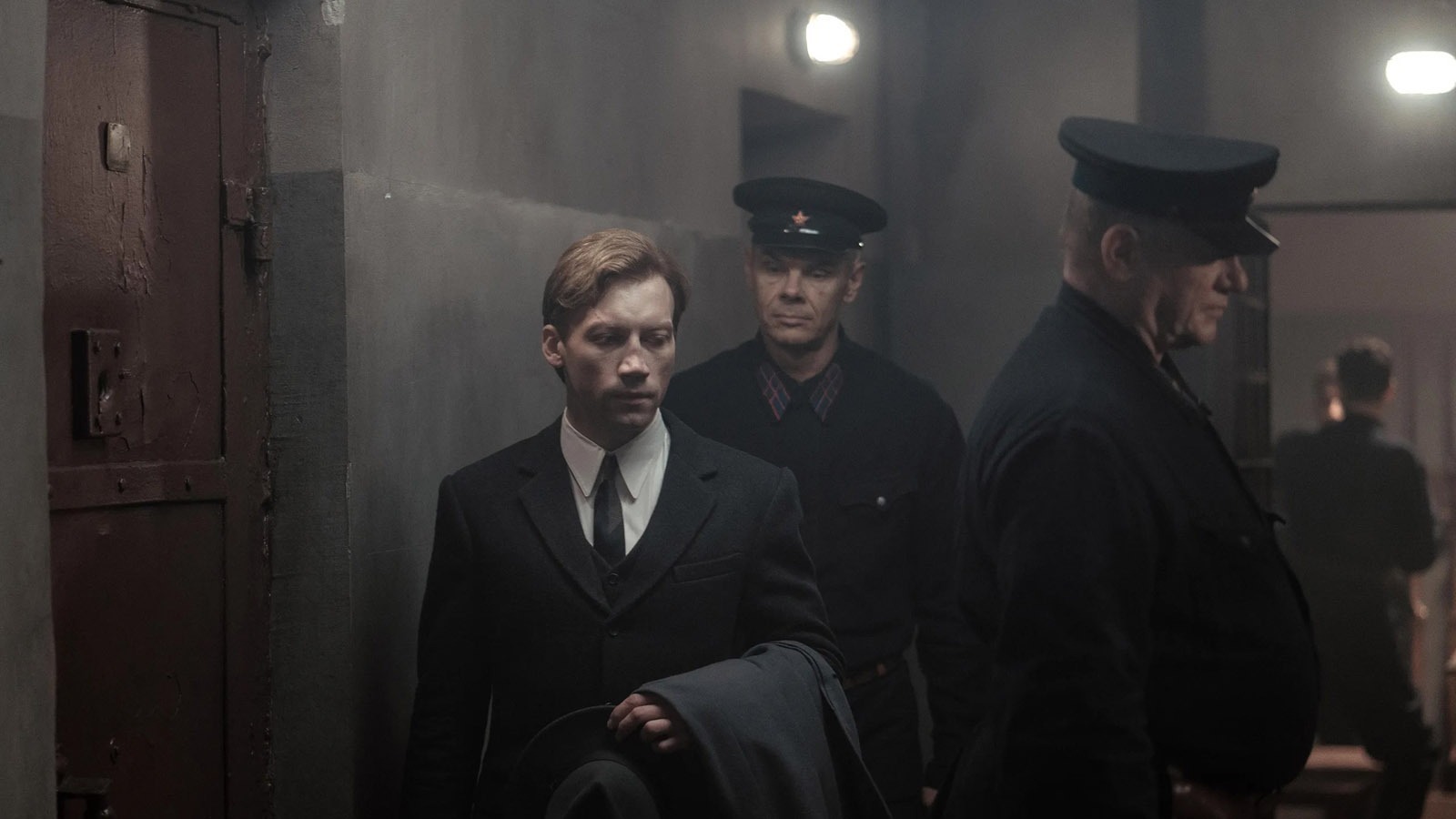
From today through Wednesday, Sergei Loznitsa will be in Los Angeles, where the American Cinematheque will screen three of his five fictional features and one of his more than two dozen documentaries. The Ukrainian director’s latest, Two Prosecutors, is a Critic’s Pick in the New York Times, where Nicolas Rapold writes that “Loznitsa’s novelistic, confidently imagined investigative drama is an instant classic in the annals of film and literature about the systemic abuses of state power, specifically by a totalitarian government.”
Set in 1937, at the height of Stalin’s Great Purge, Two Prosecutors is adapted from a novella by Georgy Demidov, a physicist who spent fourteen years in the Soviet gulag. Aleksandr Kuznetsov stars as Kornyev, an idealistic young lawyer who comes across an urgent letter written in blood by an imprisoned aging prosecutor Kornyev admires, Stepniak (Alexander Filippenko). Convinced that Stepniak has been wrongfully convicted, Kornyev wins the old man’s trust and sets out to prove his innocence—and to uncover and report the corruption infesting the People’s Commissariat for Internal Affairs.
“Loznitsa’s methods are grim and exacting,” writes the New Yorker’s Justin Chang, “but the effect is never monotonous; there are shivers of Hitchcockian suspense, plus a whispery cackle of satire that veers toward the Kafkaesque. Whether Kornyev is navigating the bowels of a prison or a labyrinth of bureaucratic absurdity, the rooms and anterooms he must pass through are like successive circles of Hell. Once he reaches the core, his sense of entrapment, and ours, is total.”
Critic Tim Grierson will moderate this evening’s Q&A with Loznitsa, and tomorrow, the filmmaker will discuss the documentary he made in 2018 that could serve as a companion piece. If Two Prosecutors tracks injustices and abuses carried out behind closed doors with a quiet intensity, The Trial is a big, bombastic, public-facing show put on in Moscow in 1930. Loznitsa draws from footage shot over the course of an eleven-day show trial of top-ranking officials facing trumped-up charges of plotting a coup d’état.
“The whole thing was a spectacle of monstrous proportions, set, fittingly, in a theater and attended, presumably, by an audience of proles, and conducted with such calculated sobriety as to make the trial in Kafka’s novel seem to be Hollywood melodrama,” wrote the late Tony Pipolo for Artforum in 2019. “Yet the defendants—all professional engineers and scientists deemed to be out of touch with the working class—were real and were condemned to years of imprisonment or death. To hear them refuse to defend themselves, confessing error, and begging for mercy, is to witness the full, terrifying, and repugnant effect of Stalinist ideology.”
On Wednesday, the Cinematheque will present a double feature. My Joy (2010)—Loznitsa’s first feature and the first Ukrainian film selected to compete for the Palme d’Or in Cannes—is a road movie tracking the journey of Georgy (Viktor Nemets), a truck driver who simply wants to get his cargo of flour from one town to the next. The obstacles he faces are frequently bizarre and occasionally life-threatening.
“The world of My Joy is grim, though the experience of watching it and piecing together its fragmented story strands is anything but,” wrote Manohla Dargis in the New York Times. “It’s suspenseful, mysterious, at times bitterly funny, consistently moving, and filled with images of a Russia haunted both by ghosts and the living dead.”
Donbass (2018) is both a time capsule and an infuriatingly still-relevant portrait of the ongoing conflict between Ukrainian loyalists and Russian-backed separatists in the eastern-most region of the embattled country. Each of the film’s thirteen loosely connected stories are reconstructions of actual events captured on YouTube or reported by locals and/or professional journalists.
“Opening with a scene of actors preparing to film what we soon shockingly learn is a fake news report of Ukrainian nationalist terrorism,” writes Notebook’s Daniel Kasman, “and going on from there—a local mobster covers up the pilfering of hospital supplies in a glorious performance of false outrage, an SUV is requisitioned from a Russian loyalist, who is subsequently blackmailed for more money, and a man labeled as a volunteer in a Ukrainian death squad is chained to a public lamp post to be heckled and beaten—Donbass is a grave, sometimes blackly, absurdly comic transmission from a region roiling in intimate bloodshed and hatred.”
Don’t miss out on your Daily briefing! Subscribe to the RSS feed.