Noir, Nitrate, and a Zine
Share
Friday brings shadowy tunes to Seattle, highly combustible reels to Los Angeles, and popcorn scoopers and ticket tearers to New York. Eddie Muller, the “Czar of Noir,” will host the opening weekend of the Seattle edition of the festival he launched two decades ago, Noir City, and local author Vince Keenan will then take over hosting duties through February 19.
All fifteen films in this year’s lineup feature musicians or actors pretending they can play. The emphasis of the program, “given the classic noir time frame,” writes Keenan, “is naturally on jazz, but country and rock and roll are also on the playlist. Plenty of real-life musicians—Louis Armstrong! Ella Fitzgerald! Sammy Davis Jr.! Elvis!—will appear on the big screen, along with noir mainstays like Robert Mitchum, Dan Duryea, and Ida Lupino.”
In the opening night film—Roy William Neill’s Black Angel (1946), an adaptation of Cornell Woolrich’s novel—Duryea plays Marty, a down-and-out pianist enlisted by June Vincent’s Catherine to help prove that her husband did not murder Marty’s ex. “Black Angel portrays a world rife with deviousness, desperation, greed, and betrayal,” writes Budd Wilkins at Slant. “Its characters seem haunted by the consequences of their own worst instincts. Clocking in at barely eighty minutes, the film possesses a relentless forward momentum, courtesy of its ‘race against the clock’ scenario, while also serving up a completely unsuspected twist in its last act.”
Noir City Seattle 2026 also offers Ann Sheridan as a San Francisco nightclub singer in Vincent Sherman’s Nora Prentiss (1946), Rita Hayworth knocking ’em dead with “Put the Blame on Mame” in Charles Vidor’s Gilda (1946), Frank Sinatra struggling to stay clean in Otto Preminger’s The Man with the Golden Arm (1955), and two songs cowritten by Robert Mitchum in Arthur Ripley’s Thunder Road (1958). The series wraps with two period pieces, both of them flashbacks to jazz scenes decades past. Robert Altman’s Kansas City (1996) is set in the 1930s, while Bertrand Tavernier’s Round Midnight (1986) takes us to 1950s Paris.
Another noir opens the American Cinematheque’s Nitrate Film Festival in LA. Author and programmer Alan K. Rode will introduce a screening of John Cromwell’s Dead Reckoning (1947), starring Humphrey Bogart as a detective investigating the murder of his old friend Johnny. The trail leads to one of Johnny’s old flames played by Lizabeth Scott. Dead Reckoning is “kind of like a mash-up of favorite Bogart tropes,” notes David Cairns. “He gives a speech to Scott at one point saying he wishes he could shrink her and keep her in his pocket—according to [Lauren] Bacall, this was a line he used on her in real life.”
The point of screening nitrate film, the original stock introduced in the 1890s but discontinued in the 1950s due to its extreme flammability, was driven home by filmmaker and historian Kevin Brownlow in a 2011 issue of Sight and Sound. He recalled showing “a dim 16 mm dupe” of a 1927 comedy. “It was the usual thing that laboratories subjected us to in the 1960s,” Brownlow noted. “Then the projectionist switched over to the same scene in original nitrate. The audience gasped. The difference was indeed breathtaking. The 16 mm barely registered. The 35 mm looked stereoscopic—you felt you could walk into it.”
Highlights of this year’s Nitrate Film Festival include Mikio Naruse’s Wife! Be Like a Rose!, which was named the best Japanese film of 1935 by the critics at the prestigious journal Kinema Junpo; My Man Godfrey (1936), in which, as Farran Smith Nehme has pointed out, “director Gregory La Cava offers an exceptional amount of craziness on the way to romantic (and audience) bliss”; and Blithe Spirit (1945), David Lean’s adaptation of Noël Coward’s hit play about a novelist who inadvertently conjures the spirit of his late first wife. “Lean does not push things toward buoyancy or whimsicality,” writes Geoffrey O’Brien, “but the suggestion of straight-ahead seriousness in his direction makes things funnier than any hint of high-comic exaggeration could have done.”
William Wyler’s The Good Fairy (1935) will screen from a nitrate print in LA and from a 35 mm print in New York as part of the ten-film series Cinéma du Cashiers at the Brooklyn Academy of Music programmed by Dan Welch and David Cardoza, the editors of Cashiers du Cinéma. “The movie theater employee has a rich psychological profile for the film-going community to readily dive into,” say Welch and Cardoza. “Cashiers du Cinéma is a showcase of this very life: a magazine by cinema workers. It’s an ode to the movies they love, to the customers they love to hate, and to the slacker code of conduct.”
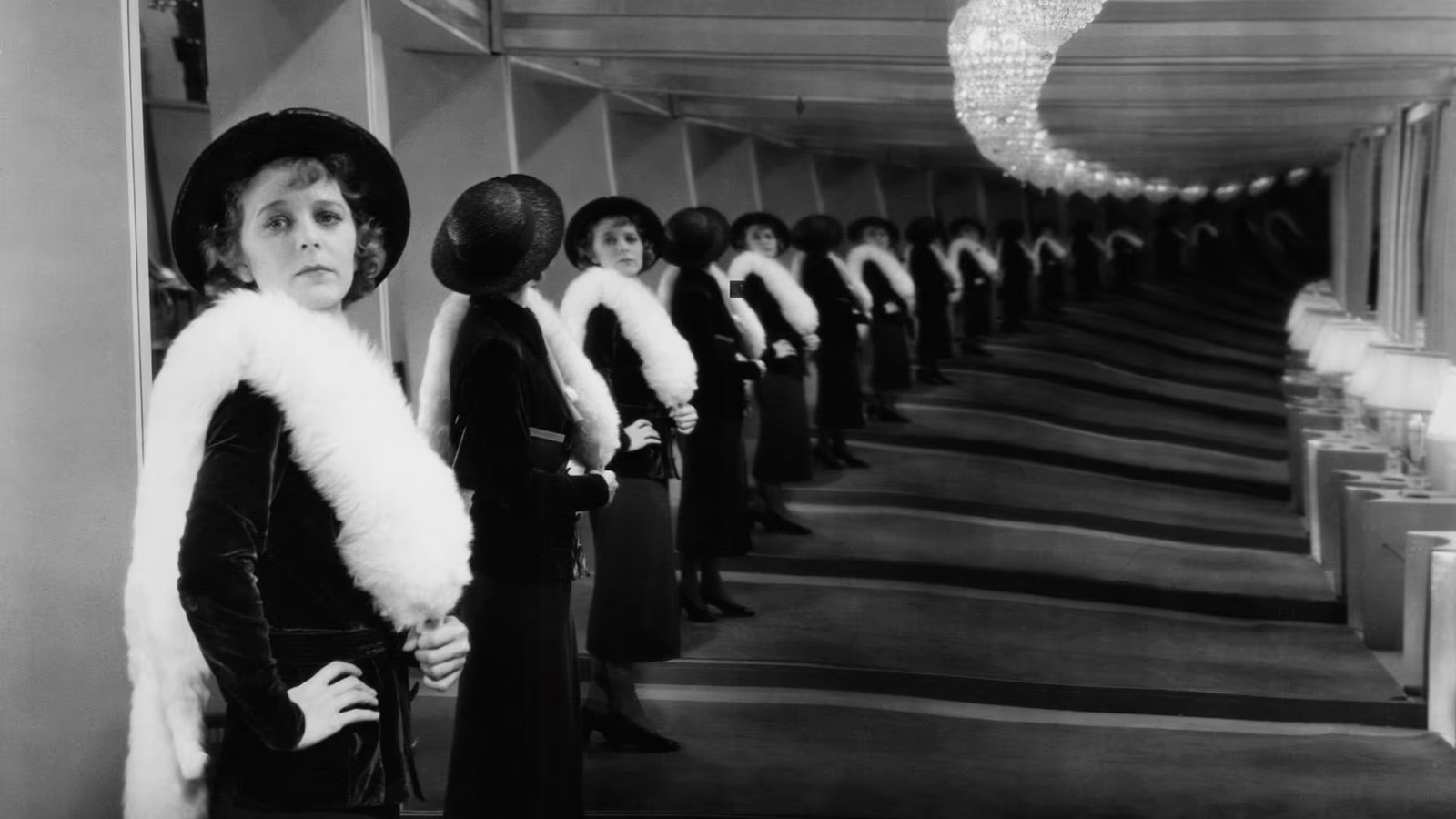
Written by Preston Sturges, The Good Fairy stars Margaret Sullavan as Luisa, an orphan working as an usher in the grandest movie palace in Budapest and determined to do one good deed each and every day. Mix-ups and misunderstandings ensue. The Good Fairy “boasts the quick wit that’s so typical of the screwball comedy,” writes Derek Smith at Slant, “but also a sharply observed critique of predatory masculinity, which defines all but one of the numerous men who flock to the wide-eyed Luisa like moths to a flame.”
Several BAM screenings will be preceded by comic readings from pieces in the zine chronicling mishaps, run-ins, and the frequent swaths of sheer boredom that a job in a movie theater can entail. “The work is so low-stakes,” Welch and Cardoza tell Natalia Keogan at Filmmaker, “and the conflicts that arise so inconsequential and stupid that they seem basically impossible to hinge an entire movie on. But we also found that this negative space has been used in interesting ways: Like [Sarah Jacobson’s] Mary Jane’s Not a Virgin Anymore [1997] or Lin Cheng-sheng’s Murmur of Youth [1997] (the latter of which screens for free), the film can follow relationships formed between coworkers when there are no customers to attend to. Like [Tsai Ming-liang’s] Goodbye, Dragon Inn [2003], [Bette Gordon’s] Variety [1983], or The Good Fairy, encounters in the theater can be used as a launching point to follow other ‘extracurricular activities.’”
Don’t miss out on your Daily briefing! Subscribe to the RSS feed.