Agnès Varda at Film Forum
Share
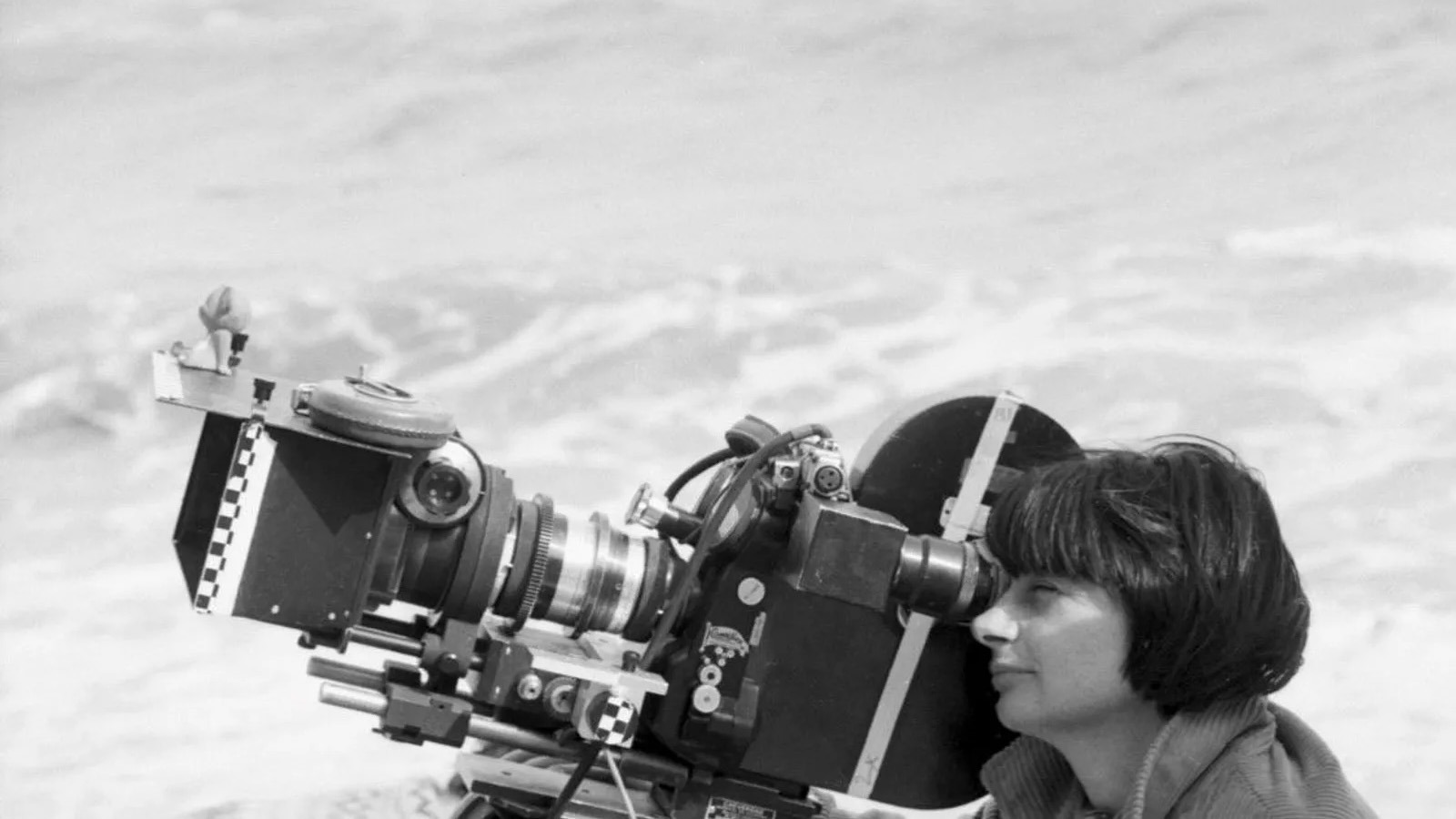
The comprehensive Agnès Varda retrospective opening at Film Forum in New York on Friday and running through April 2 will be catnip for completists. But for anyone who, let’s say, saw Richard Linklater’s Nouvelle Vague and caught a glimpse of Roxane Rivière as Varda and has since decided that it’s high time to catch up with the work of the woman known as “the godmother of the French New Wave,” the program of two dozen features and a varied array of shorts presents a daunting prospect. Programmer David Schwartz has helpfully scheduled introductions and Q&As for five essential, not-to-be-missed films.
On Friday, Carrie Rickey, the author of A Complicated Passion: The Life and Work of Agnès Varda, will introduce the New Waviest of Varda’s features, Cléo from 5 to 7 (1962), and on Saturday, Rickey will present Varda’s follow-up, Le bonheur (1965). On Sunday, Schwartz will discuss Varda’s first feature, La Pointe Courte (1955), and then on Saturday, March 21, he’ll tackle an outlier, Documenteur (1981), before A. S. Hamrah introduces Varda’s disturbing tour de force Vagabond (1985).
As it happens, Hamrah reviewed Rickey’s “compact, complete, and highly enjoyable book” for Bookforum in the fall of 2024. A Complicated Passion, the first full-length biography of Varda in English, is “moving because Varda’s life was moving, and because its existence made me realize I’d been waiting for it.”
“It’s important, I think, to start with Cléo,” wrote Hamrah. “People are often surprised to find out Varda had made films before it, and Varda’s later films can be read as variations on its theme.” Corinne Marchand stars as a pop singer with a couple of hours to kill while she awaits the result of a biopsy. She goes shopping with her assistant, returns to her apartment, rehearses a tune with her pianist (composer Michel Legrand), and then bolts back out onto the streets again. In Cléo, “the Left Bank of Paris is preserved for us in all its early 1960s vibrancy and diversity,” writes Adrian Martin. “Indeed, Varda once described the film as ‘the portrait of a woman painted onto a documentary about Paris.’”
Writing about Cléo in 2000, Molly Haskell observed that the “tension between a superficial high-gloss beauty and a dryer and deeper grounding in life marks all of Varda’s works, sometimes ambiguously as in Le bonheur, sometimes fancifully as in Les créatures [1966]. One Sings, the Other Doesn’t [1977], the feminist anthem and bonding picture, is perhaps her most political film, and—surprisingly for such an overt ‘message’ movie—one of her most enduring, while Vagabond, the 1985 film starring Sandrine Bonnaire as an unrepentant drifter who refuses to present herself as a female object and eludes all claims of men and law, is the masterpiece toward which the remarkable Cléo from 5 to 7 points.”
Le bonheur, Varda’s first feature in vibrant color, opens with a seductive vision of familial bliss. François and Thérèse and their two children—played by real-life couple Jean-Claude and Claire Drouot and their actual daughter and son, Sandrine and Olivier—frolic in the woods with Mozart on the soundtrack. One fine summer day, François meets Émilie (Marie-France Boyer), and when Thérèse asks him why he seems especially happy lately, he tells her that there’s enough happiness in him to spill over to her, their kids, and his mistress. Thérèse claims she will accept this arrangement—but she will not survive it.
Hamrah notes that Varda once called Le bonheur “a ripe summer peach with a worm inside” and that Chantal Akerman thought it was “the most anti-romantic film there is.” “Looking back at Le bonheur from the other side of the second wave of feminism,” wrote Amy Taubin in 2008, “one can read it as a not-fully-articulated call to consciousness that largely fell on deaf ears, and to a certain extent still does today.”
Born into a well-to-do family in Brussels—her father, the son of Greek refugees, was a successful engineer—Varda launched her artistic career as a photographer, and her work is currently on view in exhibitions in Rome (through May 25) and in Bologna (through January 10). Before shooting her first feature in Sète, the beach town in the south of France where she had lived as a teen, Varda practically storyboarded La Pointe Courte by shooting photos of every scene she intended to capture. On film, compositions caught at what Henri Cartier-Bresson called the decisive moment billow to life like the linens hung in the breeze on the washing lines strung up by fishermen’s wives.
La Pointe Courte essentially cuts back and forth between two strands, an ethnographic study of villagers in Sète and a somewhat theatrically stilted conversation between a husband and wife played by Philippe Noiret and Silvia Monfort. “Varda’s authorial control over both scriptwriting and directing, the exclusive use of location shooting, the mixing of professional and nonprofessional actors—all of this was groundbreaking in early 1950s France,” writes Ginette Vincendeau. “Seeing La Pointe Courte again in 2007, after Varda’s extraordinary documentary The Gleaners and I (2000), also confirms how prophetic this first feature was, heralding—beyond the New Wave—some of the most exciting developments in French postwar cinema, as well as in Varda’s own career.”
Varda met Jacques Demy at a film festival in 1958, and they moved in together the following year. After they married in 1962, Demy adopted Varda’s daughter, Rosalie. The success of Demy’s The Umbrellas of Cherbourg (1964) and The Young Girls of Rochefort (1967) got Demy invited to Hollywood, and while he worked on Model Shop (1969), Varda reveled in the California sun and exhilarating counterculture, shooting short films about an eccentric uncle and the Black Panthers and a feature, Lions Love (. . . and Lies) (1969). Returning to France with Rosalie in time to give birth to her son, Mathieu Demy, Varda captured the lives of the people working along her street, the Rue Daguerre, in Daguerréotypes (1975).
In 1979, Varda went back to Los Angeles to work on a project that fell through. Temporarily separated from Demy, she threw herself into her work again, making Mur Murs (1980) and Documenteur, “a documentary and a work of fiction that are radically interconnected,” as Michael Koresky has noted. “These tiny-budgeted films show Varda at the height of her intellectual and aesthetic powers, each reflective of her unflagging inquisitiveness and the alienation she was experiencing.” Mur Murs is a lively parade of LA murals, while Documenteur is “an abstracted drama” about a divorced woman living alone and lonely with her son—played by Mathieu Demy.
Back in France, Varda cast seventeen-year-old Sandrine Bonnaire as Mona, a vagrant found frozen to death in a ditch in the first scene of Vagabond. Via interviews with characters who interacted with Mona, most of them played by nonprofessional actors, Varda reconstructs the final days and weeks of Mona’s aimless journey. “To them she is, alternately, a blank slate, a whore, a romantic, a symbol of freedom, a nuisance, a protégé, or easy pickings,” wrote Andrea Kleine in a 2018 piece for the Paris Review.
“Watching Mona is like examining your own guts,” wrote Kleine. “Mona doesn’t care if you watch or not. I am not here for you to figure out, I imagine her saying—because like me, she says so very little. Try to judge me, she says, flipping off the camera. Try to pin me down, she says to her audience. I terrify you, don’t I?”
Varda’s fascination—and perhaps identification as well—with those living on the outer parameters of society would also lead her to a project that might be seen as something of an antidote to the fierce challenge of Vagabond. In The Gleaners and I, she wanders with her light digital camera among those living off the food and objects tossed aside by others. Writing about The Gleaners and I in the New York Times, A. O. Scott noted: “Even at their most desperate—a former truck driver, fired for drinking on the job, who lives in a shabby trailer; a group of disaffected young people who vandalize hulking trash bins—Ms. Varda’s gleaners retain a resilient, generous humanity that is clearly brought to the surface by her own tough, open spirit.”
Don’t miss out on your Daily briefing! Subscribe to the RSS feed.