Three Sundance Premieres
Share
At the top of a dispatch from Sundance, Crooked Marquee editor Jason Bailey notes that he was determined to attend the final edition of the festival in Park City before it moves to Boulder, “finances be damned, and I’m glad I did. There’s a sense of joy at this festival, a feeling of everyone sorting through their memories (moviegoing and otherwise).”
Richard Lawson, the former film critic for Vanity Fair now reviewing for the Hollywood Reporter, has had a different experience. “A certain warm nostalgia has tinged the air, sure, but it’s been heavily spiked with the bitter sense that we are only walking around in the arid, empty place where something used to be,” he writes. “All film festivals have their off years, but this has felt different, less like an anomaly and more like a troubling sign of an industry in slow collapse.”
Lawson has liked a good handful of movies he’s seen in Park City, and he’s heard good things about Beth de Araújo’s Josephine, which premiered in the U.S. Dramatic Competition and will soon head to Berlin. We’ll take a look at the various contenders in the competitions at Sundance after the awards are presented, but for now, we’ll turn to a few critical favorites from this year’s Premieres program.
Olivia Wilde’s The Invite
As of this writing, only three deals have been sealed at Sundance this year. Sony Pictures Classics has acquired Josef Kubota Wladyka’s Ha-chan, Shake Your Booty!, starring Rinko Kikuchi as an aspiring ballroom dancer in Tokyo, and Neon has picked up Adrian Chiarella’s Leviticus, a horror movie about conversion therapy. And after what Variety calls “an old-fashioned, multi-day bidding war,” A24 landed Olivia Wilde’s The Invite for a sum “north of twelve million dollars.”
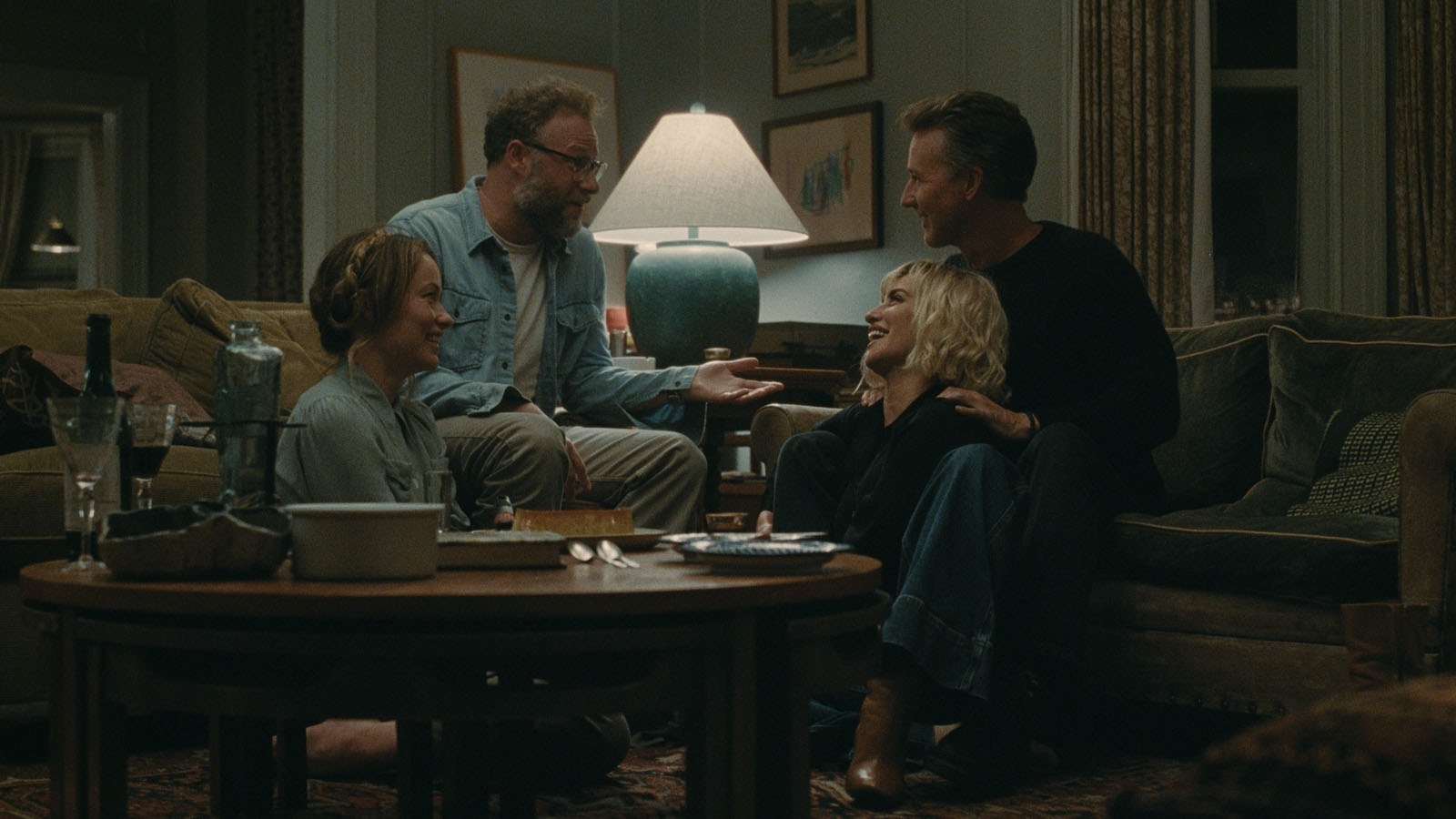
The general consensus is that Wilde’s first feature as a director, Booksmart (2019), is a fresh take on the coming-of-age comedy, while Don’t Worry Darling (2022) bears the scars of its famously troubled production. The Invite stars Seth Rogen and Wilde herself as a married couple, Joe and Angela, who are having the upstairs neighbors over for dinner. Joe wants nothing to do with Pína (Penélope Cruz) and Hawk (Edward Norton) because their loud and rowdy lovemaking keeps him up at night, but for Angela, Pína and Hawk seem to be living the life she wants. Reviews—most of them quite positive—often mention either Mike Nichols’s Who’s Afraid of Virginia Woolf? (1966) or Roman Polanski’s Carnage (2011). Or both.
As Variety’s Owen Gleiberman points out, you walk into a movie about two couples in a confined space—the setting is the San Francisco apartment Joe has inherited from his parents—expecting “light, funny, brittle, caustic” dialogue to give way to flirtation, and eventually, dark confessions. The Invite “lives up to every one of those expectations,” writes Gleiberman. “Yet it does so in a way that’s so original, so brimming with surprise, so fresh and up-to-the-minute in its perceptions of how relationships work (or don’t), that you watch it in a state of rapt immersion and delight.”
“There is nimble choreography to how everyone quips, cross-talks, interrupts, and trails off, the kind of film that could be easily mistaken as semi-improvised were you not listening intently to the carefully crafted, detail-packed dialogue,” writes the Guardian’s Benjamin Lee. “Every aside reveals something, (almost) every joke lands, and every actor is working intently at making every moment count . . . But as director and actor, this is Wilde’s triumph. This past week, she was the vampy saving grace of Gregg Araki’s Sundance sex farce I Want Your Sex, and now she has gifted us with another excellent yet entirely different comedic performance (nervy and unsure without being over-mannered) and the kind of crackling, laugh-to-cringe couples comedy that many of us have been missing.”
“When it’s cooking, which is most of the run time,” writes the Hollywood Reporter’s David Rooney, “this is a smart, sophisticated, and incisively acted adult entertainment that savages the crumbling institution of marriage, dangles the promise of sexual rescue, and then brings the walls crashing down in a bitter reckoning that seems irreversible—until a window of hope and healing gets cracked open. That closing note is so lovely, and its visual handling so graceful, that it retroactively smooths the bumps.”
Padraic McKinley’s The Weight
“The streets are full of memories,” Ethan Hawke tells Nicole Sperling in a New York Times piece about the festival’s farewell to Park City. Hawke first came to Sundance as an actor in 1994 with Ben Stiller’s Reality Bites, and the following year, Robert Redford selected Richard Linklater’s Before Sunrise as the opening-night film. Now that 1995 gem has just been selected along with twenty-four other films to become part of the National Film Registry.
Hawke’s excellent 2025—Black Phone 2 was a hit—is spilling over into 2026. Last week, he scored his first nomination for the Oscar for Best Performance by an Actor in a Leading Role for his turn as lyricist Lorenz Hart in Linklater’s Blue Moon. In Padraic McKinley’s The Weight, set in Oregon in 1933, Hawke plays Samuel Murphy, an engineer and widower whose scuffle with a couple of guys who turn out to be cops gets him tossed into a hard labor camp. His daughter will likely end up in foster care.
Warden Clancy (Russell Crowe) sees potential in Murphy and offers a deal. Before a stockpile of gold is nabbed by the government or thieves, Clancy wants it transported through the Oregon forests to a safe hand-off point. Murphy can take three fellow prisoners with him, and if they succeed, Clancy will cut his sentence short, and he can be reunited with his daughter. But if just one gold bar goes missing, the entire crew will be killed.
“Think of it as The Wages of Fear (or Sorcerer, if you prefer) but on foot,” suggests Vulture’s Bilge Ebiri. “McKinley establishes just the right amount of physical and emotional stakes,” and the cast “infuses the drama with believable camaraderie, conflict, and tension. It’s the kind of atmospheric, exciting period drama we don’t really get much anymore . . . See this one with an audience.”
“Aesthetically speaking,” writes the Daily Beast’s Nick Schager, “The Weight is occasionally showy, be it a nocturnal murder seen in sharp lightning flashes or scene transitions that cut back and forth between the present and immediate future. Yet Matteo Cocco’s cinematography has a textured beauty that overshadows any sporadic affectations.”
“We’re in charmingly old-school territory here (Paul Newman vehicles have been referenced in promo interviews), an unpretentiously direct matinee movie told without much seasoning added on top,” writes Benjamin Lee. And for David Rooney, The Weight’s “strongest asset is the charismatic Hawke in a role tailor-made for his weathered screen persona, soulful depths, and naturalistic less-is-more approach.”
John Wilson’s The History of Concrete
The half-hour comedy series How To with John Wilson was a bigger hit than its creator expected, but Wilson decided to wrap it up in 2023 after three seasons. Then the writers’ strike hit, and, at a loss for what to do next, Wilson decided to attend a workshop that the Writers Guild of America was offering its members: “How to Make and Sell a Hallmark Movie.” Wilson has applied a few of the tips he picked up there to his first feature, The History of Concrete.
“Wilson, a filmmaker from the Nathan Fielder school of meandering, bone-dry observational comedy, is a master of the modern documentary-essay-memoir, with an uncanny eye for the idiosyncratic, unintentionally hilarious and disturbing vignettes hiding in plain sight,” writes the Guardian’s Adrian Horton. “As a standalone film, The History of Concrete is consistently laugh-out-loud funny, compelling, and surprising, if twenty minutes too long. And, of course, about much more than just concrete. It is about languishing in periods of transition, the difficulty of convincing yourself to move forward.”
It is also “in some ways just a supersize installment of the series,” writes Vulture’s Alison Willmore, “and in others an experiment in what happens when the approach that Wilson first developed in short-form videos is allowed to play out over a hundred minutes. The result is scruffily endearing, though it teeters on the verge of collapse at times, as the pretense that what’s unfolding onscreen is all a serendipitous journey gets stretched to the breaking point. Wilson may affect a self-deprecating, fumbling persona, but he’s actually engaged in an incredibly involved act of storytelling that relies on wry montages of street footage, fragments of memoir, and multiple narratives that are Jenga’d together into something resembling a thematic whole.”
“Wilson’s consistently hilarious and sneakily profound The History of Concrete is sustained by an internal tension between order and entropy,” writes IndieWire’s David Ehrlich. “Between meaning and mayhem. This meandering but laser-focused essay film is, like the best episodes of Wilson’s show, sustained by parallel dramatic questions that inevitably answer each other by the end.”
Don’t miss out on your Daily briefing! Subscribe to the RSS feed.