Fidelio
Share
The winter festivals are lining up. Among the fifty-four short films selected for Sundance (January 22 through February 1) is Don Hertzfeldt’s Paper Trail, and Hertzfeldt notes that “Rejected will also return to ruin Sundance after twenty-five years, in a special anniversary program.”
Rotterdam (January 29 through February 8) will open with João Nicolau’s Providence and the Guitar, starring Salvador Sobral, the winner of the 2017 Eurovision Song Contest, and close with Rémi Bezançon’s comedy Bazaar (Murder in the Building), featuring Laetitia Casta, Gilles Lellouche, and Guillaume Gallienne. The festival has also set its Big Screen, Tiger, and Tiger Short competitions.
One of the most-anticipated premieres in Rotterdam will be Moonglow, Isabel Sandoval’s romantic noir set in 1970s Manila. “I’ve always been enamored with the methodical, slow-burn thrillers of Jean-Pierre Melville,” Sandoval told Variety’s Naman Ramachandran earlier this year. “The idea of marrying those sensibilities with the lyrical camerawork and romanticism of Max Ophuls is how the film started.”
The Berlinale (February 12 through 22) has also begun rolling out its lineups. Of the twelve films slated for the Panorama program, ten are world premieres and five are debut features. Generation, the section created for younger viewers, will offer films from Brazil, Pakistan, Estonia, Switzerland, Belgium, South Africa, China, Taiwan, the UK, and the U.S.
The theme of the 2026 Berlinale Retrospective will be “Lost in the ’90s,” a seemingly bifurcated program featuring films by Europeans Jean-Luc Godard, Chantal Akerman, Krzysztof Kieślowski, Werner Herzog, Dušan Makavejev, Harun Farocki, Ulrike Ottinger, Tom Tykwer, and Zelimir Zilnik and Americans Spike Lee, Richard Linklater, John Singleton, and Ernest Dickerson. Berlinale Classics will present a new restoration of G. W. Pabst’s Secrets of a Soul (1926) with a score by Yongbom Lee to be performed by Broken Frames Syndicate, “an ensemble of solo viola, flute, clarinet, violoncello, and percussion. The acoustic music will be augmented by electronic sound—produced by the brain activity of the violist.”
All well and good for 2026, but we’re not quite through with 2025. Gina Prince-Bythewood will be at the Academy Museum in Los Angeles tomorrow for a twenty-fifth-anniversary screening of Love & Basketball, which Rebecca Carroll calls “not just a love letter to basketball but a paean to the complexity, ambition, and perseverance of Black womanhood.” And in Toronto, TIFF Cinematheque is presenting a nineteen-film retrospective, Daughters, Wives, and Mothers: The Films of Mikio Naruse, through January 25.
In the meantime, 2025 isn’t quite through with us either. Queer cinema pioneer Rosa von Praunheim passed away on Wednesday at the age of eighty-three. Born Holger Radtke, he escaped East Germany with his family in 1953 and eventually adopted his stage name as a nod to the Rosa Winkel, the pink triangle gay people were forced to wear in Nazi concentration camps. Von Praunheim worked as an assistant to Gregory J. Markopoulos, and Dedicated to Rosa von Praunheim was a play staged by Rainer Werner Fassbinder in 1969. Von Praunheim’s 1971 film It Is Not the Homosexual Who Is Perverse, But the Society in Which He Lives is credited with sparking the LGBT liberation movement in Germany.
This week’s highlights:
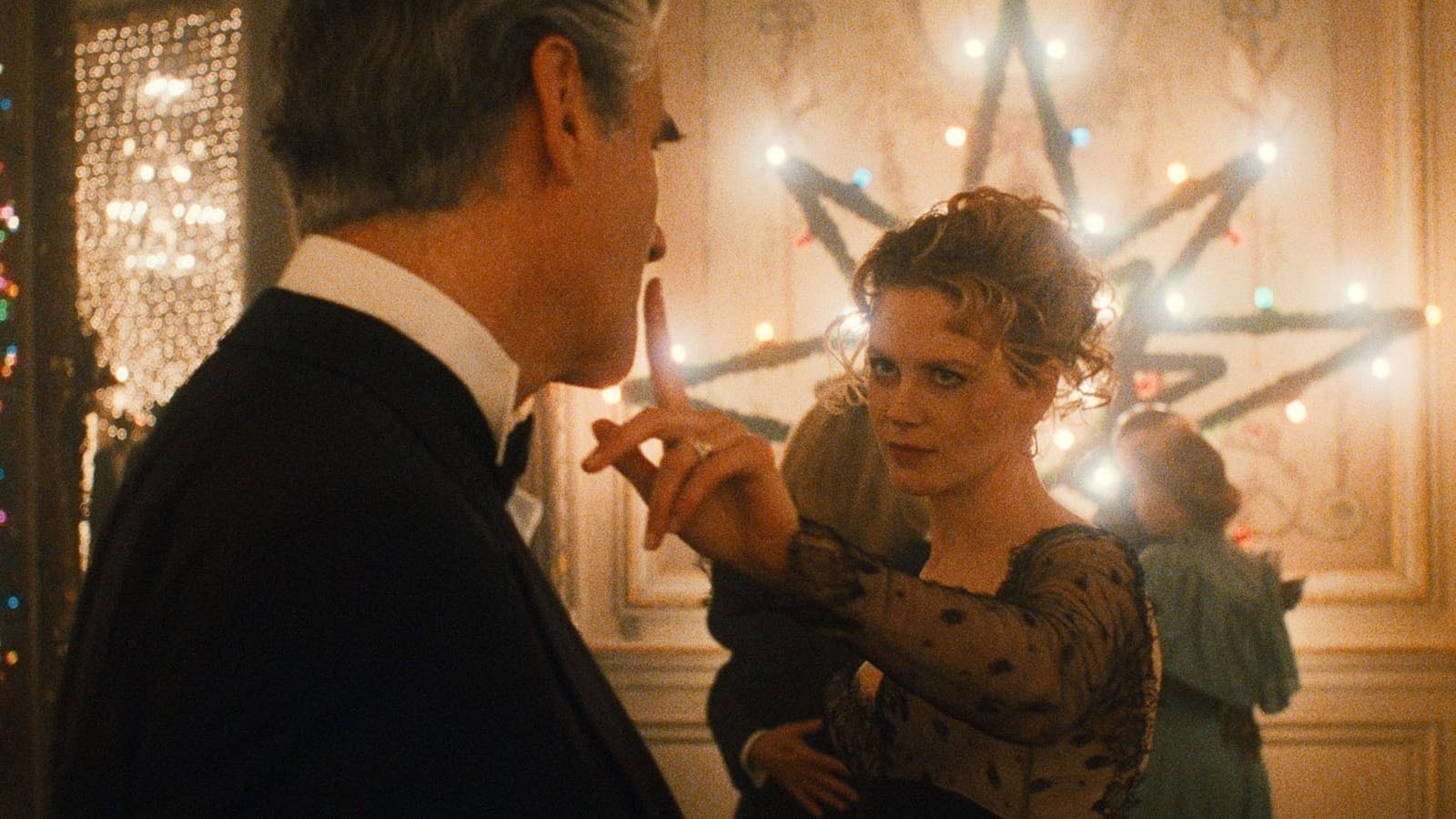
- Stanley Kubrick’s films “have a habit of aging into new meanings, like monoliths that take time for us apes to figure out,” writes Lane Brown in New York, and Eyes Wide Shut (1999) “ranks among Kubrick’s best. For all its controlled craft, it’s looser, stranger, and more dramatically flammable than anything else he ever made. It’s also unclassifiable, never bothering to explain what exactly it is. That ambiguity is part of its power, but it’s also the void into which conspiracists pour their fantasies.” One theory holds that Kubrick sought to expose an elite cabal of pedophiles—and paid for his attempt with his life. Brown dives deep into this morass and resurfaces with a solid handful of testimonies from many who worked on the film. The nuttiest theories are thoroughly debunked, but Brown admits that this probably won’t put a stop to them.
- Directed by Spike Lee, David Byrne’s American Utopia (2020) strikes a balance “between concert and generative, near-spiritual rite of togetherness,” writes K. Austin Collins. Our release this week has prompted Robert Daniels to revisit musical passages in She’s Gotta Have It (1986), School Daze (1988), Do the Right Thing (1989), Malcolm X (1992), Bamboozled (2000), Chi-Raq (2015), and this year’s Highest 2 Lowest. “Lee might be the most underrated cinematic musical director of his generation,” writes Daniels, and “while these instances of sonic and visual vitality have often happened in drips and drops, when they do occur, they reveal a filmmaker’s intense personal love for the balletic potential of the human body to translate larger political, social, and racial themes through movement.”
- “Every Spike Lee soundtrack ever” is one of Rebecca Hall’s many answers when Tom Macklin asks her at Club Ciné about her favorites. The conversation begins at the beginning, with Hall watching black-and-white classics on BBC Two and Channel Four, and it meanders through lessons learned from her parents, director Peter Hall and opera singer Maria Ewing, and an identity crisis assuaged by directing Passing (2021) to watching herself alongside the character she plays, Linda Rosenkrantz, in Ira Sachs’s Peter Hujar’s Day. At Sundance, Hall was surprised when people in their twenties “thought it was revolutionary to see a film with just two people talking to each other. It’s up there with one of the favorite movies I’ve ever been a part of.”
- “Young directors looking for heroes tend not to gravitate toward divisive religious artists whose movies don’t make money or win awards,” writes Bilge Ebiri in the Yale Review. “So what accounts for [Terrence] Malick’s impact on twenty-first-century American film?” Among the filmmakers under consideration here are Chloé Zhao, David Lowery, and Clint Bentley (Train Dreams). “The most successful Malickian films borrow from his work but find ways to transcend it and to convey new ideas,” writes Ebiri. In Nickel Boys (2024), RaMell Ross “expanded the fragmented lyricism of [2018’s Hale County This Morning, This Evening] by crossing it with a first-person camera: the story is told almost entirely through shots that appropriate the perspectives of the two characters. The result is a work that is immersive and experiential, otherworldly and mythic. It’s also entirely his.”
- Ebiri is joining Justin Chang and Alison Willmore in this year’s Slate Movie Club hosted by Dana Stevens, who opens the discussion with a question posed to her a couple of weeks ago: What movie “exemplified 2025”? Candidates include Bong Joon Ho’s Mickey 17, James Gunn’s Superman, Danny Boyle’s 28 Years Later, and Julia Loktev’s My Undesirable Friends: Part I—Last Air in Moscow, but Stevens ultimately goes with “two films that seemed to present opposing if interrelated models for how to survive and thrive—or at least create the conditions for future generations to come a little closer to thriving—in this battered hellscape we call home.” Ryan Coogler’s Sinners was a “springtime miracle” and Paul Thomas Anderson’s One Battle After Another seemed to “change the weather for the rest of the movie season to follow.”
Don’t miss out on your Daily briefing! Subscribe to the RSS feed.