The Days Go By
Share
The week began with the loss of Diane Ladd, a vivacious performer whose career spanned seven decades. Ladd was nominated for the Oscar for Best Supporting Actress three times: In Martin Scorsese’s Alice Doesn’t Live Here Anymore (1974), she played Flo, described by Scott Tobias in the Guardian as “a brassy waitress who works an unbuttoned uniform for tips.” David Lynch directed Ladd and her daughter Laura Dern in Wild at Heart (1990) and noted that Ladd “really loved to be seized by an emotion and to be carried away by it. It was quite something to contain all that energy.” And both Ladd and Dern were nominated—Dern for Best Actress—for their performances in Martha Coolidge’s Rambling Rose (1991).
In 2010, Ladd, Dern, and Bruce Dern—Ladd’s ex-husband and Laura’s father—were awarded three adjoining stars on the Hollywood Walk of Fame. Eight years later, Ladd was misdiagnosed and given six months to live. Laura Dern insisted on having a short walk with her mother each day, and their intimate conversations became a book, Honey, Baby, Mine. “If one person reads our book,” Ladd told Kate Guadagnino in the New York Times, “and does the same—really talks to someone they love—writing it won’t have been in vain. Aside from that, all I can offer is a reflection of life itself. Art is just a mirror, and that’s why we go see movies: to learn who we are.” Ladd was eighty-nine.
From today through December 14, Harvard Film Archive will present Columbia 101: The Rarities, a showcase of “remarkable, edgy, and innovative films made at the studio and the wonderful work accomplished by Sony/Columbia today to restore and make available this rich film heritage.” At RogerEbert.com, Robert Daniels previews this year’s Black Harvest Film Festival, running in Chicago through November 16, and Ross Lipman will present his Archival Impermanence Project in Los Angeles this weekend.
On Sunday, Sabzian and Bozar will host Isabelle Huppert as she delivers the State of Cinema 2025 address in Brussels. The evening will begin with a screening of the film Huppert has selected, Aki Kaurismäki’s Fallen Leaves (2923), and then critic Jean-Michel Frodon will discuss the challenges of the moment and the near future with Huppert, who owns two repertory theaters in Paris, both curated by her son Lorenzo.
Online, Le Cinéma Club is launching a series of artists’ and filmmakers’ self-portraits today with Being John Smith (2024). And Another Screen has returned with Six Times Woman: In the Shadow of a Dictatorship, a program of eight films “relating to mental health, race, aging, beauty standards, class, and the pressure of prevailing social norms.”
This week’s highlights:
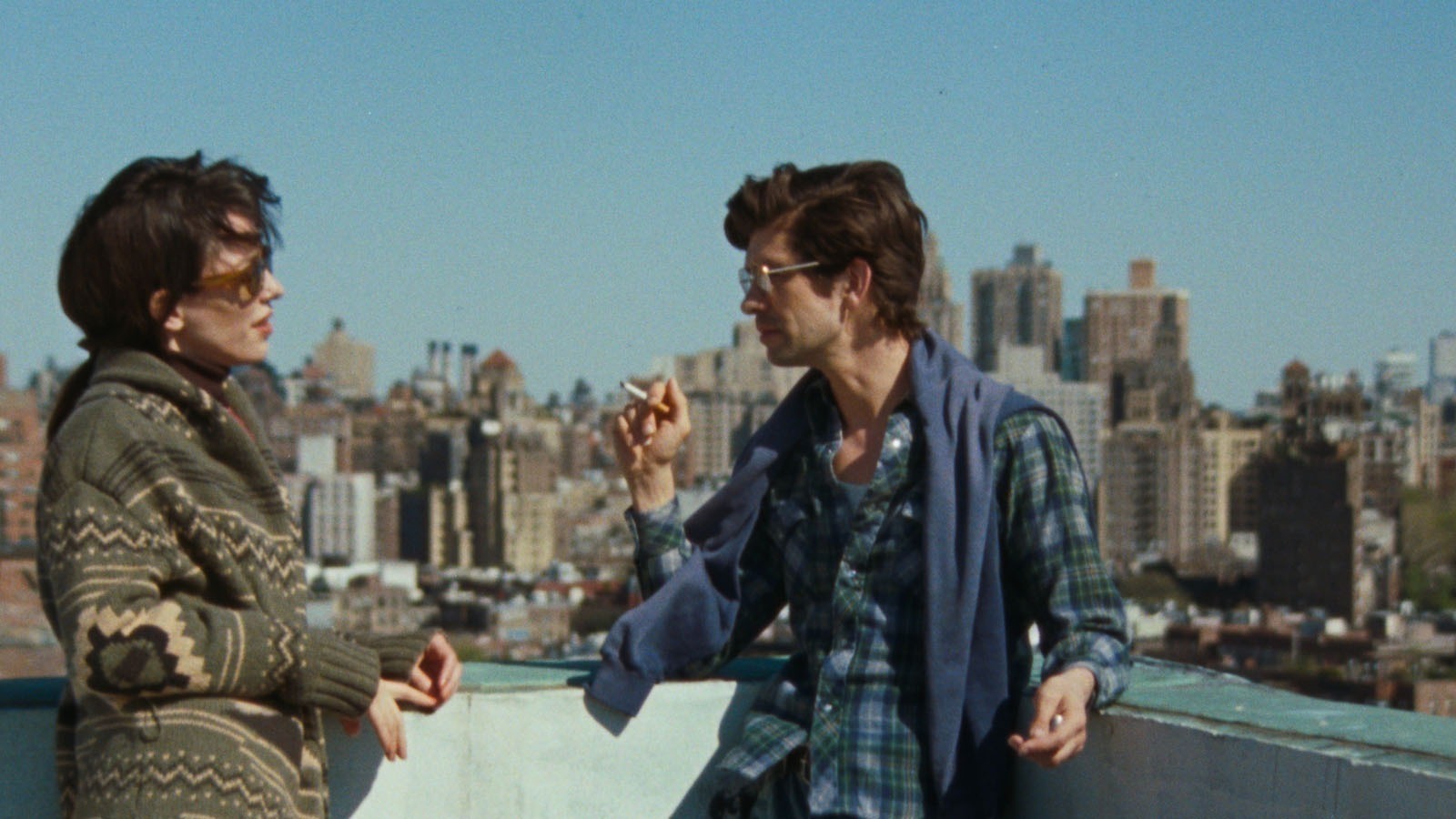
- In Linda Rosenkrantz’s slightly fictionalized novel Talk (1968), photographer Peter Hujar is one of the characters talked about, Clem Nye. On December 19, 1974, Rosenkrantz had Hujar speak for himself, describing his previous day in detail. The transcript, published in 2021, is “a perfect time capsule of gritty old bohemian Manhattan, half a century ago,” writes the New Yorker’s Michael Schulman, who speaks with Rosenkrantz, now ninety-one, and Ira Sachs, who has shot Peter Hujar’s Day with Ben Whishaw as Hujar and Rebecca Hall as Rosenkrantz. 4Columns film editor Melissa Anderson notes that the setup “could not be sparser: two people in an apartment talk for several hours. Yet within this skeletal framework blooms an abundance of memories, emotions, affection, and aspirations. Nothing less than a friendship, a life, an era are beautifully evoked and distilled.”
- Joy Williams’s latest beautiful and disturbing piece for Harper’s is both a good old-fashioned mystery and a reverie on time, dogs, disorientation, estrangement, and Gene Hackman. “He was so emotionally intelligent in his roles, though in real life, in the time of his ascent, not so much,” writes Williams. Hackman appeared in some “truly great” films, but none of his on-screen deaths “could hold a candle to the real thing, a departure so circumstantial, grotesque, and profoundly lonely that one could only think that Death had lost her marbles with this one. Inventiveness, cruelty, the playful distortion and extension of passing time had just gone too far.”
- Editor Claire Atherton has worked with Eric Baudelaire, Wang Bing, and Marta Mateus, but she’s best known for her thirty-year collaboration with Chantal Akerman. In 2018, Atherton delivered an address that Nicholas Elliott has translated and is now up at e-flux. “Chantal would never tell me her intentions,” says Atherton. “In fact, she often didn’t know ahead of time what she was going to film. She didn’t like to be asked what she was looking for. She said that if you’ve found what you’re looking for, it’s no longer worth making a film. Her way of making films intersected with my own path: let things happen, respect movement, and don’t force meaning.”
- Introducing a selection of artifacts from the personal archives of the late Terence Davies, Marc David Jacobs, writing for the BFI, notes that “despite the enduring acclaim” of his first autobiographical features, Davies “confidently declared he had made his first ‘mature’ work” with his adaptations: The Neon Bible (1995), The House of Mirth (2000), The Deep Blue Sea (2011), and Sunset Song (2015). “Davies was remarkably faithful to his authors,” writes Jacobs. “The more he loved their work, the more his screenplays reflected their original text and construction. Even when obliged to add to them, his talent for mimicry was borne out by critics like those who expressed delight at so much of novelist Edith Wharton’s witty dialogue being heard throughout his version of The House of Mirth, little realizing that several of the examples they quoted were entirely Davies’s invention.”
- The new Senses of Cinema opens with a robust dossier on “the Music Videos that Made Us Queer,” with contributions ranging, as the editors put it, “from intimate introspection to peer-reviewed precision, from first-person origin narratives to academic historiography—and often both in the same intoxicating swoop.” There are also articles on Bi Gan’s Resurrection and Víctor Erice’s Close Your Eyes, interviews with Claire Denis and Christoph Hochhäusler, festival reports, and profiles of directors Guru Dutt and Shuji Terayama and actor Denis Lavant.
Don’t miss out on your Daily briefing! Subscribe to the RSS feed.