Marta Mateus: Under the Sun and Moon
Share
In 2017, Daniel Kasman wrapped Notebook’s coverage of the Cannes Film Festival with a few words on “two of the strongest films—both Portuguese—at the Directors’ Fortnight and, indeed, at the festival in general.” The first was The Nothing Factory, the debut fictional feature by Pedro Pinho, whose follow-up, I Only Rest in the Storm, premiered to critical acclaim in the Un Certain Regard program in Cannes this year and screened as part of the New York Film Festival’s Main Slate earlier this month.
The second was the twenty-five-minute Barbs, Wasteland (Farpões, baldios), the first film by Marta Mateus. “Following a lineage begun by America's cine-historiographer John Ford,” wrote Kasman, “more directly politicized and de-commercialized by Jean-Marie Straub and Danièle Huillet, and re-contextualized to Portugal’s social history in revolutionary digital aesthetics by Pedro Costa, Farpões, baldios confronts us with a provincial landscape populated by a people dangerously left adrift in a country that seems on the verge of forgetting its past. Those who find bountiful reserves of power, expression and outrage in Straub-Huillet and Costa’s works will immediately recognize the striking wide-angle photography, low framing of uncannily forceful architecture and foliage, and bold, presentational posing and declamations of actors in this film.”
With a cast of children and workers from Portugal’s southern region of Alentejo, where Mateus grew up, Barbs, Wasteland resonates with stories passed from the old to the young, stories of life before the 1974 Carnation Revolution eventually—and mostly peacefully—brought an end to nearly half a century of dictatorship. “I ran through those fields and climbed the trees when I was a child,” Mateus told Jonathan Rosenbaum in a 2020 Notebook interview. “I felt these stories in my bones. They came from their voices, timbres, and emotions, the calluses on their hands, their deep tenderness and solidarity, their hopeful eyes.”
“In one of the only shots marked by camera movement,” wrote Dan Sullivan for Film Comment when Barbs, Wasteland screened at the Viennale, “a boy and a girl walk along a path, arms locked; she faces forward as he faces backward, the camera tracking carefully behind them as they make their way down a hill. Together they comprise something like a Janus-headed twist on Paul Klee’s Angelus Novus, gliding ahead with half of its double-gaze fixed upon something in the past and the other half upon a future that, under the right conditions and however improbably, might just redeem that which came before.”
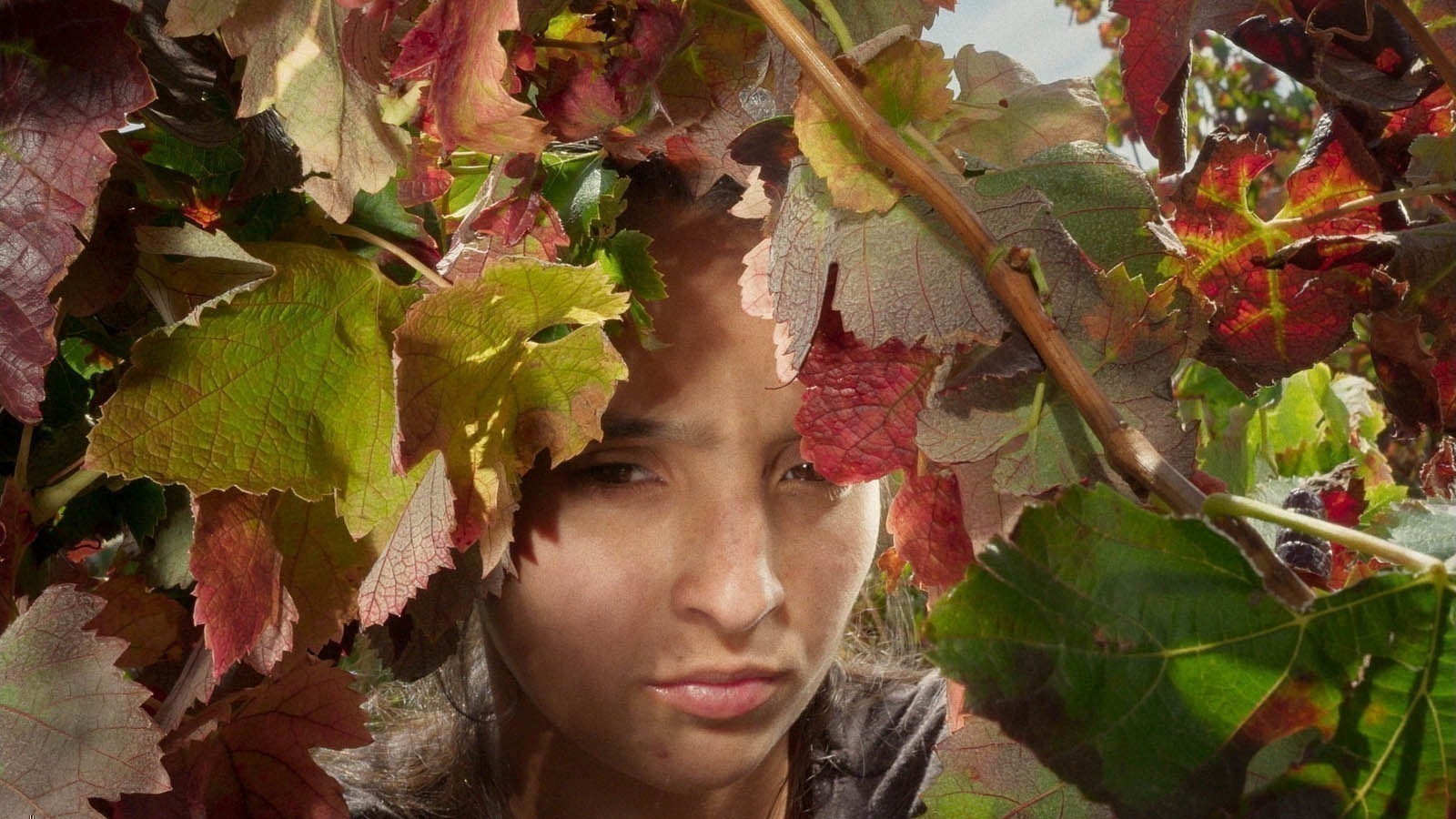
Mateus returned to Alentejo for her first feature, Fire of Wind (Fogo do Vento), which premiered last year in Locarno. As grape-pickers work the vineyards, a black bull breaks loose, sending the harvesters scrambling for the trees. High in the branches, they share stories, wine, and bread.
“Mateus (who shares cinematography credit with Vítor Carvalho) captures this waiting game as a mostly silent series of static tableaux, each frame encompassing a worker, or group of workers, as they stare out in steely introspection,” writes Beatrice Loayza in the New York Times. “The plot is minimal by design, directing our attention toward more painterly details: the arrangement of bodies within the landscape; the way the sun pokes through the green foliage and seeps into the fleshy ochres of the environment. The tension comes courtesy of the bull, who lurks restlessly in the background.”
“There is a sense of replay in the heightened and artificial diction with which Mateus has her cast bear witness, and this sense is enhanced by the painterly compositions that frame the speakers,” writes the New Yorker’s Richard Brody. “Fire of Wind is a movie of images, and its attention to light and shadow, to the texture of faces and of tree bark, of foliage and terrain, is among the most careful and most daring that I’ve ever seen.”
“The bright sunshine of the opening vine-picking sequences gives way to some of the most remarkable nighttime images in recent memory, with faces now illuminated by shafts of moonlight as the workers keep their marooned vigil,” wrote Sam Wigley when he interviewed Mateus for the BFI. Mateus explained why it took four years to make Fire of Wind, discussed her delicate work with reflected sunlight, and spoke of her admiration not only for Straub-Huillet but also for Abbas Kiarostami and Chantal Akerman, whose longtime editor, Claire Atherton, coedited the film with Mateus.
Currently on an informal tour of the U.S. that began a few weeks ago at the Harvard Film Archive, Mateus is presenting and discussing not only her own two films but also several works that have informed and shaped them. She’s programmed a series for Anthology Film Archives in New York that begins on Friday along with a ten-day run of Fire of Wind.
In Chicago, a November 5 screening Fire of Wind at the Siskel Film Center will be followed by a conversation between Mateus and Jonathan Rosenbaum, and another program Mateus has curated will run at Doc Films from November 8 through December 7. Acropolis Cinema will bring Mateus to Los Angeles on November 10, and from November 13 through 16, Mateus will be at the Berkeley Art Museum and Pacific Film Archive (BAMPFA) to take more questions and to present three films by Margarida Cordeiro and António Reis, a formative influence on Pedro Costa—who produced Fire of Wind.
Don’t miss out on your Daily briefing! Subscribe to the RSS feed.