Akira Kurosawa Restorations
Share
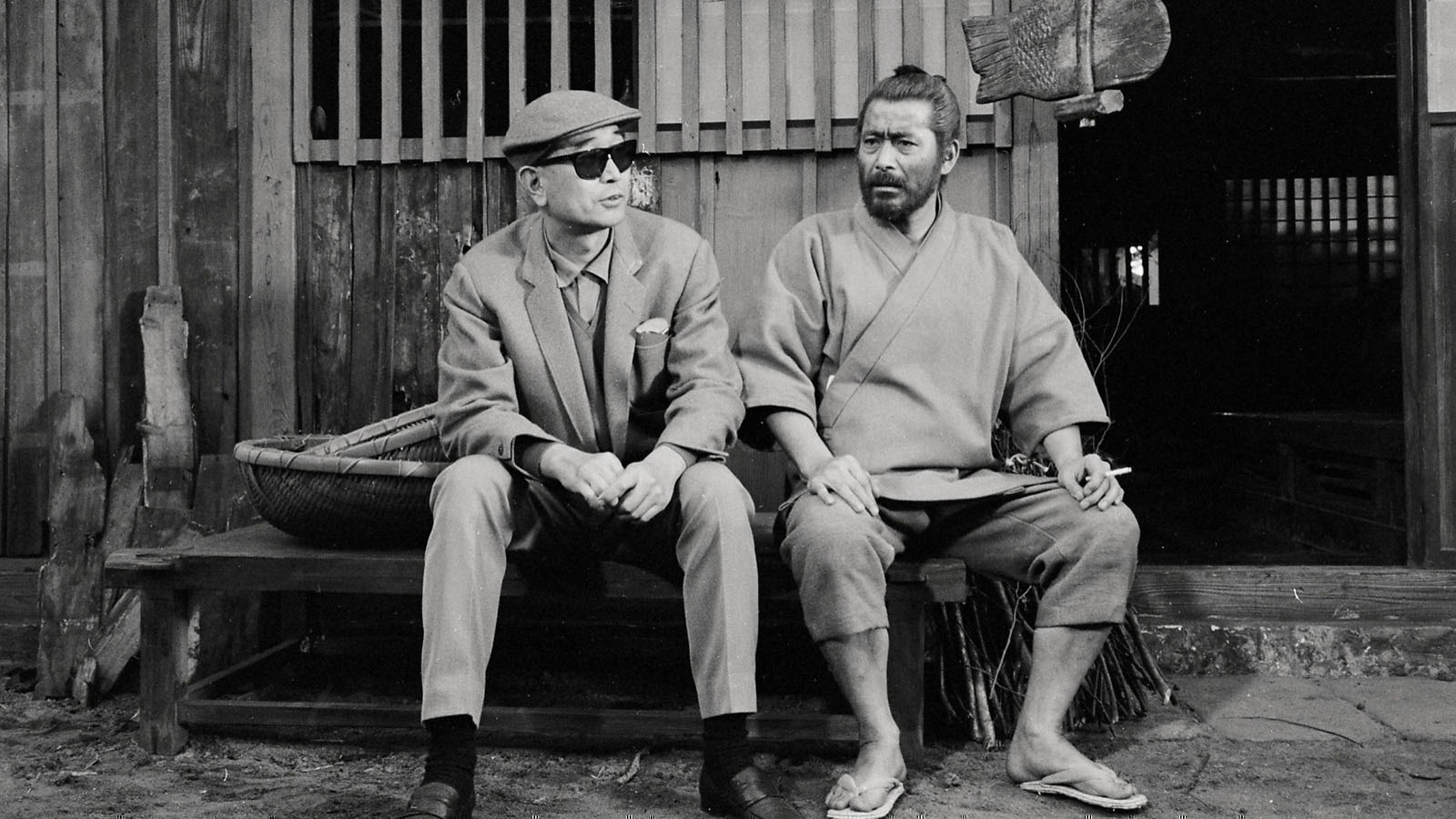
Janus Films is sending Toho’s sublime 4K restorations of nine of Akira Kurosawa’s classics to North American theaters. The tour begins on Friday at Film Forum in New York before heading to Austin and Seattle next week and Los Angeles on August 1. The program will arrive in Vancouver in the fall, and as a taster, the Cinematheque is screening two noirish detective movies throughout August, Stray Dog (1949) and High and Low (1963).
“Stray Dog is, I think, Kurosawa’s first masterpiece,” wrote Terrence Rafferty twenty years ago. “In essence, Stray Dog is the story of a young detective chasing his own shadow. It’s a highly stylized coming-of-age narrative—a moral tale disguised as a thriller.”
Toshiro Mifune stars as Murakami, a homicide detective whose gun is stolen while he’s riding a crowded trolley winding through Tokyo during a heat wave. Teaming up with veteran detective Sato (Takashi Shimura), Murakami grows increasingly desperate as he learns that his gun is being used to steal—and kill. What Kurosawa “takes from Hathaway (Call Northside 777) and Dassin (The Naked City),” writes Fernando F. Croce, “he gives to Kazan (Panic in the Streets) and Fuller (Pickup on South Street). Pushing forward even as the characters wander in circles, the camera is all swift pans and hard curves, one sinewy composition after another.”
Loosely adapted from Evan Hunter’s 1959 novel King’s Ransom and reimagined this year by Spike Lee as Highest 2 Lowest, High and Low gives us Mifune as Kingo Gondo, an industrialist poised to take over a shoe company when he learns that his son has been kidnapped. The ransom would ruin Gondo, but he’s willing to pay. Then he learns that the kidnapper’s got the wrong boy. Will he accept financial ruin in exchange for the life of his driver’s son?
“Where Mifune literally bounced off floors and walls in the early noirs,” writes Moeko Fujii, “in this film he’s tense and compact, a pivot point, the brittle needle on which the compass of the story spins. He’s always somewhere, bent. We don’t see him flailing or bellowing; he ossifies his samurai’s waiting crouch into a businessman’s stiff neck and bow.”
What Celine Song (Past Lives, Materialists) especially admires in High and Low is “the power of Kurosawa’s blocking,” and Geoffrey O’Brien has pointed out that the director “revels in the geometric play permitted by the widescreen ratio; we are positively invited to appreciate his constantly changing designs, as when Gondo opens curtains and a sliding glass door in abrupt horizontal movements analogous to the curiously old-fashioned wipes that were always Kurosawa’s signature form of narrative transition. The binding agent is the editing, with which Kurosawa, often working with footage captured from multiple angles simultaneously, freely cuts in and out of different spatial planes. There is no more conscious exercise in virtuosity in Kurosawa’s oeuvre.”
That virtuosity is rooted in part in Kurosawa’s upbringing—his father encouraged his children to appreciate not only Japanese arts but also Western literature and cinema—and in part to the five years he spent working for P.C.L., the company that would become the studio Toho, as an assistant director, gathering experience in practically every aspect of filmmaking. The first feature he directed, Sanshiro Sugata (1943), was a critical and commercial hit, but the real breakthrough—not only for Kurosawa but for all of Japanese cinema—came with Rashomon (1950).
A tale of murder and rape told in four divergent and self-serving versions by a woodcutter, a thief, a woman, and the spirit of a dead man, Rashomon was met with mixed reviews when it opened in Japan. But then Italifilm president Giuliana Stramigioli recommended the film to the selection committee in Venice, where it won the Golden Lion in 1951 and sparked a sudden hunger in the West for more where that came from. Doors around the world flew open for Kurosawa but also for Kenji Mizoguchi, Yasujiro Ozu, and eventually, Mikio Naruse.
Rashomon is known for its distinctly modernist take on the malleability of truth—two words: “Rashomon effect”—but Stephen Prince reminds us that Kurosawa was also “consciously attempting to recover and recreate the aesthetic glory of silent filmmaking. Thus, the cinematography (by the brilliant Kazuo Miyagawa) and editing are incredibly vital, and many passages are composed as silent sequences of pure film, in which the imagery, ambient sound, and Fumio Hayasaka’s score carry the action . . . Mesmeric, exciting, fluid, and graceful, these are among the greatest moving camera shots in the history of cinema.”
In the almost unbearably moving Ikiru (1952), Takashi Shimura plays the most bureaucratic of bureaucrats who learns that he has less than a year to live and decides to make the most of his final days. Kazuo Ishiguro, who wrote an adaptation that became Oliver Hermanus’s Living (2022), first saw Ikiru as a child growing up in England.
“It told me you don’t have to be a superstar,” says Ishiguro. “For most of us, life is very circumscribed and humble and frustrating; it’s a daily grind. But with some supreme effort, even a small life can turn into something satisfying and magnificent. This is a very different message from, say, the one you find in A Christmas Carol, which tells us that if you should discover you’re a pretty shitty person, you can change yourself overnight and transform. The message is also different from the one in It’s a Wonderful Life, which says you might think your life is nothing but all along you’ve actually been doing wonderful things. Maybe that’s true, but usually it isn’t. I like that Ikiru says you can’t be passive about life. It’s not easy, but you don’t have to end up a shell.”
“Breathtaking, fast-moving, and overflowing with a delightfully self-mocking sense of humor,” Seven Samurai (1954) is a “rip-snorting action-adventure epic about a sixteenth-century farm community led by a band of samurai warriors defending itself against a marauding army,” wrote the late David Ehrenstein in 1999. “Watching this raggle-taggle band of fighters defend the village makes for a climax as stirring as ever seen on a motion picture screen.”
With Throne of Blood (1957), Kurosawa shifted the setting of Shakespeare’s Macbeth from medieval Scotland to feudal Japan. Throne of Blood is “possibly Kurosawa’s definitive expression of the estrangement one experiences from their own life as it spins wildly out of control, and he goes about invoking this existential damnation with a ruthless precision,” writes Chuck Bowen at Slant. Kurosawa once told Donald Richie that he’d “always thought that the Japanese period film is historically uninformed. Also, it never uses modern filmmaking techniques. In Seven Samurai we tried to do something about this, and Throne of Blood had the same general feeling behind it.”
Known to countless Star Wars fans as a primary influence on George Lucas’s franchise-spawning 1977 film, The Hidden Fortress (1958) is “at once a samurai film and a road movie, with a significant nod to the American western,” as Catherine Russell puts it. Two peasants (Minoru Chiaki and Kamatari Fujiwara) escort a defeated clan’s general (Toshiro Mifune) and princess (Misa Uehara) as they smuggle gold through hostile territory. The Hidden Fortress is “a Japanese Hollywood action film in the best sense of the term,” finds Oren Moverman. “Kurosawa’s painter’s eye. Absurdist comedy. The spear fight between Mifune and a rival general. Fierce compositions. Fierce atmosphere. Fierce control of every element but our feelings.”
Mifune stars as a masterless samurai pitting two warring clans against each other in Yojimbo (1961). The film was so well received and made so much money that Kurosawa wrote Mifune’s character into his next film, Sanjuro (1962), which Michael Sragow has called “the sassy kid brother to Yojimbo, and like many lighthearted younger siblings, it’s underrated.” If Sanjuro “lacks the savage intensity of Yojimbo,” adds Sragow, “it does possess compelling sweep, a gutter charm, and an encompassing irony that transforms the swordsman’s bluster into a form of domestic comedy. In Yojimbo, he’s the perfect man to clean up a town filled with homicidal grotesques (by killing off just about everyone); in Sanjuro, he’s a Japanese bull in a china shop.”
For Jonathan Lethem, Red Beard (1965) is “Kurosawa’s secret Dickensian masterpiece: sprawling, sentimental, and encompassingly humane.” In his last performance in a Kurosawa film, Mifune plays the director of a public clinic dealing with an arrogant young doctor who feels the place is beneath him. The director patiently guides the doctor toward empathizing with his patients.
“After Red Beard had opened, while it was still playing to packed houses and was proving to be indeed just the kind of picture that people want to see,” recalled Donald Richie in 1989, “I told Kurosawa that I sensed that he had come to some sort of conclusion, some sort of resting place. He had pushed his style to what appeared to be its ultimate.” With Red Beard, “he had vindicated his humanism and his compassion.” While he would go on to make seven more features, the director did not disagree.
Don’t miss out on your Daily briefing! Subscribe to the RSS feed.