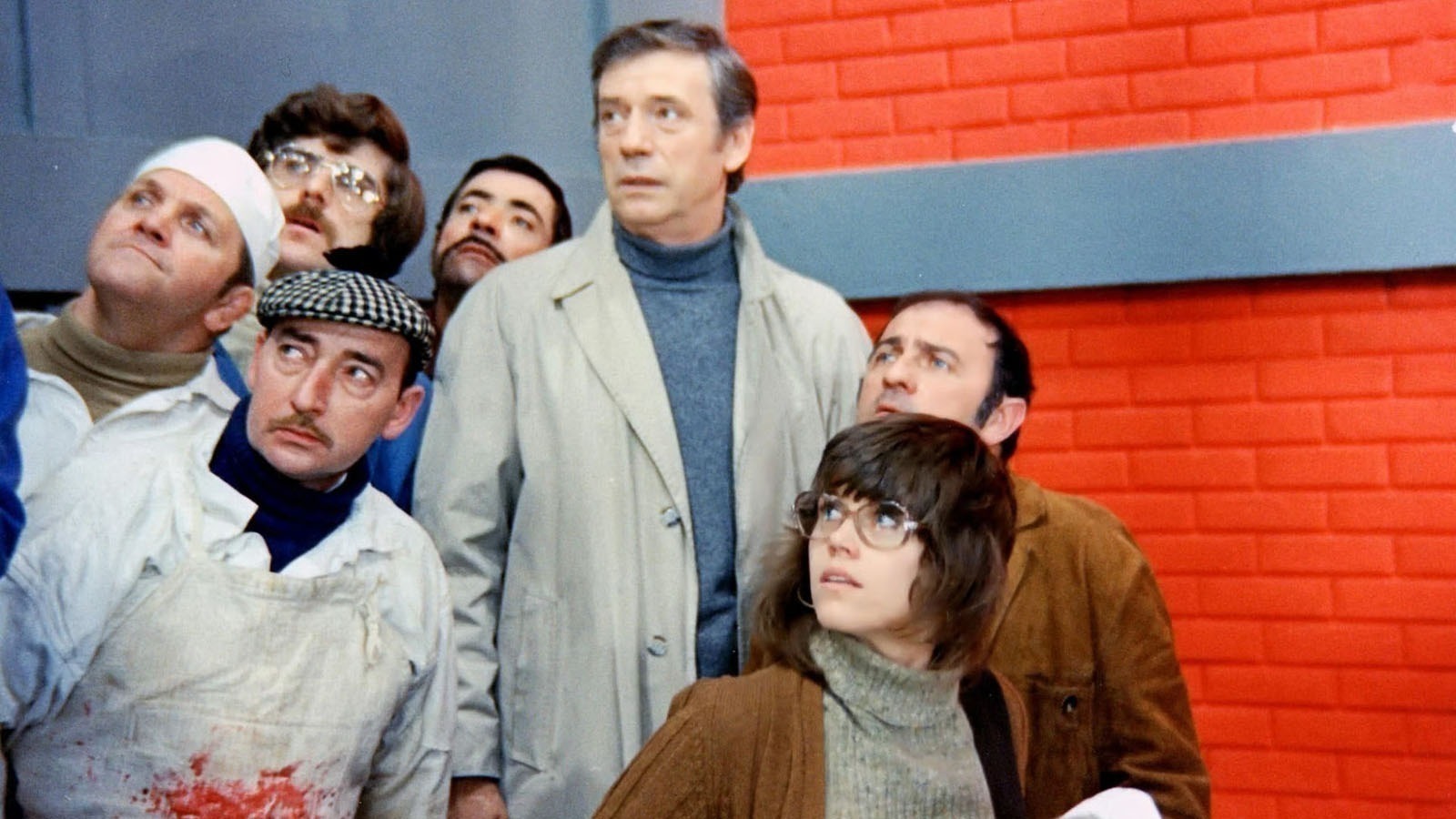
Yves Montand and Jane Fonda in Jean-Luc Godard and Jean-Pierre Gorin’s Tout va bien (1972)
There are two sets of program notes for Why? Because . . . with Jean-Pierre Gorin, the L’Alliance New York series opening this evening and running through June 11. The first set comes from programmer Jake Perlin, working here with Yuka Murakami. Perlin introduces Gorin as “a filmmaker, film theorist, and professor emeritus at the University of California, San Diego” and the cofounder with Jean-Luc Godard of the “revolutionary filmmaking collective” Dziga Vertov Group. The impact of DVG is remarkable, considering that it was only active for a few years in the late 1960s and early ’70s. Perlin notes that Gorin “offered political and theoretical guidance that ignited what he referred to as ‘the revolutionary potential in aesthetics that Jean-Luc brought to his previous films.’”
In the mid-1970s, prompted at least in part by an invitation from critic and artist Manny Farber to teach at UCSD, Gorin left France for the U.S., where he made three films that came to be known as the “Southern California trilogy.” Gorin will be at the Roxy Cinema tomorrow to talk about two of them, Routine Pleasures (1986) and My Crasy Life (1992), and on Saturday afternoon, he’ll be at the e-flux Screening Room to discuss Poto and Cabengo (1980) with Murakami and Lukas Brasiskis. Shot by Les Blank, the unclassifiable Poto and Cabengo is something like an essay film that takes as its starting point twins Grace and Virginia Kennedy, who were believed to have created their own private form of communication.
“At first glance,” wrote Kent Jones in 2012, “we sophisticates may feel like we have the Kennedy household, Routine Pleasures’ Pacific Beach & Western railway crew, and My Crasy Life’s West Side S.O.S., Sons of Samoa, 32nd Street gangbangers all figured out. We are disabused of such notions almost instantaneously. Every rhetorical move is either jarred or knocked out of place by a countermove, and we are left with a cinematic organism in which nothing is frozen and everything is in ceaseless motion. I honestly can’t think of another movie that keeps tunneling through its own foundation as relentlessly as these three do, each stopping just short of a complete cave-in.”
These are “rude and lovably inelegant movies,” added Jones, “resisting any drift into sophistication or severity, and resembling nothing so much as the earliest sound productions of Walsh or Wellman as reimagined by a political firebrand who has just escaped from the prison house of his own theories.”
Jones and Gorin will be at L’Alliance this evening to discuss Jean Renoir’s Toni (1935), a film that, as Ginette Vincendeau wrote a few years ago, signaled “a move on Renoir’s part toward a socially committed cinema and is justifiably recognized as anticipating Italian neorealism.” Toni is the first film Gorin has selected for the L’Alliance series, and it’s here that the second set of notes comes in—and gives the series its title. “Toni, why?,” asks Gorin rhetorically. “Because one who doesn’t think about the Thirties these days is a fool.” But also because, “as Sei Shonagon and Chris Marker would say: ‘There is not a shot in this film that doesn’t quicken the heart.’”
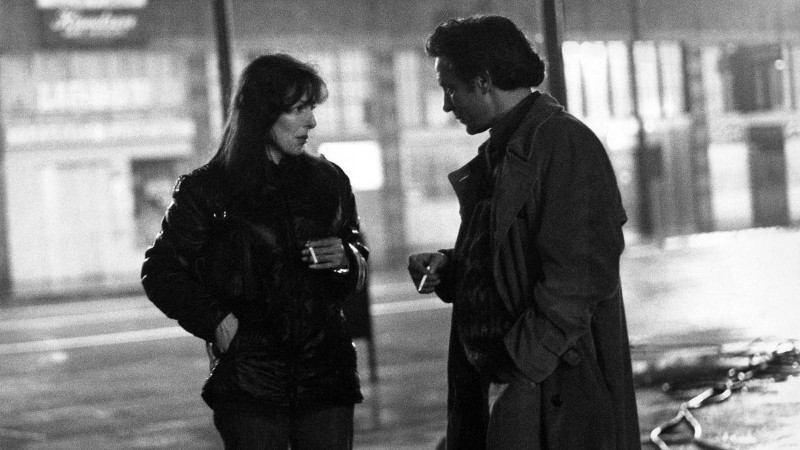
Gorin’s notes follow this pattern right on through the program. “Lumière d’été, why?” Because of “the thread that runs from Toni, Renoir, 1935 to Lumière d’été, [Jean] Grémillon, 1943. Eight years that go from the collective hopes of the Popular Front to the bloody senility of Vichy and its complicity with Nazism.”
Writing about Lumière d’été in 2012, Michael Koresky found “nothing benign about its portrayal of bitter class warfare in the guise of an overpopulated romance. In fact, the film it most resembles is The Rules of the Game, Renoir’s 1939 poetic realist class satire, which was summarily banned by the Nazis when they took power. Lumière d’été—which itself bears traces of poetic realism in its moody fatalism and sympathy with the lower classes—was destined for the same fate; the censors read it as an attack on the establishment, as well as too cynical a view of human nature to show to an already disturbed populace under occupation.”
On Friday, Gorin and David Fresko, a writer who teaches at Rutgers University, will discuss Vladimir and Rosa (1971), featuring Godard and Gorin as the title characters as well as Yves Afonso and Juliet Berto. Why? “Because the films of the Dziga Vertov Group were tagged as Sunday school Maoism and it is time to see them for what they truly were: DIY garage punk experiments.”
The New Yorker’s Richard Brody has described Vladimir and Rosa as “a Brechtian farce of the trial of the Chicago Seven. What emerges is a probing psychological analysis of the modern radical as well as an incipient effort to speak in a new voice in another court: Godard and Gorin themselves, raising a racket on a tennis court with the help—or, rather, the decisive hindrance—of a low-tech feedback loop.”
Vladimir and Rosa was funded by Barney Rosset of Grove Press, and he brought Godard and Gorin to the U.S., where they toured with their films and—somewhat reluctantly at first—talked about what they were up to with Michael Goodwin, Tom Luddy, and Naomi Wise in what turned out to be a lengthy and substantive interview that ran in a 1971 issue of Take One. Ralph Thanhauser’s forty-minute documentary Godard in America (1970) was shot during this tour, and it will screen after Vladimir. Gorin: “I’ll pay you not to watch this film.”
Gorin has much more to say about Yves Allégret’s Such a Pretty Little Beach (1949), which screens on Tuesday. This is “a film on the cusp, both anchored to the past and announcing the future,” he writes. Shot by Henri Alekan, Such a Pretty Little Beach stars Gérard Philipe as a man who checks into a hotel in a seaside town, and while several of the other characters are played with what Gorin calls “the declamatory style of the Thirties,” this man is “another beast altogether. Walled in silence is a figure in a landscape swept by the wind and pelted by the rain. It is as if the existentialism of Sartre and Pavese was finally reaching the screen. Gérard Philipe and his preternatural wounded beauty open a door through which generations of actors will pass.”
Allégret, “nearly invisible from contemporary discussion and almost never revived in theaters,” notes Jake Perlin, “contributes a late era twist on French realism, which will be a significant discovery for many.”
The series will wrap with Godard and Gorin’s Tout va bien (1972). “Because of the names Jane Fonda and Yves Montand the film was released in ‘normal theaters,’” writes Gorin. “After years tinkering in the garage, we were out in the open.” Fonda’s Suzanne is an American reporter who arrives at a sausage factory with her husband, Montand’s Jacques, who was once a renowned nouvelle vague filmmaker but now directs commercials. Moments after their arrival, the workers go on strike and hold their boss, Suzanne, and Jacques captive for a couple of days.
“Tout va bien insists on class struggle throughout but is mainly about radicalizing its stars,” wrote J. Hoberman in 2005. “Their role in the factory is to look and learn. Indeed, Godard and Gorin upped the class-resentment ante by having the striking workers played not by real workers but by unemployed actors.”
The film was a commercial and critical flop and was “tepidly received” when it premiered in the U.S. at the New York Film Festival, notes Hoberman: “I vividly recall my own youthful disappointment that Tout va bien was not Weekend. (Of course, as Tout va bien makes clear, 1972 was not 1968) . . . It is, in any case, a far better movie than it seemed, at least to this former and then skeptical hippie, back in the day.”
Don’t miss out on your Daily briefing! Subscribe to the RSS feed.