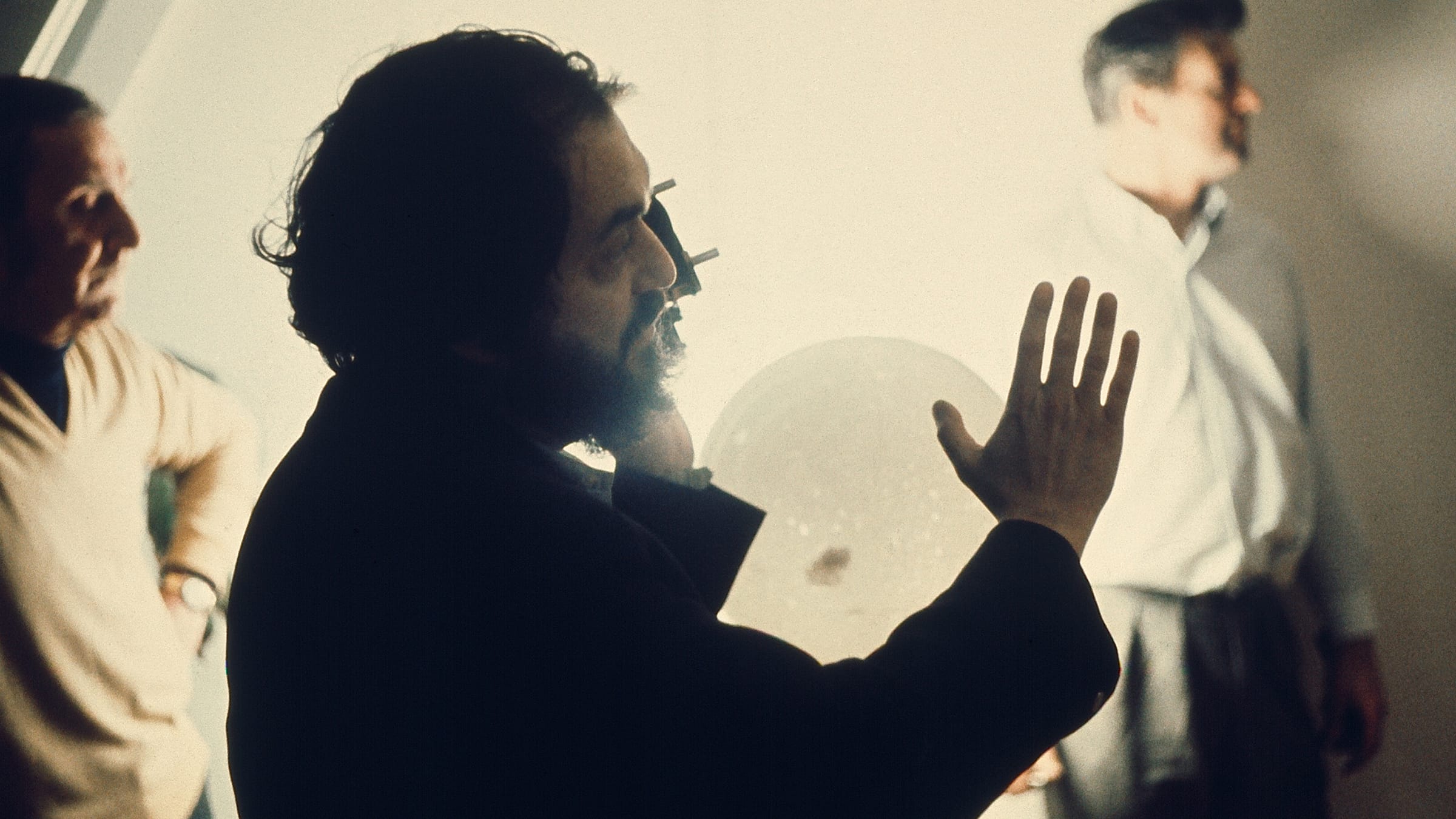
Stanley Kubrick would not appear, at first glance, to have the stuff of a Kubrickian hero. He did not in any sense resemble the ringleader of a racetrack heist, a colonel or a soldier of fortune, not an astronaut or a droog or Tom Cruise. He wore a uniform of anoraks and gratuitously pocketed fatigue jackets; he mumbled; he feared airplanes. But Kubrick did share with his heroes one essential trait. He endeavored, to quote one of his favorite philosophers, to become an Übermensch—a master of his own universe, engineering his fate through force of will, with an obsession bordering on monomania. His eye was ever on the sparrow. Unlike Johnny Clay or Humbert Humbert or Barry Lyndon, Kubrick got away with it.
The first shiver of an auteur-instinct can be detected at age six, when Kubrick was told (presumably) to go to school. He refused. Is there any power more awesome in a child than the power of refusal—and any power less likely to be countenanced, particularly in a grandchild of striving Austrian Jewish immigrants in the Depression-era Bronx? Kubrick, in any case, was triumphantly, virtuosically truant. He missed exactly half of first grade, half of second, and more than half of third. The Bartleby act continued right through his formal education. He refused to study for a bar mitzvah, refused to attend more than a minimum of high school (he graduated with a low C-minus), and did not attend college—with the notable exception of auditing several classes at Columbia University, taught by Mark Van Doren, F. W. Dupee, and Lionel Trilling.
The two pastimes that did interest him, however, he undertook with a ferocity of focus that his peers found bizarre, if not frightening. Introduced to chess by his exasperated father, Kubrick took it up with all the energy he had withheld from his studies. After high school, he would support himself by playing for quarters in Washington Square Park. Later in life, he boasted, wistfully, that he could have been better than Bobby Fischer, if only he’d been allowed to study chess nine hours a day. Then again, who was stopping him?
But it was photography—in the form of an eight-pound Graflex the size of a shoebox, a gift from his father on his thirteenth birthday—that swallowed him up entirely. Finally, he had a good reason to skip school: marathon picture-taking excursions across New York City, the Graflex hidden in a brown paper bag, a hole torn for the lens to poke through. Even then, Kubrick’s approach was marked by strict command over form and narrative, applied through doleful, unblinking repetition. The day after Franklin Delano Roosevelt died of a cerebral hemorrhage, Kubrick had the idea to photograph a newsstand on Grand Concourse and 172nd Street. In the image, a disconsolate vendor sits slumped in the newsstand window, head in hand, framed by 120-point headlines. Kubrick brought the picture to the Manhattan office of Look, one of the nation’s most prominent photo magazines, and sold it for twenty-five dollars, launching his professional career. Kubrick claimed at the time that the photo had been a lucky shot, a scene he had just chanced upon, but that was a lie. As biographer John Baxter revealed decades later, Kubrick had admitted to a friend that he had “sweated blood” trying to convince the seasoned old news vendor to pose with sufficient despair.
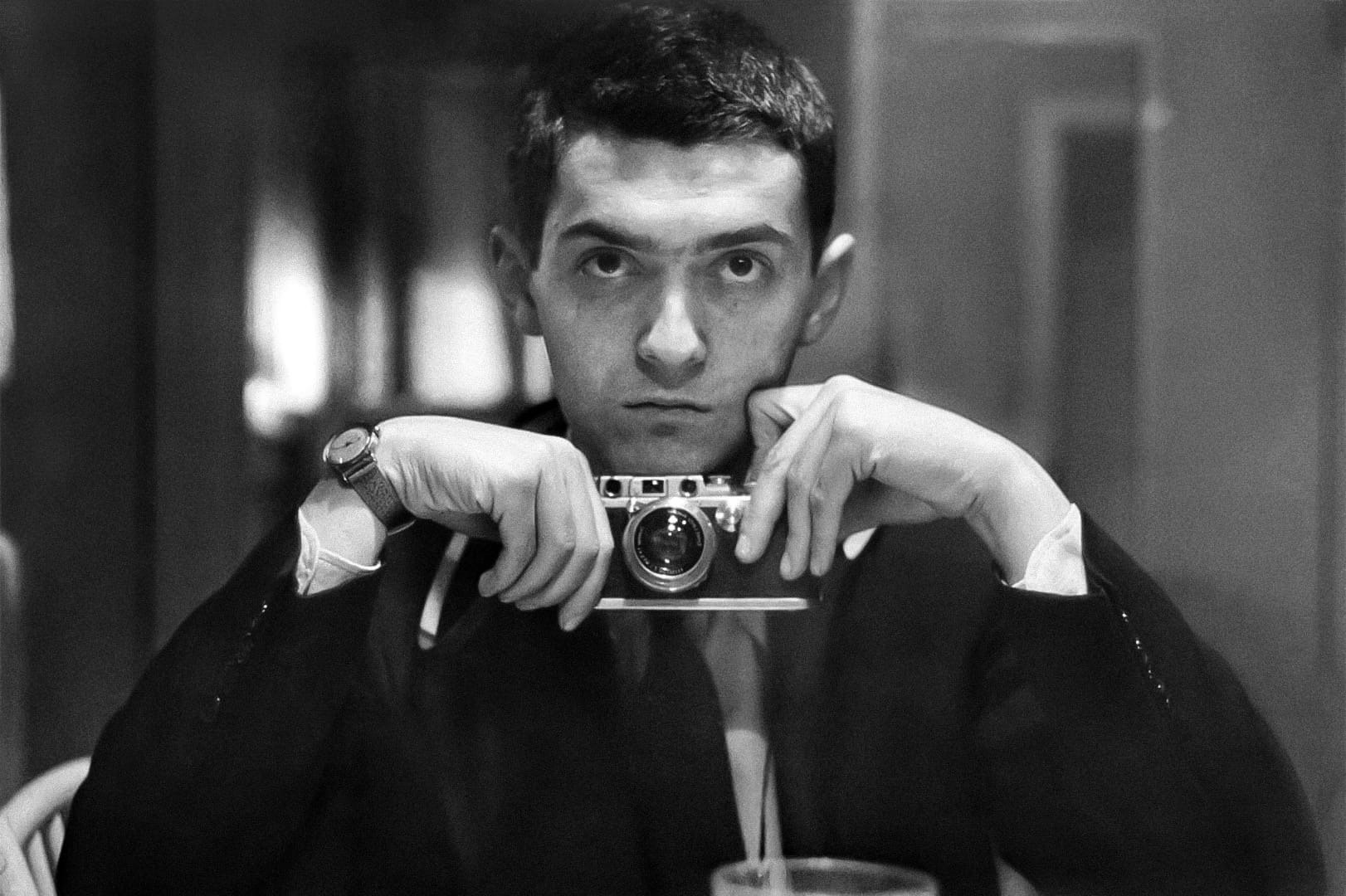
Look was the ideal training ground for a photographer who hoped to graduate to motion pictures. The magazine specialized in narrative photojournalism, though when the two mandates came into opposition, the masthead cheerfully sacrificed journalistic etiquette for drama. Kubrick’s editor, Arthur Rothstein, permitted his photographers to go so far as to stage a reenactment, provided “the photographer honestly believes that his directions are creating a true picture of what actually happened.” It was a permissive policy, by any journalistic standard, but Kubrick would not be so constrained. Forget reenactment: he elected enactment.
An early success was “A Short-Short in a Movie Balcony,” a series of photographs that purported to show a young man making a move on a “total stranger” in a theater during a film screening, only to be rebuffed with a slap. In fact, the two principals were Kubrick’s high-school friends, the sole other audience member in the frame was his younger sister, Barbara, and the shoot was staged in a closed theater. In another series, “Life and Love on the New York City Subway,” a young couple embrace beside a body sprawled unconscious (dead?) on the Museum of Natural History station platform. The scene unfolds in a stark, noirish chiaroscuro—an effect created by the professional lighting equipment Kubrick had hauled down the subway steps. The couple were his first wife, Toba Metz, and his best friend, Alexander Singer. Whether the unconscious body was a third confederate is unknown, though one clue is provided by the fact that, in the test photographs taken for the series, the corpse pops up in different locations.
It was a Look assignment, a day in the life of the boxer Walter Cartier, that Kubrick developed into his first film. Despite the documentary billing (“All Events Depicted in This Film Are True”), Kubrick staged Day of the Fight (1951) as deliberately as he did his photographs. The day was shot over several weeks, and nothing was left to chance. A typical directive: “I want you to get out this side of the bed, walk, stretch, and yawn.” To elicit the viewer’s sympathy, Kubrick eliminated Walter Cartier’s girlfriend from the narrative and replaced her with a little cocker spaniel, whom Cartier feeds from his plate. The fight itself was restaged (the tell: in the close-ups, Cartier doesn’t wear a mouth guard), and supplementary crowd shots were taken in Kubrick’s living room, with Singer and his wife posing as bloodthirsty fans.
The real star of the bout was obvious, even to the film’s hero. “Stanley comes in prepared like a fighter for a big fight,” Cartier later said. “He knows exactly what he’s doing, where he’s going, and what he wants to accomplish.” Though others are listed in the credits—including Singer, with an assistant-director credit—Kubrick claimed to have done everything himself, “from keeping an accounting book to dubbing in the punches on the soundtrack.” Sharing the screen with the film’s title is the credit, “A Stanley Kubrick Production.” He was twenty-two years old.
There is one significant way, however, in which Kubrick’s debut breaks from the films that would follow: Walter Cartier wins his fight.
Kubrick would win most of his bouts too. According to his own unsparing appraisal, he finished with a career record of 8–3, with one split decision (and one no contest). His first two features, Fear and Desire (1952) and Killer’s Kiss (1955), he considered apprentice works. He disowned Spartacus (1960), his first large-budget production, on which, at star Kirk Douglas’s request, he replaced director Anthony Mann two weeks into filming. It was the only time in Kubrick’s career that he was not granted final cut. “I tried with only limited success to make the film as real as possible,” he complained nearly three decades later, “but I was up against a pretty dumb script.” He judged Lolita (1962) flawed (grumbling that he failed to “sufficiently dramatize the erotic aspect of Humbert’s relationship with Lolita”), and he died four months before the opening of Eyes Wide Shut (1999), which he may not have finished editing. But the rest were knockouts.
Over the decades, Kubrick’s sensibilities evolved, as he went where his reading took him. He claimed that he had never read a book for pleasure until he turned nineteen, but he made up for it for the rest of his life. He was a consummate autodidact—another vehicle for his bootstrapped self-creation—and interlarded his promotional interviews with knowing references to arcane academic studies, Continental philosophers, and Central European novelists. He confounded expectations with each new film, exchanging the lavishly populated toga rebellions of Spartacus for the claustrophobic college-town angst of Lolita, the brutalist dystopia of A Clockwork Orange (1971) for the baroque eighteenth-century romanticism of Barry Lyndon (1975). He rarely worked with the same leading actor twice, the only exceptions coming early in his career for Sterling Hayden, Kirk Douglas (by contractual necessity), and a multiplicity of Peter Sellerses in Lolita and Dr. Strangelove, or: How I Learned to Stop Worrying and Love the Bomb (1964). “He was a chameleon,” said Steven Spielberg. “He never made the same picture twice.” But a chameleon only sheds its skin—not its nervous system.

How, then, to chart Kubrick’s nervous system? How to define Kubrickian? If you blur your eyes to the varied settings and genres and periods, a central conceit emerges. The critic James Naremore describes it as “the story of how a carefully constructed plan fails.” Biographer David Mikics: “His movies are about mastery that fails. Perfectly controlled schemes get botched through human error or freak accidents.” Writer Geoffrey O’Brien characterizes it as “the obsessiveness of the human attempt to control the future—one’s own or the world’s—and the complicated ways in which that attempt fails.” The films begin with vanity and end in failure, failure, failure.
The Kubricks, and everyone they knew, would have had a more concise way of putting it: “Mann tracht, un Gott lacht.” Man plans, and God laughs. This is the DNA of Kubrick’s storytelling. Like any other genetic trait, once you know to look for it, you can’t unsee it.
Kubrick liked to say that he was not really a Jew, he just happened to have two Jewish parents. He also happened to have a Jewish sibling and Jewish cousins and aunts and uncles and grandparents and friends and wives. His Galician great-grandfather, Hersh Kubrik, arrived on the Lusitania in 1899. Kubrick’s father, Jacob, in the well-worn tradition of assimilationist German-speaking Jews, changed his name to Jacques (and later to Jack). Jack graduated from NYU, studied obstetrics at the New York Homeopathic Medical College and Flower Hospital, and moved from the Lower East Side to the Bronx, where he began his own practice, specializing in otolaryngology. Stanley grew up comfortably middle-class, which to many of his friends resembled opulence. “He lived in a house,” Alexander Singer told Baxter. “I didn’t know anybody who lived in a house.”
Though Kubrick received no religious education and was disdainful of all monotheistic religions, an emergent branch of Kubrick studies has devoted itself to reclaiming his Jewishness. The biographical evidence for the claim lies in his devotion to the literature of Mitteleuropean Jewry (Sigmund Freud, Franz Kafka, Stefan Zweig, and Arthur Schnitzler, whose Traumnovelle Kubrick adapted into Eyes Wide Shut), his association with Greenwich Village’s Jewish intellectual scene (Diane Arbus invited him to Saturday-night charades), and his lifelong preoccupation with Nazi Germany, which bloomed when he met his third wife, Christiane Harlan.
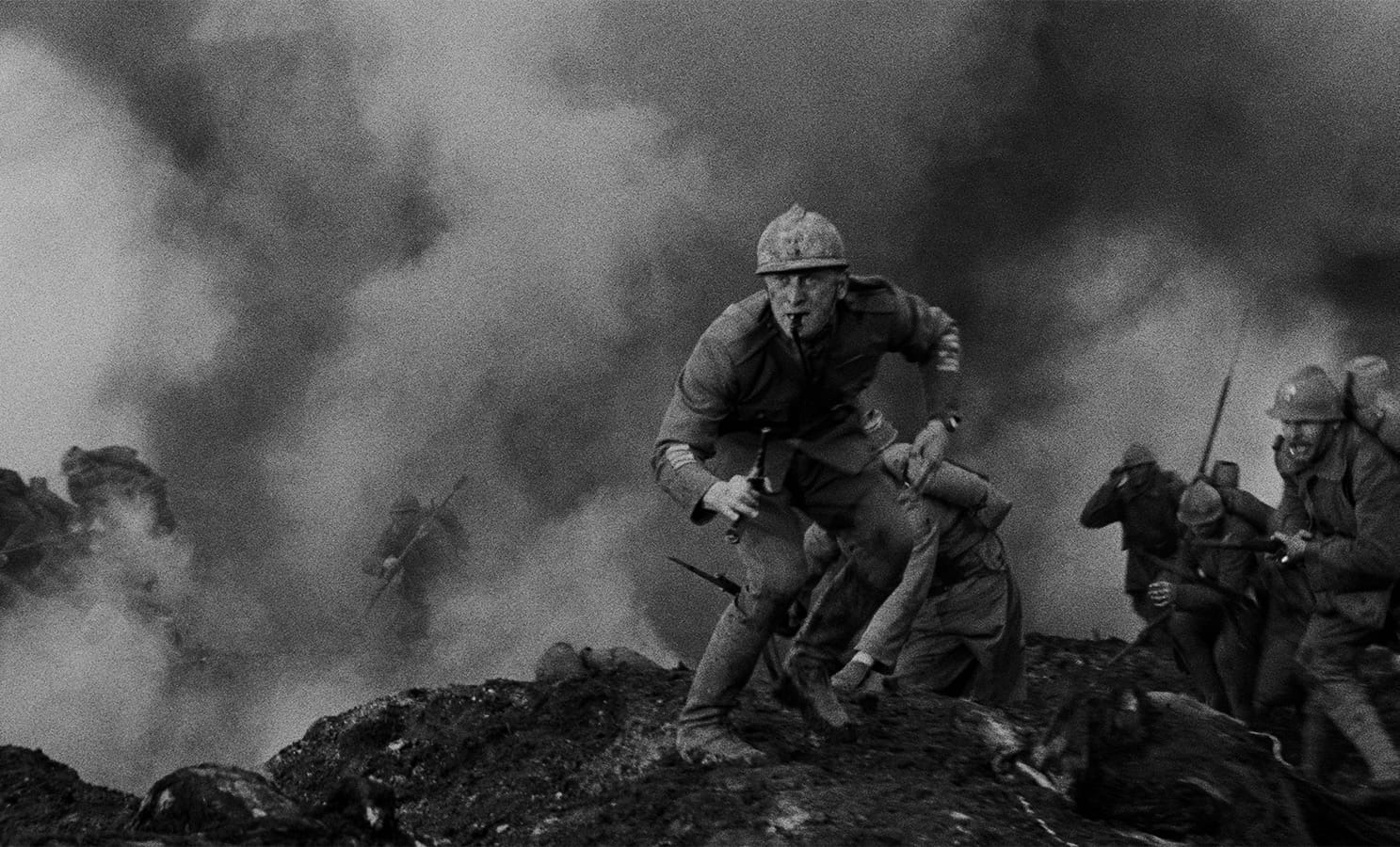
Kubrick spotted Harlan on German television and, after they began dating, cast her in the stunning, ennobling final scene of Paths of Glory (1957)—a last-minute addition to the film. She sings “The Faithful Hussar” to the cynical and weary French troops, offering a redemption that has been withheld on the battlefield. Harlan, to whom Kubrick remained married for the rest of his life, was the daughter of entertainers who performed for Nazi troops at the front. Her uncle was Veit Harlan, the director of the Joseph Goebbels–sponsored film Jud Süss (1940), after Triumph of the Will the most notorious, and effective, work of Nazi propaganda. (Before meeting Veit Harlan and Christiane’s other Nazi relatives, in 1957, Kubrick fortified himself by chugging a glass of vodka. “I’m standing here like Woody Allen,” he later told Christiane, “looking like ten Jews.”) Kubrick spent most of his career trying to make a film about European Jewry during World War II, obsessively reading Hannah Arendt, Raul Hilberg, William L. Shirer. “Given that he wanted to make a film about the Holocaust and researched it for years,” said his daughter Katharina Kubrick, “I leave it to you to decide how he felt about his religion.” At his funeral, mourners recited the kaddish.
Yet it is in the narrative design of his films that you can see most clearly the shadows of Job, and Absalom, and Nebuchadnezzar. Ambitious schemes unerringly collapse, often with the abruptness of a punch line. Hubris is mocked; ambition is undermined by incompetence; humiliation is inevitable, and usually delivered with comic bathos.
The climactic sequence of Killer’s Kiss is structured around a carefully timed meeting organized by Davey (Jamie Smith), a boxer about to abandon his career—essentially Walter Cartier, had he lost his bout. Davey tries to rescue his downtrodden neighbor Gloria (Irene Kane), a taxi dancer in Times Square, from her loutish boss by arranging to pick her up outside her club at the exact moment his manager drops off his payment. The plan seems poised to succeed until two teenagers steal Davey’s scarf. When he chases after them, he blows the timing of the various handoffs, inviting a whirlwind of violence, chaos, and a misery that withstands the embrace between Gloria and Davey that concludes the film.
The Killing tracks the slow-motion unraveling of a heist that succeeds marvelously in its conception, only to fail, in every possible way, in its execution—a film noir that unfolds with the narrative logic of a screwball comedy. In Paths of Glory, a suicidal attack mission, undertaken for no strategic reason other than to help a succession of French generals each curry favor with his superior, backfires predictably and catastrophically. Colonel Dax (Kirk Douglas), the only one in the line of command to protest the order, manages to retain his humanity, but nothing else. Dax learns that even a selfless act of heroism cannot obstruct the cruelty of a system founded upon a single motivation: to increase its own power.

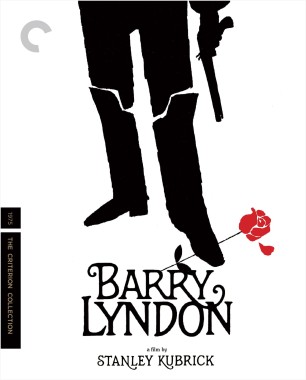
The same synopsis could be applied, with slight adjustments of tone and emphasis, to Kubrick’s other war pictures, Dr. Strangelove and Full Metal Jacket (1987). Lolita is the story of a domestic, if equally shortsighted, scheme: H. Humbert’s seduction of a child, enabled by chance (a car accident) and undone by self-deception and clumsiness. Barry Lyndon pursues a succession of half-baked plans that yield fleeting triumphs, only to cost the hero his honor, his fortune, his son, his left leg . . .
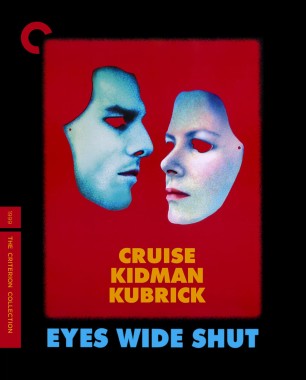
As Kubrick’s canvas broadened, and his budgets expanded, the “carefully constructed plan” became, more often than not, the product of institutional groupthink: a military desperate to train brainless killers, a government pursuing the principle of mutually assured destruction to its logical end, a conformist dystopian society, a secret cabal of lecherous plutocrats. Kubrick was always careful to personify the cruelty of institutions in a character, the better to expose the inhumanity of rationalism gone amok. Eyes Wide Shut’s Victor Ziegler, A Clockwork Orange’s minister of the interior, and even HAL 9000 announce their schemes with a disarming charm that under pressure is revealed to be a charade, hiding power-hungry depravity.
“The most terrifying fact about the universe,” Kubrick told Playboy in 1968, “is not that it is hostile but that it is indifferent.” This is also the most terrifying quality of Kubrick’s glare. The slow, receding zoom, used in the opening shot of A Clockwork Orange and as a central motif in Barry Lyndon, reduces Kubrick’s heroes from giants to ants. His tracking shots pin his characters in the center of the screen as the world, indifferent to their crises, transforms around them. The implacable rigor, symmetry, and stateliness of Kubrick’s framing devices—particularly his use of the magisterial one-point perspective, which draws the eye toward a single vanishing point in the center of the screen—lead the viewer to assume an interpretative stance. Instead of encouraging an intimate identification with his heroes, Kubrick’s formalism travels in the opposite direction. We are not face to face, eye to eye, but standing in the museum gallery, examining the canvas, asking questions of composition, context, perspective. On the rare occasions when Kubrick does move in tight, it tends to be during outbursts of violence, or to suggest a character has gone insane (which explains the preponderance of the technique in 1980’s The Shining).
Barry Lyndon’s epilogue would suit most of his films: “Good or bad, handsome or ugly, rich or poor they are all equal now.”
Yet Kubrick never submitted himself to this equalizing view. On the contrary: with each passing film, his method grew increasingly pharaonic. Only Kubrick would be exempted from the laws of hubris—and the laws of gravity. For 2001: A Space Odyssey (1968), rather than use camera tricks to simulate weightlessness, Kubrick commissioned Vickers-Armstrongs Limited to construct a working centrifuge at the full scale of the spaceship Discovery, for the equivalent of about eight million dollars in 2026. Weighing thirty tons and resembling a Ferris wheel, it rotated at three miles an hour, allowing the actors to appear to walk up the walls, across the ceiling, and down the other side. The centrifuge forced the production into an extraordinary series of contingent measures: every piece of the set needed to be bolted down; crew members wore steel helmets to protect against flying debris; and so many cables, lights, speakers, computers, and climate-control systems had to be installed that Kubrick insisted a fire-department rescue team remain on call. “Had there been a fire,” said one studio executive, “it could have been a flash fire like the one in Apollo 1 that killed the three astronauts.” A camera traveling the walls of the set did once tear loose from its track, falling thirty feet to the floor; but since this was life, and not a Kubrick film, nobody was hurt.

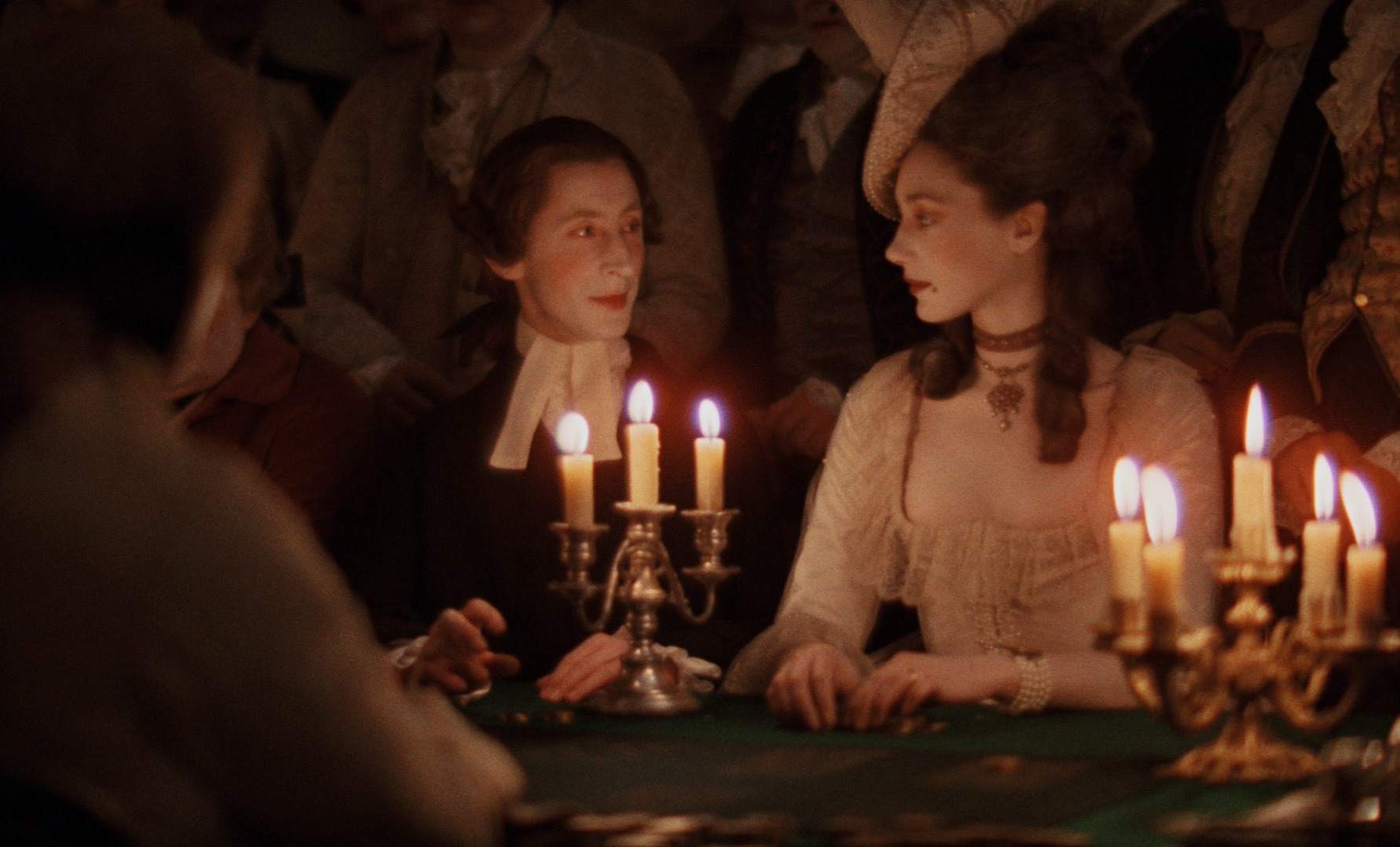
The tales of Kubrick’s exactitude—his “rage for order,” in Mikics’s phrase—are the subject of an entire lineage of documentary films (see, for instance, Jon Ronson’s Stanley Kubrick’s Boxes, from 2008), but any list would have to begin with Candlegate. Insisting that Barry Lyndon be lit exclusively by period-consistent light sources, Kubrick embarked on a global search to find a lens capable of capturing night scenes by candlelight, settling upon one developed by NASA to photograph the dark side of the moon; to preserve continuity, dozens of new candles had to be burned to precise lengths for each take (causing the actors to complain of breathing problems). The Guinness Book of World Records credits Kubrick with the highest number of retakes of a single scene with dialogue, by filming Scatman Crothers telling Danny Lloyd how to shine 148 times; in the shot used for the film, the six-year-old’s expression is convincingly catatonic. (Director Lee Unkrich, after studying the shot logs at the Stanley Kubrick Archive in London, has recently contested this claim, insisting that the longest Kubrick spent on any scene in The Shining was on the early dolly shot following Jack and Wendy on their tour of the Gold Ballroom, completed in a mere sixty-six takes—a distinction without much difference.) With Eyes Wide Shut, Kubrick set the record for the longest uninterrupted film shoot in history, at eighteen months—followed by nine months of editing (which concluded with a heart attack). Once a film was completed, he supervised the editing; the marketing; the graphic design of the posters; the press tour; the projection systems of the individual cinemas in which the films would screen; the foreign translations of not only his film titles but every line of dialogue dubbed into French, Italian, Spanish, and German; and the selection of voice actors . . .
Kubrick knew he was getting away with something. In a recorded speech accepting the Directors Guild of America’s D. W. Griffith Award for lifetime achievement, he cited the myth of Daedalus and Icarus: “I’ve never been certain whether the moral of the Icarus story should only be, as is generally accepted, ‘Don’t try to fly too high,’ or whether it might also be thought of as, ‘Forget the wax and feathers, and do a better job on the wings.’ ” Nobody did a better job on the wings than Kubrick.More than a quarter century after his death, it is possible to pursue Kubrick’s influence down nearly every hallway and cul-de-sac of modern culture. It would be difficult to find a prominent contemporary director who hasn’t credited him for some foundational aspect of their own work. “Kubrick is something you live by,” Martin Scorsese has said. “Not that you live with the work, but you live by the work. It’s part of your experience of being a human being.” Christopher Nolan, who for the fiftieth anniversary of 2001’s release initiated and oversaw a new 70 mm print of the film, speaks of Kubrick as an ideal he can only chase. “I don’t think there is anybody who hasn’t been influenced by Stanley Kubrick,” said Paul Thomas Anderson, who met Kubrick on the set of Eyes Wide Shut. Direct homages to Kubrick’s films can be found in the work of Jordan Peele, Tim Burton, Sofia Coppola (who reused costumes from Barry Lyndon in Marie Antoinette), Greta Gerwig, Jonathan Glazer, Frank Darabont, Lars von Trier, Guillermo del Toro, the brothers Coen and Duffer and Safdie.
Kubrick has been claimed by architects, designers, photographers, sculptors, sociologists, urbanists, musicians. His costume design has inspired lines by Alexander McQueen and Gucci; his use of music has been cited by the Weeknd, Daniel Lopatin, and Jonny Greenwood and has inspired works by Blur, New Order, Kate Bush, and Lana Del Rey. Aphex Twin imagined his masterpiece, Selected Ambient Works Volume II, as an alternative soundtrack to The Shining, which was also the inspiration for Dorothea Lasky’s eponymous poetry collection (“I have eaten all the cans of beans and lemons / And am face drunk on the floor . . .”). The Simpsons alone has referenced Kubrick forty-six times. For more than fifteen years, beginning in 2007, a one-thousand-square-meter exhibition of his work has traveled to more than a dozen museums all over the world, to Melbourne, Istanbul, Seoul, San Francisco, Berlin. Political scientists speak of the “Strangelove effect,” neuroscientists of the “Clockwork Orange problem,” forensic psychologists of the “Kubrick stare.” The space-age set design of 2001 has so profoundly influenced modern technological product development that Samsung successfully used the film to defend itself against a copyright lawsuit filed by Apple; to dispute the claim that the Galaxy tablet mimicked Apple’s iPad, Samsung insisted that both devices had instead stolen the concept from the tablets used on board the Discovery.

And now that civilization dangles over the maw of machine learning, Kubrick has reclaimed his status as one of the leading techno-ethicists of our age:
There’s no doubt that we’re entering a mechanarchy . . . Eventually, we will have to share this planet with machines whose intelligence and abilities far surpass our own . . . Looking into the distant future, I suppose it’s not inconceivable that a semisentient robot-computer subculture could evolve that might one day decide it no longer needed man.
That was Kubrick in 1968, promoting the first great work of art about artificial intelligence, and still widely considered the best. Not far behind is A.I. (2001), a film Kubrick tried to make for decades, before ceding it to Steven Spielberg (Kubrick had optioned the short story on which it is based, Brian Aldiss’s “Supertoys Last All Summer Long,” in the early seventies). Both films examine, with harrowing precision, many of the still-unsolved ethical conundrums posed by machine intelligence. The central drama of 2001 concerns the alignment problem, today commonly known as the “HAL 9000 problem”: What happens when superintelligent machines conclude, as seems inevitable, that humanity stands in the way of their goals? A.I., which begins with a minute-long voice-over detailing the inevitable consequences of unchecked climate change and ends in a drowned New York City, asks what happens when we can no longer distinguish between imitation and reality, or when we no longer want to. Behind that question stands a series of additional ones, each nested within the last like the hedges of the maze at the Overlook Hotel. Can one fall in love with a machine? Can a machine feel? Can a machine love? Can humanity survive technological progress beyond a certain threshold? If we merge with silicon, will we still be human? Now that we have begun to merge with silicon—now that we have, to a greater or lesser degree, outsourced our memories, our characters, our intellects to the cloud—have we already lost our humanity? What more is there to lose? What to gain?
An even more uneasy resonance can be found in the sudden preponderance of Daedalus figures in American public life. Call it the “Jack D. Ripper problem,” or the “Paul Mireau effect”—or the “Napoleon complex,” to borrow the subject of another of Kubrick’s unrealized projects: imperious men in positions of influence who believe themselves responsible for ushering in a new world order. The political scene perennially disgorges such figures, but now that the power locus has shifted west, the Jack D. Rippers and Dr. Strangeloves have proliferated in Silicon Valley, where 2001 has acquired the status of a sacred text—the tech industry’s chosen monolith. Elon Musk credits 2001 as the source of his core convictions about AI. In 2024, Jeff Bezos’s Blue Origin sent miniature black slabs modeled after the 2001 monolith into outer space. Microsoft CEO Satya Nadella has chided the public not to associate AI with “the haunting voice of HAL,” as if the neutral, gentlemanly tenor of actor Douglas Rain were to blame for fears that humanity will cede authority to androids.
There is a temptation, when writing about artists who have left the stage, to ask what they might have made of this or that contemporary phenomenon. With Kubrick, the temptation is misplaced. What would he have made of our current predicaments? We already have the answer. You can find it in Dr. Strangelove, 2001, and A.I., but also in The Killing, where a meticulously designed scheme fails under the weight of incompetence and envy. Or in A Clockwork Orange, a satire about a society in which constant barrages of images of sex and violence become, as Kubrick himself put it, “dangerous new weapons for a totalitarian government to use to impose vast controls on its citizens and turn them into little more than robots.” You can find it in Paths of Glory, where Kubrick never shows us the opposing army—because the real enemy wears the embroidered stars of the French high command. You can even find it in Eyes Wide Shut, in which extremities of wealth and power lead, ineluctably, to barbarism. Kubrick’s films are timeless because he asked, with as much psychological clarity as any filmmaker ever has, timeless questions—the kinds of questions that will be with us, no matter what technological powers we inherit, at least until the city of his childhood sinks to the bottom of the sea.
More: Essays
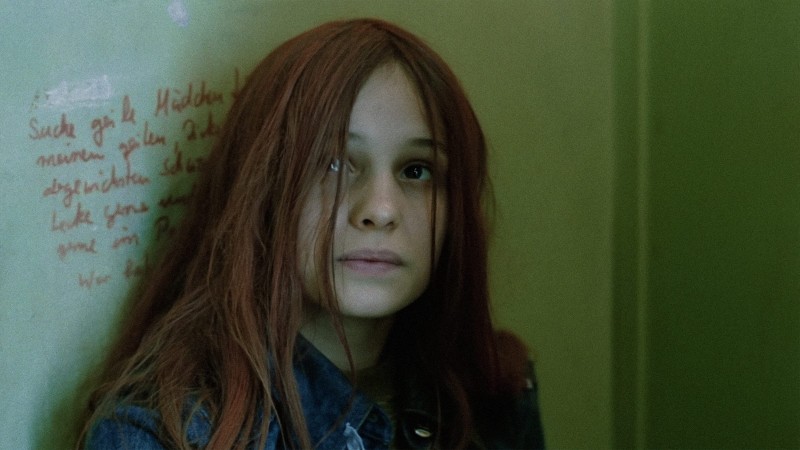
Christiane F.: Up Against the Wall
Uli Edel’s harrowing tale of youth rebellion is one of cinema’s greatest Berlin films, a visceral urban portrait that captures the city’s doom and decadence during the Cold War era.
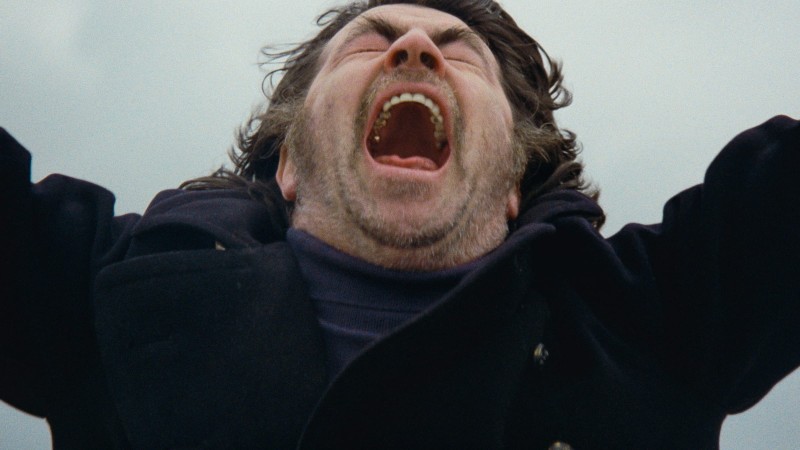
The Shout: Sound and Fury
Blending elements of psychological thriller, social satire, and psychedelic film, Jerzy Skolimowski’s Cannes-award-winning classic uses its audacious sound design to evoke the terror of English civilization.
Welcome II the Terrordome: The Future Is Furious
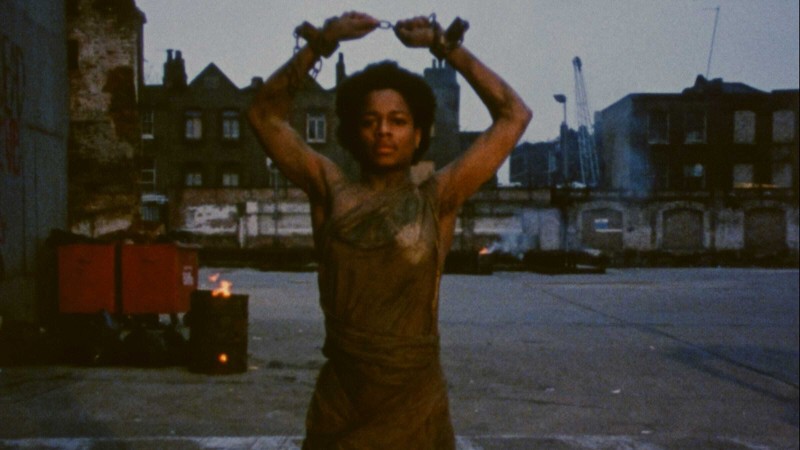
A dystopian drama that draws on the influences of African mythology and hip-hop, Ngozi Onwurah’s debut feature uses a mix of speculative forms to expose anti-Blackness as a system that underpins the modern world.
Days and Nights in the Forest: Into the Woods
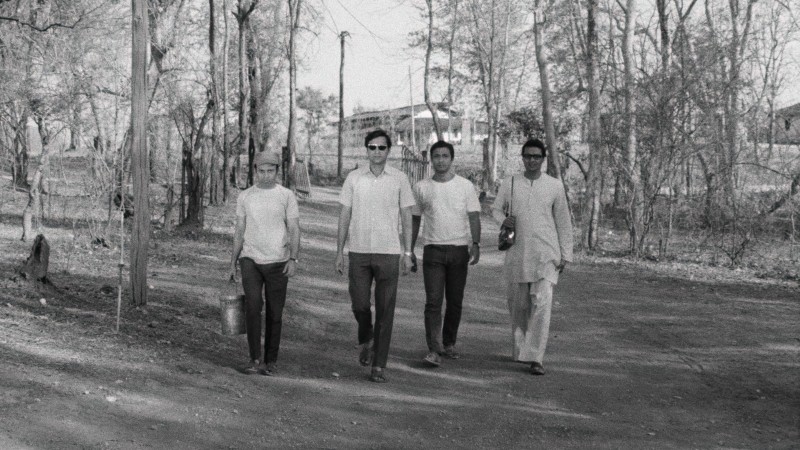
In this tale of four privileged bachelors who embark on a trip to the Indian countryside, Satyajit Ray balances a biting critique of masculine fragility with splendid visual grace.