Fests and Events
Share
This week is packed. The New York Film Festival is on through Monday, Yorgos Lanthimos is presenting a selection of favorites at the Athens International Film Festival through Sunday, and the Busan International Film Festival has just opened with the world premiere of Kim Jong-kwan’s The Table: Day and Night. It’s an anthology film tracking the stories of four couples who cross paths at a café in Seoul as summer turns to fall.
Busan’s thirty-first edition marks its first year as an “A-list festival,” a classification granted by the International Federation of Film Producers Associations (FIAPF) to just sixteen other top-tier festivals, including Cannes, Venice, Berlin, and Sundance. Zhang Yimou is presiding over the competition jury, Michelle Yeoh will receive the Asian Filmmaker of the Year Award, and other special guests this year will include Isabelle Huppert, Lee Chang-dong, Hirokazu Kore-eda, Maggie Gyllenhaal, Lav Diaz, and Tsai Ming-liang.
“If you are anything like me,” writes Pamela Hutchinson, “then you may well consider the two-hour flight to Italy for the Pordenone Silent Film Festival at least partially justified by the chance to see four minutes of a lost F. W. Murnau film. Right or wrong, it’s how we’re made. And yes, today I did get to see two separate fragments of Murnau’s Satanas (1920). Well, they say the devil has all the best films.”
Pordenone’s forty-fifth edition is on through Saturday, and in her daily dispatches to Silent London, Hutchinson likes to include an “Intertitle of the Day.” For example: “Wretched woman! Don’t you know your corpse is lying in one of the rooms in this house?” That one’s from Augusto Genina’s dramedy La maschera e il volte (1919).
Wednesday
Tomorrow sees the opening of seventieth BFI London Film Festival with Simon Stone’s Elsinore, and the Guardian’s Peter Bradshaw and contributors to Sight and Sound offer guides to the highlights. The fifty-third edition of Film Fest Gent will open with Lukas Dhont’s Coward. In her Little White Lies review, Hannah Strong notes that Coward “continues the Belgian filmmaker’s exploration of queer belonging as first expressed in Girl and Close, but establishes a sense of growing ambition and skill, here channeled into a layered wartime drama.”
Of the more than a hundred features screening in Ghent, Sabzian has selected ten to spotlight as well as one exhibition, Sentiments, Signes, Passions, conceived by Fabrice Aragno and focusing on Jean-Luc Godard’s The Image Book (2018). Film Fest Gent has invited Mariano Llinás and Agustín Mendilaharzu to take part in a symposium on El Pampero Cine, the collective they cofounded more than twenty years ago with Laura Citarella and Alejo Moguillansky. And within the Classics program, attendees will find an Eric Rohmer retrospective.
Robert Beavers will be in Toronto tomorrow evening to present three of his films, The Sparrow Dream (2022), The Hedge Theater (1986–1990/2002), and The Ground (1993–2001). “Beavers has created one of the most distinctive oeuvres in contemporary cinema, celebrated for its meticulous 16 mm and 35 mm formal lyricism,” writes TIFF Wavelengths programmer Andréa Picard. In The Sparrow Dream, Beavers revisits places he’s lived, and throughout, notes Picard, “pages of an illustrated copy of The Odyssey are turned, and a meditation on memory is awakened to a resplendent state of being in time.”
In Berlin, Arsenal will launch a twenty-film series, Just Revolutionary: The Films of the Ninjin Club, celebrating the production company founded in 1954 by Ineko Arima, Keiko Kishi, and Yoshiko Kuga and featuring work by Yasujiro Ozu, Kenji Mizoguchi, Kinuyo Tanaka, and Masaki Kobayashi. “Within the rigid, strictly hierarchical, patriarchal Japanese studio system of the 1950s and 1960s, which expected actresses to embody a traditional image of the women and largely denied them positions behind the camera,” writes Milena Gregor, Ninjin Club was “entirely unprecedented both politically and socially.”
The Cinémathèque française’s Jean-Paul Belmondo retrospective will run parallel to the exhibition Belmondo, le Magnifique, on view from tomorrow through January 31. The Cinémathèque is also celebrating its ninetieth anniversary, offering Parisians 180 films screening through November 29. General Director Frédéric Bonnaud explains that the entire staff was consulted to come up with a list restricted to two films per year of the Cinémathèque’s existence—and only one film per director would be allowed. “Ultimately,” writes Bonnaud, “what began as a simple diversion has become—modestly yet confidently—an ideal introduction to a history of cinema.”
Thursday
The Independent Film Festival Boston’s Fall Focus program is on from Thursday through Tuesday, and after a break, it will return on October 29 to run through November 4. Suggesting that “you won't find a better preview of the coming wave of end-of-year specialties and critical favorites,” Ty Burr recommends seven features he’s seen and flags five more he’s looking forward to catching. And that’s out of a total of twenty-seven.
“The sad reality is that a lot of these movies will not get a proper local release,” IFFBoston executive director Brian Tamm tells Sean Burns at WBUR. “You know, the last Mike Leigh film only played at the AMC Boston Common. There’s a real chance that for some of these films, the only way you’re going to see them in an art-house theater projected by people who care if they look and sound good is at this festival. So I feel like we’ve got an obligation to fit in as many movies as we can.”
The Chicago Film Society will screen a 35 mm print of Michael Powell’s Peeping Tom (1960) at the Music Box Theatre.Megan Abbott notes that while the film was met with “aggressive, outraged” reviews when it was released, it is now “considered a masterpiece, a virtuoso achievement of craft and cunning that has profoundly influenced generations of directors (from Martin Scorsese and Brian De Palma to Michael Haneke and Kathryn Bigelow) and helped inspire an entire subgenre of ‘slasher’ movies centered on a psychopathic killer and a cast of beautiful women who fall under his knife, axe, machete.”
Editor Claire Atherton is best known for her thirty-year collaboration with Chantal Akerman, and recently, she’s been working with Éric Baudelaire, Wang Bing, Bani Khoshnoudi, and others. Atherton will be in New York to introduce and discuss her work for the first several days of the series that the Museum of Modern Art will present through October 23. “When I’m asked about my approach to editing, I always insist on the fact that you need to discover while doing,” Atherton said a few years ago. “It’s important to know where you’re starting from, but you have to take the risk of not knowing where you’re going.”
Friday
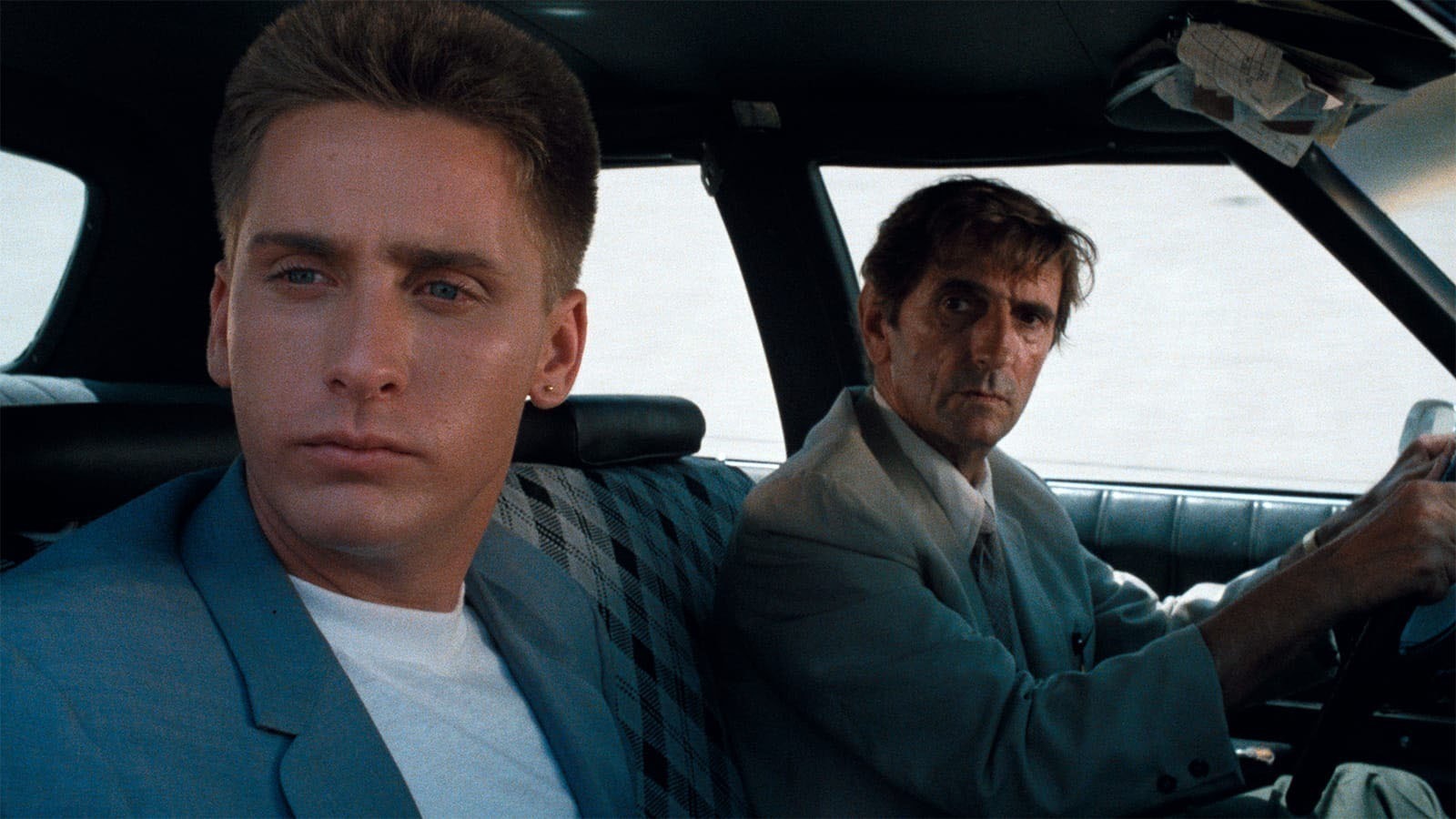
Alex Cox will be spending the weekend in Los Angeles as the American Cinematheque screens six of his features, including his first, Repo Man (1984), whose “outlandishness isn’t forced; it’s forceful,” writes Sam McPheeters. “Sid & Nancy (1986) continued the punk trajectory in a (mostly) dramatic direction. Straight to Hell (1987) inverted this format by using punks, including members of the Circle Jerks and the Clash, as actors, drawing out the gloopy spaghetti-western violence of Repo Man’s main firefight. Walker, shot in the summer of 1987, is Cox’s most overtly political work, a pointed satire that, along with such other films of its time as Missing, Romero, and Salvador, dared to depict the Grand Guignol of U.S. foreign policy in Latin America.”
Facets will present The Revolution Is My Boyfriend: The Films of Bruce LaBruce from Friday through Sunday, and in the Chicago Reader, Annette LePique talks with senior programmer Raphael José Martinez and a few of the filmmakers and artists who will be conducting Q&As with LaBruce, including Joe Swanberg, Henry Hanson, Susanne Sachsse, and Frédéric Moffet. “Once again, there is plenty to fight for and against, and woke queers are starting to actually wake up!” LaBruce tells LePique. Those nowhere near Chicago may want to tune into our new Criterion Channel program Bruce LaBruce: Reluctant Pornographer.
The Weekend
The eighteenth Lumière Festival, founded in Lyon and overseen by Cannes artistic director Thierry Frémaux, opens Saturday to run through October 18. This year’s Lumière Award will be presented to Joel and Ethan Coen, and other special guests will include Todd Haynes, Abel Ferrara, Tsui Hark, Robert Eggers, Zhang Ziyi, Agnès Jaoui, Nadine Labaki, and Bérénice Béjo. Retrospectives will focus on Ettore Scola, Norman Jewison, Gustav Machete, women filmmakers, and Greek cinema.
Also on Saturday, New York’s Metrograph and Razom for Ukraine will launch Oleksandr Dovzhenko: Earth and Empire in the run-up to this year’s Ukrainian Cultural Festival (October 18 through November 6). Jonathan Rosenbaum has called Dovzhenko “a pagan mystic whose masterful films look as wildly experimental, as dreamlike, as hysterically funny, as fiercely tragic, and as beautiful today as they did a century ago.” The series features such classics as Arsenal (1929) and Earth (1930) screening from 35 mm prints and live accompaniment to the silent films.
“Dovzhenko had the strange fate to extend his vocation beyond the grave, employed in this clandestine mission by his surviving collaborator, codirector, and wife Yuliya Solntseva,” writes Alena Lodkina for Metrograph’s Journal. “Solntseva directed five features based on the scripts, diaries, memoirs, and notes that Dovzhenko left behind, two of which—Poem of the Sea (1958) and The Enchanted Desna (1964)—will show as part of Dovzhenko’s retrospective.”
On Sunday, Mezzanine will present a rare 35 mm screening of the theatrical version of Peter Watkins’s Edvard Munch (1976) at Brain Dead Studios in Los Angeles. Writing for Not Coming to a Theater Near You in 2005, Leo Goldsmith called Edvard Munch “a rich and intensely personal film, representing a widening breadth of subjects, concerns, languages, and milieux in [Watkins’s] filmmaking.”
Let’s wrap with two events in London. Fireflies Press cofounder Giovanni Marchini Camia will be at the Close-Up Film Centre on Saturday to introduce a screening of Morvern Callar (2002) and to launch Anwen Crawford’s new book on Lynne Ramsay’s second feature. And on Sunday, Sonic Cinema, the series programmed by Oliver Dickens, will present a rare screening of Tony Conrad’s audiovisual experiment Loose Connection (1973/2011) preceded by a live solo performance by violinist Billy Steiger.
Don’t miss out on your Daily briefing! Subscribe to the RSS feed.