All of a Sudden and Paper Tiger
Share
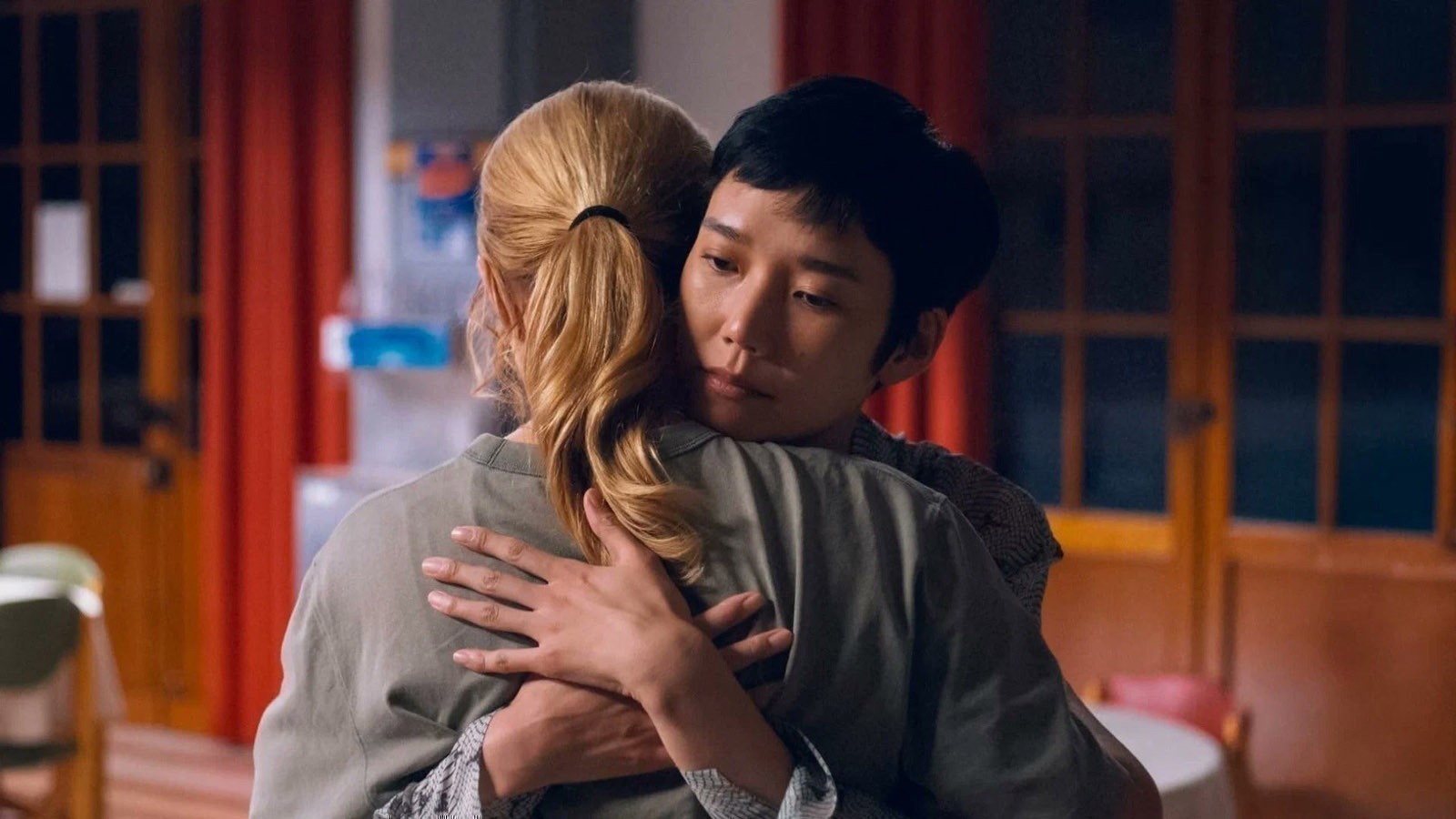
One of the new features at the freshly relaunched Film Comment is a critics’ grid showing contributors’ numerical ratings of films premiering in Cannes. As of this writing, Ryusuke Hamaguchi’s All of a Sudden has taken the lead among the contenders for the Palme d’Or. At Moirée, All of a Sudden is tied with Paweł Pawlikowski’s Fatherland—which we took a first look at yesterday—and James Gray’s Paper Tiger for second place behind Arthur Harari’s The Unknown.
Fatherland is out front on the grids at Screen and Ioncinema, but Paper Tiger has pulled ahead at the International Cinephile Society. A film festival is, of course, much more than a horse race, but we can take these scores as a prompt to sample some of the most notable early critical responses to the new films by Hamaguchi and Gray.
All of a Sudden
To be clear, even some admirers of Hamaguchi’s past work, such as Happy Hour (2015) and Drive My Car (2021), have their problems with All of a Sudden. Jonathan Romney is one of them, as he explains on The Last Thing I Saw, but for host Nicolas Rapold, it was well into the film’s 196 minutes when he found himself clicking in with it. On the Film Comment Podcast, it’s Devika Girish raising objections while Inney Prakash argues the case for the defense.
Marie-Lou (Virginie Efira) is the director of an elderly care center on the outskirts of Paris, where she’s introduced a program—Humanitude, a real thing—wherein patients are treated with dignity, taken out of the beds where the healthcare system would have them filed away, and encouraged to participate in communal activities. Some of Marie-Lou’s underlings object that the facility is already too overstretched and understaffed to spend all the extra time and effort, but Marie-Lou, teetering on the edge of burnout herself, does have her supporters.
Heading home after another trying day, Marie-Lou spots a young man running through a park and immediately recognizes that he’s developmentally challenged—and on his own. She rushes to his side, and spotting a GPS tracker, waits for his guardians to arrive. One of them is Mari (Tao Okamoto), the director of a Japanese theater on tour, and she hands Marie-Lou a flyer with an invitation to the next show. What Marie-Lou sees is a production inspired by the work of psychiatrist Franco Basaglia, an advocate for the reform of Italy’s approach to the treatment of the mentally ill.
“There are multiple theatrical performances which nest neatly within the drama,” notes David Jenkins at Little White Lies, “and there are numerous Q&A sessions—a Hamaguchi kink—in which the unique dynamic of responding to intimate questions in public allows for the most unguarded and poetic answers.”
It’s during the Q&A following this first performance that Marie-Lou and Mari, switching between French and Japanese—Marie-Lou completed a degree in anthropology in Tokyo and Mari studied philosophy at the Sorbonne—discover that they are kindred spirits. Marie-Lou learns that Mari is suffering from a form of cancer that can at any time—and all of a sudden—take a severe turn for the worse.
“Almost half the running time of this three-hour-plus film is given over to the women’s first extended meeting,” writes Dennis Lim for Film Comment. “As they make their way from the theater to the Seine and eventually to Marie-Lou’s workplace, amid fading light and into the still suspension of night, the gravity of Mari’s situation stretches time and imbues it with urgency, imparting a tender, searching intensity to their flowing conversation. All of a Sudden deepens the philosophical inquiry of Evil Does Not Exist (2023). If that film contemplates the folly and fragility of human existence on a despoiled planet, this one asks how we might live in a failing body (as we all will) and within a tangle of broken systems (as we already do).”
Cowriters Hamaguchi and Léa Le Dimna have drawn from a 2019 collection of correspondence between medical anthropologist Maho Isono and philosopher Makiko Miyano, who knew that cancer would soon take her life. As Leonardo Goi notes at the Film Stage, during one of their lengthy discussions that will actually incorporate diagrams on a whiteboard, Mari prods Marie-Lou “into discussing her university dissertation’s central dilemma—why does capitalism lead to lower birth rates?—only to pivot from that and problematize the genesis and scope of her empathy-driven approach to elderly care.”
If all of this sounds a little dry, Jessica Kiang assures us in Variety that All of a Sudden “achieves a kind of levitating grace . . . It is difficult to divide any one thing from the other here, from those inextricably interlinked lead performances to Samuel Andreyev’s sparing score to Azusa Yamazaki’s liquid editing and the camerawork from DP Alain Guichaoa, that is unobtrusive yet makes intensely talky scenes feel roomy and cinematic. All the craft is in humble service of a screenplay uncommon for its faith in the power of language and communication to transform and to console.”
Paper Tiger
Adam Driver delivers what IndieWire’s David Ehrlich describes as “a career-best performance” in James Gray’s ninth feature as Gary, a flashy former cop who’s done well in the private sector and is now getting itchy as he peers down the barrel of a divorce. It’s 1986 when he rolls up to a house in Queens with caterers from Peter Luger Steak House and dinner for his younger brother, Irwin (Miles Teller), and his family. Irwin’s wife, Hester (Scarlett Johansson), appears flustered to see Gary after what appears to be quite a while, and Irwin and Hester’s teenage sons, Scott (Gavin Goudey) and Ben (Roman Engel), marvel at the pistol Gary keeps in his ankle holster.
Gary has come to Irwin with a business proposition. Brooklyn’s infamously polluted Gowanus Canal is up for a good cleaning and gentrification. While the Italian mafia is on its way out, the Russians are moving in, but Gary assures Irwin that he can handle them. The idea would be to apply Irwin’s engineering experience and know-how to a potentially lucrative consulting gig. Irwin has been fretting over how he might be able to afford sending his son Scott to a decent college and maybe even moving to a more upscale neighborhood, so it’s a yes.
But one night, Irwin decides to show his sons the canal, and as they pull up, they spot Russians dumping industrial waste. For the Russians, that makes Irwin and his boys a problem that needs to be taken care of. Back home, in the meantime, Hester isn’t telling anyone about the vision-impairing bouts of wooziness she’s been experiencing lately.
“Elements of Paper Tiger are drawn from Gray’s own experience,” notes the New Yorker’s Justin Chang, “and you may recognize plot points from some of his earlier films, namely Little Odessa (1994) and We Own the Night (2007): a gnarly Russian-mob milieu, a festering estrangement between two brothers, and a mother who is succumbing, or has already succumbed, to a grave illness. Johansson has been showily dowdified—thick-rimmed glasses, a big blond wig—but never loses her hold on the character; when her voice cracks and her eyes widen in shock, she conveys a bone-deep understanding of Hester’s anguish and fear.”
“While Driver is pure neighborhood movie star,” writes Hannah Strong at Little White Lies, “it’s Teller who gives a transformative performance as the meek and mild Irwin, just trying to do right by his family but instantly in over his head and blustering about it.” For Vulture’s Alison Willmore, Paper Tiger is “a tragedy with the momentum of a thriller,” and Time’s Stephanie Zacharek finds that there are passages when “this picture is wrenchingly tense, as if Gray were discovering a gift he didn’t know he had, playing on the audience’s nerves the way you’d gently tighten the pegs on a violin.”
The Hollywood Reporter’s David Rooney calls Paper Tiger “a bracing melodrama—the good kind, fueled by raw emotional power, not the artificial kind that traffics in overwrought audience manipulation—with a dark, burdened heart . . . While the obvious antecedents outside of Gray’s own body of work might be Coppola or Lumet or Scorsese or Mann, I kept thinking while watching of the early crime films of Akira Kurosawa, from Drunken Angel and Stray Dog up to the classic police procedural, High and Low.”
Don’t miss out on your Daily briefing! Subscribe to the RSS feed.