Cannes: Three Critical Favorites
Share
We wrapped last week noting that the New York Times’ Manohla Dargis felt that Cannes had “gotten off to a quiet start” this year. Now that we’re halfway through the seventy-ninth edition, the volume may be inching up.
The Guardian’s Peter Bradshaw calls Paweł Pawlikowski’s main-competition entry Fatherland “an impossibly elegant, poised historical vignette whose brevity and control can hardly contain its characters’ personal and historical pain.” At IndieWire, Siddhant Adlakha suggests that The Diary of a Chambermaid, premiering the Directors’ Fortnight, “might be [Radu] Jude’s most slyly character-focused work, culminating in a completely unexpected emotional gut punch.” And Club Kid, the debut feature from comedian Jordan Firstman, has livened up the Un Certain Regard program, taking critics by surprise and sparking a bidding war between eager distributors. A24 won.
Fatherland
Leonardo Goi closes his first Notebook dispatch from Cannes with a visit to the grave of Klaus Mann. The son of Nobel laureate Thomas Mann was only forty-two when he died of an overdose on the French Riviera in the summer of 1949. Speaking recently to the New Yorker, Olivier Assayas suggests that Mann’s The Turning Point (1942)—the autobiography of a gay man who grew up in an antifascist milieu and eventually, like most of his family, self-exiled from Germany—“should be compulsory reading in schools.”
Fatherland opens with Klaus (August Diehl), disheveled and desperate in his Cannes hotel room. He’s on the phone with his sister, Erika (Sandra Hüller), who begs him to emerge from his funk and join her and their father on a return trip to Germany, a country none of them have set foot in since 1933. Klaus and Erika, a writer and war correspondent, had been close all of their lives. In the 1920s, they paired up with actors Pamela Wedekind and Gustaf Gründgens to perform plays they’d written, and for a few years, Erika and Gründgens were married.
Played by Joachim Meyerhoff, Gründgens briefly resurfaces in Fatherland, wounded by having been execrated in Klaus’s 1936 novel Mephisto, a thinly veiled portrait of an actor who ingratiates himself with the Nazis and lands the role of Mephistopheles in a production of Goethe’s Faust. Gründgens’s feeble attempt to explain himself in Fatherland earns him a slap across the face from Erika.
The year 1949 marked the two-hundredth anniversary of the birth of Goethe, and two cities invited Thomas Mann to speak at their respective commemorations: Frankfurt in an increasingly Americanized West and Weimar in an East beginning to recede behind what would become the Iron Curtain. In reality, Mann made the trip with his wife, Katia, but Pawlikowski and cowriter Henk Handloegten have tweaked the timeline and overall outline of Mann family lore to have him accompanied by Erika.
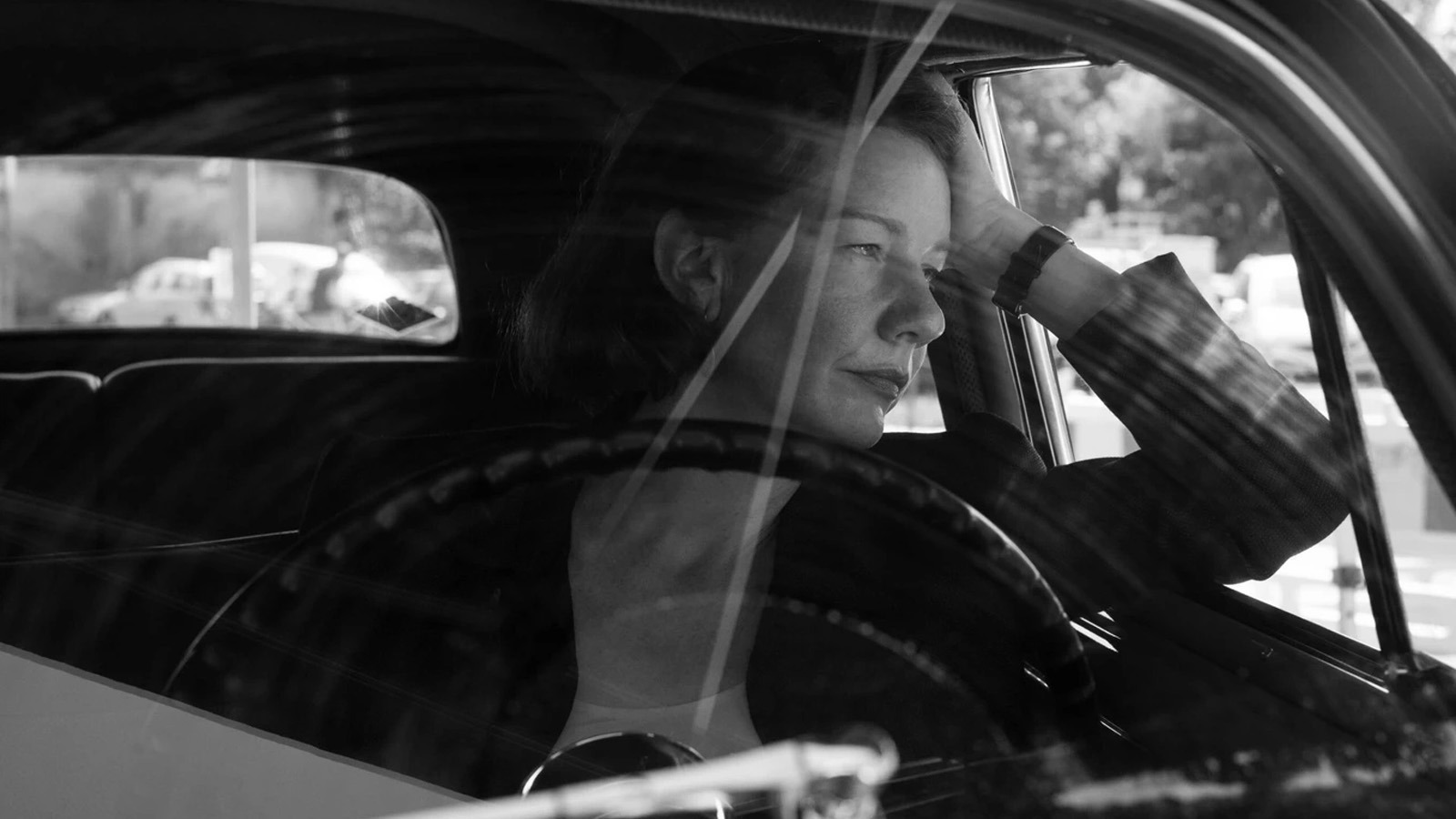
Pawlikowski has reteamed with cinematographer Łukasz Żal, who, as he did with Ida (2013) and Cold War (2018), shoots Fatherland “in a lustrous monochrome that turns shadows into punctuation marks and sunbeams into something holy, and that makes its performers, chief among them an incredible Sandra Hüller, look lit from within,” writes Vulture’s Alison Willmore. “The world cracked open, and now everyone’s striving to fit the jagged pieces back into a box called civilized society. In the East, that means obliterating the recent past and starting anew in pursuit of communist utopian dreams under the already alarmingly heavy hand of the Russians. In the West, it means pretending to have never cared for, much less been aligned with or had anything to do with, the Nazis, gliding forward on an oil slick of denial with the CIA guiding the way.”
Thomas Mann is played with a somber gravity by Hanns Zischler, who may be best known to international audiences as Hans in Steven Spielberg’s Munich (2005) but who made his mark in Europe appearing in early films by Wim Wenders and working with Chantal Akerman, Jean-Luc Godard, Liliana Cavani, and István Szabó, who in 1981 directed an adaptation of Mephisto. Zischler also played Dr. Serenius in a 1982 adaptation of Thomas Mann’s Doctor Faustus.
Hüller, who won a Silver Bear in Berlin a few months ago for her lead performance in Markus Schleinzer’s Rose, is also appearing this year in the smash hit Project Hail Mary and alongside Tom Cruise in this fall’s Digger. In Fatherland, she’s “at her best—quiet but barbed, with a honed inner edge of defiance—as a woman who seems to have embraced daughterly subservience in response to the spiritual exhaustion occasioned by war and exile,” writes Jonathan Romney for Film Comment. “Żal’s photography has a dappled, luminous grace that elevates the realist period evocation, finding beneath the rubble and brutalist concrete some residue of the Romantic-era grace of Goethe’s bygone world. Right up to its gorgeously direct ending, set to a Bach organ piece, Fatherland is at once simple and a very special achievement—not just a serious film but one that dares to take seriousness itself seriously.”
The Diary of a Chambermaid
Radu Jude calls The Diary of a Chambermaid “a variation on” the 1900 novel by Octave Mirbeau previously adapted by Jean Renoir, Luis Buñuel, and Benoît Jacquot. Jude’s version is “modest in scale and rich in ideas: essentially an essay film disguised as a conventional narrative,” suggests Victor Morozov at Films in Frame. “Migration, economic inequality, and the idea of a two-speed Europe are not background concerns; they shape the entire film, reframing Mirbeau’s perversely charged material through a distinctly contemporary lens. Less formally radical than some of Jude’s recent work, the film still retains his familiar experimental impulse, folding in reflections on art and society, history and contemporary life, as well as the uneasy relationship between theater, literature, and cinema.”
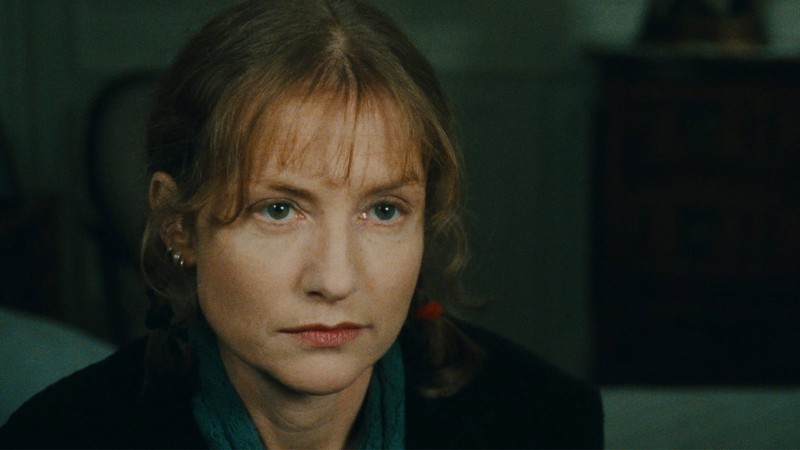
Gianina (Ana Dumitrașcu) works as a housekeeper in Bordeaux for a microaggressively liberal French couple, Pierre (Vincent Macaigne) and Marguerite (Mélanie Thierry), and as a nanny for their son, Louen (Louen Bouteiller). Gianina has left her own daughter, Maria (Sofia Dragoman), with her grandmother (Liliana Ghita) in Romania. Maria misses her mother terribly, so Gianina tries to steal what time she can to maintain digital contact. At night, Gianina rehearses at a local theater, where she has been cast as the lead in a rowdy adaptation of Mirbeau’s novel.
In the house, Gianina is “an obedient, semi-invisible servant,” writes Sarp Sozdinler at In Review Online, while on stage, she’s “a carnal beast that’s open to all forms of pleasure and experimentation. The duality here might seem a touch convenient, yet both spaces demand something morally compromising from her. The French family sees her as mere labor, though never as far to see her as a part of the family . . . The theater troupe sees her as an abject material for art, subjecting her to challenging, and at times humiliating, requests that vary from nudity to emotional exposure.”
At Little White Lies, Mark Asch finds that The Diary of a Chambermaid is “such a perfect encapsulation of Jude’s preoccupations that he can basically replay variations on his characteristic scenes to make a rich text in a singular voice; it’s proof that he’s a major contemporary filmmaker even when he barely gets out of second gear.”
Club Kid
“Ask any gay man with a social-media account, and they likely have an opinion about Jordan Firstman,” writes Ryan Lattanzio at IndieWire. “The backlash-courting queer actor/comedian, controversial most recently because of an online flare-up over querying the sexual realism of Heated Rivalry, is labeled either candid or confrontational. He also has a record of taking on sexually explicit projects like Sebastián Silva’s suicide-ideating, ketamine-fueled dark comedy Rotting in the Sun. His status as a self-aware, hyper-online provocateur may not seem to suggest the makings of a bona fide filmmaker, but just wait.” Club Kid is a “hugely crowd-pleasing, excruciatingly funny, and poignant first film.”
Firstman stars as Peter, a party promoter in New York who, on a hot and woozy night in 2016, is drawn into a threesome and his first and only sexual encounter with a woman. “Evoking Sean Baker in its style, a whirlwind ten-minute opening sequence—sweatily shot by Adam Newport-Berra and feverishly cut by editors Taylor Levy and Sofía Subercaseaux to a steady, heavy throb of bass—establishes this world to either seductive or nightmarish effect,” writes Variety’s Guy Lodge. Ten years of stimulants and repercussions wash by until the best friend of that one woman arrives from London to tell Peter that the mother of the child he didn’t know he had has “tossed herself off,” and now the doe-eyed boy, Arlo (Reggie Absolom), is his problem.
Fortunately, Arlo is so winning that Peter is motivated to sober up. “From Charlie Chaplin’s The Kid through to Mike Mills’s C’mon C’mon a full century later, we all know what tends to happen in the movies when manchild meets actual child,” writes Lodge, “and the real surprise of Club Kid is that Firstman is happy to follow the formula.” At Little White Lies, Hannah Strong puts it this way: “Like the very best remixes, Club Kid is familiar at its core but lovingly transformed by a new artist.”
“I don’t think the film is a public renouncement of Firstman’s social milieu, a ‘guys, haven’t we grown out of this?’ bit of smarm from someone trying to give his image a mainstream polish,” writes Richard Lawson in the Hollywood Reporter. “But it is, maybe, suggesting to those who might be lost in the party that life can be led with more—and I apologize for using this particular buzz word—intentionality. It’s a call to consciousness, really, a gentle urging that slowing down is not giving up, that cool is not the only currency, and that what happens in the dark room may not always stay there.”
Don’t miss out on your Daily briefing! Subscribe to the RSS feed.