Last month marked the hundredth anniversary of the birth of Shohei Imamura, a key figure in what would retroactively be called the Japanese New Wave. Three years before Imamura died in 2006, Nelson Kim wrote in Senses of Cinema that in the nineteen features he’d made over a period of forty-five years, Imamura “probed the lower depths of Japanese society and ‘the Japanese consciousness.’ Not for him the tourist-friendly vision of Japan as the postwar economic powerhouse of Asia, the land of kimono-clad elegance, Zen serenity, and harmonious Confucian social hierarchies. Instead he has put on-screen a world populated by prostitutes, pimps, and petty thieves, peasant farmers and middle-class pornographers, serial killers and shamen. This is the irrepressibly ‘real’ Japan of his bawdy, ragged, sensual films.”
Kim’s profile opens with a quote from the director that also tops the program notes for The Lower Depths: The Cinema of Shohei Imamura, a series running at the Institute of Contemporary Arts in London through December 13: “I am interested in the relationship of the lower part of the human body and the lower part of the social structure on which the reality of daily Japanese life obstinately supports itself.”
The third son of a well-to-do doctor, Imamura neglected his studies to take an active role in theater, politics, and the black market that thrived in the wake of Japan’s defeat in the Second World War. He’d buy cigarettes and booze from American GIs and resell them to his professors. The ICA credits Akira Kurosawa’s 1948 noir Drunken Angel, screening this evening, with sparking Imamura’s interest in cinema.
Almost immediately after graduating, Imamura started working at Shochiku studios as an assistant to Yasujiro Ozu on the productions of Early Summer (1951), The Flavor of Green Tea over Rice (1952), and Tokyo Story (1953). In terms of hands-on technical know-how, Imamura gleaned quite a bit from Ozu, but temperamentally, the two men couldn’t have been more different. As the late critic and historian Tony Rayns noted, the moment Nikkatsu studios reopened in 1954, young and aspiring filmmakers, including Imamura, “flocked” to what soon became a powerhouse producer of films aiming to appeal to the rebellious spirit of young audiences.
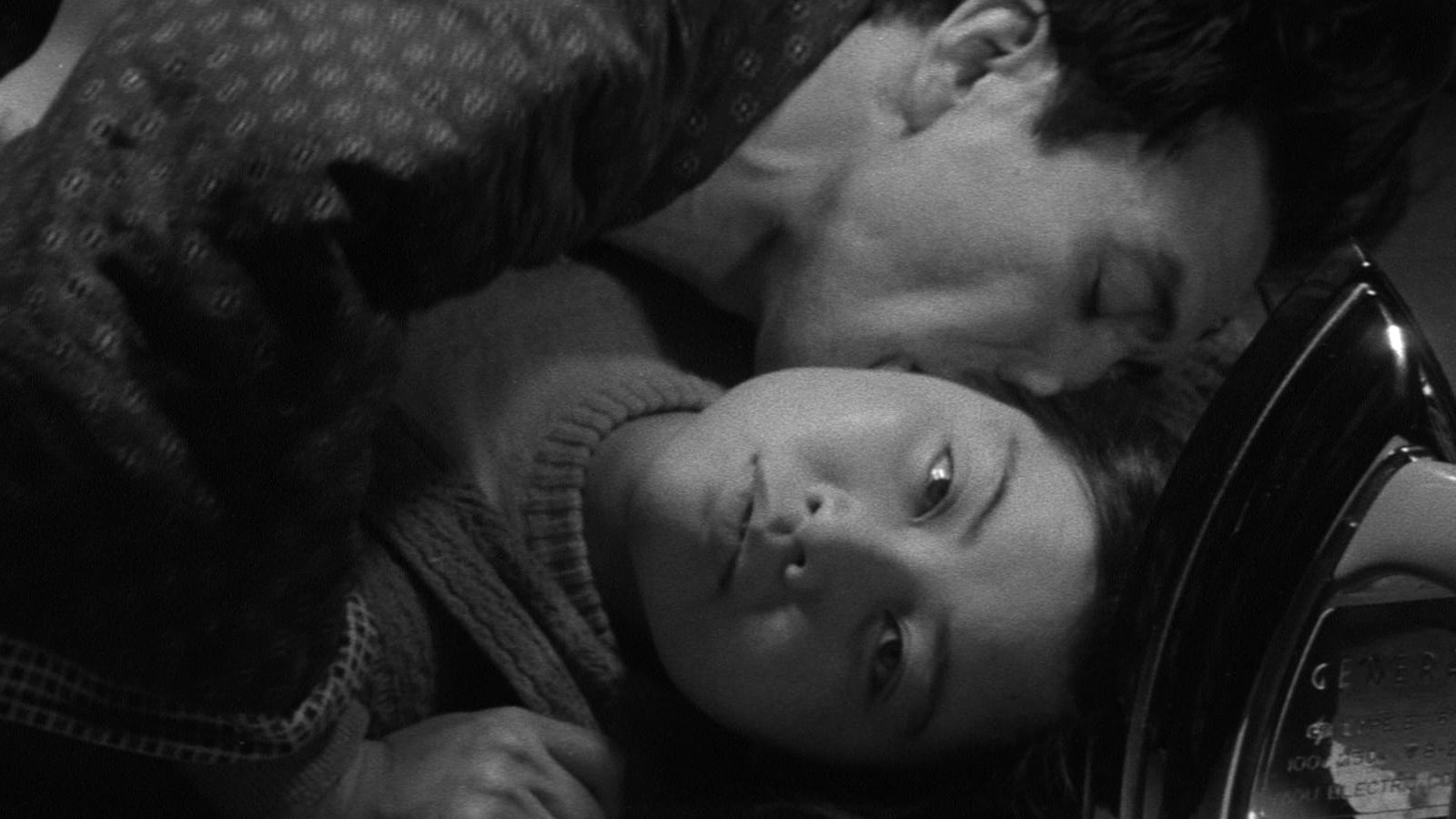
At Nikkatsu, Imamura worked under Yuzo Kawashima, whose worldview aligned a lot more closely with his own than Ozu’s. He also began directing B movies that he had little interest in, but in 1961, he came into his own with Pigs and Battleships. Hiroyuki Nagato, who had appeared in Imamura’s directorial debut, Stolen Desire (1958), as well as a few other B movies of which Imamura was not proud, stars in Pigs and Battleships as Kinta, a roustabout that Haruko, played by then-newcomer Jitsuko Yoshimura, falls hopelessly in love with. Together, they navigate the underworld of the port town of Yokosuka.
“With its raucous visual and auditory effects and its strong, down-to-earth women,” wrote film scholar Audie Bock (Japanese Film Directors) in 2009, “Pigs and Battleships was a turning point for Imamura, as it showcased his full-blown distinctive style. Here he is no longer sentimentalizing downtrodden youth or romanticizing itinerant actors, as he did in his earliest works. He combines the backstreet neorealism of Shinsaku Himeda’s mobile camera work with a caustic humor all his own, buoyed by the parodic bombast of avant-garde composer Toshiro Mayuzumi’s score. No other Japanese New Wave director has the peculiar boisterousness of Imamura . . . The bawdiness, greed, selfishness, and just plain foolishness of Imamura’s characters form a welcome counterpoint to the austere righteousness of Ozu’s modest women and taciturn men.”
Pigs and Battleships screens on Thursday, followed on Saturday by The Insect Woman (1963). “There was no aspect of the official culture that Imamura sought more vigorously to revise than the depiction of women as passive victims who achieved transcendence through suffering,” writes Dennis Lim.The Insect Woman traces the hard-knock life of Tomé Matsuki (Sachiko Hidari) from her birth in a desolate village in 1918 through decades of her exploitation and her win-some, lose-some struggles to fight back.
Imamura “regards Tomé with an awed fascination,” writes Lim. “The point of this rapt scrutiny, as in almost all of Imamura’s films, is to see through to a repressed or unacknowledged essence of Japanese society, to assert that the distance between feudal and modern Japan is shorter than anyone, least of all the modern Japanese, would like to admit . . . That this essence is akin to a vulgar life force—a font of wayward desires and ingrained superstitions—explains why his movies thrum with an ecstatic energy, not least when they are at their most perverse and irrational.”
In Intentions of Murder (1964), Sadako (Masumi Harukawa), a housewife neglected by her husband and scorned by her mother-in-law, is raped by an intruder. But she refuses to become a victim. “As if to prove his pronouncement ‘I like to make messy films,’ Imamura’s teeming ’Scope frames can barely contain the outsize performances, hectic energy, and eccentric spectacle for which he is celebrated,” writes James Quandt.
The Pornographers (1966) is “vintage Imamura,” wrote J. Hoberman in 2003. “This lurid black comedy, which the director adapted in 1966 from Akiyuki Nozaka’s prizewinning bestseller (and which he typically subtitled An Introduction to Anthropology), is set in seediest Osaka; affably grotesque, it details the personal and professional trials of one Subuyan Ogata, a minor producer/distributor of 8 mm porn films. Perhaps because The Pornographers was the first movie Imamura made for his own production company, it feels giddy with sympathy for its harried protagonist, a would-be solid citizen whose assistants call ‘maestro.’”
“All of it is filmed with an aggressive, unrelenting elegance that puts the viewer through rigorous ocular gymnastics,” noted Jean-Pierre Gorin when he put The Pornographers on his list of Top 10 Criterion releases. “If you thought that Ozu was the alpha and the omega of the visual possibilities offered by Japanese home architecture, Imamura’s truculent epic will open your eyes anew.”
A Man Vanishes (1967) is ostensibly a documentary—Imamura’s first—“about a disappearance and the transformation of reality into an ever more mercurial mystery, a vertiginous drama, and the very stuff of cinema,” wrote Manohla Dargis in the New York Times in 2012. Tokyo salesman Tadashi Oshima was first reported missing in the spring of 1965, and as the search for him “extends to those who scarcely seem to know him—the location shifting from perfectly framed cramped interiors to dense city scenes and expansive country landscapes—A Man Vanishes kinks this way and that, growing knottier and more fascinating. Each interviewee has an (often unflattering) take on Oshima’s character, temperament, actions and motivations, yet the more he or she talks, the blurrier his portrait becomes, as anecdote leads to digression leads to a discourse on the Japanese character.”
In Profound Desires of the Gods (1968), a Tokyo engineer intends to drill a well on a tropical island where he encounters an eccentric family of outcasts, resulting in “nearly three hours of quintessentially Imamurian insanity, wryness, wisdom, and acute anthropological observation,” as Glenn Kenny wrote in his 2010 Notebook review. “Imagine a cross between God’s Little Acre, Local Hero, and the opening scorpion fight of L’âge d’or, then filter it through Imamura’s particular aesthetic/consciousness, wherein tragedy walks hand-in-hand with farce, always, and a perpetually bemused cynicism finds no contradiction in an ever-abundant sense of wonder at the world both natural and unnatural.”
Imamura spent much of the 1970s making nonfiction films. History of Postwar Japan as Told by a Bar Hostess (1970) delivers what the title promises, while In Search of the Unreturned Soldiers (1970/1971) is a pair of films featuring Imamura himself as the on-screen interviewer tracking down emigrants throughout Southeast Asia. The ICA will also screen a selection of shorter docs that Imamura made for television.
Based on Ryuzo Saki’s novel, which in turn drew from the real-life story of a con man’s seventy-eight-day killing spree, Vengeance Is Mine (1979) is “paradigmatic Imamura in that the movie evades codification at every turn,” writes Michael Atkinson. “Is it psychosocial critique? Serial-killer thriller? Nippononoir? Black farce? . . . Without playing to the cheap seats, or displaying righteousness, Imamura critiques his nation’s personality with a steel-tipped whip.”
Depicting the upheaval that led to the restoration of imperial rule in 1868 and the Westernization of Japan, Eijanaika (1981) is “witty, grotesque, relentless, and beautifully engineered,” wrote Dave Kehr in the Chicago Reader. “Imamura follows eight major characters through a bright, bursting, impossibly dynamic mise-en-scene . . . A very important film, and possibly a great one.” For Kehr,The Ballad of Narayama (1983), which won the Palme d’Or in Cannes and tells the story of a seventy-year-old woman sent by her village to a mountain to die, “marks a turning point in his career, away from the violence and confrontationalism of his earlier films and toward an almost Ozu-like acceptance of human fate.”
Zegen (1987) tells the true story of Iheiji Muraoka (Ken Ogata in his fourth Imamura feature), a pimp who opened brothels across Southeast Asia as a service to the Emperor and his forces in the run-up to the Second World War. The film’s “fierce condemnation of unchecked nationalism, here spreading almost like a contagion, is reminiscent of Nagisa Oshima’s work,” notes Derek Smith at Slant, “but as it pushes the limits of its absurdist premise, Zegen ultimately morphs into something more akin to pinku farce.”
Imamura’s “turn toward more straight-laced, prestigious material with 1989’s Black Rain is one of the more unexpected left turns in his oeuvre,” writes Smith. “While Imamura expresses a deep reverence and compassion for the atomic bomb survivors depicted in the film, he neither wrings their stories for cheap sentiment nor ignores the hardships they faced afterwards at the hands of their fellow compatriots, who often saw them as pariahs who had to be supported by others who worked themselves to the bone.”
In 1997, the Palme d’Or went to both Abbas Kiarostami’s Taste of Cherry and Imamura’s The Eel, the story of a man who has served eight years for killing his wife and her lover in a fit of passionate fury. As he begins a new life in a small town, The Eel “swims with grace, insight and vast compassion along the ineradicable fault line that separates flawed mankind from the elusive realization of heavenly perfection,” wrote Lawrence Van Gelder in the New York Times.
The 1998 comedy Dr. Akagi was intended to be a final feature, and in the Village Voice,J. Hoberman wrote that Japan’s “master of bawdy black humor and enigmatic raunch has chosen to sign off with a thorough and characteristically wild recapitulation of his favorite themes.” But Imamura returned with one more, Warm Water Under a Red Bridge (2001), a romantic comedy reuniting The Eel’s Koji Yakusho and Misa Shimizu.
Warm Water “may well be Imamura’s funniest film,” wrote Kevin Thomas in the Los Angeles Times, adding that “it is also one of his most accomplished. It is the work of a mature artist who has kept his adventurous spirit alive, which he has expressed in a complex and risky work carried off with an effortlessness that comes only from wisdom and experience.”
Don’t miss out on your Daily briefing! Subscribe to the RSS feed.
This month’s roundup spotlights new titles on Murnau, Welles, Capra, Zulawski, and Richard Fleischer as well as forthcoming books from Matías Piñeiro and Tilda Swinton.