Better Parts
Share
Introduced in 2024 and presented on behalf of the Chantal Akerman Foundation, the Directors’ Fortnight’s Audience Award goes this year to I See Buildings Fall Like Lightning, the fifth feature from Clio Barnard (The Arbor, The Selfish Giant). Based on the novel by Keiran Goddard and written by playwright Enda Walsh, I See Buildings tracks five friends who have grown up together in Birmingham and are now going on thirty. “It’s a loving return to what once was a cliché of British film,” writes B. Ruby Rich for Sight and Sound, “the noble working class, crushed by defeat (economic) or dependence (drink, drugs). Films designed to tug at audience heartstrings.”
As the Fortnight wraps in Cannes, the French Society of Dramatic Authors and Composers has selected its Special Jury Favorite, Lila Pinell’s debut feature, Shana. Eva Huault plays “a twentysomething with no filter, endless chutzpah, and nonstop boyfriend problems,” writes Lauren Wissot for Slant, and “what begins as an unassuming dramedy about a short-fused Zoomer who doesn’t give two fucks slowly reveals to be something far more consequential.”
Another first feature, Sarah Arnold’s Too Many Beasts, has won the Europa Cinemas Label as Best European Film premiering in the Fortnight. Arnold has found “clever new ways to tell a familiar story of crooked cops and small-town corruption,” writes Jordan Mintzer in the Hollywood Reporter. “What sets this slickly helmed, darkly funny debut apart from other entries to the genre is Arnold’s unusual blend of wildlife, agrarian strife, sexual frustration, and longstanding regional feuds, which in this case involve the gentrification of one of France’s oldest pastimes: game hunting.”
Actor-turned-director Pegah Ahangarani’s Rehearsals for a Revolution not only got picked up today by Sony Pictures Classics, it’s also won the L’Oeil d’or, the award presented to the best nonfiction film premiering in any section in Cannes, including the Fortnight and Critics’ Week. Writing for Screen, Jonathan Romney calls Rehearsals “a searching documentary that can surely lay claim to being the timeliest film in Cannes this year. Going right up to the present and the war currently waged by the U.S. and Israel with Iran, the film focuses on several key moments when Iran entertained real hope for social change, only to find it repeatedly crushed.”
In her latest dispatch from Cannes, the New York Times’ Manohla Dargis notes that the “most harrowing drama this year hands down has taken place offscreen.” On the day before the festival opened, Libération published an open letter decrying the growing influence of billionaire Vincent Bolloré, who holds a controlling stake in telecommunications conglomerate Canal+ S.A. and “whose news outlets have promoted the far right,” as Dargis points out. “The letter warned that his influence would lead to ‘a fascist takeover of the collective imagination.’ On Sunday, the head of Canal+, Maxime Saada, said at an event that the company would no longer work with the signatories.”
There are well over six hundred of them, including Juliette Binoche, Javier Bardem, Mark Ruffalo, Walter Salles, and Ken Loach. “The threat of a boycott in the arts is gravely unsettling,” writes Dargis, adding that “it also could be calamitous given how many movies rely on French financing, including from other countries.”
In other festival news, the lineup for this year’s Il Cinema Ritrovato is set. Running from June 20 through 28, the fortieth edition of Bologna’s festival celebrating cinema’s rich history will feature more than five hundred films, including the world premiere of a new restoration of F. W. Murnau’s Sunrise: A Song of Two Humans (1927), Lino Brocka’s newly restored Weighed but Found Wanting (1974), and new documentaries on Marilyn Monroe, James Dean, Jean Cocteau, Orson Welles, and Pier Paolo Pasolini.
This week’s highlights:
- Starring Keke Palmer as the head of a team of shoplifters out for righteous revenge against a ruthless fashion maven (Demi Moore), I Love Boosters is “a screwball farce, a Day-Glo dystopia, a heist flick, a sci-fi adventure, and a psychedelic social satire, double-stuffed with anti-capitalist themes and absurdist detours, plus a touch of vampire cunnilingus,” writes Emily Nussbaum in her profile of director Boots Riley in the New Yorker. Writing Boosters, Riley saw it as “his best chance to infiltrate the mainstream,” writes Nussbaum. “He’d spent decades as a critics’ darling, first in music and then in film and TV; in Oakland, he was perfectly in synch, a Marxist bohemian auteur-virtuoso whose class-war themes were native to the culture. Now his goal was to blast Boosters far beyond that radius, turning it into a summer blockbuster, a popcorn hit with a revolutionary heart.”
- “Casual Viewing,” an essay on Netflix by Will Tavlin that n+1 published last year, quickly became the magazine’s most widely read piece in its twenty-plus-year history. The latest issue features Tavlin’s pithily observant meander through Park City during the last edition of Sundance to be staged there before the festival moves to Colorado next year. Tavlin talks with a few veteran critics and insiders, sits in on a few panels, and of course, sees some movies, including The Moment, a mockumentary starring Charlie XCX as herself. Director Aiden Zamiri’s film “wants us to understand that Charli’s creative success happened in spite of her record label and the morons who run it,” writes Tavlin, “a lesson for anyone trying to rebuild indie cinema. Much like the boom that followed [Steven Soderbergh’s] sex, lies, and videotape [1989], any future indie renaissance will be built first and foremost around great films by singular artists. It will not be reverse engineered from above, by industry executives and nonprofit operators whose ideas consist of crackpot marketing stunts and who use the words value corridor in conversation. But that won’t stop any of these people from trying.”
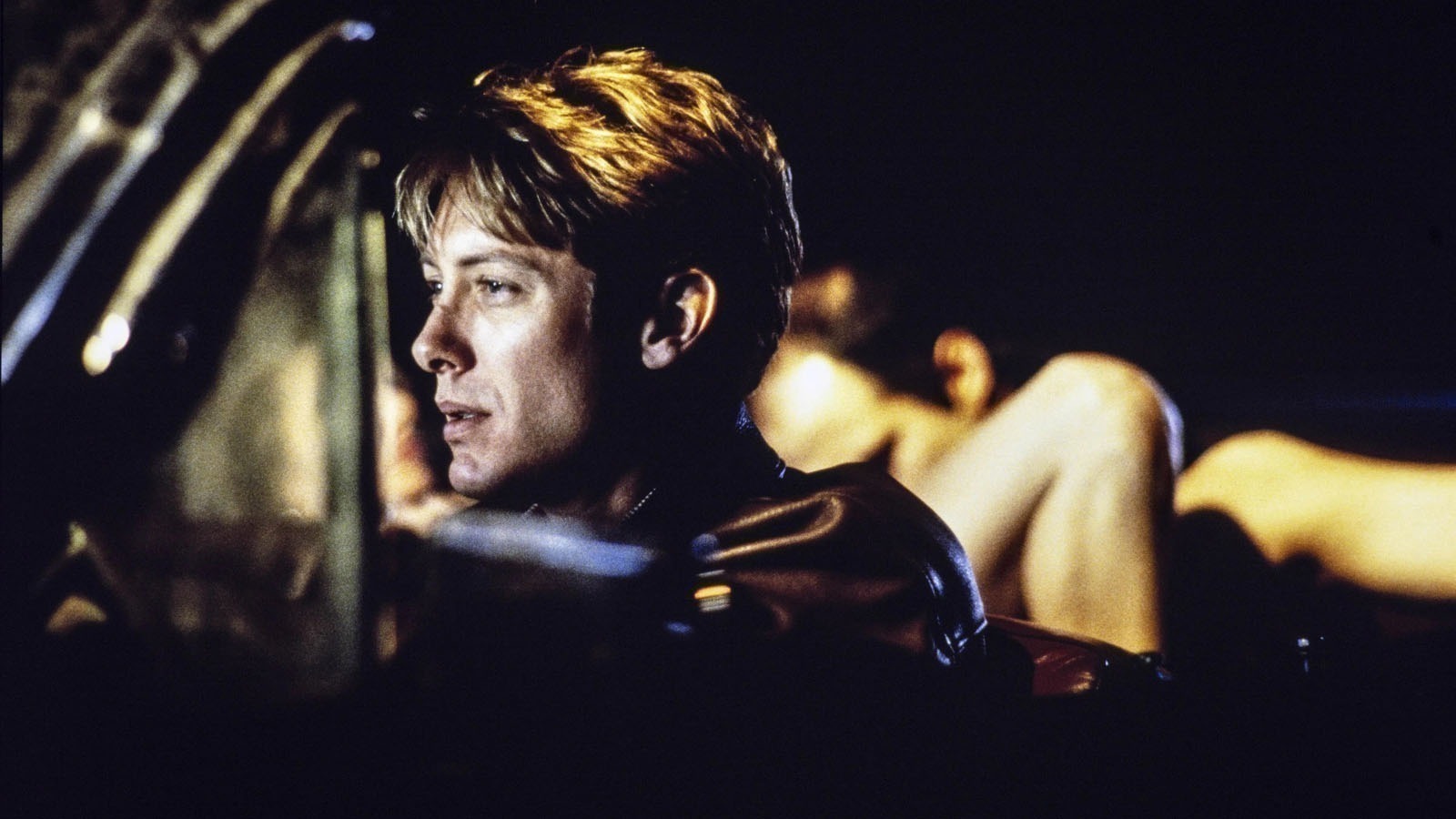
- Revisiting Crash (1996) thirty years after its premiere kicked up a storm in Cannes, Travis Woods writes at Letterboxd that David Cronenberg’s adaptation of J. G. Ballard’s novel “strips the chassis of its source material for parts, ripping out and keeping the story’s metal heart (the near-death trauma of car crashes violently freeing its characters from their icy emotional purgatories, a rebirth that hot-wires their potential for romantic and sexual intimacy) while abandoning the rest (including a car-crash sex/death cult that plans to kill Elizabeth Taylor in an elaborately goregasmic wreck).” Crash “presages Cronenberg’s more meditative twenty-first-century work because it reckons with death, confronts it, and considers whether it can be yet another transformative event, rather than a final one.” Sidenote: Debbie Harry tells the Observer’s Megan Nolan a quick story about an exchange on the set of Cronenberg’s Videodrome (1983).
- The Brazilian Film Critics Association, Abraccine, has polled its members to come up with a list of one hundred “essential” (rather than “best”) Brazilian films. The list is “revisionist in the ways one would expect it to be,” writes Filipe Furtado, comparing the results to the last Abraccine poll, which was conducted in 2015. “It is more diverse, with fourteen movies directed by women instead of five, more movies by Black filmmakers, a higher number that deals with queer and racial themes, a slight increase in shorts and nonfictions, and one animation.” Voters have also “moved away from the traditional Brazilian film historiography that centered around Cinema Novo and, to a lesser extent, Cinema Marginal movements and found more movies that existed in the margins.” Cinema Novo, the new wave that swelled in the 1960s and ’70s, “was inseparable from an awareness of Brazil as a neocolonial country, serving as a model for other ‘poor’ and ‘imperfect’ cinemas across Latin America and the then-called Third World,” writes Tiago de Luca at the top of an annotated list of ten “great Cinema Novo films” at the BFI.
- At eighty-two, Wallace Shawn has two plays running in New York through Sunday, What We Did Before Our Moth Days and The Fever, and he’ll be heard next month as the voice of Rex the dinosaur in Toy Story 5 before appearing as Buckminster Fuller in Greg Pritikin’s The Man Who Changed the World. “The last forty-nine years that I’ve been acting feel like a very short part of my life, and something I took up quite recently and never expected to do,” Shawn tells Greta Rainbow in Interview. “But I think probably every actor thinks, ‘I should have had better parts,’ and I’m one of those people. Every actor may feel it, but it doesn’t mean they’re right. Somebody has to play small parts. But I do get annoyed. Having just seen [Louis Malle’s Vanya on 42nd Street (1994)], I think, ‘Why wasn’t Brooke Smith in every film? She’s mind-blowing. She’s incredible.’”
Don’t miss out on your Daily briefing! Subscribe to the RSS feed.