Cannes Openers
Share
Traditionally, Cannes does not put its best foot forward when presenting an opening night film. Variety’s Owen Gleiberman ticks off a few past duds such as Michel Hazanavicius’s Final Cut (2022) and Maïwenn’s Jeanne du Barry (2023) and then adds that Pierre Salvadori’s The Electric Kiss, which has opened the festival’s seventy-ninth edition, “may be the worst festival opener I’ve seen in a decade.” At In Review Online, Hugo Emmerzael finds that the film “props up the worst tendencies of French cinema all at once.”
The Electric Kiss does have at least one champion in the Telegraph’s Robbie Collin, though. He calls it “a deeply charming French rom-com.” Jane Schoenbrun’s Teenage Sex and Death at Camp Miasma, in the meantime, has opened the Un Certain Regard program and emerged as the first triumph of Cannes 2026. As for the independent sidebars, Kantemir Balagov’s Butterfly Jam and Phuong Mai Nguyen’s In Waves, which have opened the Directors’ Fortnight and the Critics’ Week, respectively, have been met with mixed reviews.
The Electric Kiss
Venus Electrificata is one of the main attractions at a Parisian carnival in 1928. Suzanne (Anaïs Demoustier) places herself between two generators, allowing the current to flow through her body. She sells kisses for thirty centimes a jolt. Suzanne is taking a break in the psychic’s tent when a grief-stricken painter, Antoine (Pio Marmaï), tumbles in. He mistakes Suzanne for the psychic and demands to speak with his recently deceased wife, Irène (Vimala Pons, seen in flashbacks).
Spotting an opportunity, Suzanne obliges. Antoine’s spirits are lifted, and he starts painting again. His dealer, Armand (Gilles Lellouche), is thrilled and insists that Suzanne keep up the ruse. But she’s discovered Irène’s diaries and finds herself falling in love with Antoine.
The Electric Kiss “promises snap, crackle, and pop—but the sparks fizzle out before it reaches its unapologetically contrived climax,” finds Jonathan Romney at Screen. “Based on an original idea by directors Rebecca Zlotowski and Robin Campillo, the film shows undeniable complexity and mischief, echoing a vintage tradition of French comedies (Renoir, Sacha Guitry, René Clair). But it is rather hampered by pedestrian execution, dominated by claustrophobically stagey interior-bound dialogues, the more effusive crowd scenes tending to stand out as production numbers rather than feeling part of an organic whole.”
“Salvadori was last on the Croisette in 2018 with the far jauntier screwball crime romance The Trouble With You,” notes the Hollywood Reporter’s David Rooney. “Working with the same cowriters, Benjamin Charbit and Benoît Graffin, Salvadori struggles to breathe life into The Electric Kiss, a film whose air of strained whimsy falls flat . . . While the romance, the deception, the surprise discoveries, the attempted suicides (genuine or fake), and the burlesque comedy should be gathering steam, it all becomes a tedious muddle.”
Teenage Sex and Death at Camp Miasma
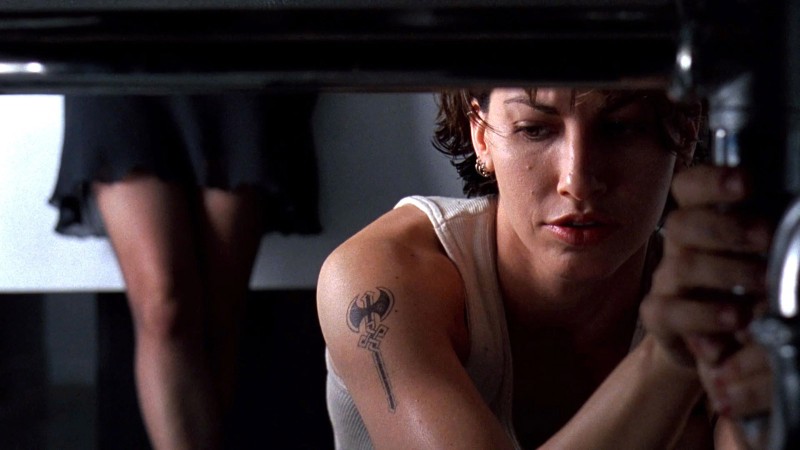
“For kids who grew up sneaking glances at horror movies at sleepovers or between shopping channel infomercials on late night television, Teenage Sex and Death at Camp Miasma feels like coming home,” writes Hannah Strong at Little White Lies. Hannah Einbinder (Hacks) stars as Kris, a queer filmmaker who has broken through at Sundance and been tapped to reboot a slasher franchise, Camp Miasma, that has become a “zombie IP,” merchandized to the point of oversaturation and drained of the thrill seeing the vengeful ghost Little Death (Jack Haven) off teenage campers.
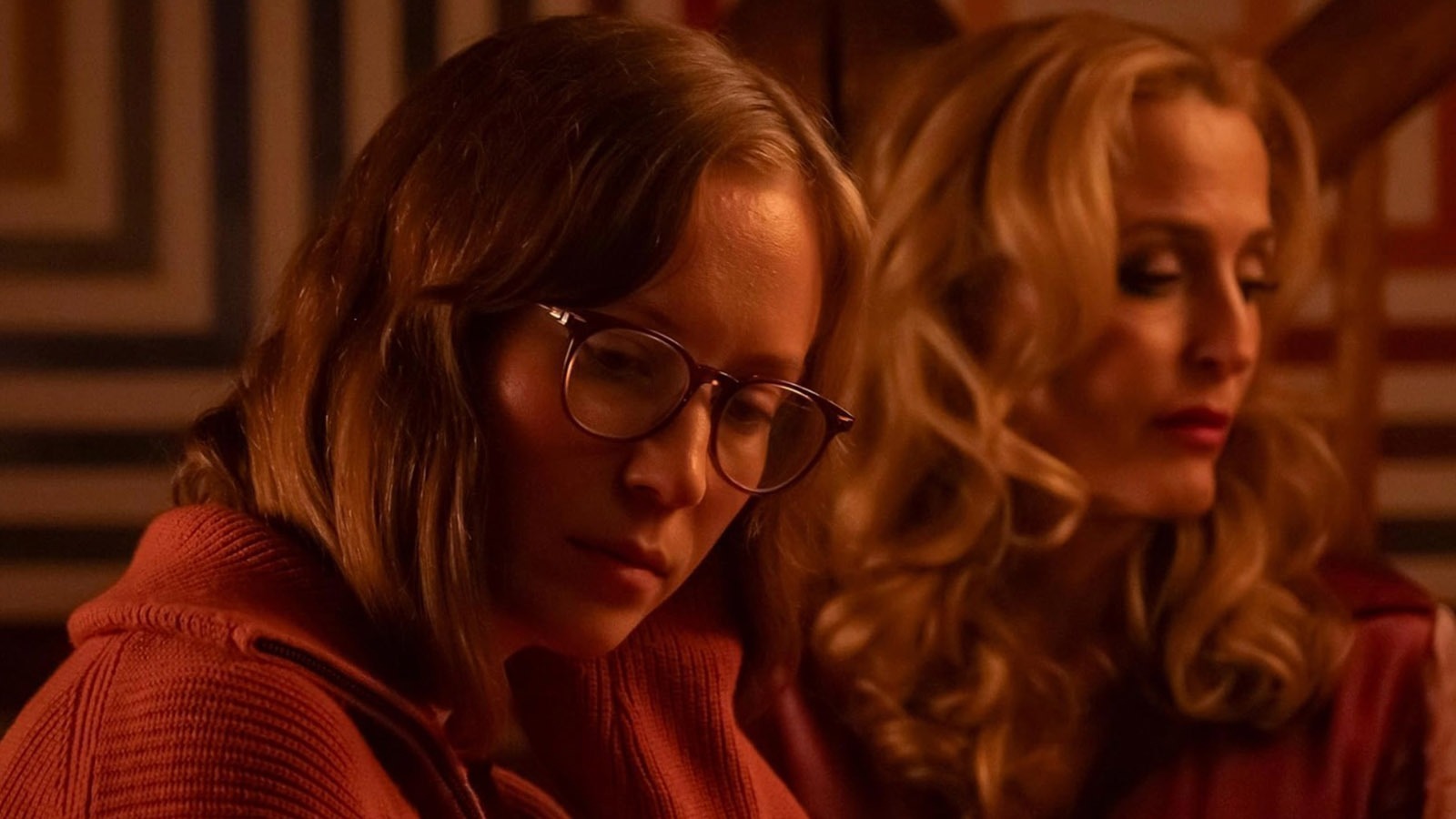
Billy (Gillian Anderson), who played the final girl in the original movie, refused to take part in any of its sequels, and now lives as a recluse—at the very site where the first Camp Miasma was filmed. Kris has tracked her down, and she’s determined to cast Billy in her rejuvenation of a depleted cinematic universe.
Following We’re All Going to the World’s Fair (2021) and I Saw the TV Glow (2024), Teenage Sex and Death is Jane Schoenbrun’s “most accomplished, most persuasive, and most playful movie yet,” writes Jessica Kiang for Variety. “Anderson appears to be enjoying her foray into Sapphic high-camp tremendously, and the supporting cast is speckled with equally game performers, from Eva Victor’s punk DJ to Dylan Baker’s insufferable studio exec, to Kris’s lover Mari (Jasmin Savoy Brown) and her dopey hookup Thor (Aren Buchholz). But then everyone here, in front of and behind the camera, looks to be having a great time, which keeps the mood bouncy, however gory or splattery or thematically knotty the moment.”
“If something about the now-problematic gender-bending killer of Camp Miasma reminds you of 1983’s Sleepaway Camp, Schoenbrun is not coy about the parallel,” notes Richard Lawson in the Hollywood Reporter. “If Billy, who wears a turban and caftan in a few scenes, calls to mind Norma Desmond of Sunset Boulevard, Schoenbrun directly assures you that that is not an accident. There is a hyper awareness to TSADACM, a determination to point out each of its Easter eggs and allusions, lest the viewer think Schoenbrun is trying to outsmart anyone. Schoenbrun is welcoming us into a collective pool of memory, though they have very particular, very personal things to discuss once we’re all in there.”
Teenage Sex and Death is “about what happens after gender dysphoria’s annihilation—a reflection on the sexual unease experienced once you’ve finally fit into your body but perhaps don’t know what to do with it,” writes IndieWire’s Ryan Lattanzio. “You can view the work as a visceral slasher send-up, a stylish academic exercise about gender expression and inquiry in horror iconography, or as just a plain old, super fun, future cult lesbian classic. Either way, it will take multiple viewings of this film to fully embed yourself inside it—body, brains, and all.”
Butterfly Jam
Kantemir Balagov’s first two features, Closeness (2017) and Beanpole (2019), were both set in Russia, and both premiered in the Un Certain Regard section, where they both won the FIPRESCI Prize. Beanpole also scored Balagov a UCR Award for Best Director, but after he spoke out against Putin’s invasion of Ukraine in 2002, Balagov self-exiled to the States. Cowritten with Maria Stepnova, Butterfly Jam was originally set in the North Caucasian region of Russia, but he’s transplanted the story, embedding it in the Circassian community in Newark, New Jersey.
Brother and sister Azik (Barry Keoghan) and Zalya (Riley Keough) arrived in the States in their teens, and they now run a diner where Azik’s delens, fried flatbreads stuffed with potatoes and cheese, are a hit. To the Circassian customers, they taste like home. Azik’s sixteen-year-old son, Temir—often called Pyteh, meaning “little one”—is a promising wrestler who loves his dad but is beginning to doubt that any of Azik’s hare-brained schemes will ever pan out. Azik’s boisterous friend Marat (Harry Melling) pops over too often to tear up the place, infuriating Zalya, who has more than enough on her hands, especially with a baby on the way any day now.
“An agreeably shaggy, mood-driven portrait until a startling act of violence that recalibrates proceedings entirely—a comparable jolt to the one that stunningly stopped Beanpole in its tracks, though far later and more wayward in its fallout—Butterfly Jam is most rewarding at its most relaxed, when Balagov’s flair for movement, ambience and particularity of place is most generously on display, in tandem with Nickel Boys DP Jomo Fray’s propulsive camerawork,” writes Variety’s Guy Lodge. “Even out of place and not entirely on form, Balagov remains a filmmaker of outsize, thrillingly declarative talent.”
“Drawing on his own cultural context and working with the Safdie brothers’ street-casting whiz Eleonore Hendricks, Balagov illuminates corners of Newark that food tourists can only guess at,” writes Mark Asch at Little White Lies. “Akdogan, a teenage Kazakh immigrant with no previous film experience, is a find, as is the professional mourner who weeps into a Bluetooth microphone connected to a karaoke speaker. Every time the film begins to seem fatally overdetermined, Balagov doubles down and produces a moment of absurd grace.”
The Guardian’s Peter Bradshaw finds Butterfly Jam to be “contrived, tonally uncertain, implausible, and frankly plain silly in its underpowered kind of magic-unrealism.” But for IndieWire’s David Ehrlich, it’s when the film “seems doomed to repeat the same dark fatalism of Balagov’s earlier work that it suddenly affirms itself as the bittersweet fable that it’s been all along. It’s only then, after shit has gone bad enough that the film seems like it’s about to steer into self-parody, that this seemingly unclassifiable whatsit assumes its final form as a half-formed (and highly bizarre) fairy tale about the magic that’s baked into even the most anguished of family histories.”
In Waves
Based on AJ Dungo’s 2019 graphic novel, In Waves is the story of AJ (voiced in the English version by Will Sharpe), an introverted skateboarder who falls hard for an outgoing surfer, Kristen (Stephanie Hsu). AJ is terrified of the water, but Kristen and her crew coax him out onto the waves, and not long after he masters them, a dreaded diagnosis upends both of their lives.
“A doomed love story, especially one based on real-life young people braving their own The Fault in Our Stars-style tale, is bound to shatter even the coldest of hearts,” writes Tomris Laffly in Variety. “Earnest, disarming, and unapologetically conventional, prolific graphic artist Phuong Mai Nguyen’s elegantly animated feature debut In Waves grasps this fact on such a philosophical level that it aims to do not a great deal more than wash over the viewer with its raw sentiments. Right out of the gate, you can see a soft-hearted tearjerker on approach like a rolling wave, one that will inevitably swell in size and break at the exact spot that you’ve been standing.”
But at Little White Lies, David Jenkins warns that “just when you think the film has reached absolute peak earnestness, it finds a way to sneak just a little bit more in there.” Eventually, In Waves “switches from earnest to maudlin, essentially rolling out like an animated Nicholas Sparks movie as the pair attempt to come to terms with the dismal hand they’ve been dealt.” For Marya E. Gates at IndieWire, the film is “an overly sanitized, almost idealized account of what it is like watching someone you love die from cancer.”
In the Hollywood Reporter, though, Sheri Linden calls In Waves “an understated marvel, its elegant hand-drawn simplicity bolstered by a strong emotional throughline . . . Water is the drama’s connective tissue. With remarkable fluency, In Waves captures its various textures, trajectories, and degrees of translucency, and, in a sweetly sly touch, the way it can spatter against the lens of a camera . . . This is a movie that effortlessly marries primal poetry to the quotidian.”
Don’t miss out on your Daily briefing! Subscribe to the RSS feed.